
A welcome email is not just the polite little receipt that shows up after someone subscribes. That is the comforting myth. In practice, it is your first real chance to prove the signup was worth it, explain what happens next, and make the reader feel like they made a smart decision instead of a casual typo.
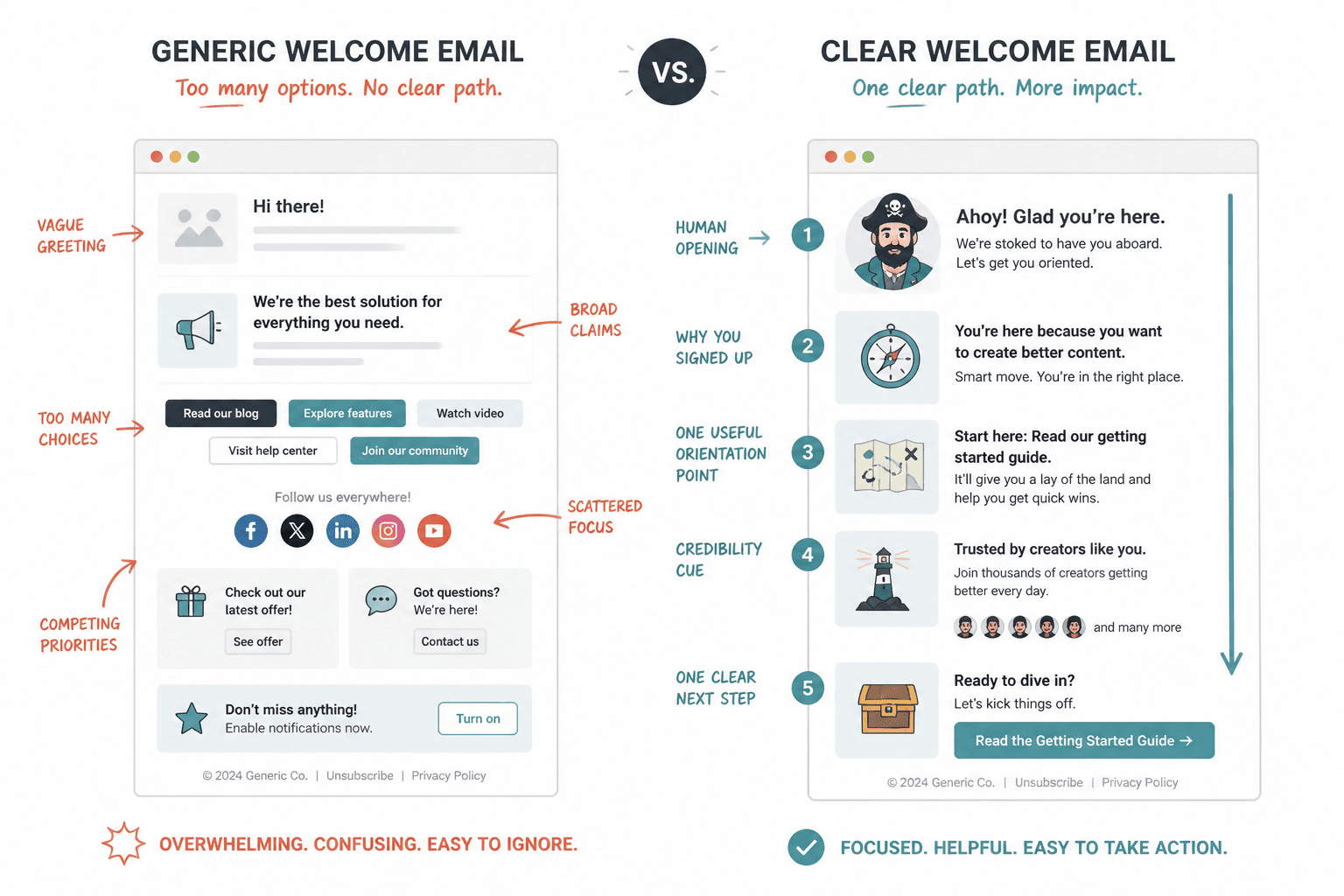
That shift matters. A better welcome email does three things at once: it reduces confusion, starts building trust, and points to one useful next step. Anything else is decorative padding in a fresh inbox.
What a welcome email is actually supposed to do
At its best, a welcome email is a bridge. The subscriber just crossed from curiosity into attention, and the email needs to make that moment feel intentional.
- Confirm the signup without sounding like a vending machine.
- Orient the reader so they know what kind of emails to expect.
- Deliver something useful quickly, even if it is small.
- Point to one next step that makes sense for the relationship.
If you want the larger system view, the parent guide on welcome emails covers where this fits inside a creator email system.
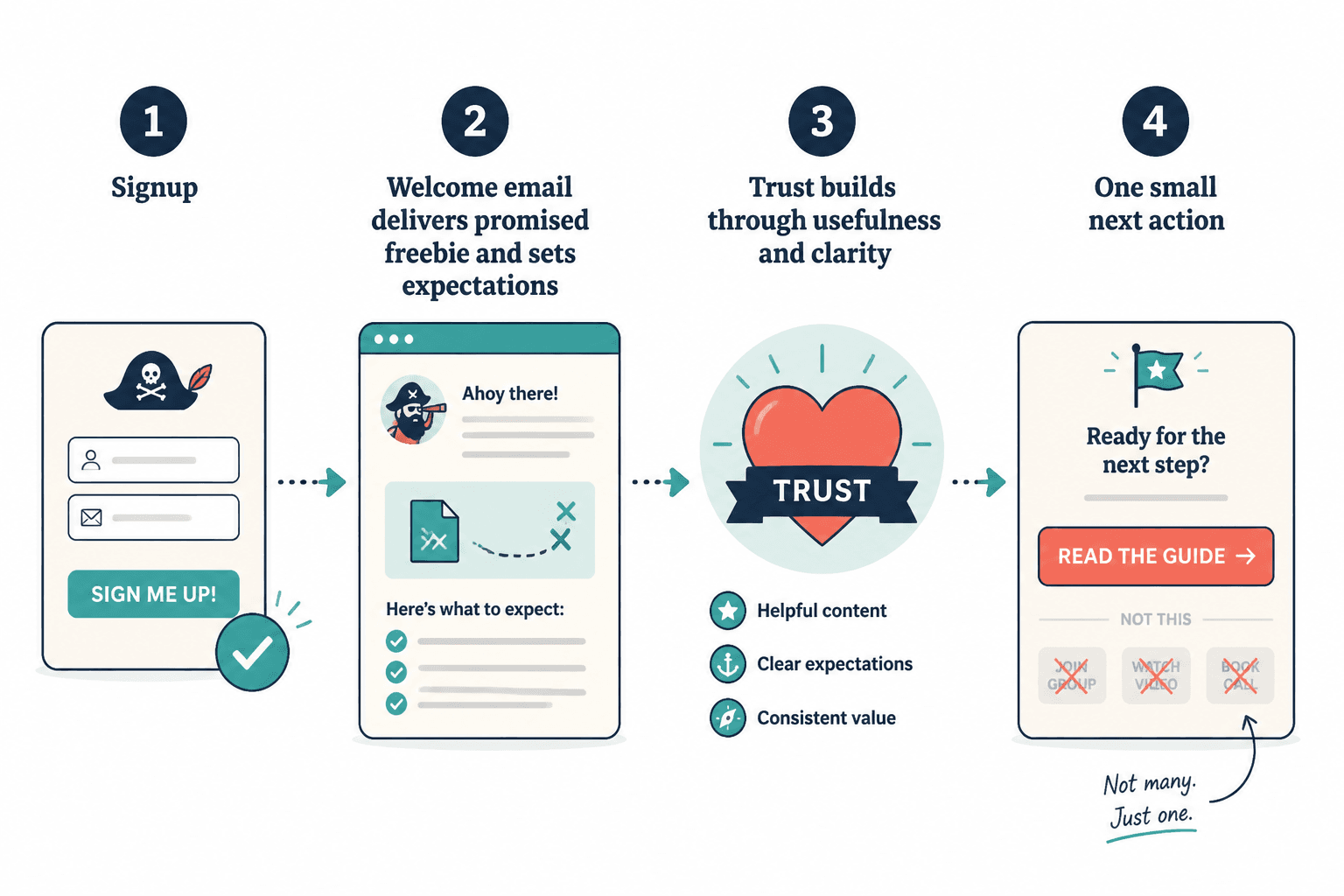
The core structure of a welcome email that gets better results
1. Subject line: clear beats cute
Your subject line does not need to be clever. It needs to tell the reader why the email matters right now. Clarity usually wins because curiosity without context is just inbox clutter with ambition.
Better:
- Welcome – here’s what happens next
- Your guide is inside
- Thanks for signing up
If you want more examples, see best welcome emails ideas and examples for creators.
2. Opening: make the signup feel smart
The opening should answer the quiet question in the reader’s head: “Did I join the right thing?”
That usually means a direct thank-you, a short reminder of what they signed up for, and a line that makes the decision feel useful rather than random.
Weak:
Hi there, and welcome to my newsletter.
Stronger:
Thanks for signing up for the newsletter. You’ll get practical email advice, occasional examples, and a few ideas you can use without rebuilding your whole system.
If openings are where your drafts wobble, the companion guide on how to start welcome emails without a weak opening goes deeper on first lines that actually earn attention.
3. Quick value: give them something useful immediately
Do not make the reader wait through three paragraphs of biography before you give them a reason to care. Offer a useful idea, a resource, a shortcut, or a very specific next step.
Examples of quick value:
- a link to your best resource
- a short checklist
- a single useful framework
- a recommendation for where to start
This is where welcome emails stop being ceremonial and start being useful.
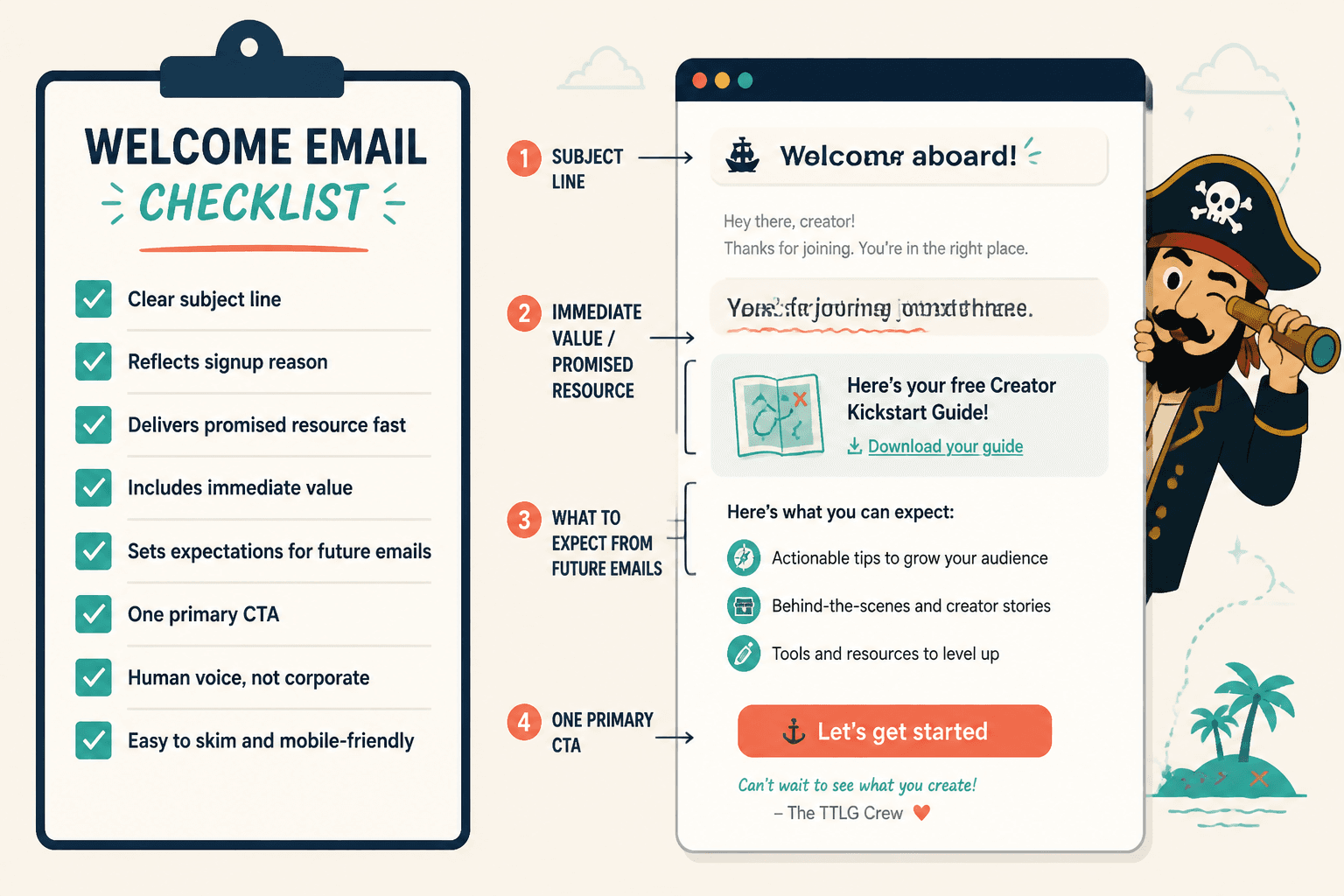
4. Set expectations before confusion sets in
Readers relax when they know what comes next. They get suspicious when they do not.
Say how often you email, what kinds of topics you cover, and what they should expect from the relationship. Short and plain is better than polished and vague.
For example:
- “I send one email a week with practical writing and email ideas.”
- “Expect occasional essays, templates, and examples.”
- “You can unsubscribe anytime, obviously, but I hope you stick around.”
5. One next action is enough
Welcome emails often get overloaded with links, options, and “while you’re here” extras. That is how a useful email starts acting like a distracted hallway.
Pick one next step:
- read a best post
- download the lead magnet
- reply with a question
- visit a key page
One clear action is easier to follow and usually performs better than a basket of near-choices.
Why so many creator welcome emails get ignored
Welcome emails tend to fail for boring reasons, which is annoying but useful. The fix is usually not a grand creative breakthrough. It is just better decisions.
- They say almost nothing. A bland thank-you note is not a strategy.
- They make it about the sender. Readers do not need your origin story before they need help.
- They try to sell too soon. A welcome email can support sales later, but it should not open like a checkout counter.
- They forget expectations. Ambiguity makes inboxes feel heavier than they need to.
- They offer too many paths. Decision fatigue is not a virtue.
The mistake list in better welcome email mistakes to avoid for personal brands covers these failure modes in more detail.
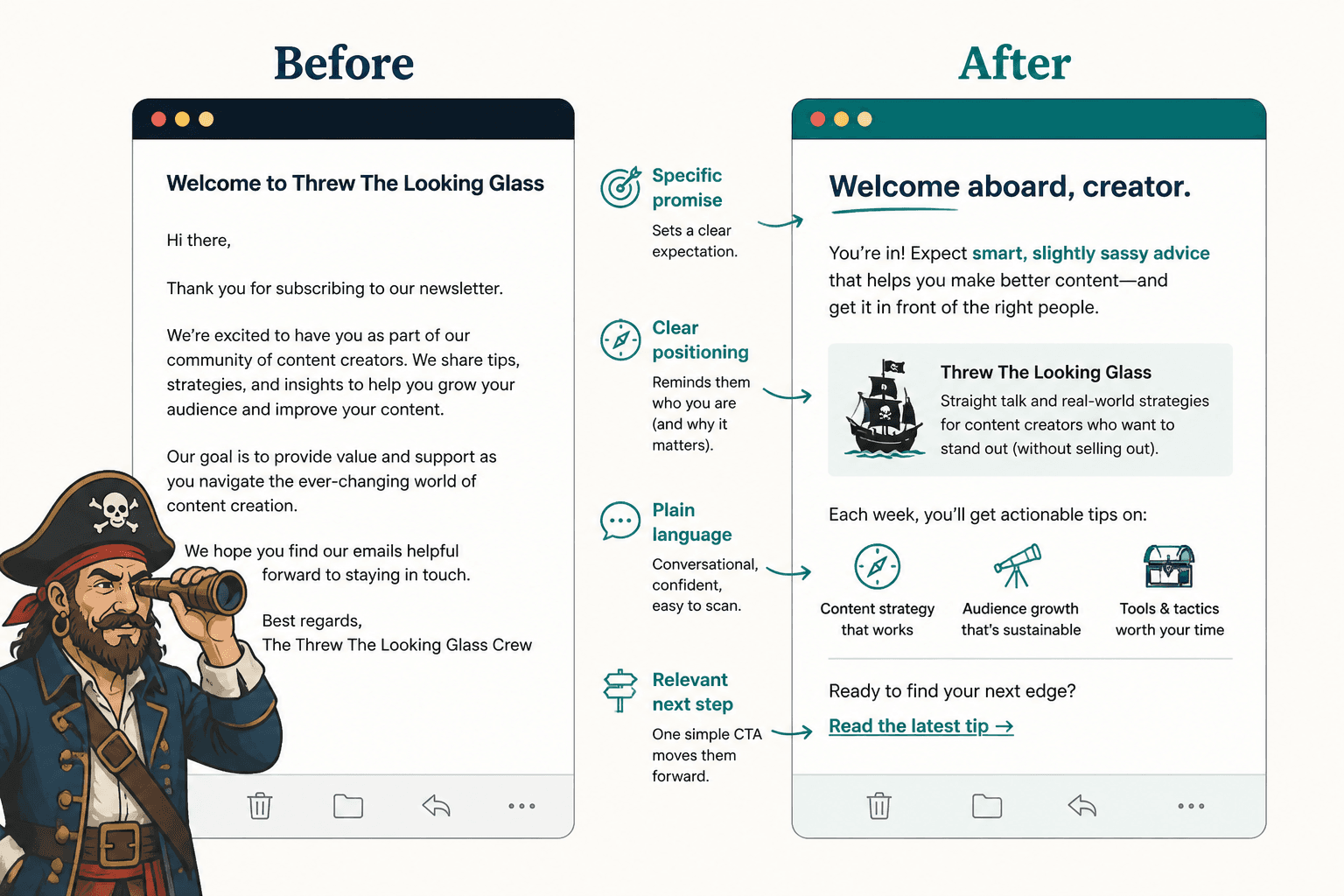
How to write welcome emails without sounding salesy or robotic
There is a narrow line between helpful and performative. The good news is that the line is not invisible. It just gets crossed whenever the email starts sounding like brand theater.
Keep the tone human by doing four things:
- Be direct about why they’re here.
- Use normal language.
- Offer value before pressure.
- Make the CTA feel like a next step, not a trapdoor.
A welcome email does not need to sound “warm” in the abstract. It needs to sound useful, readable, and aware that the person on the other end has a life.
If you want a closer breakdown, see how to write welcome emails without sounding salesy or robotic.
When short welcome emails beat long ones
Not every welcome email should stretch into a mini essay. Sometimes a shorter email works better because the job is simple and the reader is already paying attention.
Short usually wins when:
- the signup was for one clear thing
- the next step matters more than the backstory
- you already have a welcome sequence
- your audience is busy and inbox-fatigued
- trust is built better through consistency than intensity
Long can still make sense when the offer is more complex, the audience needs more context, or the email is doing real onboarding work. The trick is not length for its own sake. The trick is matching the email to the actual job.
For a focused comparison, see when short welcome emails beat long ones and how long should welcome emails be in 2026?.
Mini onboarding flows: when one welcome email is not enough
Some subscriptions need more than a single welcome note. That is especially true when the signup promises a tool, a process, a lead magnet, or a series of steps the reader needs to understand.
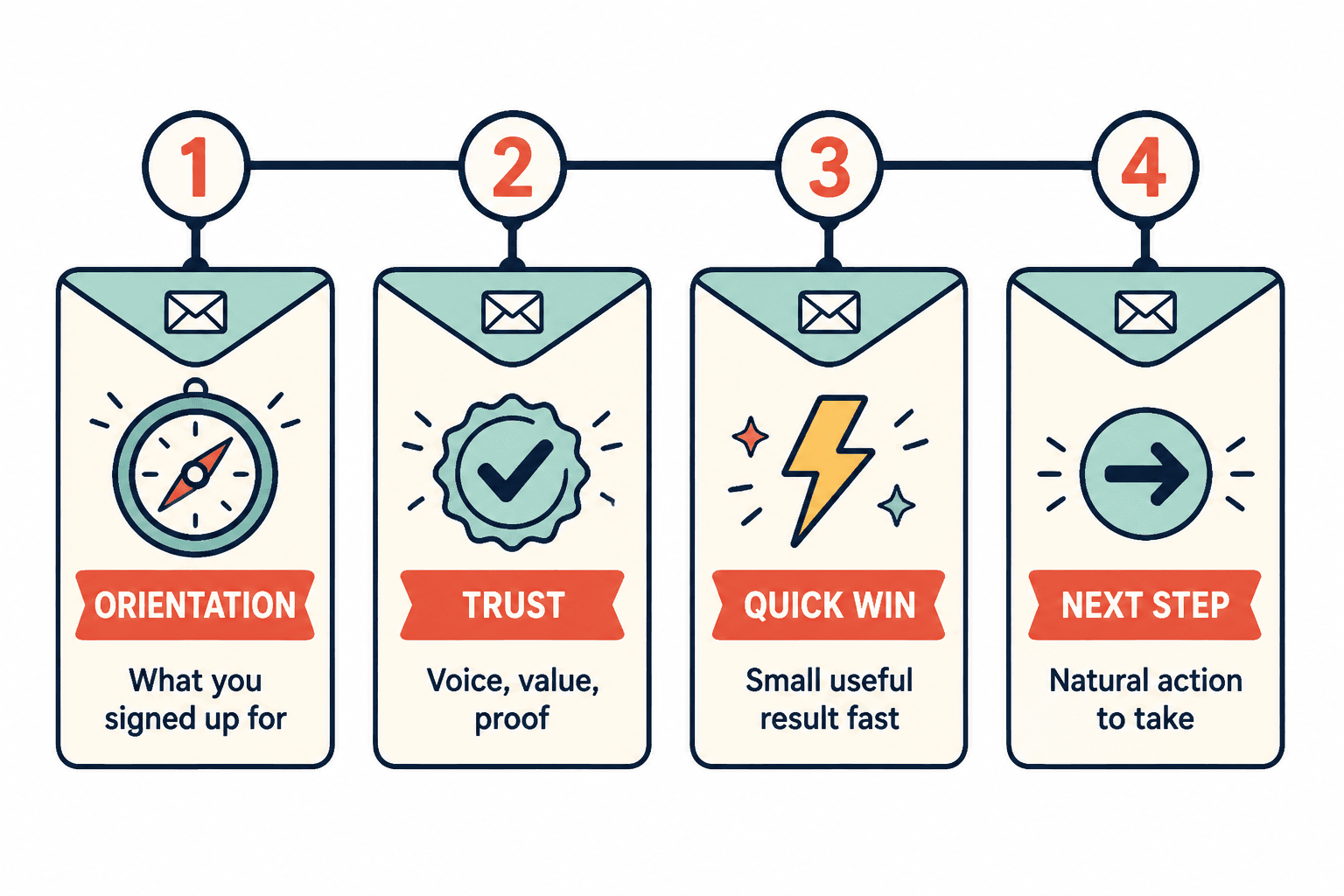
A short welcome flow can handle the relationship better than one overloaded message. A simple sequence often works like this:
- Orient and reassure. Confirm the signup and explain what happens next.
- Deliver a fast win. Give the reader something useful immediately.
- Build belief. Show a result, example, or framework that increases trust.
- Point to the next step. Move toward a reply, a resource, or an offer.
The companion article on how to improve welcome email mini onboarding flows without sounding generic goes deeper on that structure.
A simple rewrite process for boring welcome emails
If your current draft feels thin, formal, or vaguely “professional” in a way that makes it less readable, rewrite it in this order:
- Find the actual promise. What did the person think they were getting?
- Cut the filler. Remove greeting-card language and extra throat-clearing.
- Make the opening earn attention. Say something useful fast.
- Replace vague claims with specifics. Use concrete expectations and examples.
- Add trust without overexplaining. A short proof point is enough.
- Choose one next step. Then stop handing the reader a menu.
If the draft is especially dull, the rewrite guide on how to rewrite boring welcome emails is a useful companion.
What to say in the first welcome email
The first welcome email does not need a speech. It needs a shape.
A reliable version usually includes:
- a short thank-you
- a reminder of why they signed up
- one useful resource or idea
- a plain expectation for future emails
- one clear call to action
That structure is enough to make the email feel intentional without turning it into a one-paragraph hostage situation.
For examples by format and use case, the welcome email examples guide is the most practical next stop.
How to make welcome emails work harder for leads or sales
Not every welcome email needs to sell. But if your business depends on leads, calls, or product interest, the welcome email should at least make the next step easier to see.
That means:
- linking to the most relevant resource
- hinting at the offer without forcing it
- building enough trust to earn a later click
- avoiding a hard pitch before the reader knows who you are
For the conversion angle, see how to turn welcome emails into more leads or sales.
Practical examples of better welcome email positioning
Here are a few simple ways to frame a stronger welcome email, depending on what the subscriber just joined for:
- Newsletter signup: “Here’s what I send, how often, and the kind of ideas you can expect.”
- Lead magnet download: “Here’s your download plus one suggestion for what to read or do next.”
- Service interest: “Here’s a quick overview of how I work and what step makes sense next.”
- Mini course or onboarding: “Here’s how the sequence is structured and what you’ll get from each part.”
The key is that the email should match the reader’s intent, not just your preferred brand voice.
Useful sources and tools for better welcome email writing
If you are comparing approaches or testing drafts, a few outside references are worth keeping nearby.
- Google Mail help: senders and deliverability basics
- Mailchimp help center for automation and welcome flow basics
- Campaign Monitor resources for email structure and testing ideas
For a quick internal workflow, you may also find the companion guide on best AI tools for welcome emails useful when you want drafting help without losing control of the final edit.
Bottom line
A better welcome email is not about sounding more polished. It is about being clearer, more useful, and less self-absorbed than the average automated greeting.
Write one that confirms the signup, gives a quick win, sets expectations, and points to one sensible next step. That is the work. Everything else is just email wearing a tie.
Start with the parent guide to welcome emails, then move into examples, mini-flows, and conversion-focused follow-ups as needed.