
Most welcome emails do not start weak because the writer lacks manners. They start weak because the writer mistakes politeness for persuasion.
So you get openings like “Hi there, thanks so much for subscribing” or “Welcome to my newsletter, I’m excited to have you here.” Fine. Harmless. Also deeply forgettable. They do not build momentum. They do not set expectations. They do not make the reader care about what happens next.
If you want to know how to start welcome emails without a weak opening, the fix is not to sound more “professional.” It is to open with something that gives the reader immediate orientation, value, tension, or relief. In other words: a reason to keep reading.
This article will show you how to do that without sounding stiff, fake-friendly, or weirdly intense. We’ll cover what strong welcome email openings actually do, what to avoid, and a bunch of practical opening formulas you can steal and adapt.
For the full path around this topic, head to the parent guide.
Why most welcome email openings fall flat
The first mistake is treating the opening like administrative small talk.
Yes, someone joined your list. Yes, you should acknowledge that. But the opening line is not there just to confirm the transaction happened. It is there to shape the reader’s first impression of your voice, your usefulness, and what being on your list will actually feel like.
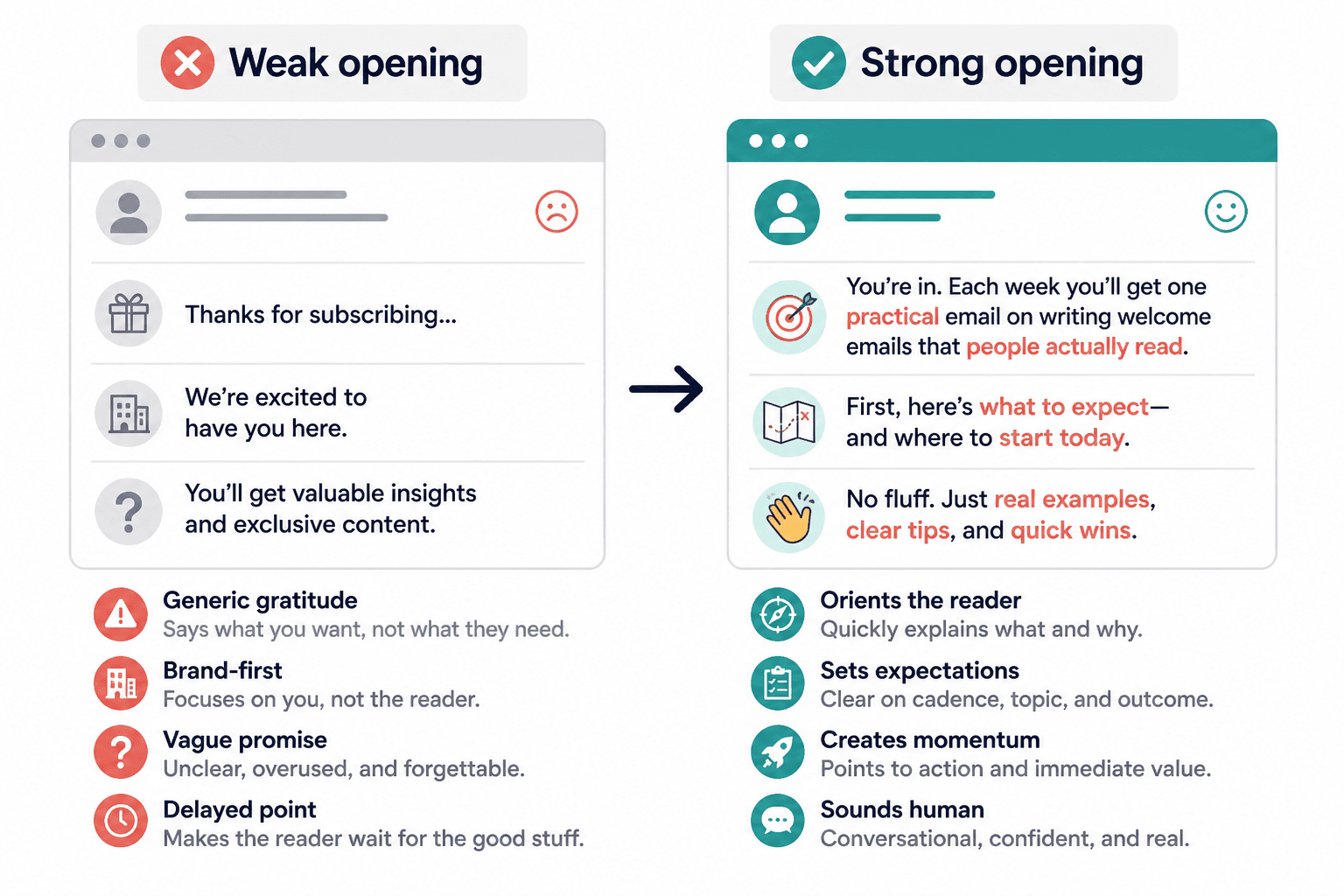
Weak openings usually do one or more of these:
- Lead with generic gratitude and nothing else
- Sound like a template trying to cosplay as a human
- Talk about the brand before talking about the reader
- Delay the point for three or four sentences
- Use vague promises like “valuable insights” and “exclusive content”
- Feel overly polished, which is another way of saying slightly dead
A welcome email is the beginning of a relationship. You do not need fireworks. But you do need a pulse.
And if your opening is weak, the rest of the email has to work much harder than it should. That is a bad trade.
What a strong welcome email opening actually needs to do
A good opening does not need to be clever. It needs to be useful.
In most cases, your first few lines should do at least two of these four jobs:
- Orient the reader: tell them where they are and what they signed up for
- Set expectations: explain what kind of emails they’ll get and why they should care
- Create momentum: give them a reason to keep reading now, not later
- Build trust quickly: sound clear, specific, and human
That is the standard. Not “be nice.” Not “thank them politely.” Those are fine extras. They are not the engine.
The easiest test
Read your opening and ask: if I removed the sender name, could this have come from almost anyone?
If the answer is yes, it is probably too generic.
“Thanks for joining my newsletter” is not wrong. It is just doing almost nothing. That is a recurring problem in email writing: people keep defending lines that are technically fine but strategically lazy.
How to start welcome emails without a weak opening: 7 better approaches
You do not need one perfect formula. You need a handful of opening types that fit different goals, brands, and audiences.
1. Start with the reader’s actual problem
This works especially well if people joined your list for help with a specific struggle. Instead of opening with thanks, open with recognition.
If you joined this list because your content is getting polite little likes and absolutely no business traction, you’re in the right place.
Why it works:
- Shows you understand why they signed up
- Creates instant relevance
- Feels more alive than “welcome aboard”
Use this when your audience has a clear pain point, frustration, or goal. It gives the email some grip immediately.
2. Start with a sharp promise and a realistic expectation
People trust you more when you promise something specific and sane.
Here’s what you can expect from me: useful emails about writing better content, building more trust, and selling without sounding like a funnel escaped from 2019.
This kind of opening works because it gives shape to the relationship. It tells the reader what they are getting and what tone you are bringing.
It also quietly filters the wrong people out, which is healthy. Welcome emails should not try to charm everybody with beige friendliness.
3. Start with a useful truth
A strong opinion or practical truth can pull a reader in fast if it is relevant to the reason they signed up.
Most content does not fail because the creator lacks expertise. It fails because the packaging is vague, timid, or trying way too hard to sound smart.
That kind of line earns attention because it sounds like a person with a point of view. Not a nurture sequence generated by committee.
Use this if your brand has a clear perspective and your audience appreciates directness.
4. Start by rewarding the signup immediately
If your reader joined for a resource, lesson, checklist, or mini-course, do not bury the payoff under fluff. Put the useful thing early.
You joined for the welcome email checklist, so here is the short version first: your opening should do more than say hello. It should tell readers why staying subscribed will be worth it.
This approach respects the reader’s time. It also creates a nice first impression: you said you’d help, and then you did.
5. Start with a short “you’re here because…” line
This is one of the cleanest welcome email openings around. Simple. Useful. Not trying to win a writing prize.
You’re here because you want better email copy that sounds human, gets read, and does not collapse into robotic sludge by line three.
This works because it confirms intent. It tells the reader, quickly, that they made the right choice.
6. Start with a brief personal framing, but make it useful fast
Sometimes a personal angle makes sense, especially for creators, consultants, and personal brands. But the key word here is brief. The reader does not need your origin story in paragraph one.
I write these emails for people who are very good at what they do and tired of sounding bland online while trying to prove it.
That gives voice and positioning without wandering into autobiography. Good. Keep moving.
7. Start with a next step
If your welcome email is part of a broader onboarding flow, your opening can immediately point the reader somewhere useful.
First, do this: reply and tell me what kind of emails you’re trying to write better right now: welcome emails, sales emails, newsletters, or all of the above.
This works best when the ask is small and relevant. Not “book a call with my team” five minutes after signup. Relax.
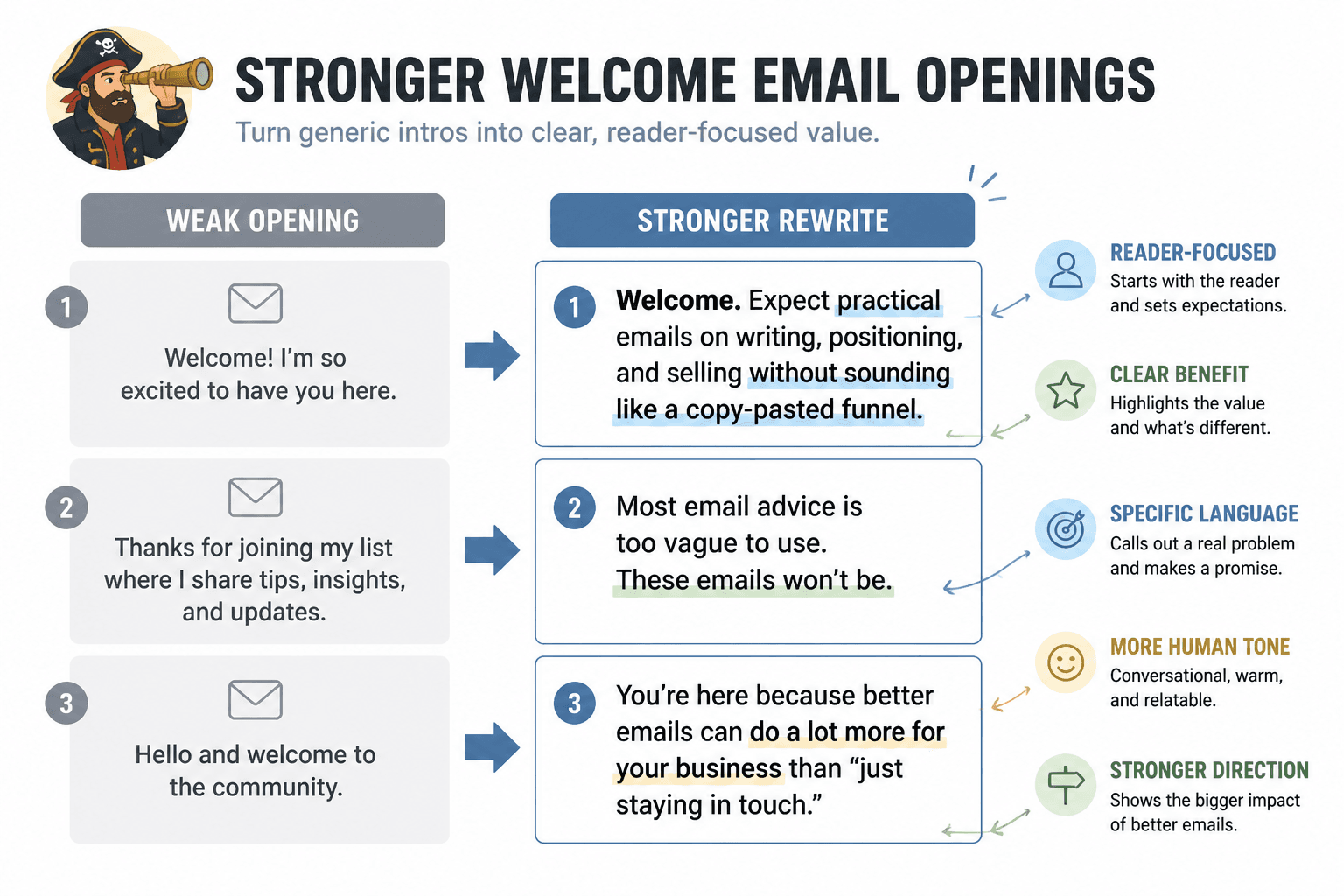
Weak opening vs stronger opening: quick rewrites
Sometimes the difference is not dramatic. It is just that the stronger version gets to the point faster and sounds like it has somewhere to go.
| Weak | Stronger |
|---|---|
| Hi there, thanks for subscribing to my newsletter. | You signed up for sharper email writing help, so that’s exactly what you’ll get here. |
| Welcome! I’m so excited to have you here. | Welcome. Expect practical emails on writing, positioning, and selling without sounding like a copy-pasted funnel. |
| Thanks for joining my list where I share tips, insights, and updates. | Most email advice is too vague to use. These emails won’t be. |
| Hello and welcome to the community. | You’re here because better emails can do a lot more for your business than “just staying in touch.” |
Notice what changed:
- The reader became the focus
- The benefit got clearer
- The language got more specific
- The tone got more human
- The opening gained direction
That is usually enough.
A simple framework for writing stronger welcome email openings
If you want a repeatable way to write these, use this:
- Name why they are here
- Show you understand what they want or what they are dealing with
- Tell them what they can expect
- Move into the body before the energy drops
In shorthand, it looks like this:
You’re here because…
That usually means…
Here’s what you’ll get…
Example:
You’re here because you want your emails to sound more like you and less like they were assembled by an anxious marketing intern. That usually means you do know what you want to say, but the opening gets soft, generic, or overloaded. Here’s what you’ll get from me: practical email breakdowns, stronger examples, and better ways to turn attention into trust.
That is not flashy. It is just solid. Which is often the better goal.
What to avoid in your first few lines
If you want stronger openings, you also need to stop doing a few very common things.
Over-thanking
One quick thank-you is fine. Three lines of gratitude starts to feel oddly nervous.
You are not interrupting them at dinner. They chose to join.
Vague promises
“I’ll share tips, value, updates, and insights” means absolutely nothing now. It has been flattened by overuse.
Say what kind of help you actually provide.
Fake warmth
If “I’m thrilled you’re here” is true in your voice, fine. If it sounds like borrowed internet politeness, cut it.
Readers are pretty good at sensing when a line exists because it seemed like the sort of thing a welcome email is supposed to say.
Talking too much about yourself too early
Your credentials, story, and philosophy may matter. But at the opening, the reader is still asking a simpler question: is this worth my attention?
Answer that first.
Throat-clearing before the point
This is the sneakiest one. You write two soft setup sentences because you are warming yourself up. The reader does not need to witness that process.
Start closer to the actual point. Most welcome emails get better the second you delete the first two lines.
Opening templates you can adapt
Here are a few templates that are actually usable, not those weird fill-in-the-blank things that make every business sound identical.
Template: problem-first
If you joined because [specific problem], you’re in the right place. These emails are for [specific audience] who want to [specific result] without [specific frustration].
Example:
The bigger point is simple: clearer structure and clearer writing make the piece more useful. That is usually what makes the ending land better too.