
Affiliate articles rarely fail because the links are wrong. They fail because the article itself arrives late, talks vaguely, and asks for trust before it has done the work to earn any. That is the whole trick: a stronger affiliate article is not louder, longer, or more “salesy.” It is clearer about the decision the reader is trying to make, and more useful at the exact point where that decision gets difficult.
That means the job is not to cram in more product praise. It is to shape the article so it helps a reader move from interest to judgment to action without having to wade through decorative prose. If you want the bigger system this sits inside, the parent guide is here: affiliate articles. For format ideas, the companion guide best affiliate article ideas and examples for creators is the useful next stop.
What better affiliate articles are supposed to do
A good affiliate article does four jobs at once:
- It matches a real buying intent instead of guessing at one.
- It helps the reader compare options without turning the page into a catalog.
- It gives a reason to trust your recommendation.
- It makes the next step obvious when the reader is ready.
That sounds basic because it is basic. The hard part is that many drafts only do one of those jobs, usually the last one, and then do it badly. A paragraph of praise is not a strategy. Neither is a link dump with a polite intro.
The best affiliate articles feel like a competent guide talking through a decision: here is what matters, here is what does not, here are the trade-offs, and here is the option that fits this situation.
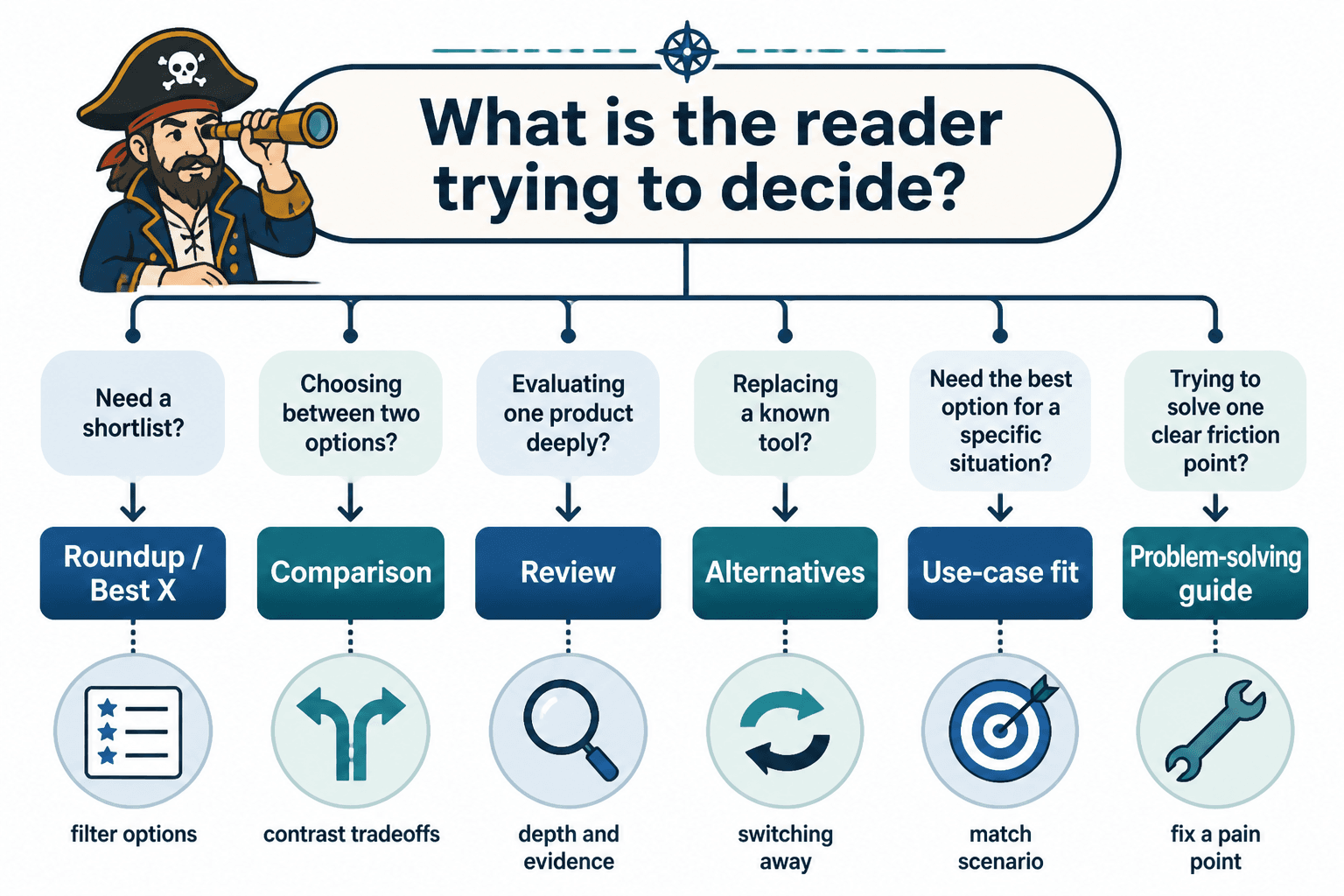
Pick the format that matches real buying intent
Before you write, decide what kind of decision the reader is making. Different intent calls for different structures. If you get the format wrong, the article will feel off even if every sentence is decent.
1. Best-for articles
Use these when readers want the best fit for a specific need: best budget option, best for beginners, best for travel, best for small teams, best for noise-sensitive people, and so on. These articles work because they reduce choice without pretending the world is simple.
2. Comparison articles
Use these when the reader is already weighing two or more options. Comparison posts work best when the point is decision-making, not feature trivia. If you want a deeper look at what usually goes wrong here, see affiliate article comparison block mistakes that hurt performance.
3. Use-case articles
Use these when the product makes more sense in a specific scenario than as a generic recommendation. For example: a tool for solo creators, a camera for low-light indoor video, or a planner for people who hate elaborate systems.
4. Problem-solution articles
Use these when the reader is trying to fix a pain point first and buy second. The article should define the problem clearly, show the likely causes, and explain why the recommended option fits the job.
5. Honest review articles
Use these when you can actually evaluate something from a useful point of view. Honest reviews do not need fake drama. They need specific criteria, clear limitations, and enough context for the reader to know whether the product is a fit.
Start with the reader’s decision, not the product
The opening of an affiliate article should answer a simple question: what is this article helping me decide? If the intro spends too long warming up, the reader has to do the sorting themselves, which is rude in a very polished way.
Strong openings usually do three things early:
- name the specific problem or situation,
- narrow the audience or use case,
- signal the criteria being used to judge the options.
That gives the reader a frame. Without it, the article feels like it is circling the airport.
For a focused guide on openings, see how to start affiliate articles without a weak opening.
Build trust before the CTA
Most weak affiliate CTAs are not weak because they are short. They are weak because they show up after the article has done almost nothing to justify them. A trust-building CTA should feel like the next logical step, not a random commission-shaped interruption.
To do that, the CTA should usually:
- tie back to a specific use case,
- acknowledge a limitation or trade-off,
- reflect the criteria you used to recommend the product,
- use a useful next-step verb instead of a vague sales verb.
That can sound as plain as “check current pricing” or “see whether this fits your setup,” and that is fine. Clarity tends to outperform decorative enthusiasm, which is annoying but reliable.
For a deeper version of this idea, see how to improve affiliate articles trust-building CTAs without sounding generic.
Write comparison blocks that help decisions
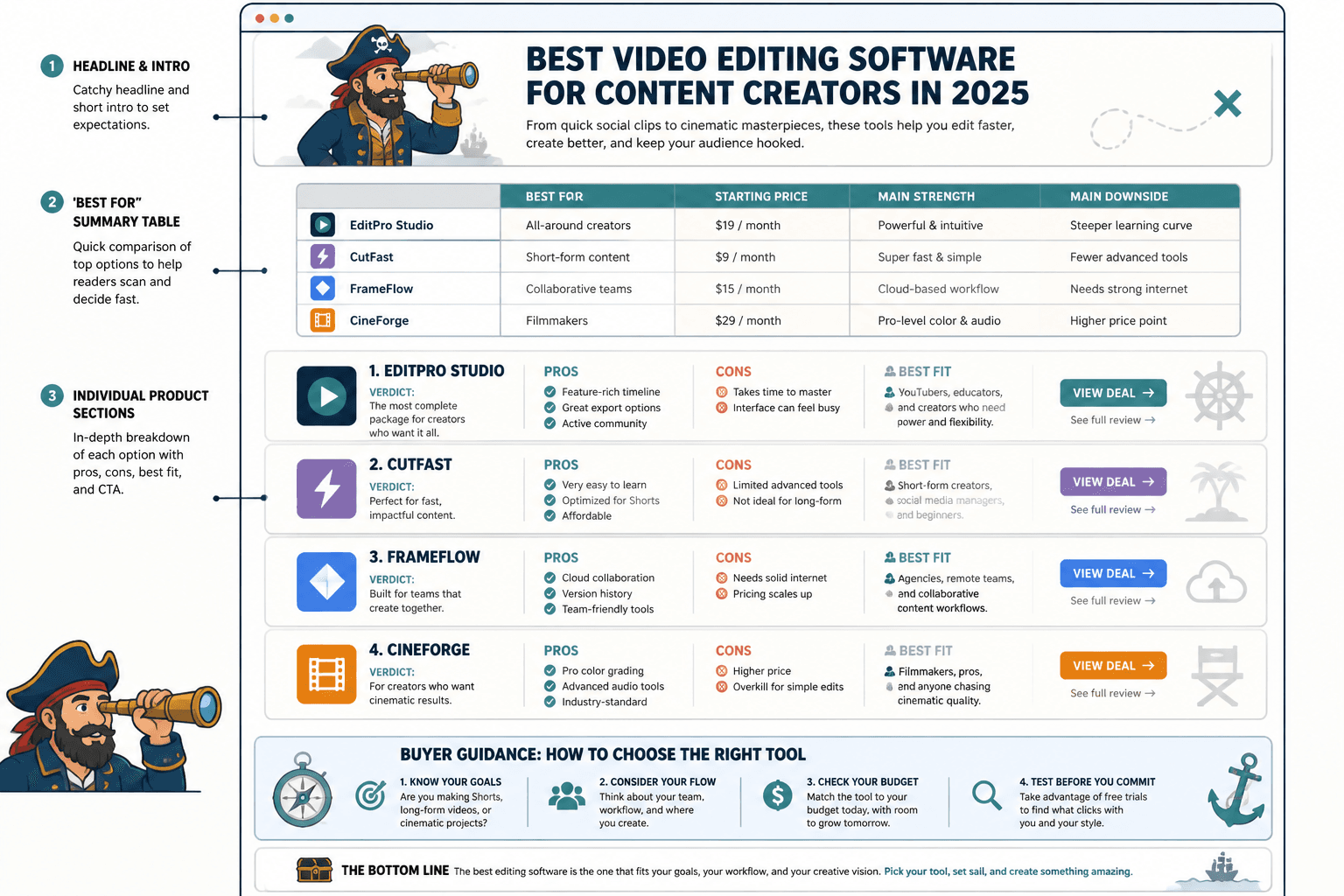
Comparison blocks are often where affiliate articles either become useful or become a shopping mall sign with paragraphs. A good comparison block does not try to make every option look equally appealing. It helps the reader understand what each option is for and why one might be the better fit.
Useful comparison blocks usually keep the focus on:
- decision criteria, not feature lists,
- real trade-offs, not polished symmetry,
- clear labels that mean something to the reader,
- a concise recommendation at the end.
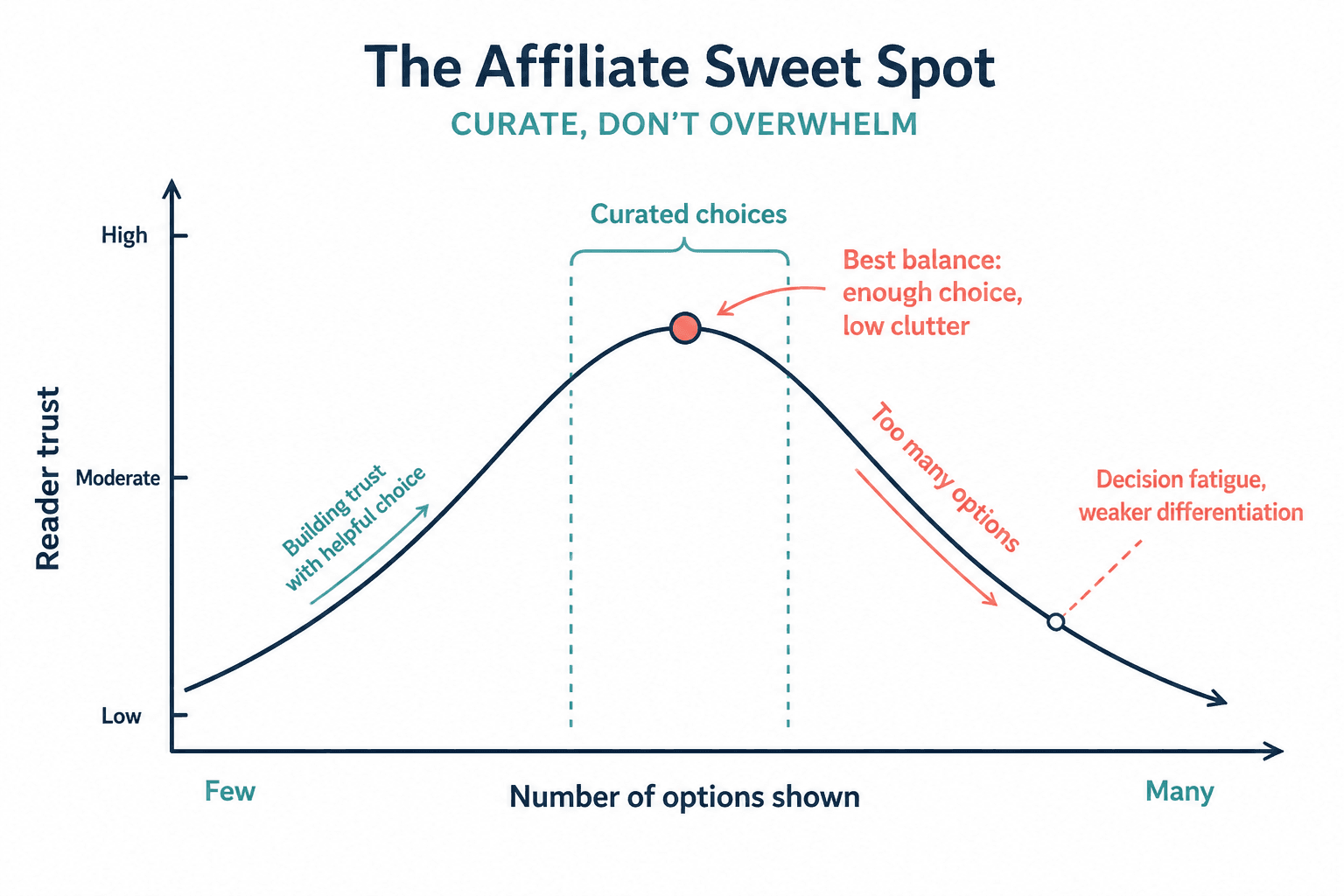
If you compare five products and describe all of them as “great,” the reader learns nothing except that you had a paragraph quota. This is the part where restraint makes the page stronger.
The comparison-block article above goes deeper on that. A related visual can also help here:
Keep disclosures clear and human
Disclosures matter more when your voice is personal or creator-led, because the reader is not just evaluating the product. They are evaluating your judgment. A disclosure should be easy to notice, easy to understand, and not dressed up like a legal memo that got lost on the way to a retirement party.
A practical disclosure should:
- say there may be affiliate links,
- avoid sounding evasive,
- sit where readers can see it without hunting,
- fit the tone of the article.
For placement and examples, see better affiliate disclosures for personal brands.
Choose the right length for the job
Longer is not automatically better. Shorter is not automatically better either. The right length depends on how much decision support the reader needs.
In practice, length is driven by:
- search intent,
- decision complexity,
- how many options you need to compare,
- how much proof or nuance you have,
- whether the article is the main decision page or a supporting asset.
A narrow, practical query may only need a compact article with a clean recommendation. A more complex purchase may need enough room for trade-offs, alternatives, and context. If you want a tighter decision rule, the companion piece when short affiliate articles beat long ones is worth using alongside this guide. For the 2026 length question, see how long should affiliate articles be in 2026?
Use a simpler structure when the audience is small but relevant
Small audiences are not a problem if they are the right audience. In fact, a smaller but more specific readership often makes affiliate writing easier, because the intent is clearer and the recommendation can be more direct.
For a smaller audience, the article should usually be:
- more specific about the use case,
- less padded with background noise,
- more direct about who the product is and is not for,
- easier to scan on mobile.
That is usually enough. You do not need an epic. You need a clear route from problem to option to action. There is a useful companion guide here: affiliate articles for creators with small audiences.
Trim the common mistakes on revision
When an affiliate draft feels flat, the fix is usually not “add more persuasion.” It is to remove the parts that make the reader work too hard.
- Cut throat-clearing. Get to the use case faster.
- Replace vague praise. Say what the product actually helps with.
- Reduce option sprawl. Too many choices weaken confidence.
- Surface trade-offs. Readers trust limits more than cheerleading.
- Make recommendations specific. “Best for X” beats “great overall” most days.
If a section reads like it could be swapped into any other affiliate article without changing much, it probably needs another pass.
A practical checklist before you publish
- Does the opening name the decision the reader is trying to make?
- Does the format match the actual intent?
- Are the comparison criteria clear and useful?
- Does the article show trade-offs instead of pretending every product is equally good?
- Is the disclosure visible and natural?
- Does the CTA follow the reasoning instead of jumping ahead of it?
- Is the length doing a job, not just filling space?
If you want to build the surrounding content system, the broader parent guide is still the best starting point: affiliate articles. For adjacent execution work, the most useful sibling pages are the ones on best AI tools for affiliate articles and how to turn old content into better affiliate articles.
Better affiliate articles are not built from hype. They are built from fit, judgment, and a structure that respects the reader’s time. Which is less flashy than marketing language would prefer, but considerably better at earning the click.