
A draft sits in one tab, the keyword list is in another, the outline is half-finished in a notes app, and the “final” version still needs a better comparison section plus three affiliate links that do not look like they were dropped in by a distracted intern. That is usually not a writing problem. It is a toolchain problem. The fix is not more software in a trench coat. It is a lean system that helps you move from research to draft to update without turning every handoff into a small administrative war.
This guide is about choosing affiliate-article tools that actually reduce friction. Some help you find a stronger angle. Some help you write faster without sounding like a machine auditioning for the role of “helpful.” A few are useful for compliance, link management, comparison tables, or updating older posts. The trick is to keep each one doing a specific job.
If you also want structure ideas before you pick tools, see best affiliate article ideas and examples for creators and how to write better affiliate articles.
What AI tools should actually do for affiliate articles
AI tools are useful when they help you do one of four things:
- Find a better angle for the article.
- Turn rough notes into a usable draft without flattening the argument.
- Improve clarity and conversion structure so the article helps readers decide.
- Keep older posts current when products, prices, or recommendations change.
That is the job. Not “make content appear.” Not “generate 12 variations of a headline nobody asked for.” A good tool stack supports the real workflow: research, draft, optimize, update.
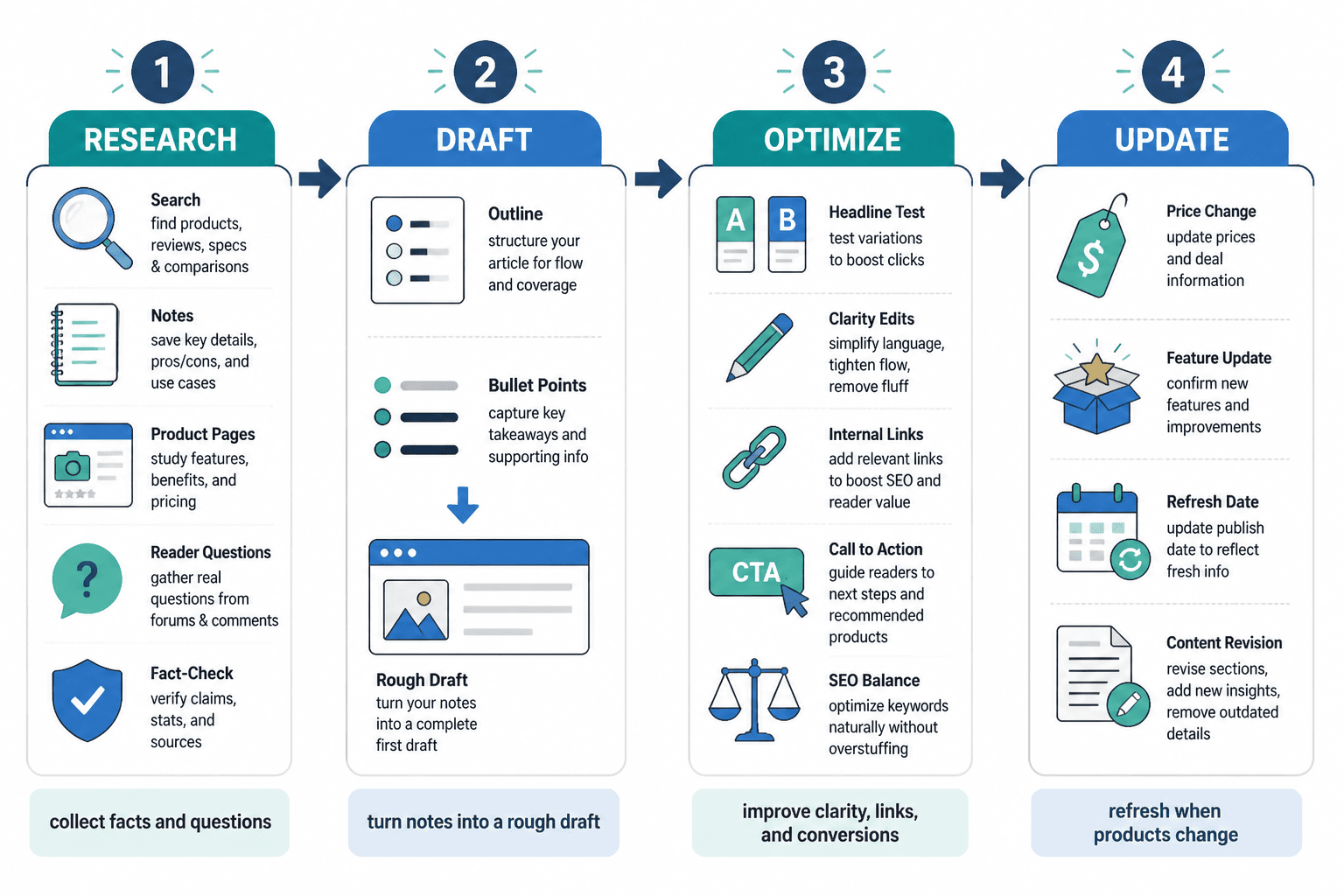
The best AI tool types for affiliate article workflow stages
1. Research and idea expansion tools
These are useful when you know the topic but not the angle. The goal is not to let the model invent your opinion for you. The goal is to surface:
- common buyer questions,
- comparison points readers care about,
- feature clusters worth grouping together,
- search intent patterns, and
- obvious gaps in competing articles.
Good uses include keyword expansion, question clustering, outline prompts, and competitor summarization. Bad uses include blindly accepting “top 10” lists with zero judgment. That is how you end up with an article that looks confident and reads like it was assembled from spare parts.
Best fit: writers choosing between article angles, especially for roundup and comparison posts.
2. Outlining and angle-selection tools
Outline tools are most useful when they help you make the article easier to decide from. That means they should support:
- clear section order,
- decision-oriented headings,
- feature-to-benefit translation,
- comparison tables, and
- buying criteria that match the reader’s actual problem.
If your outline does not make the decision easier, it is just decorative scaffolding. Pleasant, perhaps. Not useful.
For a more structured version of this approach, see simple affiliate article buyer-intent sections and templates for busy creators.
3. Drafting and rewriting tools
This is where most people overbuy. Drafting tools are helpful, but only if they take a clear brief and do not flatten everything into a generic voice. For affiliate articles, they should help with:
- section drafting from bullet notes,
- rewriting clunky paragraphs,
- reducing repetition,
- tightening transitions, and
- adjusting tone to sound credible rather than overeager.
Use them to move from rough material to something editable. Do not use them to skip judgment. Affiliate readers can smell the difference between “efficiently written” and “never really thought through.”
4. Editing, fact-checking, and optimization tools
These tools are often the quiet winners. They help with:
- grammar and readability,
- SEO checks,
- heading consistency,
- internal link placement,
- affiliate disclosure reminders, and
- finding thin sections that need more evidence or clearer examples.
If you want your post to stay useful after publish day, this layer matters. A polished article that still misses the reader’s decision point is just a better-dressed problem.
5. Affiliate-specific on-page tools
This is where tools and plugins stop being the same thing. Some tools support the writing process. Others help the page itself convert better.
For affiliate articles, useful on-page helpers can include:
- link management tools,
- comparison table plugins,
- product box or review block tools,
- disclosure helpers, and
- basic click tracking.
These do not replace good writing. They make the writing easier to scan and easier to act on. If you want a more specific breakdown, see best affiliate plugins and creator ops tools for affiliate articles.
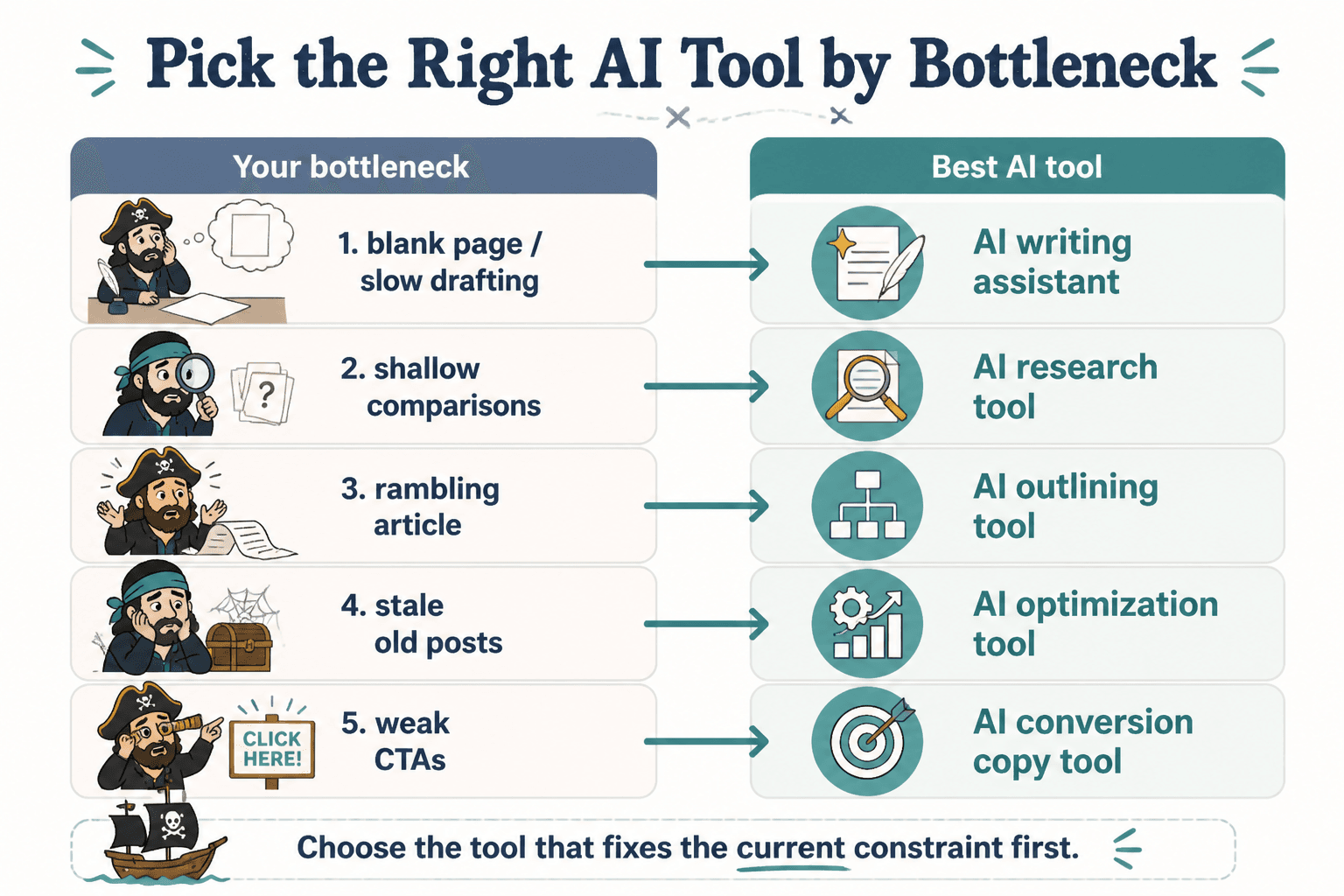
6. Updating old affiliate articles
One of the most practical uses for AI is making old affiliate content less embarrassing. Useful update tasks include:
- refreshing product names and features,
- spotting outdated recommendations,
- finding sections that need a stronger buyer-intent angle,
- adding newer alternatives, and
- rewriting stale intros and conclusions.
If you have older posts with decent traffic but weak conversions, this is often the easiest place to win back performance. See also how to turn old content into better affiliate articles.
A simple AI stack that works for most affiliate articles
You do not need a twelve-app relay race. A useful stack is usually just:
- one research tool for idea expansion and competitor scanning,
- one drafting tool for outline-to-prose work,
- one editing tool for cleanup and consistency,
- one on-page plugin set for tables, disclosure, and link handling, and
- one update workflow for revisiting older posts.
That is enough for most people. The rest is usually subscription theater.
How to choose tools without building a subscription museum
When comparing AI tools for affiliate articles, ask five questions:
- Does this tool save time in the actual workflow?
- Does it help the reader decide, or just help me produce more words?
- Can I keep the output accurate and on-brand?
- Does it fit the kind of article I actually write most often?
- Will I still use it after the novelty wears off?
If the answer is “probably not, but the demo looked nice,” that is your cue to walk away slowly.
Recommended workflow for AI-assisted affiliate articles
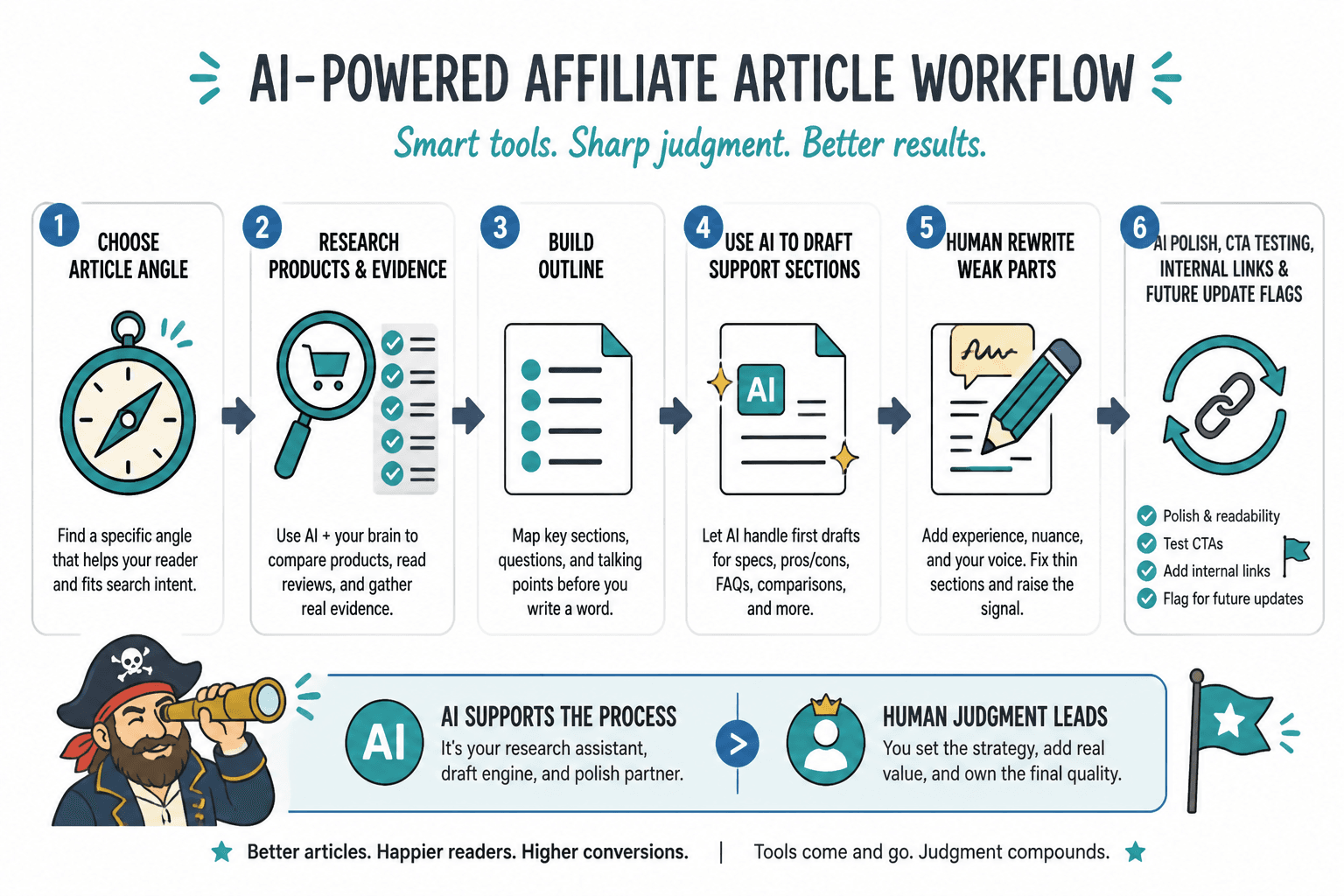
A practical workflow looks like this:
- Choose the article angle. Start with the reader’s decision, not the product list.
- Use AI for research support. Pull common questions, feature comparisons, and content gaps.
- Draft the core sections. Use the tool to speed up the rough pass.
- Rewrite for judgment. Make sure the article reflects your actual position.
- Add affiliate elements. Place links, disclosures, comparison tables, and product boxes where they help.
- Optimize for clarity. Tighten headings, transitions, and calls to action.
- Schedule updates. Revisit the post when tools, prices, or buyer concerns shift.
This workflow keeps the article human where it matters and automated where it helps.
Common mistakes to avoid
- Using AI to replace judgment. Faster nonsense is still nonsense.
- Buying too many overlapping tools. One good workflow beats five half-used dashboards.
- Skipping update plans. Affiliate articles age. Not always gracefully.
- Letting the tool dictate the structure. The structure should follow the decision, not the other way around.
- Forgetting the on-page layer. Drafting alone does not make an article useful to a buyer.
Use the tools to support the article, not impersonate it
The best AI tools for affiliate articles are the ones that help you think more clearly, write faster, and update smarter without turning the page into generic sludge. That usually means a small stack with a clear purpose: research, drafting, editing, on-page support, and maintenance.
If you want the larger framework around this topic, the parent guide is here: affiliate articles. For related practical examples, browse ideas and examples for creators and how to write better affiliate articles.