
An old post can sit there for months doing its job in the laziest possible way: a little traffic, a little relevance, and not nearly enough useful action. The content is still alive, but it is drifting. That usually means it does not need a dramatic rewrite. It needs maintenance, a clearer job, and a better route from reader interest to a justified recommendation.
This is the practical version of affiliate content refresh work: take something already indexed, already known, and already doing some of the heavy lifting, then shape it into a stronger affiliate article without pretending the draft was born perfect. If you want the bigger cluster context, start with the parent guide on affiliate articles. For a broader writing pass, how to write better affiliate articles covers the core craft; for idea selection, affiliate article ideas and examples is the better companion.
What makes old content worth turning into an affiliate article?
Not every stale post deserves the same treatment. Some pieces are too thin to salvage. Some are structurally wrong for monetization. Others are quietly useful already and only need the article version of a tune-up.
- It still gets traffic. Even modest search traffic is a sign the topic has surviving demand.
- The topic matches a buying decision. Reviews, comparisons, problem-solving guides, and “best for X” posts usually adapt well.
- The intent is close but not complete. The reader is asking a useful question, but the post does not yet answer it in a way that supports a recommendation.
- The content can support a decision. If the page can credibly explain tradeoffs, criteria, and next steps, it is usually worth updating.
That last point matters. A post that simply mentions products is not necessarily an affiliate article. A real affiliate article helps a reader decide. It earns the recommendation by making the choice easier, not louder.
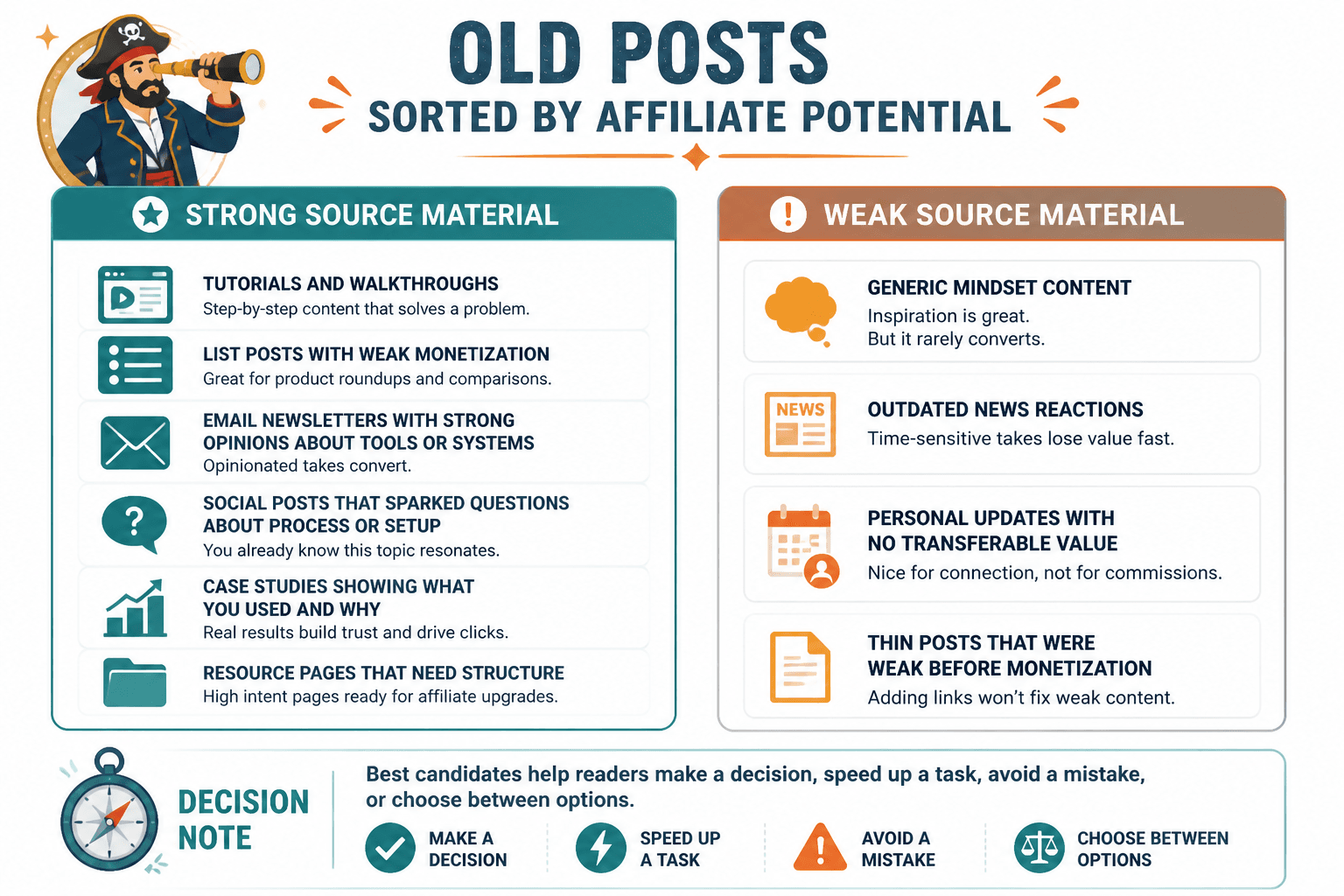
Start with the posts most likely to convert cleanly
The best updates usually come from content that already sits near a buying query. A how-to post about a tool, a comparison between two methods, or a list of options all gives you a better starting point than a vague thought piece that only incidentally mentions products.
A simple way to triage old posts:
- Look at the traffic. Which posts still earn impressions or clicks?
- Check the intent. Is the reader looking for information, a solution, a recommendation, or a comparison?
- Check the product fit. Can you recommend something without forcing the fit?
- Check the structure. Does the post already have room for decision-making sections?
- Check freshness. Are screenshots, examples, prices, features, or references stale?
If a post has traffic and intent, but the recommendation is currently hidden behind outdated framing, that is usually a good candidate. If it has no traffic, no clear reader need, and no natural product fit, it may be better to leave it alone or retire it.
Choose the affiliate format that matches the reader’s decision
One of the fastest ways to improve an old post is to stop asking it to be the wrong kind of article. A generic article can become a focused affiliate piece if the format matches the decision the reader is actually trying to make.
- Recommendation post: Best when the reader has a clear problem and needs a direct solution.
- Comparison post: Best when the reader is choosing between similar options.
- Roundup: Best when several tools or products solve adjacent versions of the same problem.
- Problem/solution post: Best when the buying decision is secondary to the pain point, but still present.
- Use-case post: Best when the same product fits different reader situations in different ways.
If the old content is already close to one of these forms, keep the shape and strengthen the decision path. If it is not, then the structure may need a bigger edit than the prose does.
Rebuild the article around buyer intent
Buyer intent is where old content usually starts paying rent again. The original draft may have been informative, but informative is not the same as useful at decision time. The updated version needs to answer the reader’s real question: What should I choose, and why?
That means the article should do more than describe. It should compare, narrow, and justify.
What to add or strengthen
- A clearer opening. State the problem, the decision, and the value of the page early.
- Decision criteria. Explain what matters when choosing among the options.
- Tradeoffs. Show where each product or approach is strong and where it falls short.
- Objection handling. Address the “yes, but” questions before they stall the click.
- Specific use cases. Help different readers see which option fits their situation.
That is also where a simple section map helps. The page should guide a reader from problem to option to recommendation without making them hunt through decorative content. For a cleaner structure pattern, the companion guide on buyer-intent sections and templates is useful.
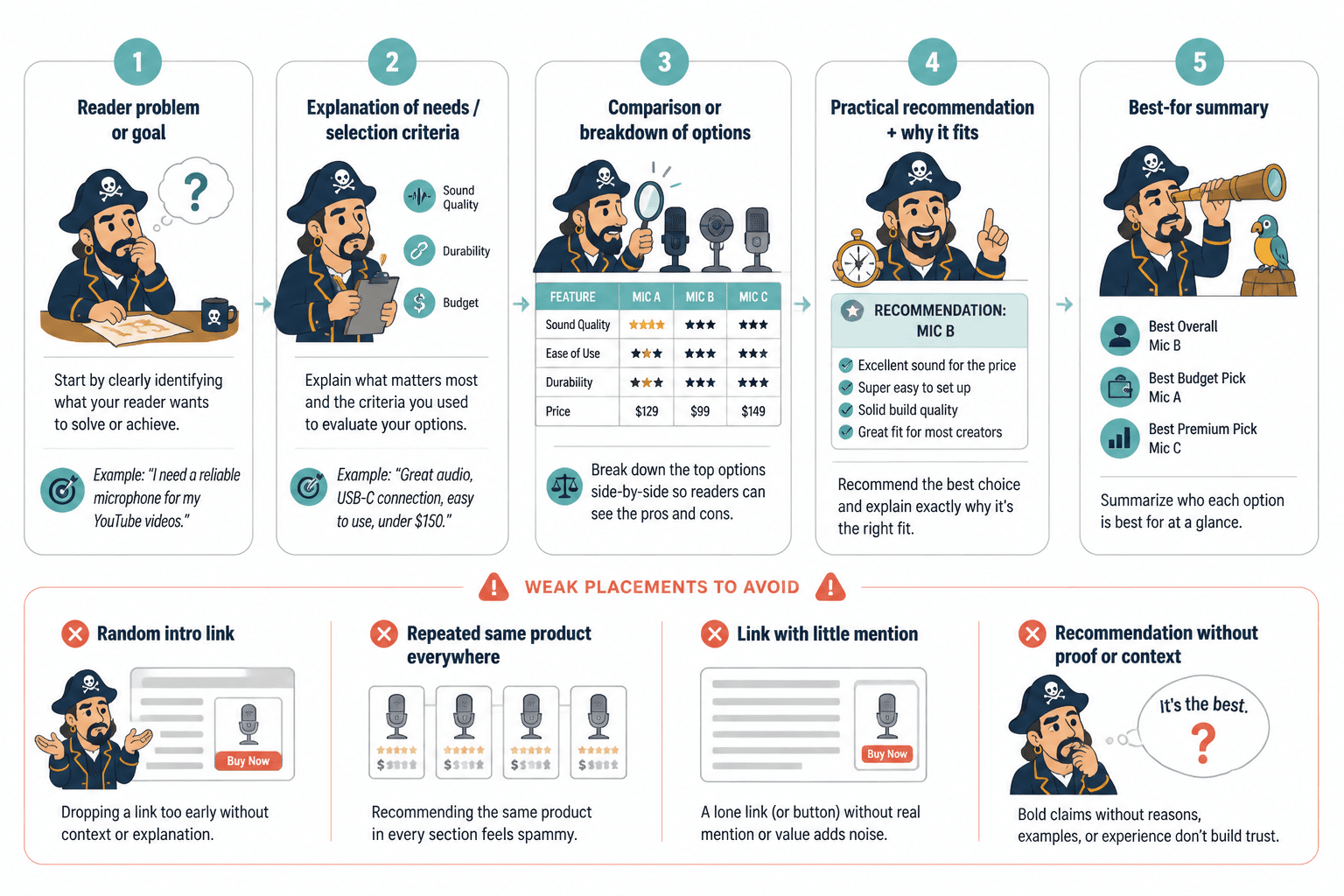
Update the substance, not just the label
A lot of content refresh work fails because the title changes but the article still behaves like the old version. That is decoration, not maintenance. If you want a stronger affiliate article, update the evidence and the logic, not just the packaging.
Useful updates usually include:
- Rechecking features and pricing. Old claims age badly when the product has changed.
- Replacing generic examples. Swap vague illustrations for sharper, more current ones.
- Adding criteria. Explain why one product is recommended over another.
- Improving section headings. Headings should match the reader’s decision process, not your draft history.
- Removing clutter. If a paragraph does not help the decision, it is probably taking up space like a chair with no function.
Search engines reward useful refreshes more than cosmetic ones. Google’s guidance on creating helpful, reliable content is still the cleanest baseline here, and its advice on link spam policies and spam policies is worth keeping in view when affiliate links are involved. The point is not to be timid. It is to make the page earn its links.
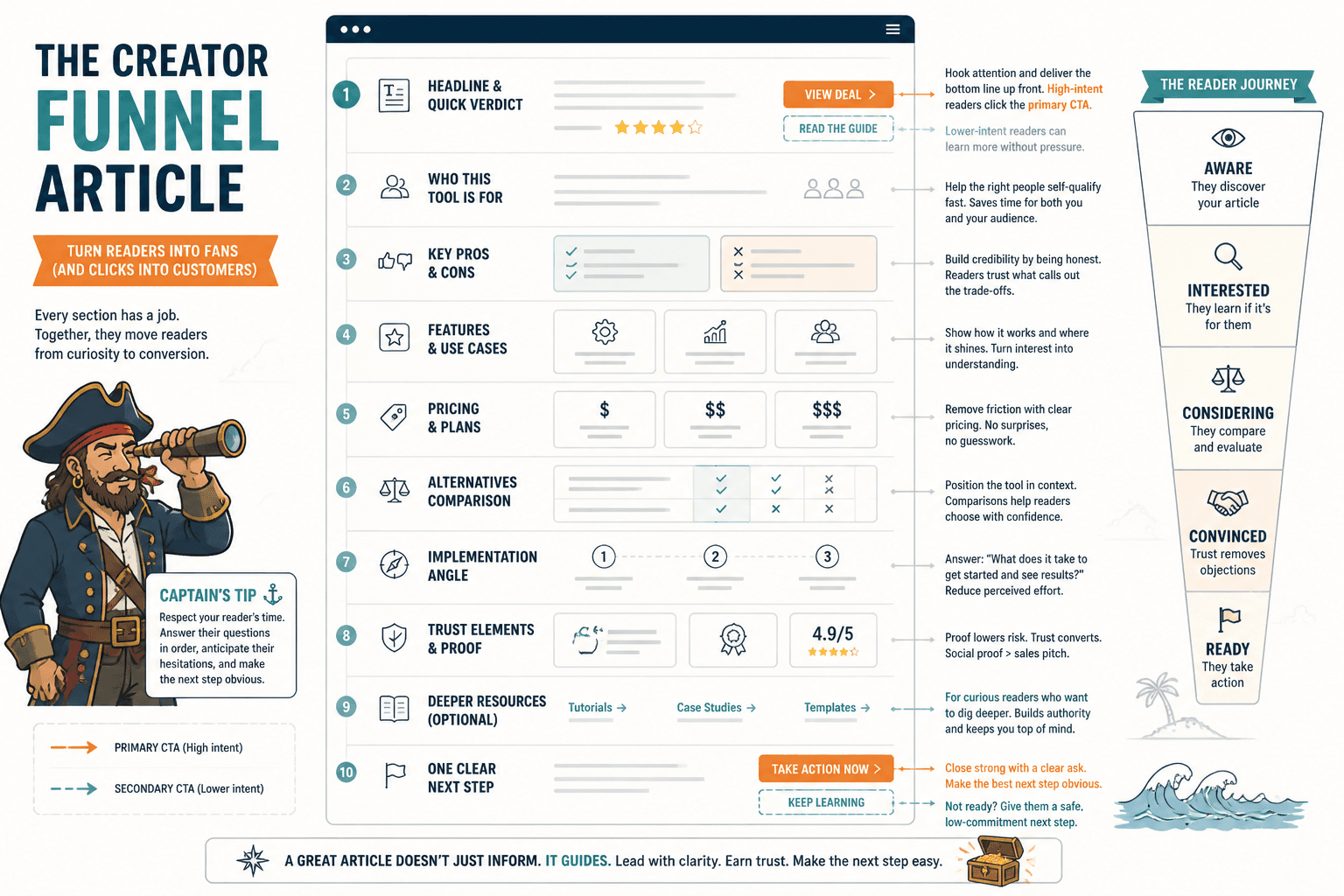
Place affiliate links where they help the decision
Affiliate links work best when they follow a reason, not a reflex. A good affiliate article does not scatter links like confetti at a particularly boring parade. It places them where the reader has enough context to click with confidence.
Good link placement usually looks like this:
- after a clear recommendation
- near a comparison conclusion
- after a use-case match is explained
- inside a section that answers a direct buying question
Avoid the old habit of dropping links before the page has established why the product matters. The reader should understand the recommendation first and encounter the link as the natural next step.
Use visuals only when they genuinely support the update
Existing visuals can help if they clarify structure, product fit, or the update process. They should not be repeated just because a page looks lonely without them. One good diagram or contextual image is enough when it actually carries meaning.
For old-content refresh articles, the most useful images are usually the ones that help readers see:
- how old content gets prioritized
- how reader problem maps to recommendation
- where a post sits in the affiliate article workflow
In other words: useful, not ornamental. The page should read cleanly with or without the visual, which is usually how you know the visual is doing its job.
Republish, monitor, and keep the post maintained
Updating old content is not a one-time ritual. It is maintenance. Once the article is republished, watch how it behaves.
- Check rankings and impressions. See whether the refreshed framing matches the query better.
- Watch click behavior. The page should make the next step easier, not merely exist more attractively.
- Review comments and signals. Reader questions often reveal what the article still misses.
- Schedule future refreshes. Product pages, prices, screenshots, and recommendations age on different clocks.
This is where content upkeep beats content heroics. A page that is reviewed regularly does not need to become dramatic to stay useful.
When to update a post and when to leave it alone
Not every old post deserves affiliate treatment. Some pages are better kept as informational content. Some should be merged. Some should be retired. The decision should be based on utility, not hope.
Update the post when:
- the topic still gets searches
- the reader has a clear decision to make
- you can recommend something honestly
- the structure can support a stronger buying path
Leave it alone, merge it, or replace it when:
- the topic has no remaining demand
- the product fit is forced
- the article cannot be made useful without rebuilding it from scratch
- the page would confuse the site more than it would help it
That last category is the one people avoid because it feels less productive. It is often the smartest choice anyway.
A simple way to think about the whole process
The update process is not mysterious. It is a sequence:
- find the post that still has some life left
- match it to a real buying decision
- rebuild the structure around that decision
- refresh the evidence and examples
- place links where they make sense
- publish, observe, and maintain
If you want a broader map of this content type, return to the parent guide on affiliate articles. If you need more help choosing what to make, the companion pages on affiliate article ideas and AI tools for affiliate articles can help with the planning side. For a fast structural reset, the guide to buyer-intent sections and templates is the more immediately useful one.
Old content does not need to stay old in the ways that matter. With the right maintenance, it can become the most efficient page on the site: already indexed, already trusted, and finally useful in the way the reader actually needed.