
Choosing the right affiliate article is usually the hard part. The product may be fine, the links may work, and the audience may even be interested, but the draft still feels slippery: review, comparison, roundup, “top tools,” “what I use,” something else entirely. That uncertainty costs time. It also leads to the classic mistake of writing a polite article that never quite helps the reader decide. The faster path is to pick an idea that matches the decision the reader is actually trying to make, then build the article around that decision.
This guide focuses on affiliate article ideas and examples creators can actually use. If you want the broader strategy behind the format, start with the affiliate articles parent guide. If you want the mechanics of structure and wording, pair this with how to write better affiliate articles. If you need templates, the buyer intent sections and templates page is the quicker route.
What makes an affiliate article worth publishing
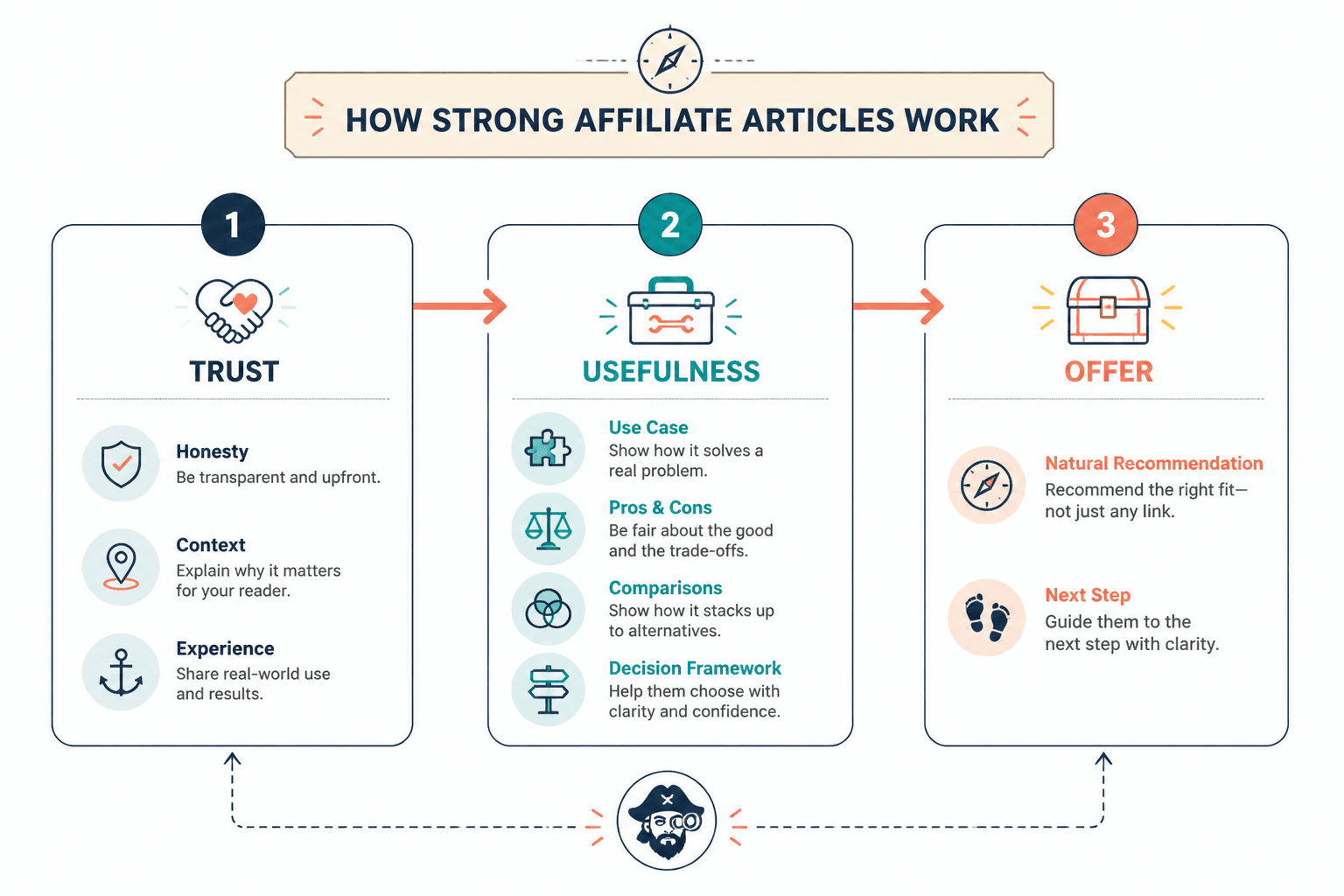
A good affiliate article does three jobs at once: it helps the reader narrow a choice, it explains why one option fits better than another, and it earns the right to recommend something. That last part matters. Affiliate content falls flat when it jumps straight to the pitch and treats context like an optional garnish.
The useful version feels more like a decision aid than an ad. It gives readers enough information to compare options without doing their homework for them. It also keeps the recommendation tied to a specific need, not a vague “best of” claim that tries to cover every possible use case and ends up covering none.
The easiest way to choose an affiliate article idea
When you are stuck, use this sequence:
- Start with the reader’s question. What are they trying to decide, compare, or avoid?
- Match the format to the question. A comparison article solves a different problem than a review or a resource list.
- Check your proof. Can you support the recommendation with firsthand use, credible research, or clearly labeled analysis?
- Trim the scope. Specific is easier to trust than “best tools for everyone, everywhere, forever.”
That is the whole trick. Good affiliate articles are not defined by how many products they mention. They are defined by how clearly they answer a decision.
Affiliate article ideas creators can adapt fast
1. Best for a specific type of reader
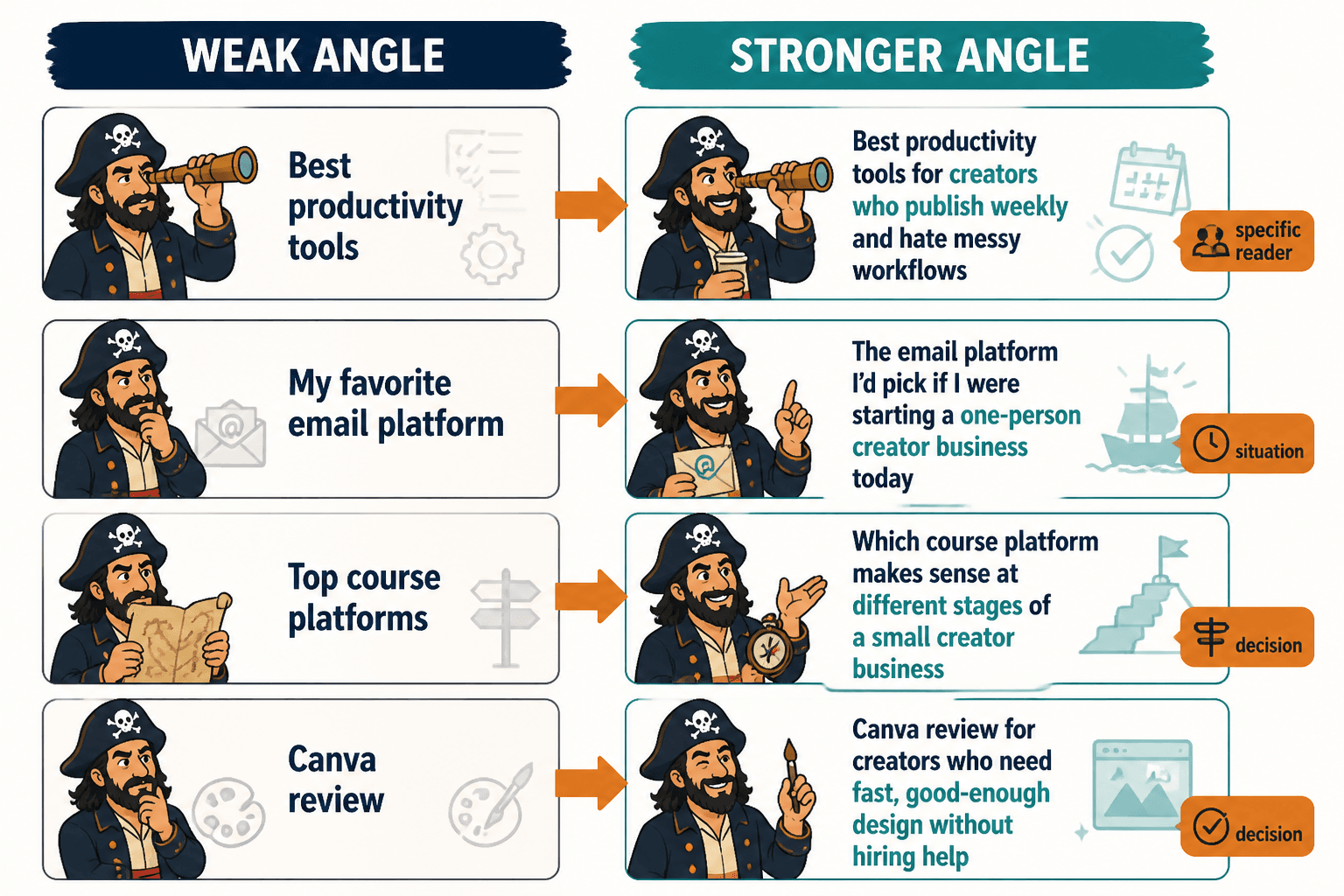
This is often the cleanest format. Instead of writing “best email tools,” write “best email tools for solo creators” or “best email tools for creators who only need simple automations.” The angle narrows the decision and makes the recommendation easier to defend.
Use when: the product is broadly useful, but one audience segment gets especially strong value from it.
Example: “Best project management tools for small creator teams”
2. Comparison article
A comparison article works when readers are already down to a few options and need help choosing between them. This format is useful when the differences matter more than the feature list.
Use when: the products are close enough that the reader needs tradeoffs, not just descriptions.
Example: “Notion vs. Airtable for content planning: which one fits a solo creator?”
3. Review article with a clear angle
Review articles get stronger when they answer one specific question instead of trying to be the final word on everything. That question might be about speed, ease of use, value, or fit for a certain workflow.
Use when: you can explain where the product fits, where it falls short, and who should care.
Example: “ConvertKit review for creators who want a simple email setup”
For more angle ideas, see affiliate review angles creators can adapt fast.
4. Recommended tools or resources page
This format works best when it is organized around actual use, not a random pile of affiliate links. Think “tools I’d recommend for this workflow” rather than “here are fourteen things I found on a marketplace crawl.”
Use when: the reader wants a short list of useful options, not a deep product comparison.
Example: “Recommended tools for building a newsletter from scratch”
5. How I use this tool in a workflow
This is less about the product itself and more about the job it helps with. It works especially well for creators because workflows make the usefulness concrete. Readers can picture themselves using the tool instead of trying to decode a generic feature dump.
Use when: the product becomes more persuasive inside a real process than in isolation.
Example: “How I use [tool] to move from draft to published post faster”
6. Best tool for one narrow problem
Sometimes the smartest affiliate article is not a broad recommendation at all. It is a narrow answer to a narrow problem. That kind of article can be highly useful because it meets the reader exactly where the frustration lives.
Use when: you know the audience’s pain point is specific and recurring.
Example: “Best tool for turning long notes into publishable outlines”
Examples of affiliate article ideas by creator use case
If you want more concrete starting points, here are ideas grouped by common creator needs:
- For newsletter creators: best email platforms, email platform comparisons, setup walkthroughs, welcome sequence tools
- For course creators: best course platforms, checkout tools, landing page tools, payment stack comparisons
- For content creators: best research tools, editing tools, planning tools, repurposing tools
- For service providers: best scheduling tools, proposal tools, CRM comparisons, client onboarding tools
- For small teams: collaboration software comparisons, workflow tools, knowledge base tools, approval tools
The point is not to chase every category. It is to choose the one where your experience, audience context, and recommendation can actually line up.
How to turn a generic title into a usable affiliate article
Generic titles tend to sound broad because they are broad. Tightening them usually means adding one of four things: audience, use case, constraint, or comparison.
- Audience: “Best writing tools for solo creators”
- Use case: “Best writing tools for faster newsletter drafts”
- Constraint: “Best writing tools for creators on a budget”
- Comparison: “Notion vs Google Docs for content planning”
That small shift changes the article from “this exists” to “this helps a specific person make a specific decision.” Which is more useful, and more likely to earn the click after the click.
What weak affiliate articles usually get wrong
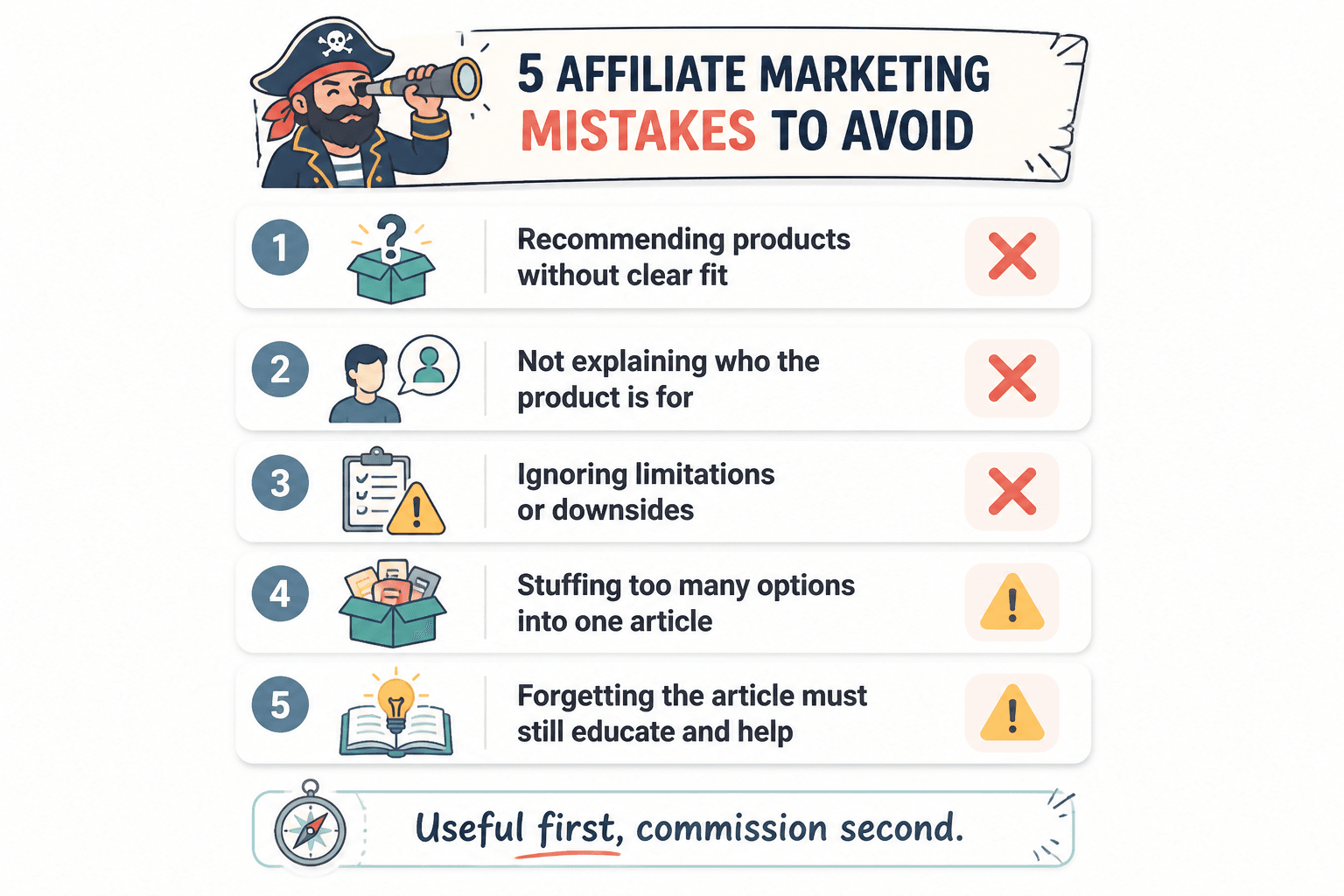
There are a few recurring mistakes that make affiliate articles feel flimsy even when the writing is technically fine:
- The angle is too broad. The article tries to cover every reader and ends up helping no one in particular.
- The recommendation comes too early. The piece asks for trust before it has given the reader a reason.
- The proof is thin. The article claims expertise without showing why the recommendation is credible.
- The structure is repetitive. Every section says the same thing in slightly different clothes.
- The comparison is fake. Products are listed side by side without meaningful differences.
If you want a stronger structure for these pages, the templates in simple affiliate articles buyer intent sections can help you move faster without flattening the argument.
A quick checklist before you publish
- Does the title match one clear reader decision?
- Does the article answer a useful question instead of just naming products?
- Have you picked the format that fits the decision best?
- Is the recommendation supported by context, not hype?
- Would a reader feel more confident after reading it?
- Does the article sound like it was written for a person, not a coupon bot with a content calendar?
If the answer to most of those is yes, the article is probably in decent shape. If not, the fix is usually not “add more affiliate links.” It is “make the decision clearer.”
Use these ideas as a starting point, not a template prison
Affiliate articles work best when they behave like useful recommendations, not assembled filler. Start with the reader’s decision, choose the format that fits, and keep the article specific enough to be trusted. That is usually enough to turn a vague idea into something worth publishing.
For the bigger system behind this page, return to the affiliate articles guide. For the next step, see how to turn old content into better affiliate articles.