
A new subscriber shows up, the automation fires, and the first email somehow reads like a polite receipt written by a nervous committee. Everything is technically in place, yet nothing feels warm, clear, or worth replying to. That is usually the point where examples become more useful than another vague instruction to “sound more human.”
That is usually where welcome email examples start to matter. Not as decoration, and not as copy-paste fuel, but as a way to see the pattern: what the email needs to say, what it should leave out, and how to move a new subscriber from “I signed up” to “okay, this is worth reading.”
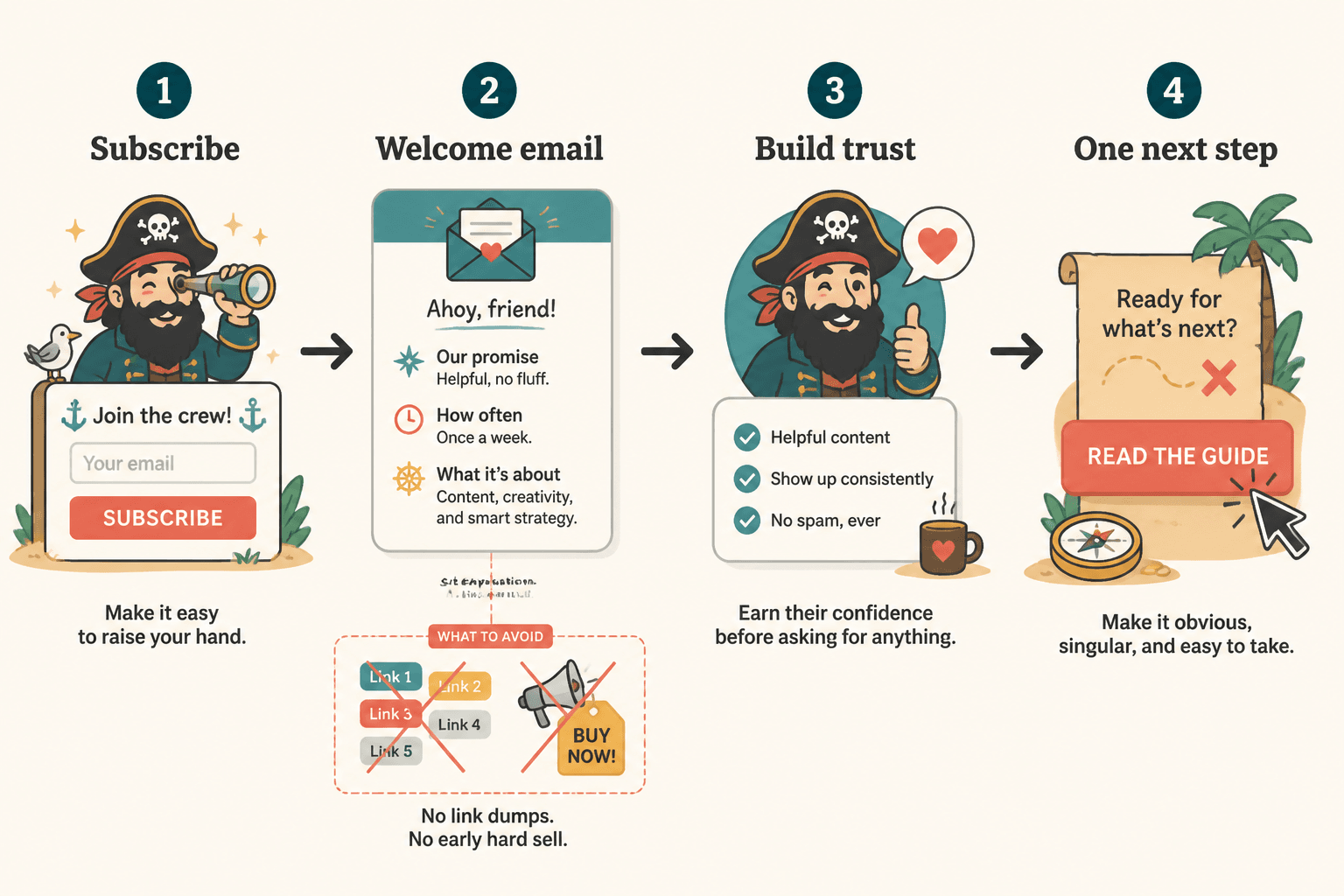
If you want the wider system behind this, the parent guide on welcome emails for creators covers the full strategy. This page stays in the practical lane: ideas, examples, and templates you can adapt without turning the intro into a small novel.
What a welcome email actually needs to do
A welcome email is not just the polite receipt that arrives after someone subscribes. It is the first real chance to prove the signup was worth it, explain what happens next, and make the reader feel like they made a smart decision instead of a casual typo.
That means the email should do a few jobs quickly:
- confirm the subscription and set a clear tone
- tell readers what they signed up for
- reduce uncertainty about frequency or format
- give one obvious next step
- create enough interest that the next email does not feel like random noise
The most useful welcome emails do not try to say everything. They try to make the next step feel obvious.
A simple structure that works for most creator welcome emails
For creators, the easiest structure is usually:
- Short welcome – friendly, grounded, not theatrical
- Why they are here – what the subscription is about
- What to expect – format, frequency, and tone
- One useful next step – a link, a reply prompt, or a quick win
That structure leaves room for personality without turning the email into a brand memoir. Which is a mercy for everyone involved.
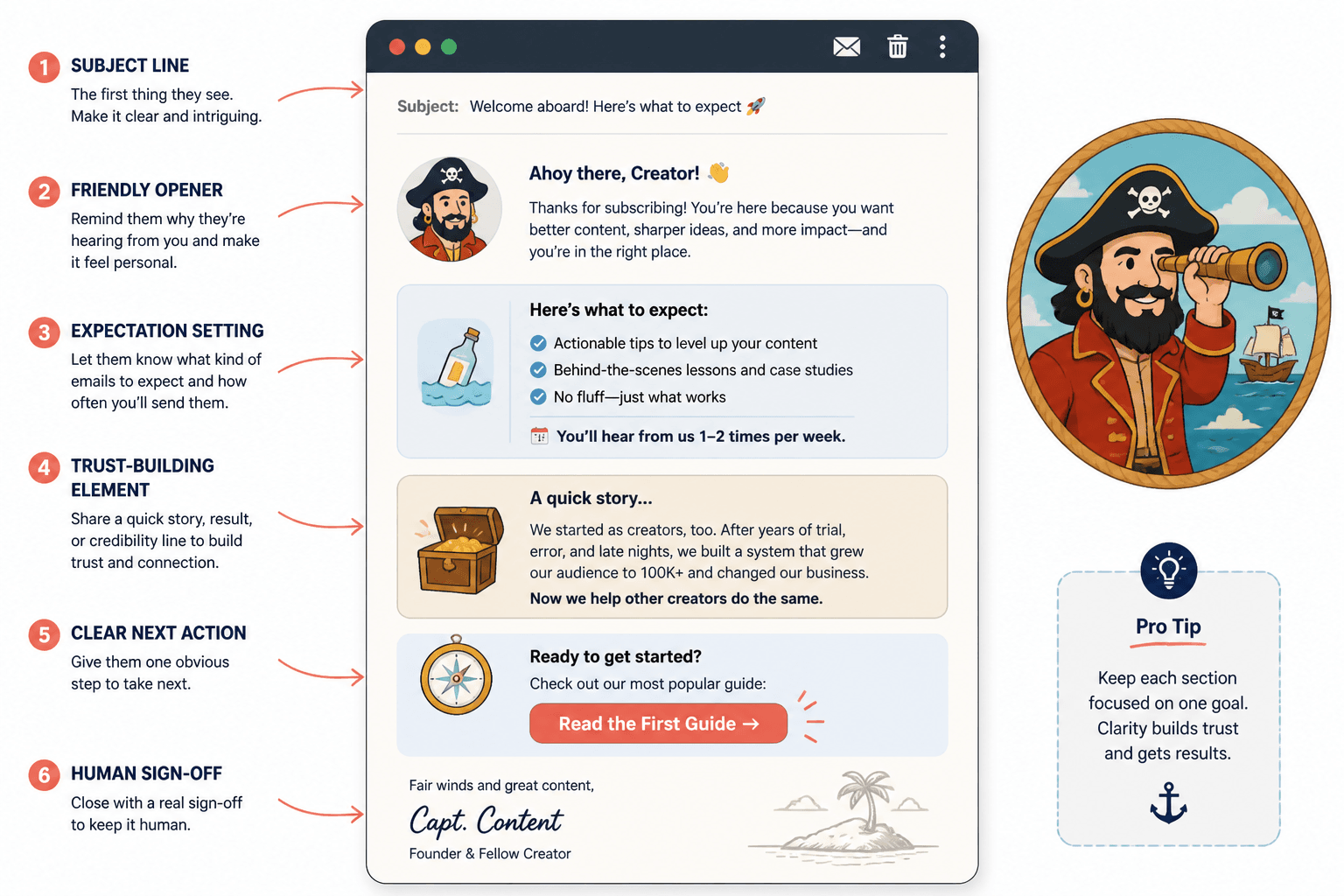
Welcome email idea 1: the direct promise hook
This version gets to the point quickly. It works when you want the reader to understand the value of the newsletter immediately.
Example
Subject: Welcome – here is what you will get here
Thanks for subscribing. You are now on the list for practical ideas, examples, and systems that help creators write clearer emails without making the process weirdly complicated.
Here is what to expect:
- simple frameworks you can use right away
- examples that show what good looks like
- occasional tools and tactics worth testing
If you want a good place to start, read how to write better welcome emails.
Why it works: the promise is clear, the tone is calm, and the reader does not have to decode the point.
Welcome email idea 2: the “you are in the right place” hook
This version helps the reader feel oriented. It is useful when your audience may be arriving from several different entry points and needs a quick sense of fit.
Example
Subject: You are in the right place
If you signed up because you want clearer creator emails and fewer blank-page moments, that is exactly what this list is for.
I send practical guidance on writing welcome sequences, improving email structure, and turning a new subscriber into someone who actually wants to keep opening.
To see how that fits into a larger system, start with the welcome emails guide for creators.
Why it works: it reassures the reader without overexplaining the backstory.
Welcome email idea 3: the expectation-setting email
This is the low-drama option that often performs better than a highly polished “brand story” opener. Readers appreciate knowing what happens next. Shocking, really.
Use this version to cover cadence, content type, and how the list is different from everything else in the inbox.
Example
Subject: What to expect from this newsletter
Thanks for joining. You will hear from me when there is something useful to send – usually a mix of examples, templates, and clear advice for creators who want their emails to do more than sit there looking organized.
Expect short, practical emails. No endless setup. No mystery schedule. Just useful work you can adapt.
If you want help with the opening of that first email, see more welcome email ideas and examples.
Why it works: it lowers uncertainty and builds trust early.
Welcome email idea 4: the quick-win email
This version gives the reader something useful immediately: a checklist, a shortcut, a prompt, or a simple fix. It is especially helpful when you want the first email to feel active rather than ceremonial.
Example
Subject: A quick win for your welcome sequence
Thanks for subscribing. Here is the fastest improvement most welcome emails need: say what the reader signed up for in one plain sentence.
For example:
You subscribed for practical creator email ideas, examples, and systems you can use without rebuilding your whole workflow.
That one sentence removes confusion and gives the rest of the email a job.
Why it works: it delivers value immediately and shows the reader what kind of help to expect.
Welcome email idea 5: the trust-builder
This version works when your audience needs a little more confidence before they move deeper into your content. It is not a memoir. It is a credibility signal with a pulse.
Example
Subject: Why this list exists
This newsletter exists because too many creator emails are either too vague, too long, or too obsessed with sounding clever. The goal here is simpler: make the next step obvious and the writing easier to use.
You will get examples, templates, and straightforward breakdowns that help you improve your own email sequence without making every draft feel like a committee meeting.
Why it works: it frames the newsletter around a useful point of view, not just a topic.
Welcome email idea 6: the personal brand or coach-style welcome
For coaches, consultants, and personal brands, the welcome email can feel a little warmer and more direct, but it still needs structure. The goal is a human tone, not an overshare with a CTA attached.
Example
Subject: Welcome – here is how I can help
Thanks for signing up. I send practical emails about improving creator systems, writing better welcome sequences, and making your next email feel less improvised.
If you are here because your own sequence needs work, start with the basics: one clear promise, one clear expectation, and one useful next step.
You can also read the guide on turning welcome emails into more leads or sales if you want the sequence to support a stronger business outcome.
Why it works: it feels personal without wandering into autobiography.
Welcome email idea 7: the consultant-style authority email
This version is useful when expertise matters and the reader is looking for informed guidance rather than warm vibes and confetti.
Example
Subject: Welcome. Here is the standard we use here.
Thanks for subscribing. This list focuses on creator email systems that are clear, practical, and built to support real decisions: what to send, when to send it, and how to make each email earn its place.
If that is useful, the next best step is to read the full welcome email guide and then compare it with the examples in this article.
Why it works: it establishes a standard without sounding like a spreadsheet in a blazer.
Template patterns you can adapt fast
Most welcome emails can be built from a few reusable patterns. These are not rigid formulas. They are scaffolding.
Pattern 1: welcome + promise + next step
- Welcome the reader
- State the newsletter promise in one sentence
- Offer one useful link or action
Pattern 2: welcome + expectations + reassurance
- Welcome the reader
- Explain what they will receive and how often
- Reduce uncertainty with a calm, plain explanation
Pattern 3: welcome + quick win + deeper resource
- Welcome the reader
- Share one immediate improvement or tip
- Link to a more complete resource
For tools that help speed up this work, see the best AI tools for welcome emails. Use them as assistants, not as little copy goblins running the whole operation.

What makes a welcome email feel flat
A lot of welcome emails fail for the same reasons:
- the opening is vague
- the promise is buried under brand language
- there is no clear expectation setting
- the call to action is missing or too broad
- the email tries to sound warm but says almost nothing
The fix is usually not more words. It is more clarity.
If the opening already feels weak, start with stronger first-line options from welcome email hook examples. A better opening can do a surprising amount of heavy lifting.
How to connect the welcome email to the rest of the system
A good welcome email should not act like an island. It should point naturally to the next useful page, offer, or step in your sequence.
That might mean linking to:
- the parent guide on welcome emails
- a deeper how-to page on writing the sequence
- a resource that helps the reader use the list better
- a later email in the automation that builds trust or moves toward a sale
The point is not to cram every link into the first message. The point is to make the sequence feel connected instead of assembled in a rush by someone with three browser tabs and a grudge.
A note on proof, privacy, and plain language
When you use examples, keep them clearly illustrative unless they are real and approved for publication. Do not pretend a composite example is a client story or a personal case study. Readers can usually smell that from a few paragraphs away.
Plain language usually beats polished vagueness. You do not need to sound like a brand workshop. You need to sound like someone worth reading next time.
Final takeaway
The best welcome email ideas are not the fanciest ones. They are the ones that make the reader immediately understand three things: why they are here, what comes next, and why opening the next email is worth the trouble.
Start with one clear promise, one useful expectation, and one next step. Then shape the tone so it sounds like a real creator wrote it, not a committee that only meets in adjacencies.
For the full system behind the sequence, return to the creator welcome emails guide. For adjacent help, the pages on writing better welcome emails, AI tools for welcome emails, and turning welcome emails into more leads or sales fill in the rest of the map.