
The common mistake is treating LinkedIn articles like blog posts that wandered onto LinkedIn by accident. That is why so many of them feel bloated, cautious, and weirdly forgettable. A better LinkedIn article is not longer for the sake of looking serious. It is sharper, more useful, and easier to trust.
That does not mean every article has to be a manifesto. It means the article should do one job clearly: help the reader understand a problem, make a decision, or take a next step without making them work for every inch of clarity.
If you want the broader map for the whole format, start with the parent guide to LinkedIn articles. This page is the practical version: how to make the article itself better.
What LinkedIn articles are actually good for
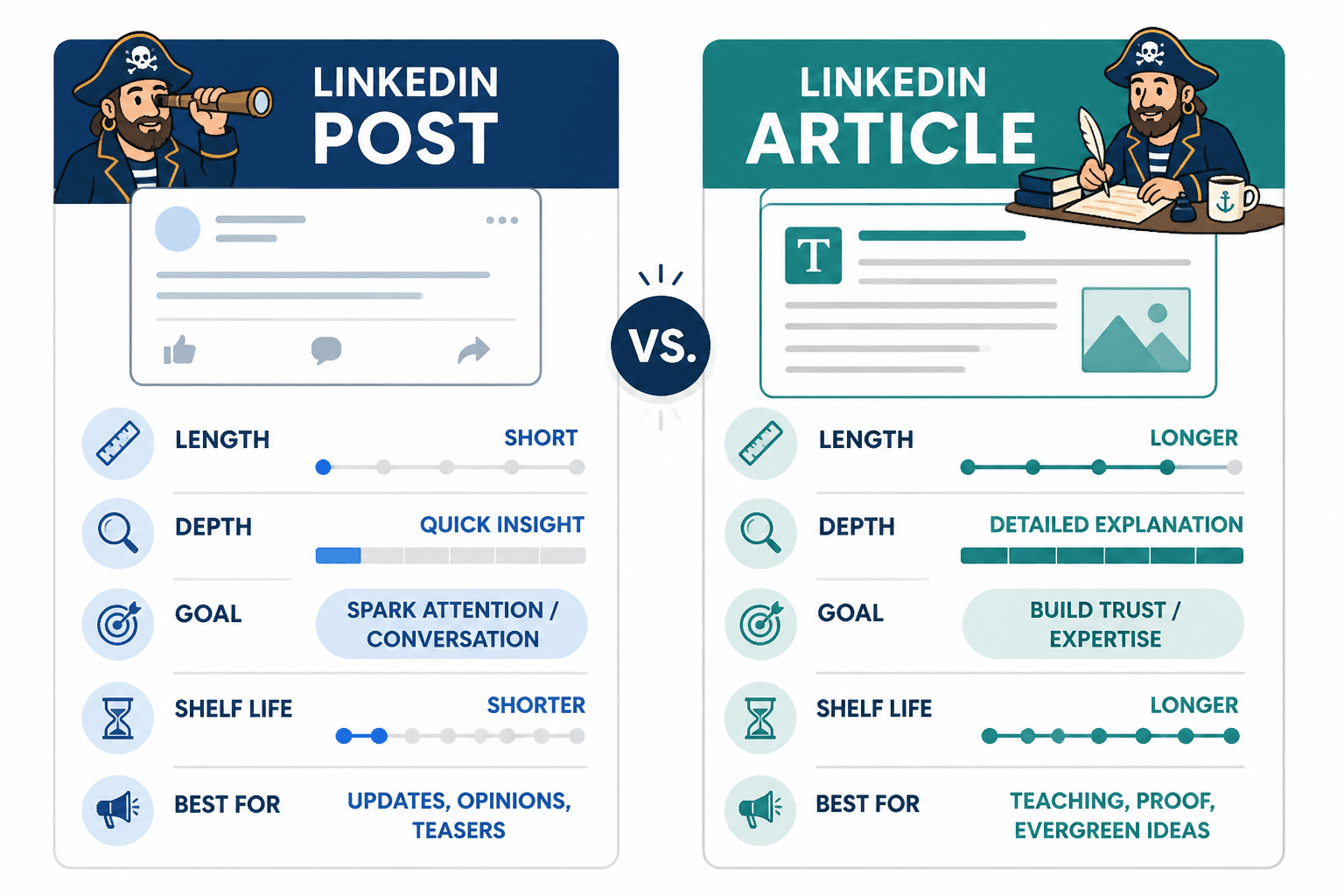
LinkedIn articles are useful when you need more room than a post can reasonably hold, but not a full website article with all the trimmings. They work best when the goal is credibility, explanation, or a more developed point of view.
- Use them to explain a process: what you do, how you think, what you would recommend.
- Use them to clarify a position: why you believe one approach works better than another.
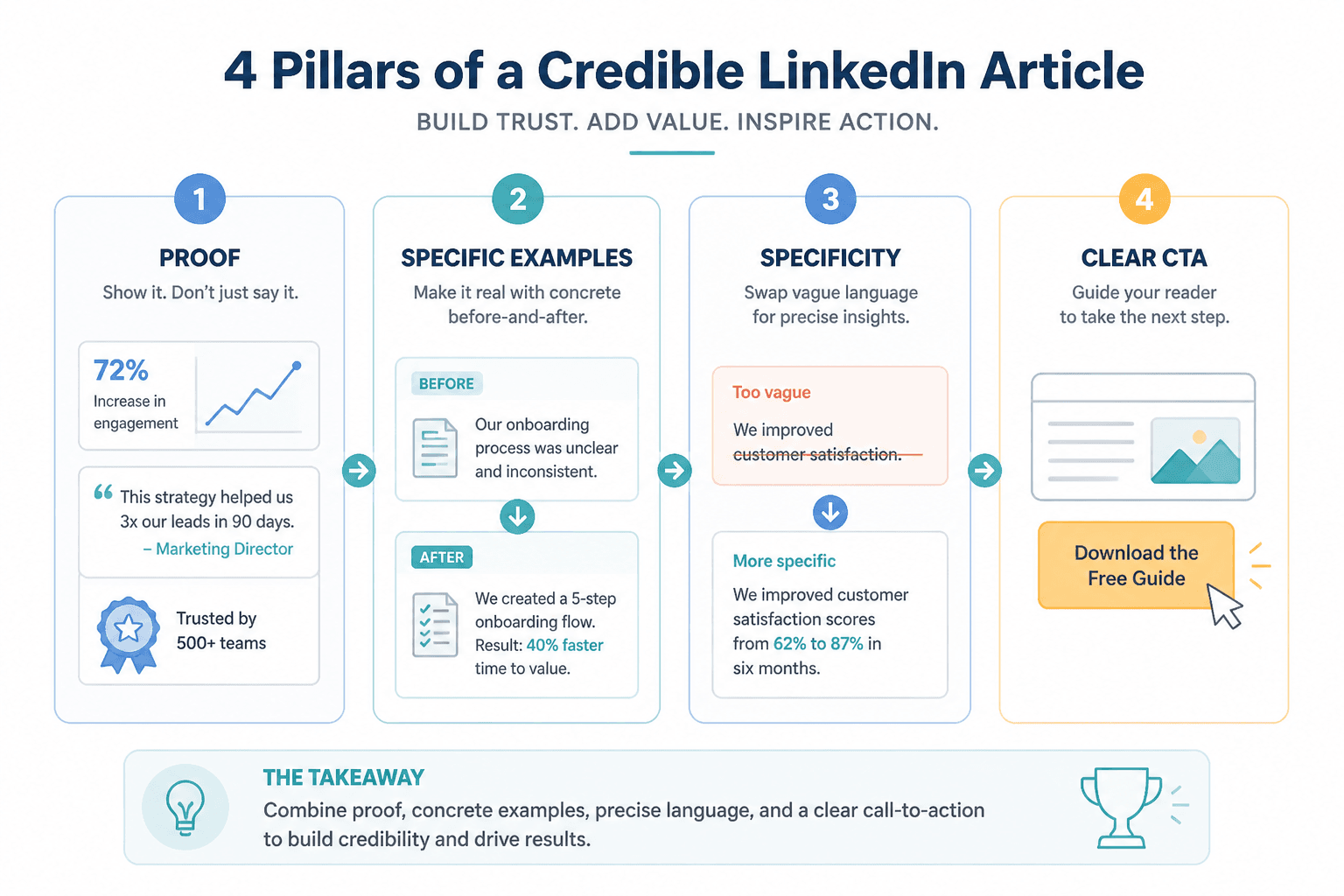
- Use them to build trust: not by sounding impressive, but by being specific enough to be believable.
- Use them to support other content: a post can tease the idea; the article can carry the depth.
They are less useful when the topic is too broad, too vague, or too thin to justify the format. “Thoughts on marketing” is not a topic. It is a shrug in sentence form.
How to choose a topic that can actually work
A strong LinkedIn article topic is narrow enough to say something real and useful. It should answer a question your reader actually has, not a question that merely sounds content-shaped.
A simple test: can you describe the point in one sentence without adding “and also a bunch of other stuff”? If not, the topic is probably too wide.
Weak topic vs strong topic
- Weak: How to market yourself on LinkedIn
- Stronger: How to write a LinkedIn article that makes your expertise easier to trust
- Weak: Content tips for creators
- Stronger: How to turn one old blog post into a LinkedIn article without making it sound recycled
- Weak: LinkedIn strategy
- Stronger: Which LinkedIn article topics are worth writing when your audience is still small
Notice the pattern: the better topics point at a specific problem, context, or tradeoff. They do not try to be everything at once.
Small audiences need sharper topics, not grander ones
If your audience is small, LinkedIn articles can still be worth it. In fact, they can be especially useful because a more detailed article can do the work of making a small audience more valuable.
What small audiences usually need is not more volume. They need:
- a topic that fits a real pain point
- an opening that gets to the point fast
- enough substance to justify the time the reader spent
That is why a focused article often beats a grand, generic one. A smaller audience will usually reward precision faster than polish.
For more topic ideas, see LinkedIn articles ideas and examples for creators.
How to start without a weak opening
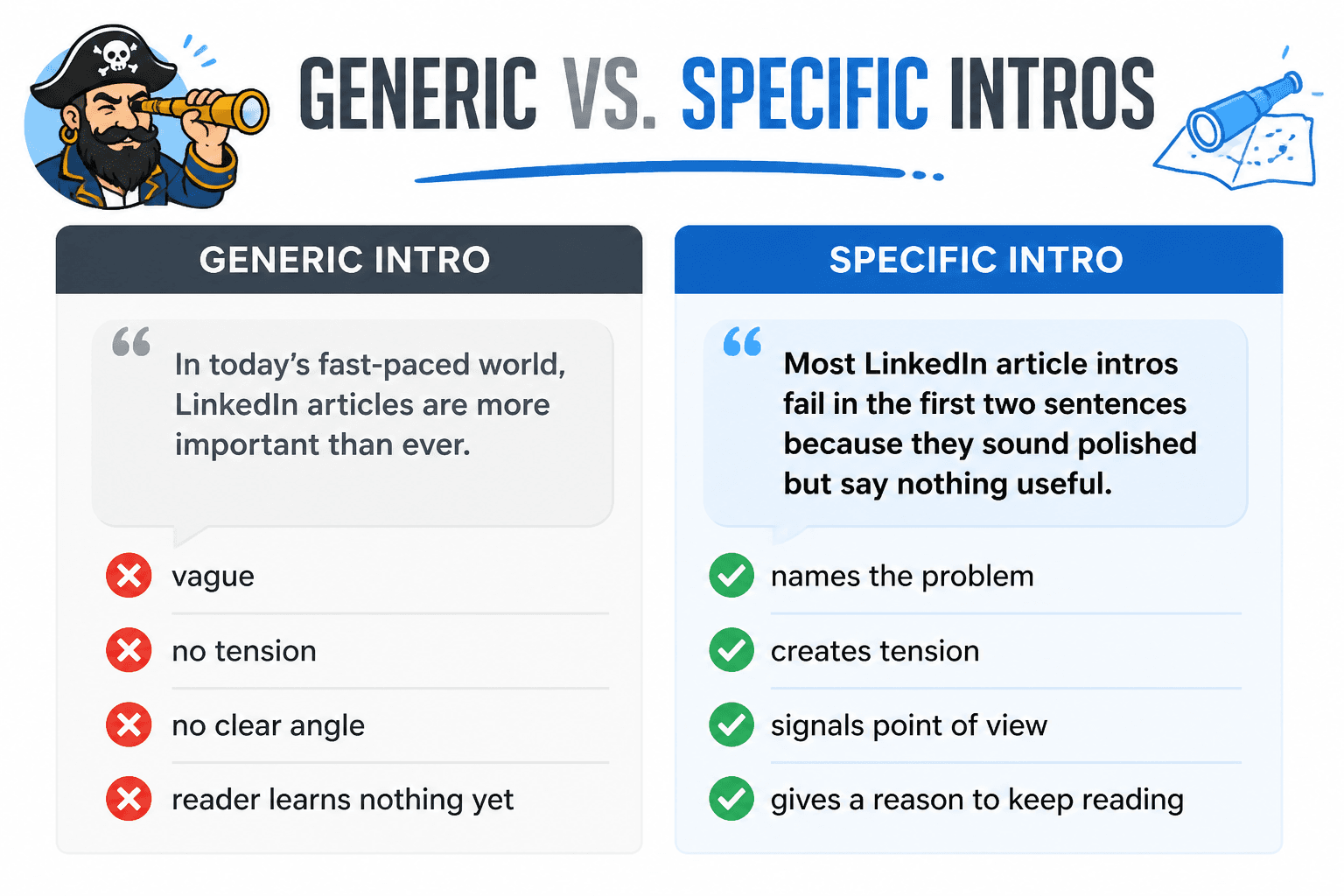
Most weak LinkedIn article openings do not fail because they are too short. They fail because they warm up for too long and keep the actual point in the hallway.
A strong opening should do three things quickly:
- Name the real problem.
- Add a little tension or consequence.
- Promise a useful payoff.
That is the difference between “Let’s talk about LinkedIn articles” and “Here is why your LinkedIn article feels dull before the reader reaches paragraph two.” One of those invites a nap.
A simple opening formula
Problem + consequence + promise
Example pattern:
The mistake is thinking a LinkedIn article only needs more words. In practice, more words often just mean more drift. A better article is built around one clear idea, enough context to make it credible, and a clean path to the next step.
If you want a deeper breakdown of openings, see how to start LinkedIn articles without a weak opening and how to improve LinkedIn article intros without sounding generic.
A simple structure for LinkedIn articles that hold attention
Good structure is boring in the best way. It keeps the article moving so the reader is not left wondering whether the point is ever coming.
1. Opening
The opening should identify the problem, state the angle, and set up the article’s usefulness. Skip the ceremonial throat-clearing.
2. Middle
The middle should do the real work. That means actual explanation, examples, comparisons, or steps the reader can use. Avoid adding paragraphs just to make the piece feel more “complete.” That kind of completeness is how articles become wallpaper.
3. Ending
The ending should not collapse into a vague motivational sigh. It should close the loop and point the reader somewhere sensible next.
How long LinkedIn articles should be
There is no magic word count. The right length depends on what the article needs to do.
- 600 to 1,000 words: good for quick authority pieces and focused explanations
- 1,000 to 1,500 words: good for stronger educational articles
- 1,500 to 2,200 words: good for deeper trust-building pieces with more nuance
Shorter articles can work better when the idea is narrow and the reader wants a direct answer. Longer articles work better when the topic genuinely needs room to breathe.
What usually makes an article too long is not length itself. It is repetition, detours, and padding that pretend to be depth.
For a fuller breakdown, see how long LinkedIn articles should be in 2026 and when short LinkedIn articles beat long ones.
How to write without sounding salesy or robotic
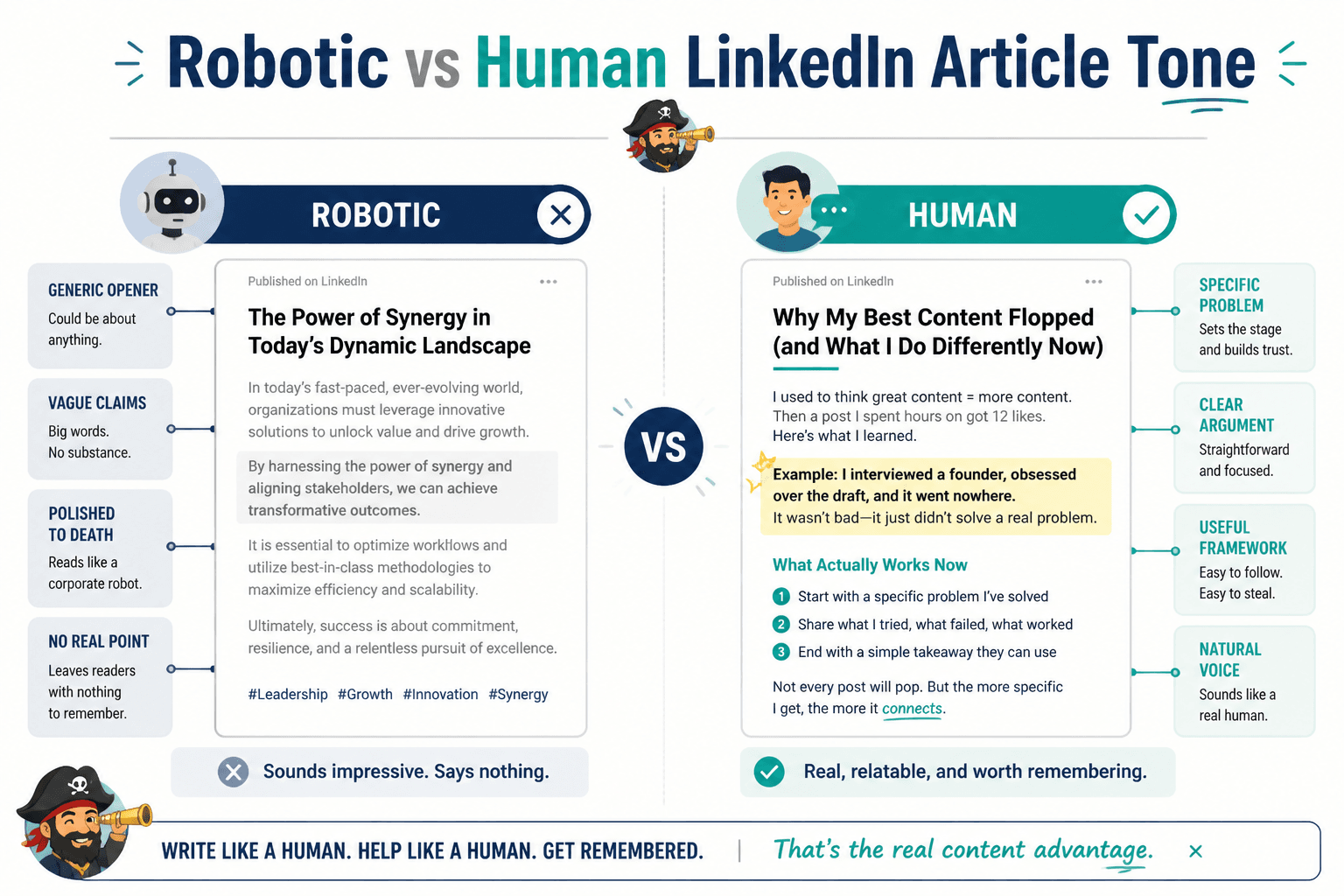
LinkedIn articles usually sound fake for one of three reasons: the language is too corporate, the point is too guarded, or the article is trying too hard to sound “professional.” That often produces a sterile little museum piece.
A better approach is simpler:
- write in plain English
- pick one sharp idea instead of five safe ones
- use specific examples instead of abstract praise
- trim any sentence that sounds like it was approved by a committee of sleepwalkers
You do not need to sound casual in a fake way. You need to sound like someone with an actual opinion who can explain it clearly.
For a deeper cleanup pass, read how to write LinkedIn articles without sounding salesy or robotic and how to rewrite boring LinkedIn articles.
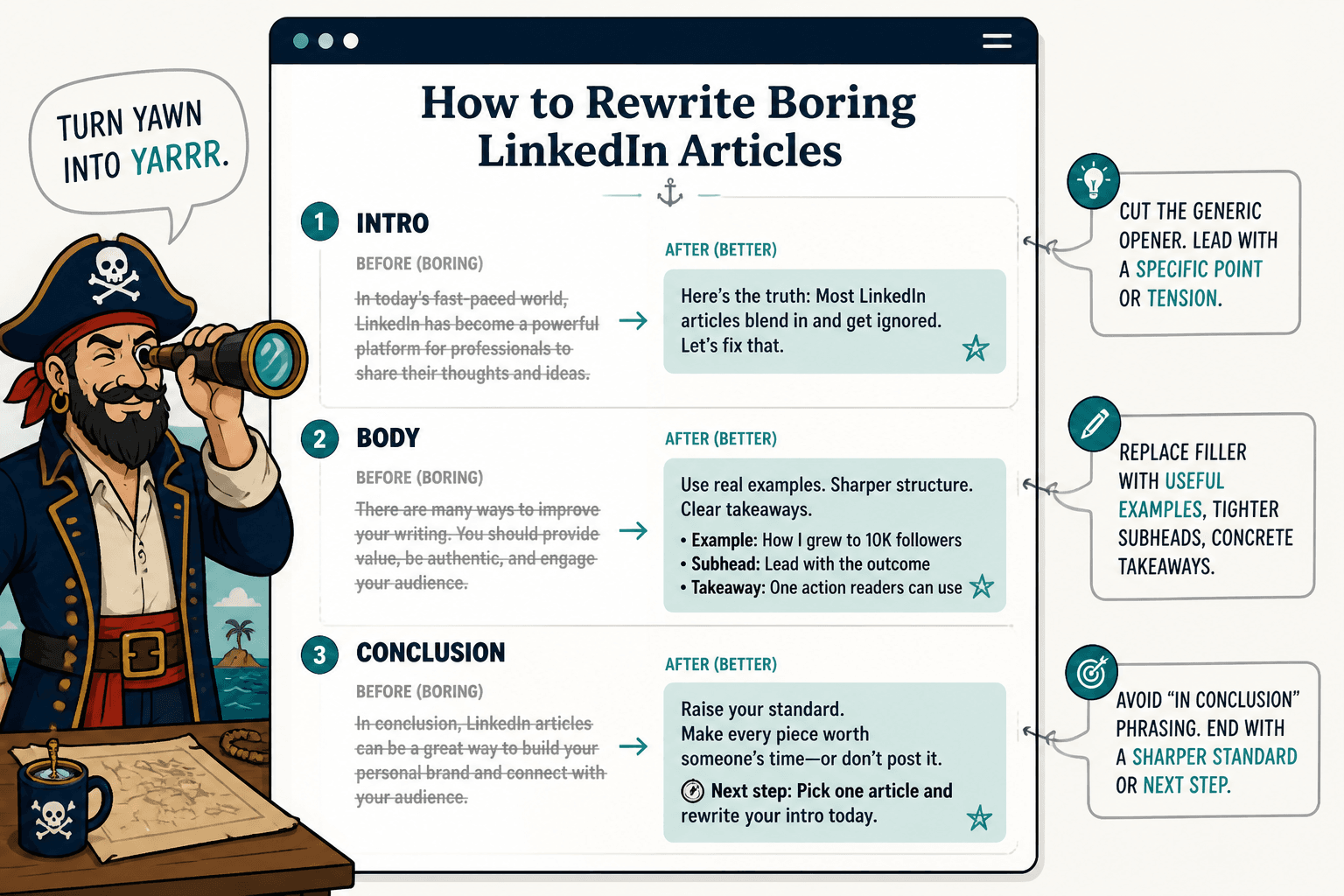
How to rewrite a boring LinkedIn article
Most boring articles do not need a total rewrite. They need a more honest edit.
Start with these cuts:
- remove the generic opener
- cut repeated phrasing
- delete any sentence that restates the headline without adding value
- replace vague claims with examples, contrast, or consequence
Then ask a harder question: what is the article actually trying to say? If the answer takes six sentences, the article probably still does not know.
A useful edit often looks like this:
| Weak | Stronger |
|---|---|
| LinkedIn articles can help you build authority. | LinkedIn articles can build authority when they explain one useful idea clearly enough that the reader feels smarter by the end. |
| It is important to have a good structure. | It is important to have a structure that moves from problem to explanation to next step without wandering off to admire itself. |
How to repurpose old content without making it worse
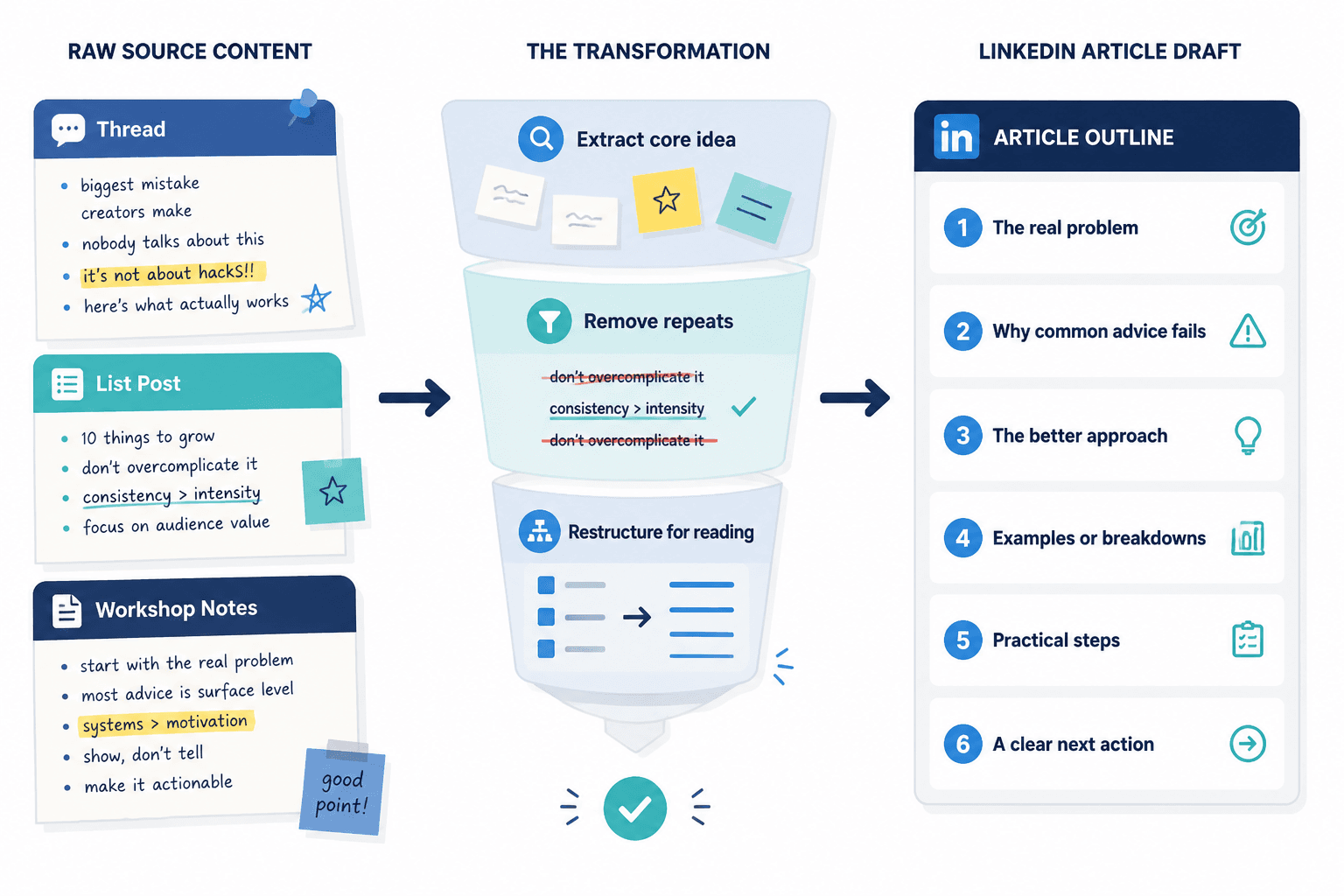
Old content is often the best raw material for a LinkedIn article, but only if you adapt it for the format instead of pasting it in and calling it strategy.
Good source material usually has one of these traits:
- a clear argument
- a real process
- a useful lesson
- enough specifics to expand cleanly
Bad source material is usually broad, stale, or built on references that only made sense in the original format.
The safest method is:
- find the core idea
- decide what the LinkedIn reader needs to know first
- add missing context or examples
- remove anything that only made sense on the old platform
See also how to turn old content into better LinkedIn articles and LinkedIn articles content repurposing mistakes that hurt performance.
How to end with a CTA that fits the article
Many LinkedIn article CTAs underperform because they ask for too much too soon or they sound like they were assembled from generic marketing parts.
A good CTA should match the article’s purpose.
- If the article is educational, invite the reader to apply the idea.
- If the article is about a process, point them to the next step.
- If the article is meant to build authority, link to a related guide, service, or follow-up resource.
Keep the ask proportional to the trust you have earned. A heavy-handed CTA at the end of a thoughtful article can feel like getting handed a bill at a museum.
For more detail, see better LinkedIn article CTAs for personal brands.
A quick editing checklist before you publish
- Does the article make one clear point?
- Does the opening name the real problem fast enough?
- Is the topic narrow enough to be useful?
- Are there examples, not just claims?
- Is any paragraph doing decorative work instead of useful work?
- Does the ending point to a sensible next action?
- Would the article still feel credible if the reader knew the topic already?
Use LinkedIn articles like they have a job
That is the whole trick. Better LinkedIn articles are not bigger by default. They are clearer, more specific, and more intentional about what the reader should get from them.
When the topic is sharp, the opening earns attention, the middle actually delivers, and the ending gives a useful next step, the article stops feeling like content filler and starts doing real work.
If you want to keep building out this cluster, go next to the LinkedIn articles parent guide, then branch into ideas and examples, strong openings, and old-content repurposing.
Primary sources: LinkedIn Help: publishing articles and LinkedIn Help: create and edit a post.