
Wasted trust is expensive. A LinkedIn post can pull views, comments, and the occasional ego boost, then quietly fail at the one job that matters: moving a reader toward a lead, a conversation, or a sale. That usually turns into more busywork, not more revenue. The fix is not to make every post louder. It is to make the path after the post obvious, relevant, and worth taking.
If you want the broader writing foundations first, start with how to write better LinkedIn posts. If you want more content angles before you build the funnel, see LinkedIn post ideas and examples. This guide is about the next step: turning attention into action without making the post feel like a bait-and-switch.
What makes a LinkedIn post convert in the first place
Conversion on LinkedIn is usually less about persuasion tricks and more about sequence. A reader sees a post, decides whether it is relevant, and then decides whether the next step feels safe and useful. If any part of that sequence is fuzzy, the lead dies quietly.
A post converts better when it does three things:
- Creates a reason to care without overpromising.
- Points to one next step instead of three competing ones.
- Feels consistent with what the reader will find after the click.
That consistency matters more than clever wording. If the post promises a useful framework and the destination is a generic sales page, trust takes a small but real hit. LinkedIn is not allergic to selling. It is allergic to mismatched selling.
Start with the right next step
Before you write the CTA, decide what kind of action you actually want. A LinkedIn post cannot responsibly do everything at once. It should move the reader into the next best place in the path.
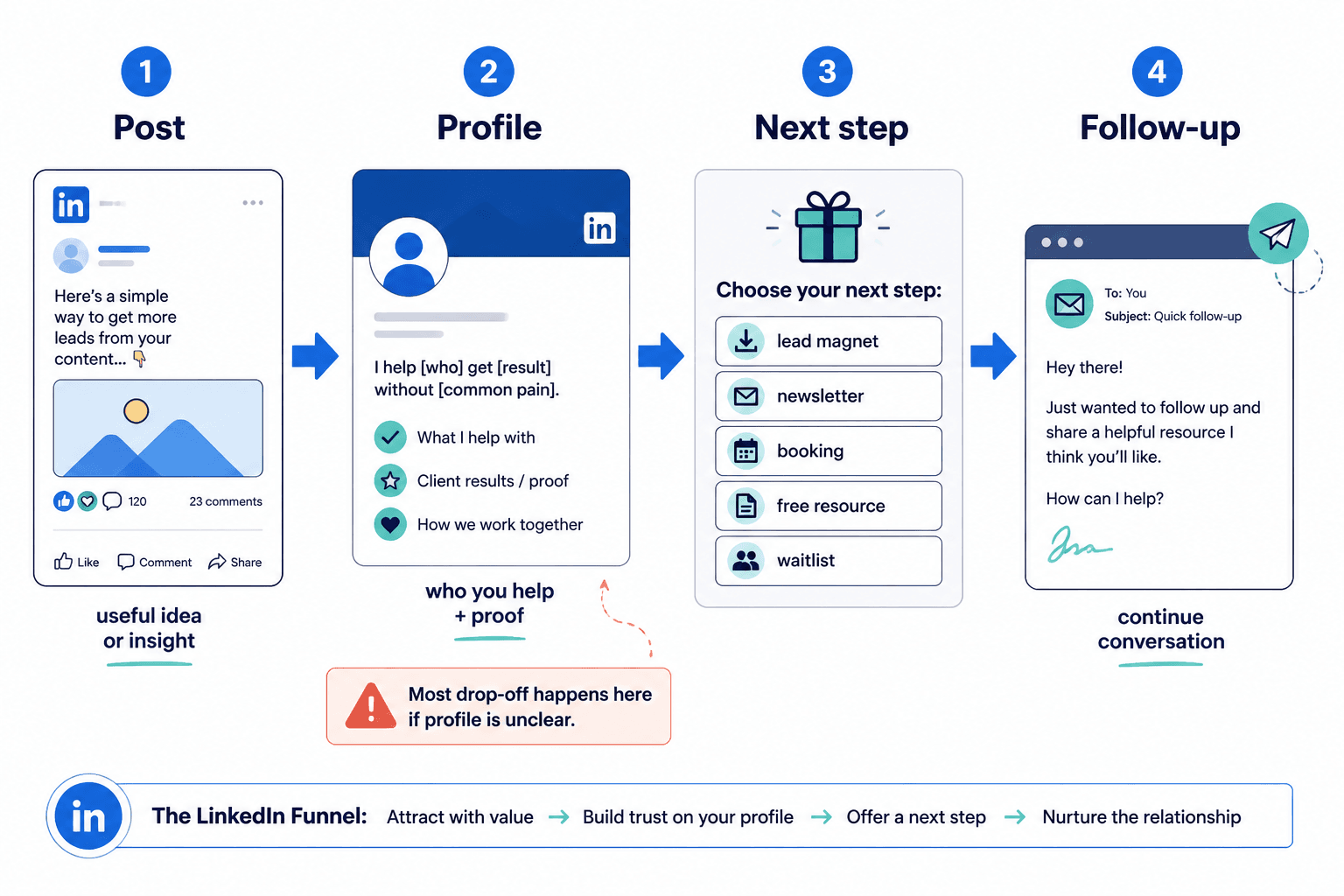
1. Post to profile
This is often the cleanest move. The post earns curiosity, and the profile does the heavier selling. That works well when the profile clearly explains who you help, what you help with, and what to do next.
2. Post to lead magnet
Use this when the post solves a real problem but the reader needs a deeper asset to keep moving. Think checklist, template, guide, or framework. The lead magnet should extend the post, not feel like a random handoff.
3. Post to newsletter
This works when your goal is repeat attention. A newsletter is a slower conversion path, but it can be a very useful one if your audience needs time before buying.
4. Post to article
Longer-form content helps when the post introduces a topic that needs more context before the offer makes sense. This is especially useful for higher-consideration services and education-led offers.
5. Post to comments or soft DM
Use this when the next step benefits from a lower-friction response. A simple “comment ‘guide’ and I’ll send it” can work, but only if the follow-up is actually useful and not a disguised ambush.
6. Post to booking page
This is the hardest ask and usually the weakest choice for cold attention. It can work for warm audiences, high-intent posts, or very clear offers. For everyone else, it is a fast way to make the post feel like it skipped a step.
Match the post type to the funnel step
Not every post should push to the same destination. The better the match between post intent and next step, the less friction you create.
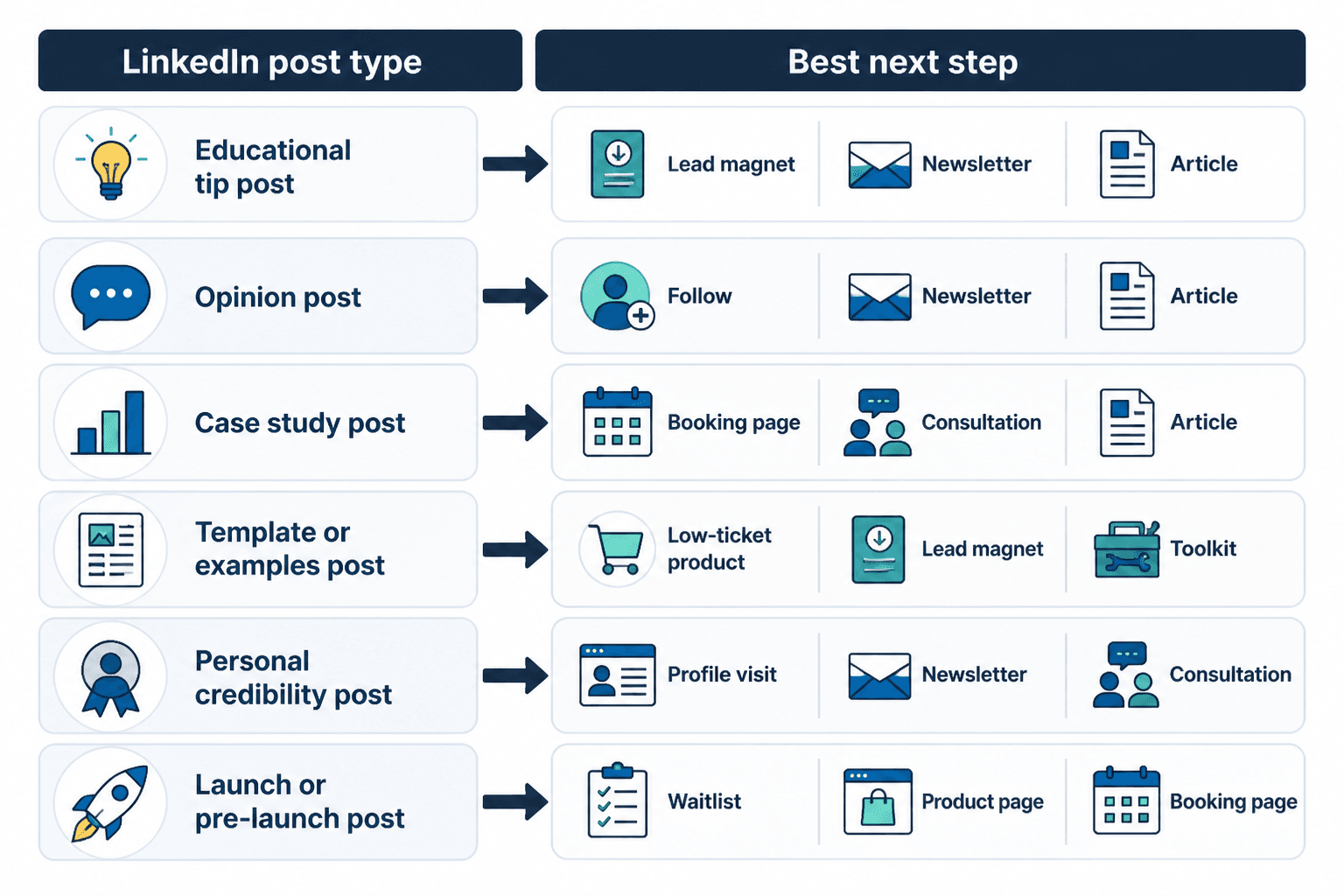
- Educational post: profile, newsletter, or lead magnet
- Problem-aware post: lead magnet or article
- Proof post: profile or booking page
- Opinion post: comments, profile, or newsletter
- Offer post: booking page or direct inquiry path
A simple rule helps: the colder the reader, the softer the ask. The warmer the reader, the more direct you can be. That is not revolutionary. It is just less stupid than asking a stranger to marry your pipeline.
Use CTAs without wrecking trust
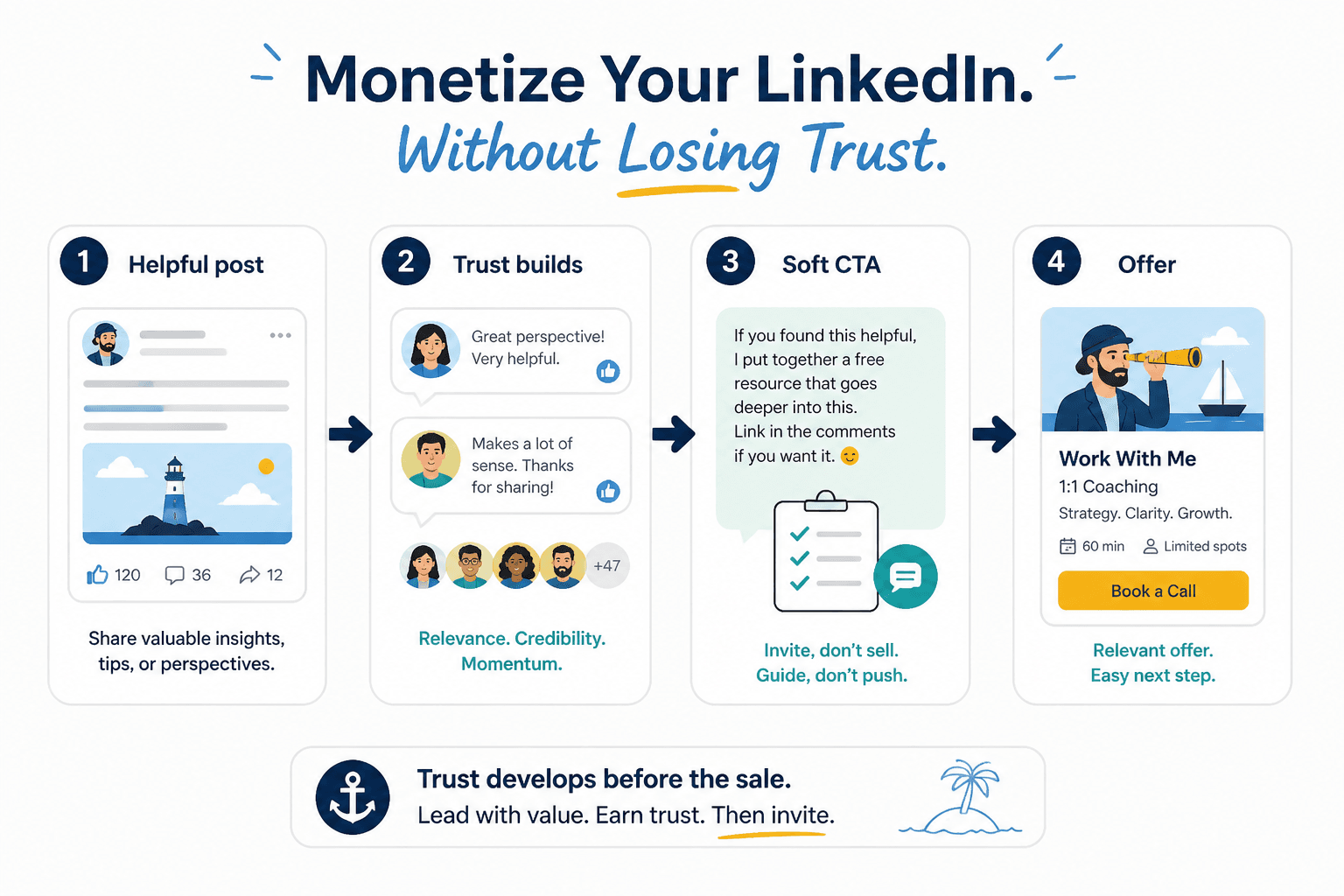
Most CTA problems come from asking too much, too early, or too vaguely. A good CTA should feel like the next logical move, not a sudden sales siren.
Good CTA patterns
- Soft CTA: “If this is useful, the next step is in the profile.”
- Context CTA: “I put the checklist behind this in a simple download.”
- Response CTA: “Comment ‘template’ and I’ll send it over.”
- Direct CTA: “If you want help with this, here is the booking link.”
Soft CTAs usually work best because they keep the post readable. Direct CTAs still have a place, but they need stronger proof and stronger intent. If the post does not earn the ask, the ask just sits there like an empty chair at a table no one wanted to join.
For a deeper trust-first approach to selling through posts, see how to monetize LinkedIn posts without wrecking trust.
Make the profile do some of the selling
Your profile is part of the conversion path whether you planned for it or not. If someone clicks through from a post and lands on a profile that is vague, cluttered, or oddly proud of being mysterious, the thread breaks.
At minimum, the profile should answer:
- Who you help
- What problem you solve
- What kind of result people can expect
- What to do next
That does not mean turning the profile into a billboard. It means making it legible. A clear profile often converts better than a more aggressive post because it gives the reader a coherent next step after the click.
If the post is doing its job, the profile should feel like the natural continuation of the same conversation, not a detour into brand poetry.
Use proof without turning every post into a victory lap
Proof helps, but only when it supports the reader’s decision rather than distracting from it. A post that brags too hard often reads like it is trying to win an argument with the internet.
Useful proof usually looks like one of these:
- A before/after pattern
- A short result framed as evidence, not a trophy
- A simple process that shows how the result happens
- A constraint or lesson that makes the result believable
The point is not to sound impressive. The point is to reduce uncertainty. A reader is deciding whether you can help them, so the proof should answer that question quickly.
Build simple funnels that fit the post
Most LinkedIn funnel advice has one of two problems: it is either too broad to use, or it treats every post like it should end in a sales page. A better funnel is smaller and more specific.
Useful funnel patterns
- Post → profile → inquiry
- Post → lead magnet → email follow-up
- Post → newsletter → offer
- Post → comments → DM follow-up
- Post → article → booking page
If you want more examples of how those paths work together, the companion guide best funnel ideas to pair with LinkedIn posts breaks the options down more explicitly.
And if the goal is keeping the sales message human while still being useful, the related guide on monetizing LinkedIn posts without wrecking trust is the better companion piece.
Measure the right signals
Views are fine. Comments are nice. But neither one pays the bills by itself.
To see whether LinkedIn posts are actually helping revenue, watch for signals like:
- Profile visits from specific posts
- Clicks to a lead magnet or booking page
- Replies or DMs that reference the post
- Email signups tied to the content
- Sales conversations that began from a post interaction
That tells you more than a generic engagement score ever will. A post with modest reach and strong conversion beats a post with noisy attention and no follow-through. Loud is not the same as effective. Annoyingly, platforms keep trying to blur that distinction.
Common mistakes that stall leads or sales
- Too many asks: one post should not ask for a comment, a follow, a signup, a DM, and a booking call.
- Mismatch between promise and destination: the post and the next step need to say the same thing in different forms.
- Overusing hard CTAs: direct selling works better when it is not the only move in the deck.
- Weak profile setup: if the post works but the profile confuses people, the funnel leaks right there.
- No proof or thin proof: claims without support create friction fast.
- Vague audience targeting: posts that speak to everyone usually convert nobody.
A simple framework you can reuse
When in doubt, use this sequence:
- Lead with a real problem or outcome.
- Teach something useful in the post itself.
- Choose one next step that fits the reader’s intent.
- Make the profile or destination page easy to trust.
- Use proof and CTAs that match the temperature of the post.
That is enough to turn a LinkedIn post from content into a conversion asset. Not every post needs to sell. But every post should know where it is going.
For more on the broader structure around LinkedIn content, return to the parent guide on LinkedIn posts.