
Most LinkedIn funnel advice has one of two problems.
Either it is absurdly aggressive, where every post is basically a badly disguised sales pitch with a pulse. Or it is so soft and vague that the “funnel” is really just posting nice thoughts and hoping money appears out of respect.
Neither works especially well.
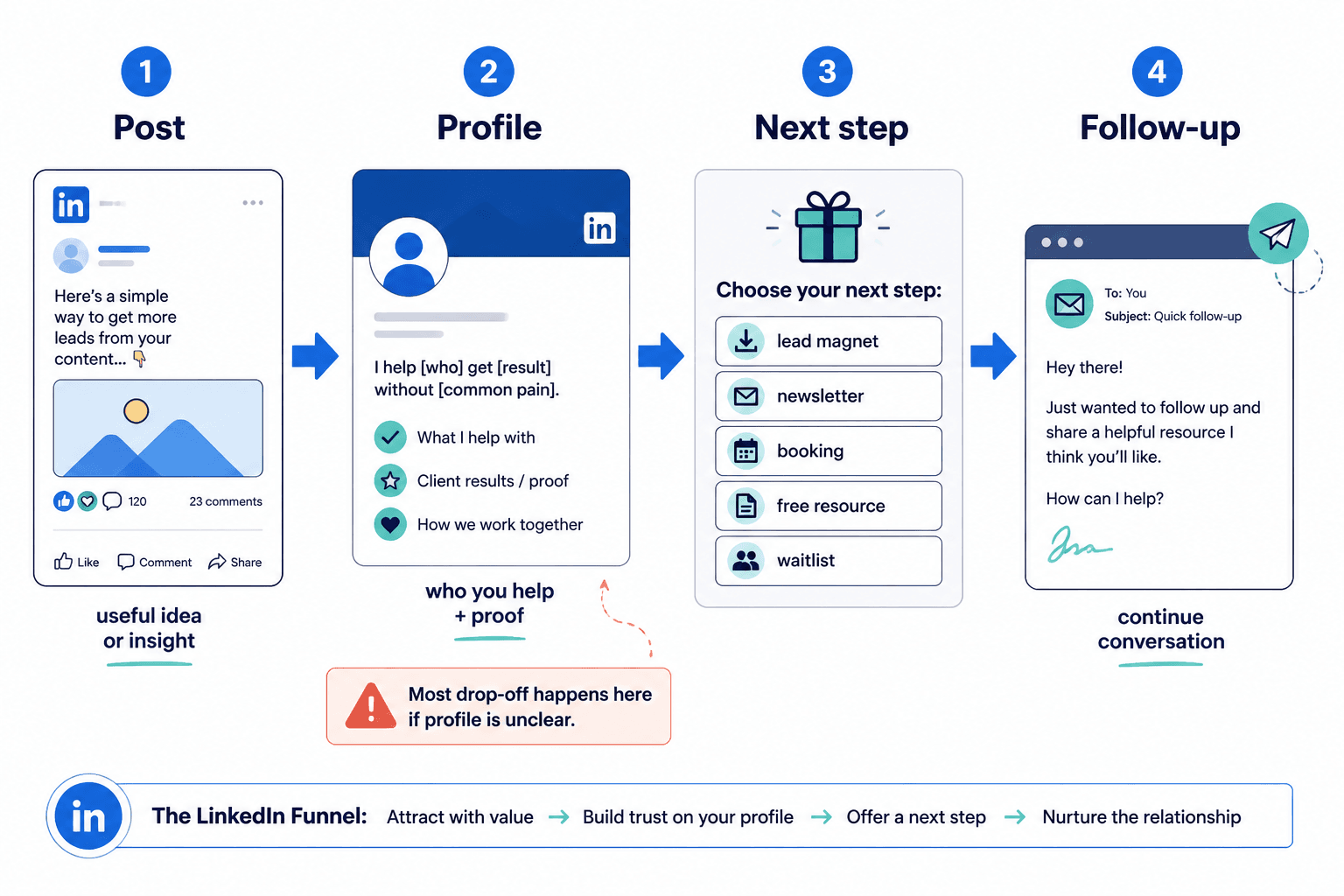
The best funnel ideas to pair with LinkedIn posts are usually simple. A good post earns attention. A good profile builds trust. A good next step gives the right people somewhere useful to go. That is the whole machine. Not sexy. Very effective.
If you are a creator, coach, consultant, freelancer, or solo founder, your LinkedIn content does not need a bloated funnel with seventeen emails, three scarcity timers, and a Calendly link shoved into every paragraph. It needs a clear path from post to action.
Here’s how to build funnel paths that fit LinkedIn properly, feel human, and actually help turn attention into leads, conversations, subscribers, and sales without making your posts read like webinar leftovers.
For the main guide behind this topic, visit the parent guide.
What makes a LinkedIn funnel work in the first place
Before getting into specific funnel ideas, it helps to get one thing straight: LinkedIn is not just a traffic source. It is also a trust environment.
People do not usually read one post, click one link, and instantly buy your service like they are panic-ordering batteries. They notice you. They read another post. They check your profile. They look for signs that you know what you are talking about. Then maybe they subscribe, download, follow, reply, or message you.
That means the best funnel ideas to pair with LinkedIn posts do three things well:
- Match the post type so the next step feels natural
- Keep friction low so the reader does not have to decode what to do next
- Respect trust so you are not asking for too much too early
If your post is educational, the next step should probably be another useful asset, not a hard sales page. If your post is a case study, a consultation offer may make more sense. If your post is opinion-driven, a newsletter or follow CTA often works better than forcing a lead magnet onto it.
Good funnels feel like continuation. Bad funnels feel like bait-and-switch.
The simplest LinkedIn funnel structure that covers most people
If you want one practical default, use this:
- Post earns attention with a clear idea
- Profile confirms who you help and why you are credible
- Next step gives readers one useful action
- Follow-up continues the conversation or nurture
That next step might be a lead magnet, newsletter, booking page, free resource, waitlist, article, or even just “follow for more.” It depends on the post and the level of intent.
Too many people skip the profile step entirely. Then they wonder why posts get attention but not leads. The post got interest. The profile failed the inspection.
If your LinkedIn profile still sounds like “Helping visionary leaders unlock transformation,” fix that before you worry about funnel optimization. Nobody knows what that means, including the visionary leaders.
Best funnel ideas to pair with LinkedIn posts
These are the funnel models that tend to work well on LinkedIn because they fit how people actually behave there.
1. Post to profile to lead magnet
This is one of the most reliable options if your audience is problem-aware but not ready to buy yet.
You publish a useful post about a specific pain point. The interested reader checks your profile. Your headline, about section, featured section, or banner points them to a genuinely useful free resource.
This works best when the lead magnet is tightly matched to the post.
- Post about weak LinkedIn hooks
- Lead magnet: hook swipe file or post opener template pack
- Post about messy content workflows
- Lead magnet: weekly content planning template
- Post about profile positioning
- Lead magnet: creator bio checklist
Why it works: low commitment, clear value, easy for the reader to understand.
What people get wrong: they offer a generic “free guide” that has nothing to do with the post. Relevance matters more than size. A 3-page resource that solves the exact next problem often beats a 47-page PDF nobody wanted in the first place.
2. Post to profile to newsletter
If your business depends on trust, repeated exposure, and stronger authority, this is a very good funnel.
LinkedIn posts are great at attracting lightweight attention. Email is better for depth, consistency, and conversion over time. So the post does not need to close the sale. It just needs to earn the subscription.
This is especially useful for:
- consultants
- coaches
- service providers with longer sales cycles
- writers and creators selling ideas
- B2B founders building authority
The key is to make the newsletter sound worth joining. Not “Sign up for weekly insights.” That means almost nothing now. Everyone has insights. Most of them should have stayed indoors.
Stronger positioning sounds more like this:
Weekly emails on writing sharper LinkedIn content that earns trust, leads, and replies without sounding polished into death.
If you want more ideas for post formats that naturally support this, readers would likely benefit from Best LinkedIn Posts Ideas and Examples for Creators.
3. Post to article to offer
This is a strong authority funnel when your topic needs more depth than a single LinkedIn post can carry.
The post introduces the problem, insight, or opinion. Then it points the reader toward a deeper article. That article does the heavy lifting: examples, nuance, proof, process, objections, and a more relevant CTA.
This works well for topics like:
- positioning
- offer design
- messaging strategy
- content systems
- brand strategy
- lead generation frameworks
The article can then lead to:
- a free resource
- an email signup
- a consultation
- a workshop
- a low-ticket product
This model is underrated because it respects buyer readiness. The post gets attention. The article filters for actual interest. The offer meets the people who stayed.
4. Post to comments to soft DM
This is the version many people try to use badly.
Done well, it can work. Done badly, it becomes one of the most annoying species of LinkedIn behavior.
Here is the good version. You post something specific and useful. Readers comment because they want the resource, want clarification, or want to engage with the idea. You reply like a normal person. If there is genuine fit, you continue the conversation privately.
Here is the bad version. You post “Comment GUIDE and I’ll send it to you,” then dump everyone into canned DMs that read like they were generated by a lead-gen intern with a stress rash.
Use this path when:
- you have a helpful free resource to share
- the post sparks strong relevance
- the follow-up can stay personal and useful
- you are willing to actually talk to people, not spray automation everywhere
If you use comment triggers, keep the next step clean. Send the thing. Add context. Do not turn a small yes into a surprise sales ambush.
5. Post to booking page
This can work very well, but only for high-intent posts.
If someone reads a post where you break down a client problem, explain your method, show proof, and make the value obvious, then a booking CTA can make sense. If someone reads a generic mindset post and you ask them to book a call, that is a pretty dramatic escalation.
The strongest posts for this funnel usually include at least one of these:
- a case study
- a mistake your clients keep making
- a process you use
- a clear before-and-after
- evidence that you solve a costly problem
A good CTA here is direct but not theatrical:
If you want help fixing this in your own funnel, the link in my profile is where to book.
That is enough. You do not need “spots are filling fast” unless that is actually true and relevant. Fake urgency is one of the fastest ways to make a decent offer smell cheap.
6. Post to free resource to nurture sequence
This is one of the best funnel ideas to pair with LinkedIn posts if you want your content to work longer than a day or two.
The post attracts the right people. The free resource captures interest. Then your email sequence continues the conversation with more education, proof, authority, and invitation.
This works best when the nurture sequence is built around the same problem the post addressed. Not when the post is about content hooks and the email sequence suddenly veers into “mindset mastery for abundant CEOs.” That sort of mismatch gives off garage-sale funnel energy.
A simple nurture flow could look like this:
- Email 1: deliver the resource and explain how to use it
- Email 2: teach one related mistake
- Email 3: show a case study or example
- Email 4: explain your method or offer
- Email 5: invite the right people to reply or book
You do not need twelve emails to prove you own an autoresponder. You need a sequence that makes sense.
7. Post to low-ticket product
If you sell templates, mini-offers, audits, workshops, swipe files, short trainings, or digital products, this can be a strong fit.
But the post has to create demand for that exact thing. Not “Here are three thoughts on branding” followed by “Buy my $29 offer vault.” The bridge matters.
Good post angles for low-ticket offers include:
- before-and-after rewrites
- mistakes a template helps fix
- examples from a framework inside the product
- common process bottlenecks the product speeds up
- small quick wins that prove the product is useful
This funnel tends to work best when your audience already understands the problem and wants speed, structure, or examples.
8. Post to waitlist
If your offer is not live yet, or you are validating demand before launching, a waitlist can be much smarter than pretending the funnel is ready when it is still emotionally in beta.
Use this when you are:
- testing a new service
- building a cohort or workshop
- pre-selling a product
- measuring interest in a niche offer
The post should make the problem, audience, and intended outcome clear. The waitlist should also tell people what they are signing up for. Vague waitlists feel lazy. Specific ones feel intentional.
Example:
I’m opening a small-group workshop for consultants who want to turn scattered LinkedIn posting into a lead-friendly weekly system. If that sounds useful, join the waitlist through my profile.
How to choose the right funnel for the post
Not every LinkedIn post should point to the same next step. That is where people flatten their strategy into mush.
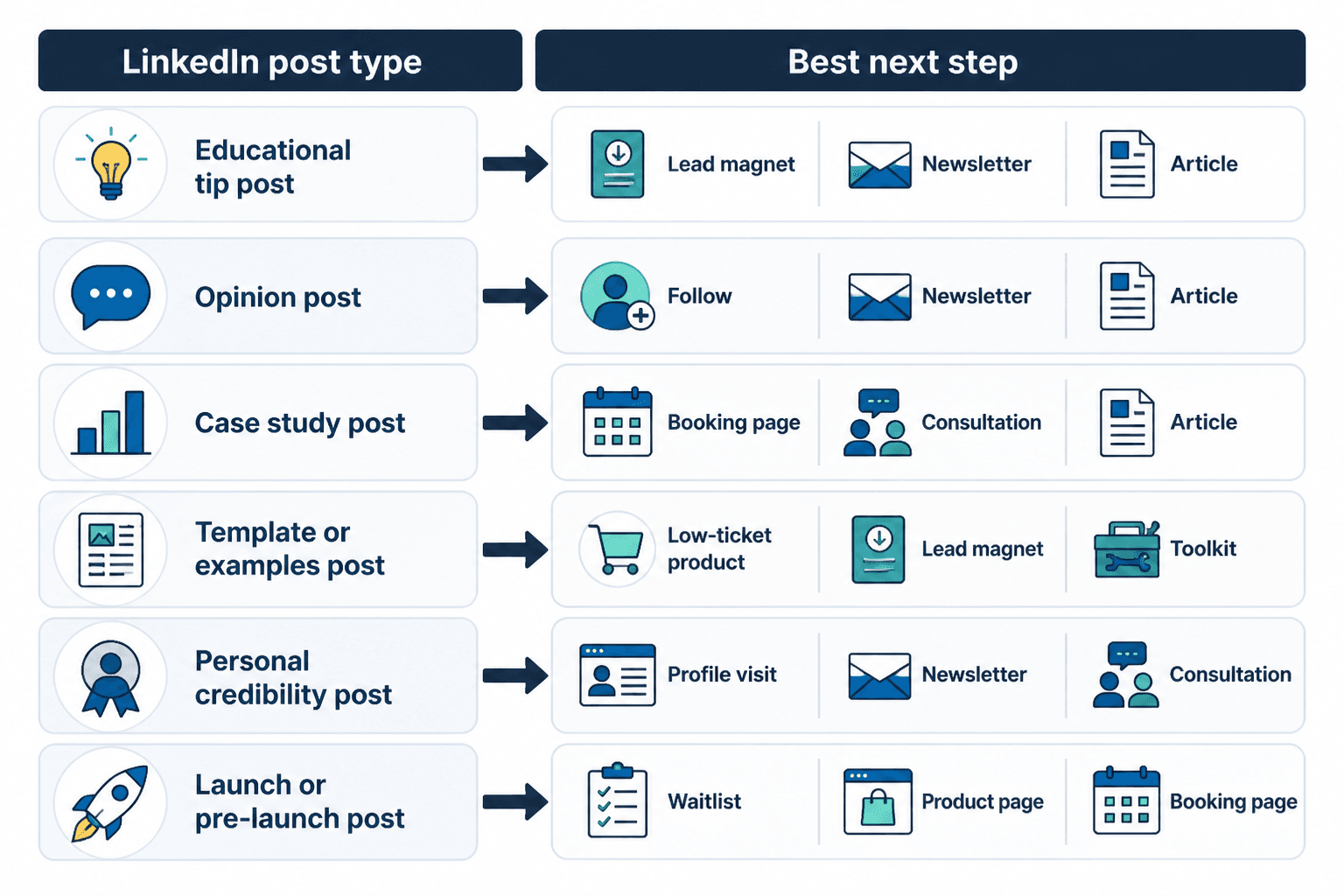
Choose the funnel based on post intent.
| Post type | Best next step |
|---|---|
| Educational tip post | Lead magnet, newsletter, article |
| Opinion post | Follow, newsletter, article |
| Case study post | Booking page, consultation, article |
| Template or examples post | Low-ticket product, lead magnet, toolkit |
| Personal credibility post | Profile visit, newsletter, consultation |
| Launch or pre-launch post | Waitlist, product page, booking page |
Think of it this way: the CTA should feel like the next obvious step for someone who liked that specific post.
That means you do not need one universal CTA on every post. In fact, you probably should not have one.
What to fix before you blame the funnel
A lot of “my funnel is not converting” problems are actually one of these:
- The post is too generic
- The audience is too broad
- The profile is unclear
- The CTA is weak
- The offer is mismatched to reader intent
- The next step asks for too much too soon
- The lead magnet is boring or irrelevant
If your posts attract the wrong people, no funnel will save that. If your profile does not explain who you help, the clicks die there. If your lead magnet feels like recycled filler, signups might happen but trust does not improve.
This is why content and funnel strategy should not be separated too hard. Your post is part of the funnel. Your profile is part of the funnel. Your comments are part of the funnel. The handoff matters at every step.
How to write LinkedIn CTAs that do not sound needy or stiff
Many decent funnel ideas get ruined by terrible CTAs.
The CTA should sound like a calm next step, not a hostage negotiation. LinkedIn readers are very good at sensing when a post exists purely to drag them into a funnel chute.
Here are stronger CTA styles by goal.
For lead magnets
- If you want the checklist, it’s linked in my profile.
- I put the full template in my featured section if you want it.
- I made a free resource for this because most people overcomplicate it. Grab it from my profile.
For newsletters
- I write about this each week by email if you want the deeper version.
- If you like practical content strategy without the fluff, the newsletter link is in my profile.
- I send weekly breakdowns like this to subscribers. You can join through my profile.
For consultations
- If you want help applying this to your own content funnel, you can book through my profile.
- I help clients fix this exact problem. Booking link is in the profile if the fit is there.
- If your LinkedIn content is getting attention but not leads, that is something I work on with clients. Details are in my profile.
The best CTAs are specific, low-drama, and aligned with the post. Calm confidence beats funnel perfume.
Funnel examples by creator type
For coaches
Post: client mindset or decision-making mistake
Funnel: Post → profile → newsletter or free guide → consultation
Coaches usually need trust and fit more than instant action. A softer but relevant funnel often performs better than pushing straight to a booking page from every post.
For consultants
Post: breakdown of a business problem, case study, or strategic mistake
Funnel: Post → profile → article or case study page → consultation
Consultants often benefit from authority-rich funnels. The more expensive or strategic the work, the more your funnel needs proof and clarity instead of pressure.
For freelancers and service providers
Post: before-and-after examples, process tips, project mistakes
Funnel: Post → profile → portfolio, lead magnet, or booking page
If your service solves a clear visible problem, direct booking funnels can work well. Just make sure the post gives enough proof that you know what good looks like.
For creators selling digital products
Post: practical examples, mini tutorial, swipe file snippet
Funnel: Post → product page or free resource → low-ticket offer or bundle
Show the usefulness before asking for the purchase. A small example can do more selling than a dozen “I’m excited to share” announcements.
For people with small audiences
Post: highly specific niche problem
Funnel: Post → comments or profile → relevant free resource or conversation
The bigger point is simple: clearer structure and clearer writing make the piece more useful. That is usually what makes the ending land better too.