
Most funnel advice falls apart for one boring reason: the funnel does not match the offer messaging.
You will see someone with a punchy lead magnet funnel, copy it, and then wonder why your conversions feel sleepy. Or worse, why you are attracting people who like free stuff, nod at your content, and then vanish the second money enters the room. That usually is not a traffic problem. It is a mismatch problem.
The best funnel ideas to pair with offer messaging & positioning are the ones that carry the same logic all the way through. The promise in the post should match the promise on the page. The lead magnet should attract the kind of person your offer is actually for. The next step should feel like the obvious move, not a sharp turn into webinar land.
That is what this article covers: how to choose funnel types that fit your positioning, your audience awareness, and the kind of trust your offer needs before people buy. Some funnels are built for fast clarity. Some are built for longer trust. Some are good for coaches. Some fit consultants better. Some are excellent at generating leads and quietly terrible at attracting buyers.
If your funnel currently feels like a stack of random marketing parts taped together with a CTA, this should help.
For the full path around this topic, head to the parent guide.
Start here: your funnel should match how your offer gets sold
Before picking a funnel, get clear on one thing: what makes your offer easy to say yes to?
Not what makes it sound impressive. What actually reduces resistance?
For some offers, the sale happens when people finally understand the problem properly. For others, the sale happens when they trust your process. For others, they need proof. For some, they just need a simple low-friction next step because the offer is already easy to grasp.
That means your funnel should support the main job your messaging needs to do.
- If your positioning is built on clarity, use a funnel that teaches people how to name the problem and spot the gap.
- If your positioning is built on expertise, use a funnel that shows depth, judgment, and proof.
- If your positioning is built on speed or simplicity, use a short funnel with a direct path to action.
- If your positioning is built on customization, use a funnel that starts a conversation, diagnosis, or qualification step.
- If your positioning is built on transformation over time, use a trust-building funnel that nurtures people before the ask.
This sounds obvious until you look at what people actually do. They position themselves as strategic experts, then offer a flimsy checklist. They sell something nuanced and high-trust, then push cold traffic to a booking page. They talk about bespoke work and then run a one-size-fits-all funnel. Strange choice.
If you need a stronger foundation first, it helps to tighten your core messaging before building the path around it. The parent guide on offer messaging and positioning is the right place to start, and so is this practical companion on offer messaging and positioning for creators who want better results.
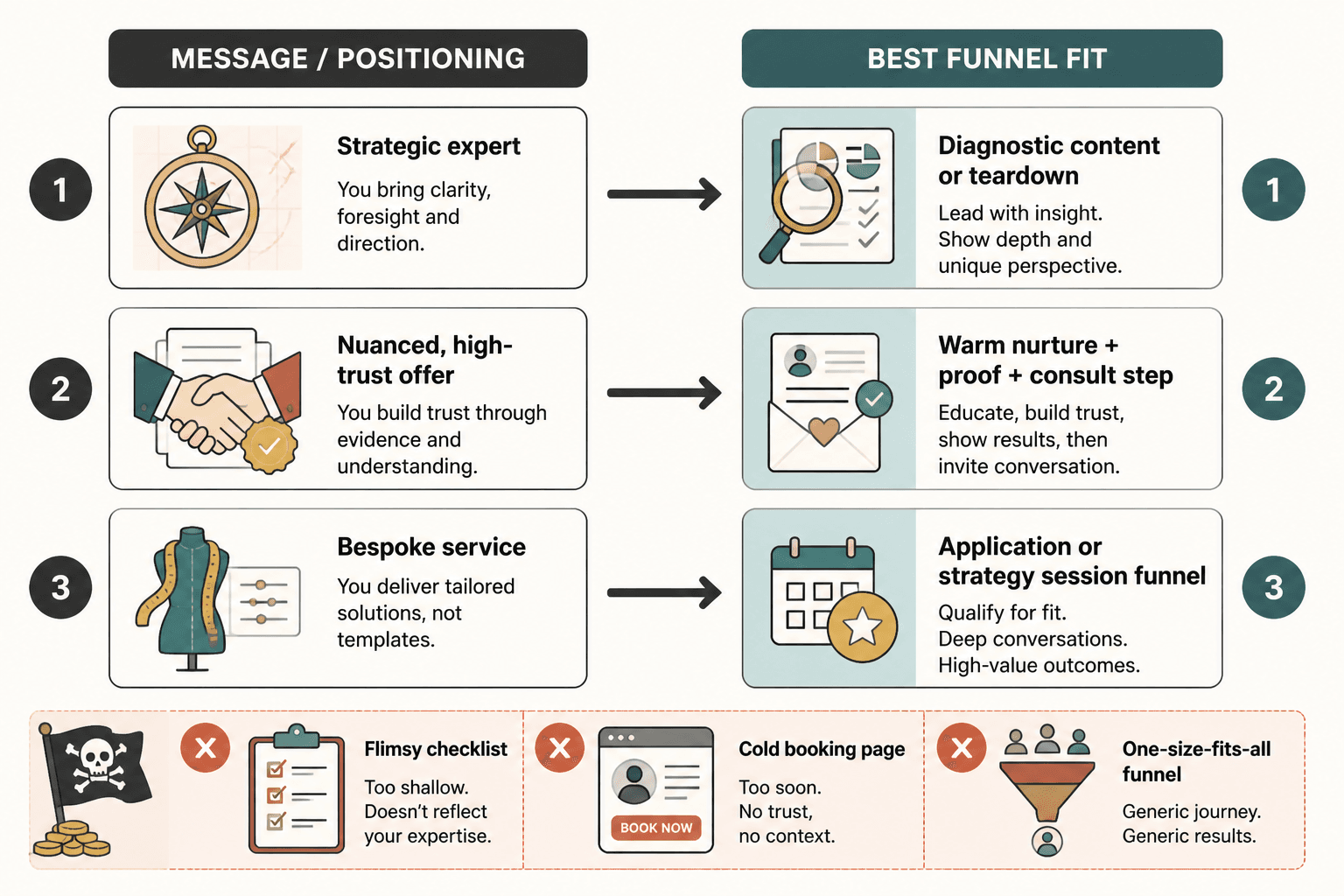
What a good funnel-message match looks like
A good match has continuity. Every step makes the next one feel sensible.
For example, if your messaging says, “I help experienced creators clarify messy offers so buyers instantly get the value,” your funnel should probably not begin with a fluffy inspiration PDF called 25 Mindset Shifts for Success. That does not reinforce your positioning. It weakens it.
A better fit would be:
- Content about common offer confusion
- A short diagnostic or messaging teardown
- An email sequence showing what strong positioning changes
- A direct offer to book a strategy session or buy a messaging package
Same audience. Same expertise. Same promise. Better path.
That continuity matters because people are not just evaluating your offer. They are also evaluating whether you seem coherent. A sharp funnel says, “This person understands the problem, has a method, and knows what step should come next.” A sloppy one says, “I found a template online and got ambitious.”
Best funnel ideas to pair with offer messaging & positioning
Here are the funnel types that tend to work best, what kind of positioning they support, and where people usually mess them up.
1. Post to profile to lead magnet to nurture to offer
This is the classic creator funnel, and it still works when the lead magnet is actually relevant.
Best for:
- Coaches
- Consultants
- Service providers
- Creators with educational content
- Offers that need some warming up before the sale
Strong fit when your messaging depends on:
- Explaining a problem clearly
- Showing your process
- Demonstrating thoughtfulness or expertise
- Building trust over several touchpoints
What makes it work is the transition between content and lead magnet. The lead magnet should not just be “valuable.” It should be a logical extension of the thing you are known for.
If your positioning is around simplifying sales pages, the lead magnet could be a sales page self-audit checklist. If your positioning is around helping experts tighten authority content, the lead magnet could be a content angle bank or authority article template. The point is not volume. It is relevance.
Common mistake: using broad freebies to attract broad attention, then wondering why qualified sales stay weak. Freebies do not just generate leads. They filter leads. Choose accordingly.
2. Post to article to related offer
This is one of the best funnels for people whose positioning relies on depth, nuance, and stronger authority.
Best for:
- Consultants
- B2B service providers
- Writers and strategists
- Experts selling higher-consideration offers
- Offers that benefit from search traffic and evergreen trust
The flow is simple:
- Publish a strong post, thread, or short-form idea
- Link or point readers to a deeper article
- Use the article to educate, qualify, and frame the problem
- Transition naturally to the related service, audit, package, or consultation
This works especially well when your offer messaging is built around sharper diagnosis than your competitors. Articles give you room to explain what others oversimplify. They help you sound like a person with judgment, not just content output.
For example, if your positioning is “I help creators fix weak website messaging so the right buyers stop bouncing,” an article about common messaging mistakes can lead cleanly into your offer. The article does the trust work. The offer becomes the practical next step.
You can also support this path with related internal resources like offer messaging and positioning ideas and examples for creators or how to turn offer messaging and positioning into more leads or sales.
3. Diagnostic funnel
If your offer depends on identifying hidden problems, a diagnostic funnel is often a much better fit than a generic freebie.
Best for:
- Messaging strategists
- Brand consultants
- Conversion copywriters
- Business coaches with a defined framework
- Offers that start with analysis, audits, or problem identification
This can look like:
- A quiz
- A self-assessment
- A scorecard
- A short teardown form
- An audit request
- A “what is actually blocking conversions?” checklist
The reason it works is simple: it lets the prospect experience your positioning. If your message is “I help you spot what your current messaging is missing,” then a diagnostic is not just a lead capture device. It is proof of method.
Just be careful. A bad quiz funnel can become novelty content wearing business shoes. The output has to be useful, specific, and tied to the next step. If everyone gets the same vague result with a different label slapped on it, people notice.
4. Case study funnel
Case studies are excellent when your offer messaging leans on outcomes, proof, or a distinct process.
Best for:
- Done-for-you services
- Consulting offers
- Premium packages
- B2B offers
- Anyone selling measurable or visible improvement
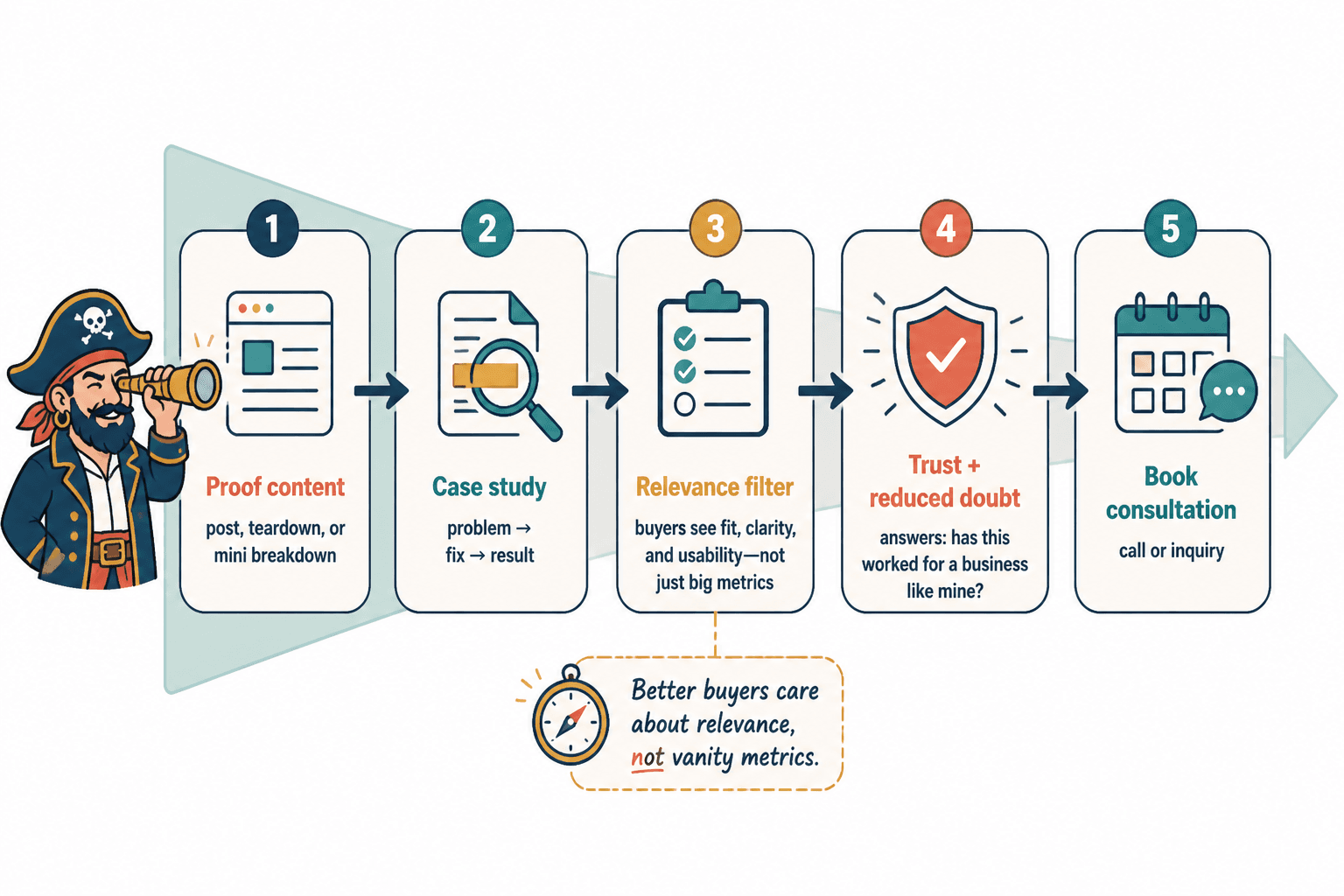
Simple version:
- Share a useful insight in a post
- Offer a case study, teardown, or mini breakdown
- Use the case study to show the problem, the fix, and the result
- Invite the reader to book a call or inquire
This is particularly strong if your positioning says some version of “I do not just write pretty words, I improve business results.” Proof-based funnels remove a lot of doubt because they answer the buyer’s private question: has this worked on a real business that looks anything like mine?
One thing worth saying here: not every case study needs giant vanity metrics. Sometimes the most persuasive proof is that a confused offer became clear, a weak page became usable, or a client started attracting better-fit inquiries. Better buyers care about relevance, not just dramatic numbers.
5. Newsletter funnel
If your offer sells through sustained trust, repeated useful thinking, or consistent authority, a newsletter funnel is one of the cleanest options.
Best for:
- Writers
- Consultants
- Coaches with a strong point of view
- Personal brands building long-term demand
- Offers that are not always bought on first touch
Flow:
- Content post or article
- Email signup
- Regular emails with insight, proof, and examples
- Soft offer mentions and direct promotions at the right time
This works well when your positioning is opinionated, strategic, or nuanced enough that people need to hear you think a few times before they are ready. It gives your ideas room to accumulate weight.
The trap is turning the newsletter into a weekly content tax with no commercial role. If it never qualifies, never sharpens the problem, and never points toward an offer, it can become a very charming hobby. There are worse hobbies, but still.
6. Low-ticket entry funnel
Sometimes the best way to support your offer positioning is to create a smaller paid step that lets people experience your method before buying the bigger thing.
Best for:
- Coaches
- Strategists
- Experts with a clear method
- Higher-ticket offers where buyers want confidence first
- Audiences that need movement, not just more content
Examples:
- Mini audit
- Template pack
- Recorded workshop
- Offer messaging teardown
- Short strategy session
This works when your positioning says, “I have a process worth paying for,” and the lower-ticket step proves that quickly. It is especially useful if your main offer feels abstract from the outside. A small paid product can make your expertise feel concrete.
But low-ticket only helps if it leads naturally to the next level. If the smaller offer solves a totally different problem, or attracts a completely different buyer, you have just built a side quest.
7. Direct consultation funnel
Not every offer needs a long funnel. If your positioning is clear, your audience is warm, and the offer is custom enough to require conversation, direct booking can be the best option.
Best for:
- Custom services
- Bespoke consulting
- Referral-heavy businesses
- Warm audiences
- High-trust niches
Simple path:
- Content or profile copy frames the problem sharply
- Website or landing page explains who the offer is for
- CTA leads to inquiry or booking
- Call handles diagnosis, fit, and sale
This is often better than forcing everyone through a lead magnet just because someone online said all funnels need one. They do not. If your buyers already understand the problem and your positioning is strong enough, a short path can convert beautifully.
The catch is that direct funnels only work when your messaging does heavy lifting up front. Your positioning has to be specific. Your website copy has to qualify. Your offer page cannot be vague and expect the sales call to rescue it.
How to choose the right funnel for your offer positioning
If you are stuck, use these three filters.
1. Ask what the buyer needs before they can say yes
- Do they need education?
- Do they need proof?
- Do they need trust?
- Do they need diagnosis?
- Do they need a smaller first step?
Your funnel should answer that need directly.
2. Ask what your positioning is claiming
If your messaging says you are strategic, your funnel should feel strategic. If your message says you simplify complexity, your funnel should feel clear and clean. If you sell hands-on customization, your funnel should probably include some kind of tailored step.
This is where a lot of people accidentally undermine themselves. Their website says premium, but their funnel says generic internet freebie. Their copy says thoughtful, but the nurture sequence reads like recycled launch emails from a stranger’s swipe file.
3. Ask what kind of lead you actually want
Not every lead is helpful.
If you want qualified inquiries, build for qualified inquiries. If you want a larger nurture pool, fine, but be honest that list growth and buyer fit are not always the same thing. A lot of creators celebrate lead volume while quietly collecting people who were never going to buy the actual offer. Great for screenshots. Less great for revenue.
A simple match table you can actually use
| Offer positioning style | Best funnel fit | Why it works |
|---|---|---|
| Clear problem solver | Post → lead magnet → nurture → offer | Helps educate and qualify while reinforcing the problem-solution angle |
| Strategic expert | Post → article → offer | Shows depth, judgment, and authority without cheapening the offer |
| Diagnostic specialist | Assessment or audit funnel | Lets prospects experience your method before buying |
| Results-driven service | Case study funnel | Uses proof to reduce doubt and support premium pricing |
| Trust-based personal brand | Newsletter funnel | Builds familiarity and confidence over time |
| Method-based premium offer | Low-ticket entry funnel | Creates a smaller yes before the bigger commitment |
| Bespoke custom service | Direct consultation funnel | Shortens the path when buyers need a conversation, not more downloads |
Common funnel mistakes that quietly wreck good positioning
Using broad lead magnets for narrow offers
If your offer is specific, the lead magnet should be too. Broad freebies pull in broad interest. That sounds nice until you are trying to sell something specialized.
Making the next step feel unrelated
The reader should feel a clean progression from content to opt-in to offer. If every step introduces a new topic, new tone, or new promise, trust drops.
Overbuilding the funnel because complexity feels impressive
You do not need six automations, three tripwires, and a spiritual bond with your CRM. You need a path that matches buyer intent. More moving parts do not automatically mean more conversions. Sometimes they just mean more places for clarity to die.
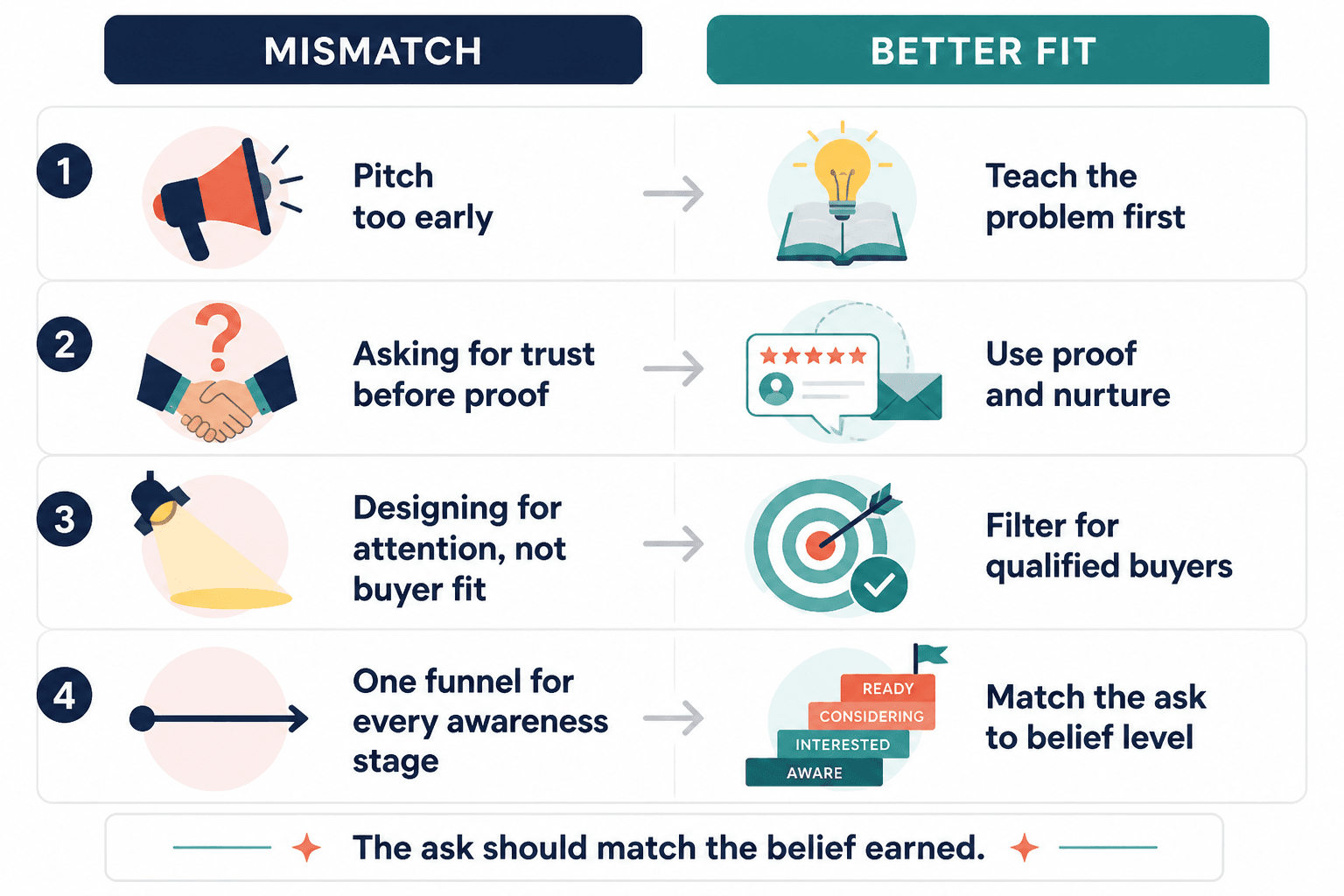
Pitching before the messaging has done its job
If your audience does not understand the problem yet, a direct sales push is early. If they understand the problem but do not trust you, it is also early. The ask should match the level of belief you have earned.
Designing the funnel for attention instead of buyer fit
Traffic matters, sure. But the right people matter more. Small audiences especially need this discipline. If that is your situation, this piece on offer messaging and positioning for creators with small audiences is worth reading next.
A practical way to build your funnel from your messaging
If you want a simple process, use this.
- Write your offer positioning in one sentence.
Example: I help creators turn vague website messaging into sharp copy that attracts better-fit leads. - Identify the main barrier to purchase.
Maybe the buyer does not know their messaging is the problem. Maybe they know, but they are not sure you are the right person. Maybe they need proof. - Choose a funnel that removes that barrier.
If they need diagnosis, use an audit or assessment. If they need depth, use article content. If they need trust, use email nurture. - Create one lead step that proves your positioning.
Not random value. Relevant value. - Make the offer transition obvious.
The offer should feel like the natural next move, not a surprise appearance. - Check the whole path for consistency.