
Most creators do not have an offer problem first. They have a messaging and positioning problem wearing the offer’s clothes.
They are good at the thing. The offer is often perfectly sellable. But the way they describe it is vague, crowded, overexplained, or trying so hard to sound professional that it stops sounding useful.
That is why people read the page, nod politely, and leave without buying. Not because your audience is broken. Not because you need a fancier funnel. Usually because your offer messaging gives them too much fog and not enough reason.
This Offer Messaging & Positioning Guide for Creators will help you fix that. We are going to make your offer clearer, sharper, more believable, and easier to say yes to without turning it into hypey nonsense. If your current copy sounds like “I help purpose-driven entrepreneurs align their authentic brand message,” we need to have a word.
Want the broader roadmap? Start with the parent guide.
What offer messaging and positioning actually need to do
Offer messaging and positioning are related, but they are not the same thing.
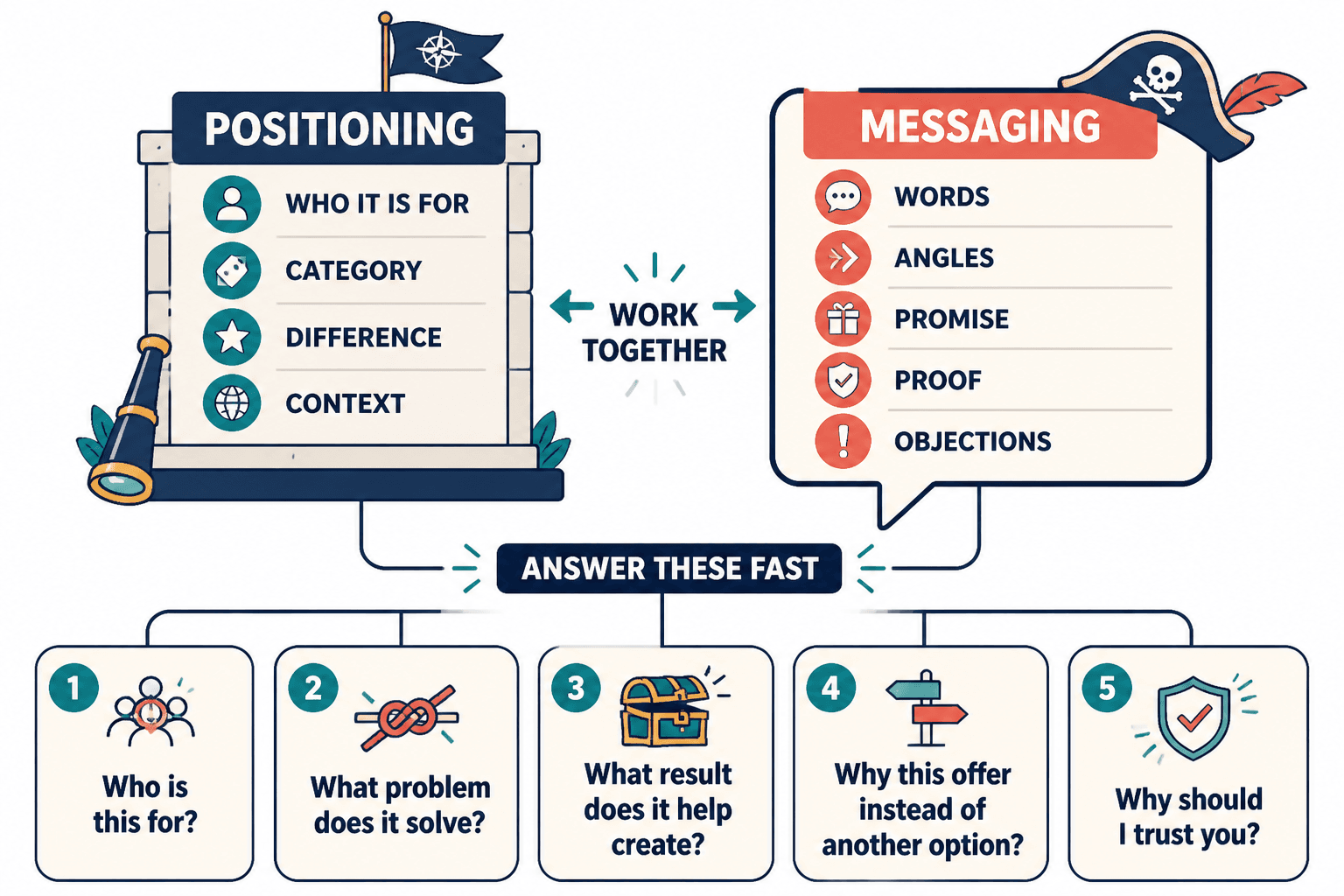
Positioning is how your offer makes sense in the market. Who it is for. What category it belongs in. Why it is different. Why it is a better fit than the other options floating around in your buyer’s browser tabs.
Messaging is how you communicate that clearly. The words, angles, promises, framing, proof, objections, and specifics that help someone quickly understand what this is and why they should care.
Good positioning without good messaging gets wasted. Good messaging without good positioning sounds polished but flimsy. You need both.
At minimum, your offer needs to answer five questions fast:
- Who is this for?
- What problem does it solve?
- What result does it help create?
- Why this offer instead of another option?
- Why should I trust you to help with this?
If your page, pitch, bio, or CTA cannot answer those without wandering off into a cloud of personal-brand incense, that is the issue.
The real reason creator offers get ignored
Most weak creator offers do not fail because they are too small, too niche, or too simple. They fail because the buyer has to do too much work to understand them.
Here is what that usually looks like in plain English:
- The audience is too broad, so the message hits nobody properly.
- The problem is described in fluffy language instead of buyer language.
- The promise sounds nice but not concrete.
- The offer looks interchangeable with ten others.
- There is no proof, no mechanism, or no reason to believe it will work.
- The copy focuses on features before relevance.
- The creator talks about their passion instead of the buyer’s decision.
A lot of creators also make one very common mistake: they describe the type of service instead of the value of the service.
“Brand strategy sessions for founders” is a service type. “Clarify what your brand stands for so your content, site, and sales pages stop sounding disconnected” is buyer-relevant value.
That distinction matters. Buyers do not wake up wanting “a done-with-you messaging intensive.” They want the mess cleaned up. They want clarity, traction, confidence, better conversions, fewer awkward sales calls, or content that stops sounding like it was assembled by committee.
Start with the offer foundation before you touch the copy
If your messaging feels slippery, do not start by polishing sentences. Start by tightening the foundation. Better wording cannot rescue a blurry offer.
1. Define the audience properly
Not “entrepreneurs.” Not “coaches and consultants and service providers and creatives and startups and small businesses.” That is not an audience. That is a panic list.
You need enough specificity that the reader can recognize themselves quickly.
Better audience framing sounds more like this:
- Coaches with inconsistent messaging across their site and content
- Solo consultants who need a clearer offer before running outreach
- Creators selling services who get attention but not enough inquiries
- Experts with a decent reputation but a weak homepage and confusing service pages
Specific does not mean tiny. It means recognizable.
2. Name the problem they already feel
The best offer messaging usually begins with a problem the buyer already knows is expensive, annoying, or blocking something they want.
Weak problem framing:
- You need more alignment in your brand communication
- Your message is not resonating authentically
- Your offer lacks magnetic market clarity
Stronger problem framing:
- Your site sounds professional, but not persuasive
- People like your content, but they still do not understand what you sell
- Your offer is useful, but your messaging makes it feel generic
- You are getting interest, but too many bad-fit leads and too few ready buyers
See the difference? One set sounds like it was grown in a greenhouse of consultant jargon. The other sounds like something a buyer might actually think.
3. Clarify the result without promising nonsense
Creators often swing between two bad options here:
- So vague it means nothing
- So inflated it sounds fake
You do not need to promise a six-figure miracle. You do need to articulate a clear, relevant outcome.
For example:
- Turn your offer into language buyers understand faster
- Make your homepage and service page clearer, sharper, and easier to convert from
- Position your offer so your content, profile, and sales conversations all pull in the same direction
- Replace vague brand copy with messaging that attracts better-fit leads
The sweet spot is specific enough to feel real, but honest enough to trust.
4. Explain your mechanism
If your offer sounds like every other offer in your category, you probably have not explained how you help.
This does not require some sacred proprietary framework with six alliterative pillars. Please rest. It just means you should show your approach.
Examples:
- We audit your current offer language, identify friction points, then rewrite the core message around buyer intent and decision triggers
- You get a focused messaging intensive that sharpens your audience, offer, homepage copy, and CTA strategy in one sprint
- We use interviews, offer analysis, and conversion copy rewrites to turn your expertise into a stronger sales narrative
The mechanism gives shape to the promise. It makes the result feel less magical and more earned.
How to position your offer so it does not blur into the market wallpaper
Positioning is not just “be different.” Different in random directions is not helpful. Positioning means being clearly right for a certain buyer, problem, context, and standard of solution.
There are a few reliable ways creators can do this well.
Position by audience
Be known for helping a specific kind of person.
- Messaging strategy for solo consultants
- Sales page copy for coaches with premium offers
- Positioning support for creators selling expertise-based services
Position by problem
Be known for solving a particular issue.
- Fixing vague offers
- Improving low-converting homepage copy
- Helping creators turn audience attention into inquiries
Position by outcome
Lead with the result your buyer values most.
- Clearer messaging that brings in better-fit leads
- Sharper positioning that makes selling easier
- Offer copy that improves trust and conversions
Position by approach
Make your process part of the value.
- Fast sprint-based positioning work instead of long retainers
- Strategy plus implementation instead of advice-only consulting
- Hands-on rewrites instead of abstract brand workshops
Position by philosophy
This works especially well if your audience is tired of the standard nonsense in your space.
- Messaging without hype, pressure tactics, or fake urgency
- Conversion copy for experts who want to sound credible, not salesy
- Simple, practical positioning for creators who hate bloated branding exercises
You do not need to use all five. Usually one or two will do the job. Stack too many, and the message starts wobbling again.
If you want more examples of how these angles can work in practice, see best offer messaging and positioning ideas and examples for creators.
A simple offer messaging formula that does not sound canned
You do not need to freestyle this every time. A basic structure helps. It just should not sound like you downloaded your personality from a webinar funnel.
Try this:
- I help [specific audience]
- solve [frustrating, relevant problem]
- so they can [valuable outcome]
- through [clear approach or mechanism]
That is the skeleton. Now give it blood pressure.
Weak version:
I help entrepreneurs clarify their authentic message so they can grow with confidence.
Better version:
I help solo consultants tighten vague offer messaging so their website, content, and calls do a better job turning interest into inquiries.
Another one:
I help coaches with strong expertise but weak copy position their offers more clearly, so buyers understand the value faster and trust the next step more easily.
Notice what changed:
- The audience became clearer
- The problem became more visible
- The outcome became more concrete
- The message stopped trying to sound enlightened and started trying to be useful
If you want practical plug-and-play frameworks, these simple offer messaging and positioning problem framing templates for busy creators will help.
Before-and-after rewrites: from vague to convincing
Sometimes the fastest way to improve your positioning is to see where weak copy falls apart.
Example 1: Generic brand copy
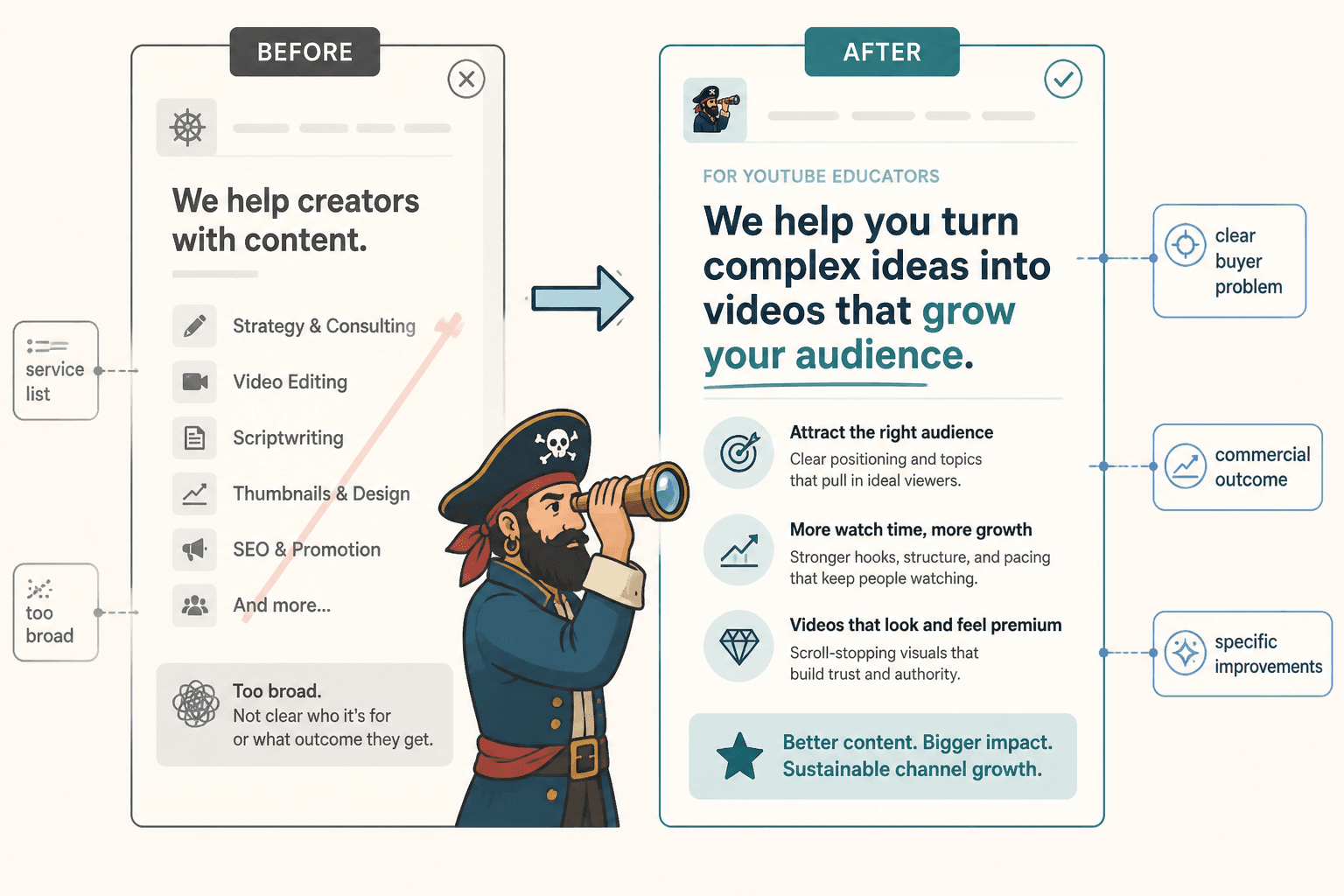
Before: I help purpose-driven business owners build aligned brands that connect and convert.
After: I help service-based creators clarify their offer message so their website and content stop sounding polished-but-vague and start bringing in better-fit leads.
Why it works better:
- “Purpose-driven business owners” became a more recognizable buyer
- “Aligned brands” got replaced with an actual problem
- The benefit became easier to picture
Example 2: Fancy words, weak meaning
Before: Through strategic messaging intensives, I unlock authentic positioning that elevates your visibility and authority.
After: In one focused messaging sprint, I help experts tighten their positioning, rewrite muddy offer copy, and make it easier for the right clients to understand why they should hire them.
Why it works better:
- The process became easier to grasp
- The promise became less floaty
- The buyer now understands what actually happens
Example 3: Skilled service, buried value
Before: I offer website copywriting, messaging strategy, audience clarity, and conversion consultation for online businesses.
After: I help online service businesses fix the gap between “people like my content” and “people actually buy” with sharper homepage messaging, stronger offers, and cleaner conversion paths.
This one matters because many creators list deliverables when they should be articulating the commercial reason those deliverables matter.
What to include on your website, profile, or sales page
Your offer messaging should not only exist in your head or inside your services tab like a forgotten receipt. It needs to show up consistently across the places people decide whether to trust you.
These are the core pieces to get right.
Headline
This should make the offer legible fast. Not clever first. Clear first.
Example:
Offer messaging and positioning for creators whose expertise is better than the way they currently sell it.
Subheadline
Add the practical outcome and the shape of the help.
Example:
Clarify your audience, sharpen your offer, and rewrite the core message so your content, site, and sales process stop leaking trust.
Problem section
Call out what the buyer is likely experiencing right now.
- Your offer sounds too similar to everyone else’s
- People enjoy your content but still ask what exactly you do
- Your website sounds polished but does not create enough action
- You are attracting interest, but not enough of the right kind
Outcome section
Show the after state without acting like you are granting wishes.
- A clearer message your audience understands faster
- Stronger positioning that makes your offer easier to choose
- Website and sales copy that feels more useful and persuasive
- Better-fit leads and less confusion in sales conversations
Approach or process section
Tell them what you actually do. Buyers trust shape.
- Offer audit
- Audience and problem clarification
- Core messaging refinement
- Page or asset rewrites
- CTA alignment and next-step cleanup
Proof section
Proof can be client examples, outcomes, testimonials, relevant experience, specific observations, or before-and-after snippets. It does not have to be flashy, but it does need to exist.
“Trusted by visionary founders” is not proof. It is decorative wallpaper.
CTA section
Do not end with “Let’s connect” unless your business model is vague handshakes. Tell them what to do next and why.
Better CTA examples:
- Book a messaging consult if your offer is solid but the wording is not doing it justice
- Apply for a positioning sprint if you need sharper copy before your next launch
- Read the process if you want to see how the offer works before booking
If you are rebuilding core copy, you may also want to explore the wider offer messaging and positioning hub and related website conversion copy resources.
How small creators should think about positioning
If your audience is still small, the temptation is to make your offer broad enough to catch anyone with a pulse and a payment method. Understandable. Usually a mistake.
Smaller creators need stronger relevance, not wider blur.
You do not need the world to think, “This is for me.” You need the right people to think, “Finally, this sounds like my problem.”
That usually means:
- Naming a more specific audience
- Talking about one painful problem clearly
- Using tighter proof, even if it is limited
- Making the offer easier to understand in one glance
- Choosing usefulness over broad aspirational branding
A small audience of relevant buyers beats a bigger audience of people who clap at your content and never buy a thing. Vanity is cheap. Fit is not.
For a deeper look at that, read offer messaging and positioning for creators with small audiences.
A quick self-audit for your current offer messaging
If you want to know whether your messaging is working, do not ask if it sounds nice. Ask if it reduces decision friction.
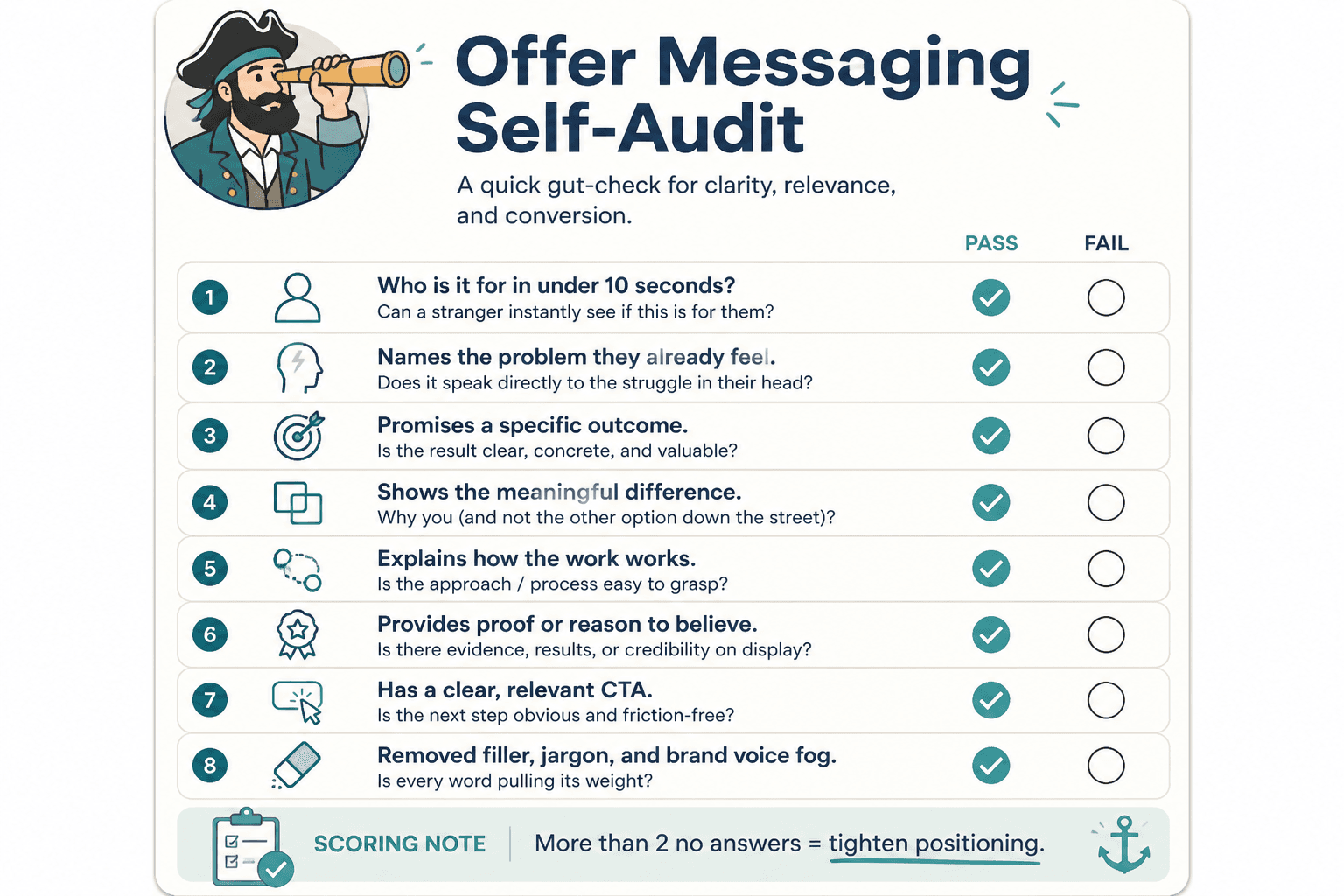
Use this checklist:
- Can a stranger understand who the offer is for in under 10 seconds?
- Does the problem sound like something the buyer already feels?
- Is the outcome specific enough to picture?
- Does the offer feel meaningfully different from common alternatives?
- Have you explained how the work works?
- Is there proof or reason to believe?
- Is the CTA clear and relevant?
- Have you removed filler words, jargon, and “brand voice” fog?
If you answered no to more than two of those, you probably do not need a prettier sentence. You need tighter positioning.
Common positioning mistakes creators keep making
Some mistakes are so common they have basically become genre conventions. That does not make them good.
- Trying to sound premium by becoming less clear. Expensive-sounding words do not create perceived value if nobody knows what you mean.
- Describing yourself instead of the buyer’s situation. Your process, philosophy, and credentials matter, but only after the buyer understands the problem you solve.
- Using broad emotional language where practical language is needed. “Feel aligned” is not always wrong, but it is rarely enough.
- Leading with service labels. Strategy, consulting, mentoring, intensives, audits. Fine. But what are they for?
- Copying the language of bigger creators. Their audience may already know what they mean. Yours probably needs more clarity and less mystique.
- Hiding the commercial result. If your offer helps people get leads, improve conversions, sell more cleanly, or reduce friction, say so.
The good news is that these are fixable. Usually faster than people think. Once you stop trying to sound like a “personal brand” and start trying to sound unmistakably useful, things improve.
How to improve your offer messaging without rewriting your whole business from scratch
You do not need a three-month identity retreat. You probably need a focused pass through the core decision points in your copy.
Start here:
- Rewrite your one-line offer description so it names audience, problem, and outcome clearly.
- Replace broad claims with specific buyer-language problems.
- Add one sentence that explains your approach or mechanism.
- Cut any phrase that sounds impressive but says very little.
- Add proof where trust currently depends on vibes.
- Tighten your CTA so the next step is obvious.
If that sounds manageable, good. It should. This is strategic work, but it does not need to become theatre.
And if you want a more detailed walkthrough of the rewrite process, go to how to write better offer messaging and positioning.
FAQ
What is the difference between offer messaging and positioning?
Positioning is how your offer fits in the market. Messaging is how you communicate that fit clearly and persuasively.
How specific should my offer be?
Specific enough that the right buyer recognizes themselves quickly. Not so narrow that the offer becomes awkwardly overfitted to one person.
Should I mention money-related outcomes?
Yes, if they are relevant and honest. Just do not turn every promise into inflated income cosplay.
What if I help more than one type of client?
Pick the audience and problem you most want to be known for in your main messaging. You can still mention secondary fits later.
Do I need a unique framework?
No. You need a clear approach. A named framework is optional. Clarity is not.
Clearer offers usually win
The point of an Offer Messaging & Positioning Guide for Creators is not to make you sound smarter. It is to make your offer easier to understand, trust, and choose.
The bigger point is simple: clearer structure and clearer writing make the piece more useful. That is usually what makes the ending land better too.