
Most offer statements are either painfully vague or weirdly inflated.
You get things like “I help purpose-driven entrepreneurs unlock aligned growth,” which sounds polished right up until someone asks, “Cool. What do you actually do?” And then the whole thing falls apart in public.
A good offer statement should make your work easier to understand, easier to remember, and easier to buy. Not because it is clever. Because it is clear. That is the job.
If you have been struggling to explain your service, package your expertise, or write website copy that does not sound like a beige business ghost wrote it, this will help. You will get offer statement examples creators can adapt fast, a simple structure for writing your own, and a clearer sense of what makes an offer statement useful instead of decorative.
If you want the wider strategy behind this, start with the Offer Messaging & Positioning hub or read the more complete guide for creators who want better results. For now, we are focusing on the part people keep overcomplicating: saying what you offer in a way another human can understand quickly.
For the full path around this topic, head to the parent guide.
What an offer statement actually needs to do
An offer statement is not your life philosophy. It is not your brand mood board in sentence form. It is a practical positioning line that helps the right person think, “Ah. This might be for me.”
The strongest ones usually answer four things fast:
- Who it is for
- What you help them do
- How or through what kind of offer
- What makes the result worth caring about
That does not mean every statement has to follow the same rigid formula. It does mean the reader should not have to solve a little riddle just to figure out what you sell.
Clarity beats clever almost every time here. Especially on websites, landing pages, sales pages, profiles, and pinned posts where people are deciding whether to keep reading or leave.
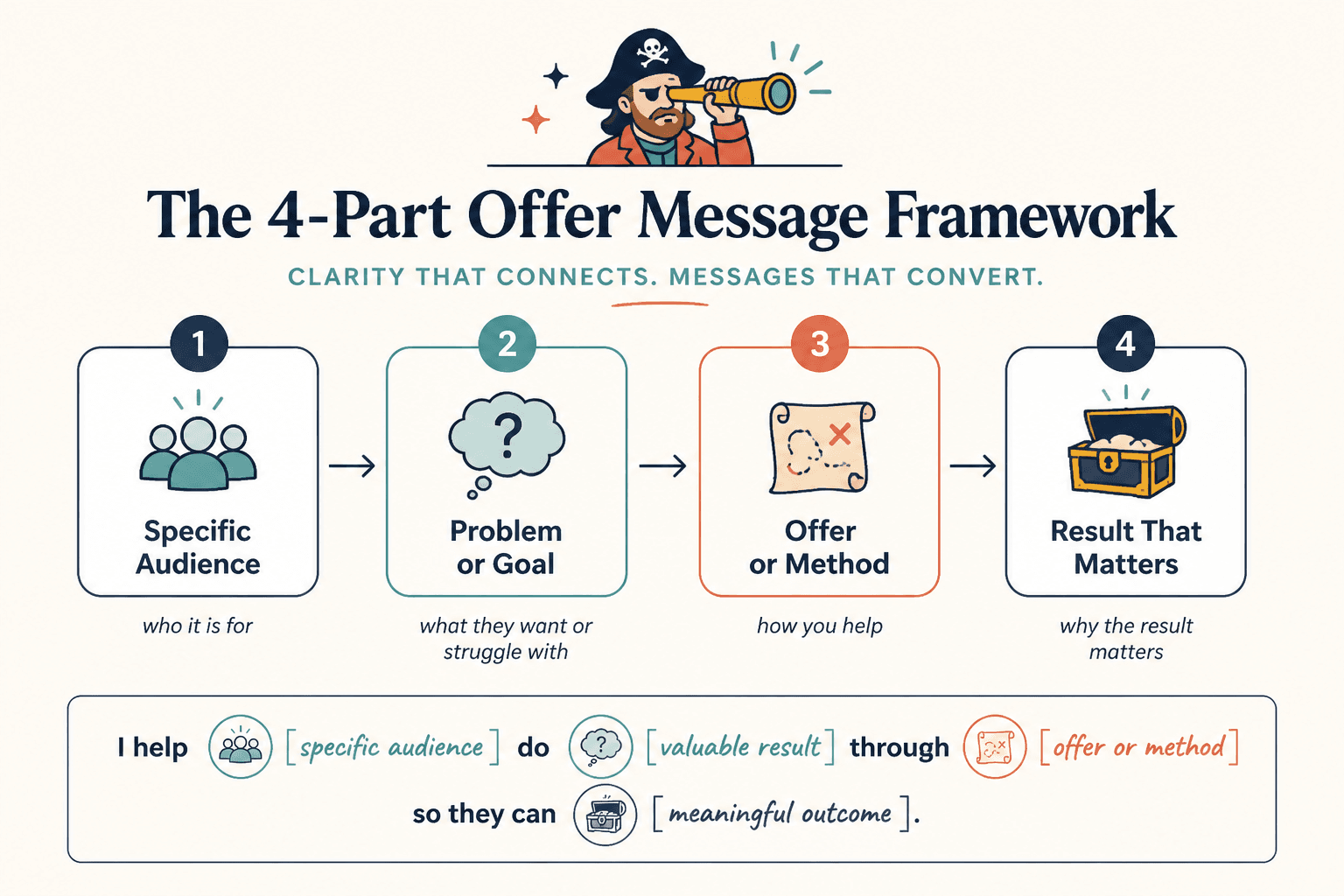
A simple formula for writing stronger offer statements
If you need a starting point, use this:
I help [specific audience] do [valuable result] through [offer or method] so they can [meaningful outcome].
Not thrilling. Very useful.
You do not have to keep all four parts every time. In fact, shorter is often better once the sentence is strong. But this structure forces you to stop hiding behind broad words like “grow,” “elevate,” “transform,” and “optimize” when you have not said what any of that means.
Example of the formula in action
Weak version:
I help entrepreneurs scale with authentic messaging.
That sounds nice. It also tells us almost nothing.
Stronger version:
I help coaches and consultants clarify their offer messaging so their website and content convert more of the right leads.
Now we know the audience, the work, and the payoff. Already better.
What makes offer statement examples worth adapting
Good examples do not just sound polished. They give you usable parts you can steal ethically and reshape for your own business.
That means the examples below are built to show structure, not just style. You are not trying to copy someone else’s sentence exactly. You are trying to notice the bones underneath it.
- The audience is specific enough to picture
- The result is concrete enough to matter
- The wording sounds like a person, not a keynote slide
- The claim is believable
- The sentence points toward an actual offer
If your current line sounds impressive but could apply to 600 other creators, it is probably too generic to do much work.
Offer statement examples creators can adapt fast
Here are practical offer statement examples creators can adapt fast across different business models. Use them as templates, not commandments.
For coaches
- I help first-time coaches turn a vague idea into a sellable offer they can explain in one sentence.
- I help health coaches package their expertise into simple programs clients can actually understand and buy.
- I help leadership coaches tighten their message so their content attracts decision-makers, not random applause.
- I help burned-out service providers reposition their business around a clearer, higher-value coaching offer.
- I help career coaches turn scattered advice into focused offers that lead to better-fit clients.
For consultants
- I help B2B founders simplify their website messaging so buyers understand the offer faster and book more qualified calls.
- I help small teams fix confusing conversion copy across their homepage, service pages, and core funnel.
- I help experts turn hard-to-explain services into sharper positioning that makes sales conversations easier.
- I help agencies refine their offer language so they stop sounding interchangeable with every other agency online.
- I help consultants build authority content tied to a clear commercial message, not just more posting.
For writers and copywriters
- I write conversion-focused website copy for creators who need a clearer offer and fewer polite no-thanks.
- I help personal brands turn good ideas into sharper messaging, stronger pages, and cleaner calls to action.
- I help service businesses rewrite vague website copy into clear positioning that attracts better leads.
- I help founders say what they do without sounding like they swallowed a startup glossary.
- I write messaging systems for experts who want their site, bio, and content to sound like the same smart business.
For designers and brand strategists
- I help creators build brands that look good and make the offer easier to trust.
- I help service businesses align their visual brand with clearer positioning so the site feels more credible from the first click.
- I help founders turn messy brand ideas into sharper identity systems rooted in actual strategy, not just aesthetics.
- I help personal brands create visual direction that supports a premium offer instead of distracting from it.
- I design brand systems for experts who are tired of looking polished but saying nothing.
For content marketers and social media strategists
- I help creators turn their expertise into content that builds trust and points people toward a real offer.
- I help consultants create content systems that support lead generation without making every post sound like a pitch.
- I help founders develop sharper content angles based on positioning, not random posting streaks.
- I help personal brands connect social content to a stronger website message and cleaner funnel.
- I help experts stop posting useful-but-floating content by tying every content theme back to a sellable offer.
For course creators and educators
- I help freelancers turn their process into practical digital products people can use without needing a 47-video maze.
- I create simple training programs that help creators learn messaging, content, and conversion without drowning in fluff.
- I help experts package their knowledge into courses built around outcomes, not just information.
- I help creators build educational offers that are easier to buy because the promise is specific.
- I help audience-first businesses design products that solve a clear problem and lead naturally to the next offer.
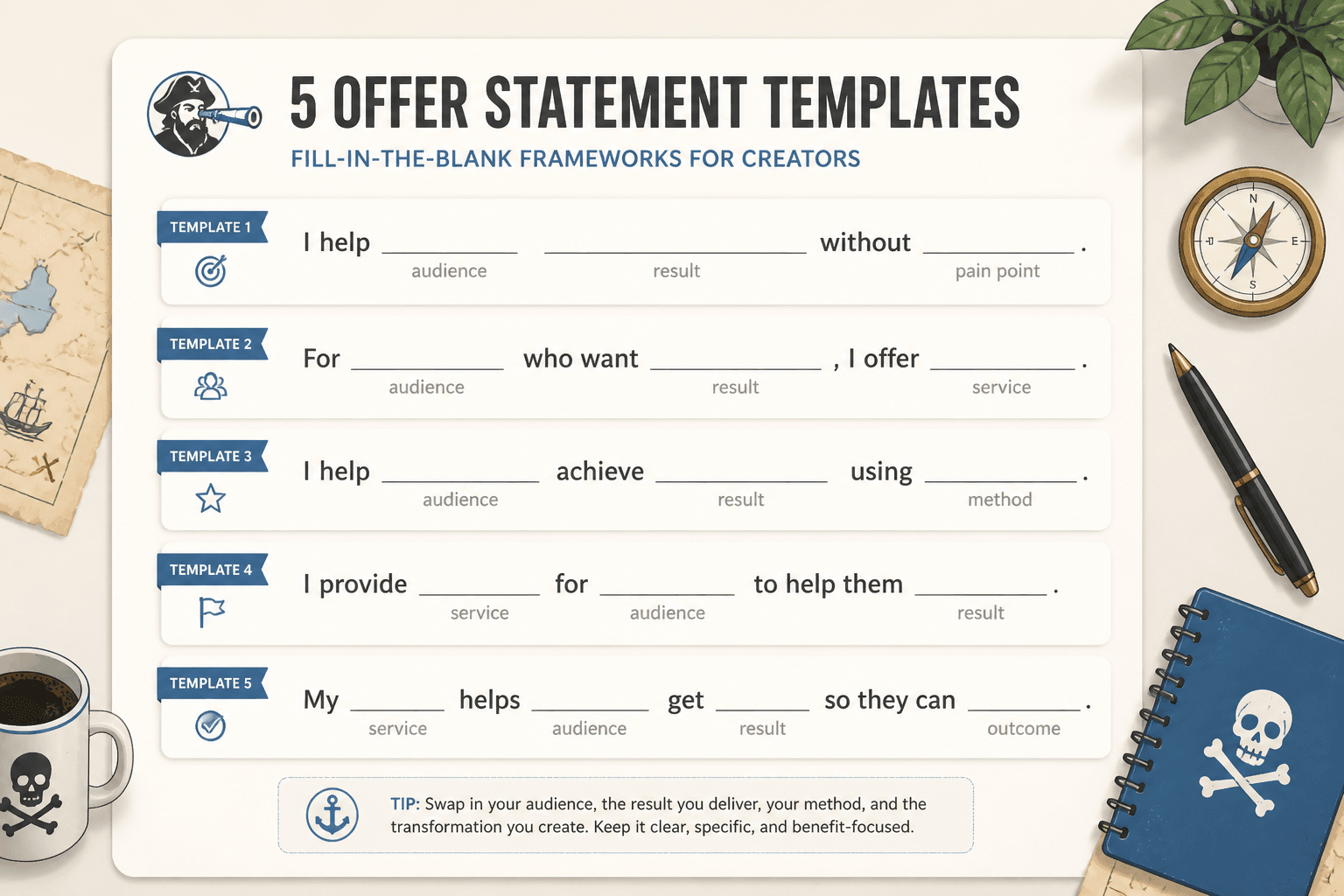
Quick-fill templates you can customize
If starting from scratch makes you stare at the screen like it insulted your family, use these.
Template 1: Clear and direct
I help [audience] get [result] with [offer].
Example: I help solo consultants get clearer website messaging with strategic copy audits.
Template 2: Problem to result
I help [audience] go from [painful problem] to [desired result] through [offer or process].
Example: I help creators go from vague offers and weak bios to clear messaging and stronger conversions through focused positioning work.
Template 3: Outcome with context
I help [audience] [action] so they can [valuable business outcome].
Example: I help coaches simplify their offer messaging so they can attract better-fit clients without rewriting their site every month.
Template 4: Offer-led
[Offer name or type] for [audience] who want [result] without [frustrating alternative].
Example: Messaging intensives for service providers who want a clearer offer without a full rebrand circus.
Template 5: Credibility plus result
I help [audience] [result] using [method, framework, or specialty].
Example: I help consultants sharpen their positioning using offer messaging strategy, website copy structure, and conversion-focused page messaging.
Need more angle ideas? The roundup of best offer messaging and positioning ideas and examples for creators is useful when your current wording feels stale.
Before-and-after rewrites
This is where the difference gets obvious. Most weak offer statements are not missing more adjectives. They are missing a real point.
Rewrite 1
Before: I empower visionary entrepreneurs to amplify their message.
After: I help online business owners clarify their message so their website and content attract better-fit leads.
Why it works: less ego fog, more actual meaning.
Rewrite 2
Before: I support heart-led brands with authentic growth solutions.
After: I help creative service businesses fix unclear positioning and build content that leads people toward a real offer.
Why it works: “authentic growth solutions” could mean anything from therapy to paid ads.
Rewrite 3
Before: I help coaches scale to the next level.
After: I help coaches refine their offer and messaging so more discovery calls turn into qualified clients.
Why it works: specific mechanism, specific payoff.
Rewrite 4
Before: Strategic brand support for ambitious founders.
After: Brand strategy for founders who need a clearer market position before they redesign their site or rewrite their copy.
Why it works: now the reader knows when this is relevant.
How to adapt these examples to your own business fast
You do not need a three-day messaging retreat to write one useful sentence. You need a better filter.
- Start with the audience you actually want. Not “entrepreneurs.” Which kind?
- Name the result they care about. Better leads, more clarity, easier sales, faster content creation, stronger positioning.
- Say what the offer is. Audit, intensive, strategy session, copy package, program, consulting engagement.
- Cut vague praise words. Transformational, aligned, authentic, elevated, impactful. These are not carrying the sentence.
- Test if a stranger could repeat it back. If not, it is still too fuzzy.
One useful trick: write the statement, then ask yourself, “What would someone assume I do from this alone?” If the answer is broad, distorted, or wrong, keep tightening.
If your audience is still small, specificity matters even more. You do not need wording that appeals to everyone. You need wording that makes the right few people pay attention. This is where offer messaging and positioning for creators with small audiences becomes very relevant, because broad language tends to perform worst when you do not have massive reach to compensate for it.
Common mistakes that make offer statements weak
Here is what keeps making perfectly good businesses sound confusing.
- Trying to sound premium instead of useful. Fancy wording does not create value. It usually hides the value you already have.
- Using audience labels that are too broad. “Founders” and “business owners” are often lazy stand-ins for actual positioning.
- Leading with your method before the result. People care about your framework after they care about the problem it solves.
- Packing in too many services. If your sentence needs three semicolons and a deep breath, the offer is probably muddy.
- Making claims that sound inflated. If the line sounds like a miracle in a blazer, trust drops.
There is also the classic mistake of trying to include every possible audience, service, result, and personality trait in one line. That is not a strong offer statement. That is a stressed-out suitcase.
Where to use your offer statement
Once you have a solid one, put it where it can actually help.
The bigger point is simple: clearer structure and clearer writing make the piece more useful. That is usually what makes the ending land better too.