
Most CTAs are not failing because the wording is weak. They are failing because they are attached to absolutely nothing.
You can write “book a call,” “download the guide,” or “reply with GUIDE” in ten cleaner ways, but if the next step is clunky, mismatched, too big, or weirdly premature, the CTA still dies on contact.
That is the real job here. Good CTA writing is not just about the line itself. It is about pairing the right ask with the right funnel shape, at the right level of trust, for the right audience. Miss that, and even a strong CTA feels needy. Get it right, and the whole thing feels obvious.
This guide covers the best funnel ideas to pair with CTA writing so your content does not stop at “engagement.” You will see which funnels fit which CTAs, when to use a softer next step, how to avoid asking for too much too soon, and how to move people from attention to action without turning every post into a dodgy little trap.
To see how this fits into the wider strategy, open the parent guide.
Why CTA writing needs a funnel behind it
A CTA is a direction. A funnel is the path that makes that direction usable.
If your CTA says “download this,” the funnel has to explain why the resource matters, make access simple, and give the person a sensible next step after they opt in. If your CTA says “book a call,” the funnel has to justify the call, pre-qualify the lead a bit, and make sure they are not landing on some vague booking page that says almost nothing.
People often treat CTA writing like a tiny copy problem at the bottom of a page or the end of a post. It is not. It is a conversion design problem.
That matters because the best funnel ideas to pair with CTA writing depend on three things:
- How much trust the audience already has
- How much friction the next step creates
- How close the person is to buying
A stranger reading one useful post usually should not be pushed straight into a sales call. A warm newsletter reader who has seen your case studies might be ready. Same CTA category, totally different context.
That is why generic advice like “always end with a strong call to action” is not very helpful. Strong for what? Strong for whom? Strong at which stage?
If you want the CTA to work, pair it with a funnel that matches the temperature of the relationship.
The basic rule: match the ask to the trust level
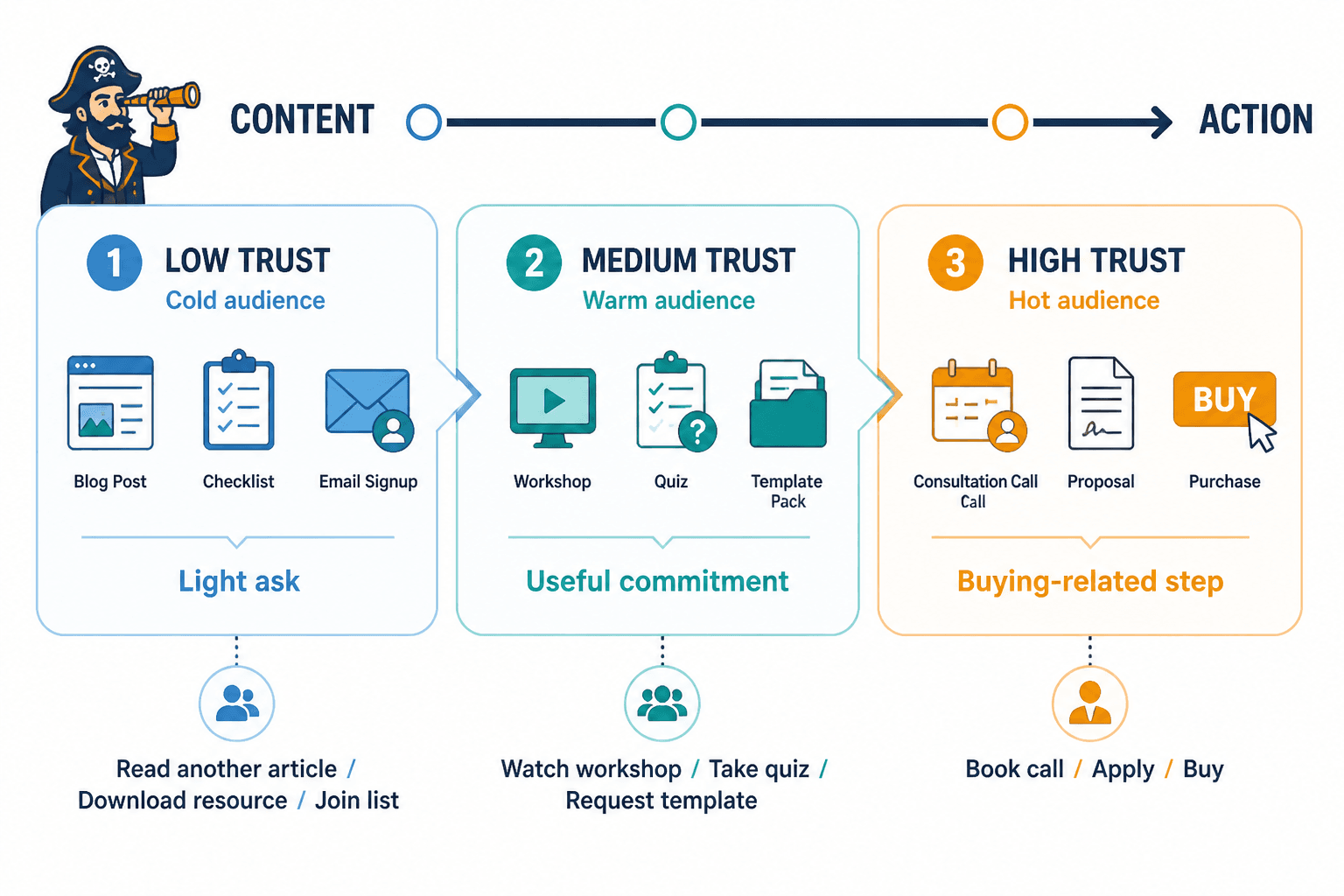
Before getting into specific funnel ideas, here is the cleaner rule underneath all of them:
- Low trust: ask for a light action
- Medium trust: ask for a useful commitment
- High trust: ask for a buying-related step
Low trust CTAs are things like reading another article, grabbing a practical resource, replying to a post, or joining your list. Medium trust CTAs include watching a workshop, taking a diagnostic quiz, requesting a template pack, or replying with a specific problem. High trust CTAs include booking a consultation, applying for an offer, requesting a proposal, or buying directly.
People get this backward all the time. They publish broad top-of-funnel content, then slap on a bottom-of-funnel CTA and wonder why nobody moves. Because the ask feels absurdly large compared to the relationship. You gave them one decent paragraph and now want a strategy call. Calm down.
Best funnel ideas to pair with CTA writing
Here are the funnel pairings that make the most sense for creators, coaches, consultants, solo founders, and service businesses.
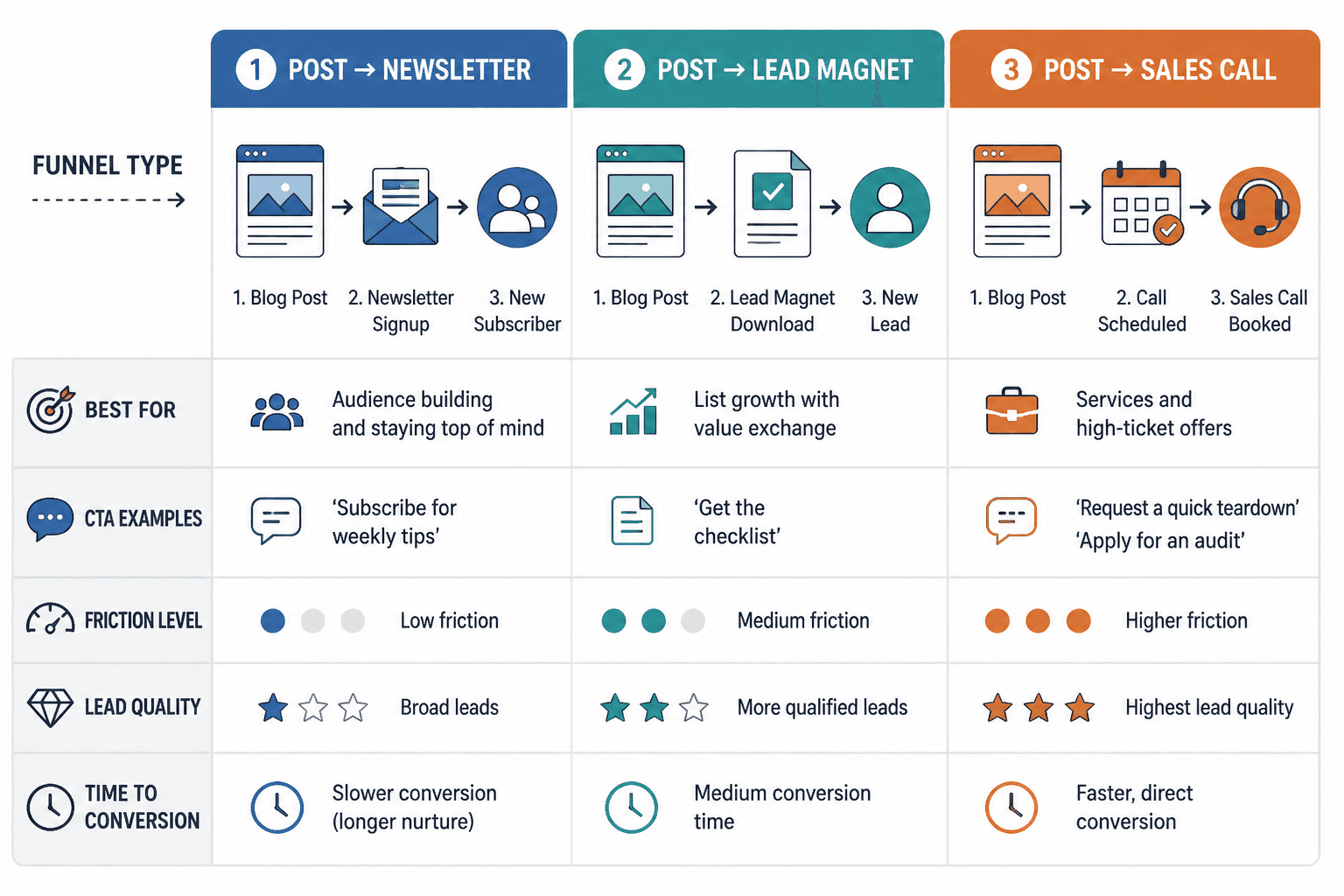
1. Content post → lead magnet → nurture emails → offer CTA
This is the classic for a reason. Not because it is glamorous. Because it works when the content and resource actually connect.
The CTA in the post should promise a clear next step related to the topic someone is already interested in. Not a random freebie you made two years ago because some marketing bro said every funnel needs a PDF.
Best for: building email lists, warming up service leads, creating repeat touchpoints
Strong CTA types:
- Get the checklist
- Grab the template
- Download the examples
- Steal the swipe file
- Get the framework
Why it works: the CTA is small, useful, and easy to say yes to. The funnel does the heavier lifting later through email.
Example: If your content teaches people how to improve homepage copy, the CTA could offer a homepage audit checklist. The follow-up emails can show common mistakes, mini case studies, and then invite readers to a paid audit or strategy session.
This is also one of the easiest ways to support more leads or sales from CTA writing without making the original CTA feel too heavy.
2. Social post → profile → booking page
This one works well when your audience is already pretty warm or your positioning is very clear.
The CTA in the content is not always “book now.” Sometimes the better move is “details in bio” or “my profile has the next step.” That gives your profile copy a chance to pre-sell the action before the person reaches the booking page.
Best for: consultants, fractional experts, service providers, coaches with a clear offer
Strong CTA types:
- See if we are a fit
- Check the details in my profile
- Apply here
- Book a consult
- Start with the audit
Why it works: the profile acts like a bridge. It can clarify audience, proof, offer, and next step before the person commits.
This funnel falls apart when the profile is vague, the booking page is thin, or the CTA appears under broad awareness content with no proof. If you are going to ask people to book, your profile and page need to do some actual selling. “Helping founders scale with authenticity” is not doing the job.
3. Article → related resource → consultation CTA
Long-form content is excellent for authority because it gives you room to teach, show judgment, and handle objections without sounding like a thread trying too hard.
Here, the CTA should usually not leap straight from article to “hire me” unless the article is tightly aligned with a high-intent topic. A related resource often makes the transition cleaner.
Best for: search-driven content, evergreen authority, mid-ticket and high-ticket services
Strong CTA types:
- Get the companion template
- Use the worksheet
- See the process in action
- Request an audit if you want help applying this
Why it works: the article builds credibility, the resource deepens engagement, and the consultation CTA feels earned instead of bolted on.
If you write articles around conversion topics, it makes sense to connect them to your broader CTA writing hub so readers can move from education to implementation without getting lost.
4. Post → comment trigger → soft DM → resource or sales page
This one can work nicely, but it gets abused by people who think every comment keyword is a clever funnel. Some of them feel less like marketing and more like being gently herded into a corridor.
The difference is intent and follow-through. If the post is genuinely useful and the person is asking for a specific resource, a comment-trigger CTA can reduce friction. If the post is bait written purely to farm comments and shove people into automated DMs, it feels gross. Because it is.
Best for: social-first creators, simple lead magnets, workshop invites, template delivery
Strong CTA types:
- Comment “checklist” and I’ll send it
- Reply with “audit” if you want the framework
- Comment “template” if you want the exact format
Why it works: it lowers the effort required, increases visible interest, and starts a more direct conversation.
Key warning: the DM should deliver the promised thing quickly. Not five manipulative setup messages before the link appears. You are not writing a hostage negotiation funnel.
5. Post → newsletter signup → weekly trust-building → offer mention
This is one of the best funnel ideas to pair with CTA writing if your sales cycle is slower or your work requires trust, nuance, and repeated exposure.
Not everyone is ready when they first find you. A newsletter gives you a place to continue the relationship without relying on platform mood swings or hoping they somehow remember your name later.
Best for: consultants, writers, educators, niche experts, B2B services, thoughtful offers that need context
Strong CTA types:
- Join for weekly breakdowns
- Get sharper content ideas in your inbox
- Subscribe for practical examples and teardown notes
- Join if you want the deeper version
Why it works: it creates recurring attention. That gives your CTA somewhere to mature.
The newsletter itself should not become a weekly pitch parade. Teach, show your thinking, share proof, and make the offer visible when it fits. Constant selling erodes the trust you just worked to build.
6. Case study → diagnostic CTA → sales call
This is excellent for warmer prospects because the case study does two important things at once: it proves you can solve the problem, and it helps the reader self-identify.
After someone reads a strong case study, the CTA can shift from general interest to diagnosis. That is usually easier to say yes to than a generic “book a call.”
Best for: service businesses, consultants, agencies, high-consideration offers
Strong CTA types:
- See if your funnel has the same problem
- Request a quick teardown
- Get a conversion diagnosis
- Apply for an audit
Why it works: diagnosis feels specific. It frames the next step around the prospect’s situation, not your desire to make a sale.
It also tends to produce better leads because the person has already seen the kind of problem you solve and the kind of outcome you help create.
7. Educational post → mini-offer → core service CTA
If you sell services, a small paid offer can be a strong bridge between free content and a larger engagement.
This could be a low-cost audit, short strategy review, template pack, teardown, or workshop. The CTA moves people into a lower-risk buying step first, which can qualify them for the bigger offer later.
Best for: experts with strong content, audiences that need a trust bridge, service offers with moderate complexity
Strong CTA types:
- Start with the mini audit
- Get the teardown first
- Buy the toolkit if you want the faster version
- Use the workshop before booking custom help
Why it works: it creates buyer intent before the main offer. People who buy a smaller thing are often far easier to convert later than people who only collect freebies forever.
The caution here is simple: the mini-offer has to be actually useful. If it is just a disguised teaser for the real thing, people will smell it immediately.
How to choose the right funnel for your CTA
If you are not sure which funnel idea fits your CTA writing, use this quick decision filter.
Ask these four questions
- How warm is the audience?
Cold audiences usually need a lower-friction next step. - How expensive or involved is the offer?
The more thought required, the more trust and context the funnel needs. - What is the content doing?
A broad educational post usually supports a softer CTA. A case study or buyer-intent article can support a stronger one. - What happens immediately after the click?
If the post promises clarity and the landing page creates confusion, the funnel is broken no matter how polished the CTA line sounded.
That last one matters more than people think. A CTA is a promise about the next step. If the destination page is messy, generic, or oddly intense, your conversion problem is not really a CTA problem anymore.
A simple CTA-to-funnel pairing table
| CTA type | Best paired funnel | Works best when |
|---|---|---|
| Download the guide | Post → lead magnet → nurture emails | You need to build trust before selling |
| Join the newsletter | Post → newsletter → soft offer mentions | Your expertise needs repeated exposure |
| Book a call | Post/profile/article → booking page | The audience is warm and the offer is clear |
| Request an audit | Case study/article → diagnostic step → sales call | You sell tailored services |
| Comment for the template | Post → comment trigger → DM/resource | You want low-friction lead capture |
| Start with the workshop | Post/article → mini-offer → core service | You need a paid bridge before the main offer |
Common mistakes when pairing CTAs with funnels
Asking for too much too early
This is the big one. A cold reader sees one post and your CTA asks for a strategy call, application, demo, and probably their blood type. That is not confidence. It is conversion delusion.
Using a lead magnet that does not match the content
If the content is about CTA writing and the freebie is a generic productivity planner, the funnel feels stitched together from unrelated leftovers. Relevance matters more than cleverness.
Writing the CTA before designing the next step
People obsess over the button copy while the landing page, form, or booking flow remains confusing. Write the CTA with the actual next experience in mind.
No transition between attention and offer
Sometimes the funnel is technically there, but there is no bridge. No email nurture, no profile clarity, no proof, no reason this next step makes sense now. Just content on one side and a sale on the other, with a weird little gap in the middle.
Turning every CTA into the same move
Not every piece of content needs to drive the same destination. Some posts should build awareness. Some should start conversations. Some should capture leads. Some should convert. If every CTA points at the exact same thing, your funnel strategy is probably too blunt.
How to write CTAs that fit the funnel better
A better CTA usually does one of these four things:
- Matches the trust level
- Makes the next step feel useful
- Reflects what the content already primed
- Reduces friction without reducing clarity
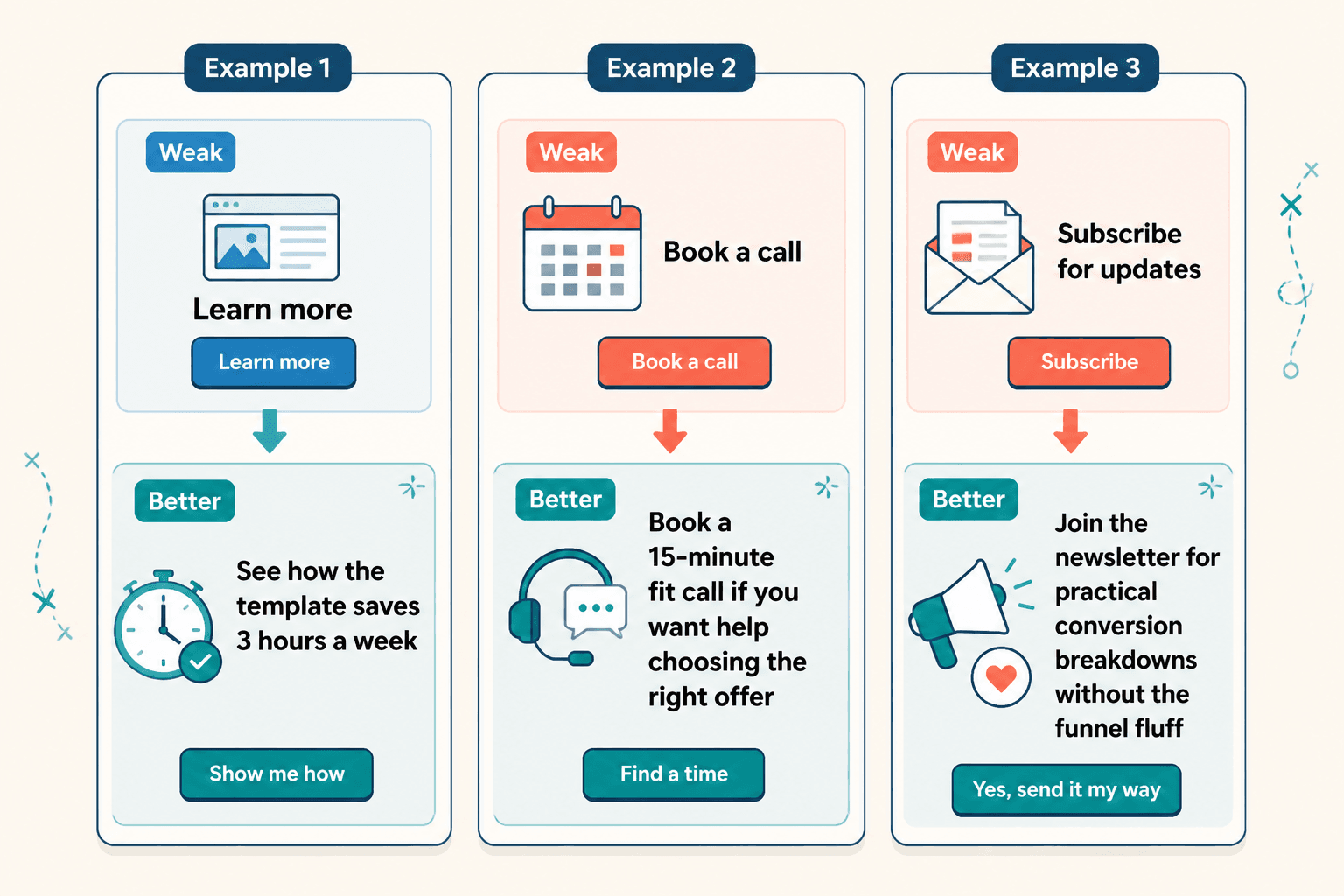
Here are a few before-and-after examples.
Example 1: post to lead magnet
Weak: Download my free resource now.
Better: If you want the exact CTA checklist behind this, grab the free version here.
The better version is specific, connected to the content, and clear about what the person gets.
Example 2: case study to audit
Weak: Book a discovery call to learn more.
Better: If your funnel has a similar drop-off problem, request a quick audit and I’ll show you where the friction likely is.
This works because it frames the next step around the reader’s problem, not your process.
Example 3: post to newsletter
Weak: Subscribe for updates.
Better: Join the newsletter if you want practical conversion breakdowns without the usual funnel fluff.
Now the value is clearer and the tone sounds like an actual human wrote it.
If you want more examples like these, it helps to pair this article with CTA writing ideas and examples for creators and the broader CTA writing guide for creators who want better results.
What small audiences should do differently
If your audience is still small, you do not need a massive funnel stack with twelve moving parts and a dashboard that looks like an airline cockpit.
You need one sensible path.
For smaller audiences, the best funnel ideas to pair with CTA writing are usually:
- Post → profile → inquiry page
- Post → lead magnet → short nurture sequence
- Post → newsletter → direct relationship building
- Post → comment conversation → soft DM
The advantage of a small audience is that you can be more direct, more specific, and more conversational. You can often convert through relevance and trust faster than larger accounts with broad, low-intent audiences.
The bigger point is simple: clearer structure and clearer writing make the piece more useful. That is usually what makes the ending land better too.