
A draft sits open in one tab, the notes app has six half-finished headlines, and the newsletter idea itself is somewhere between “useful” and “please do not make me invent this from scratch again.” That is usually the real problem. Not lack of ideas. Lack of a repeatable shape. Examples help because they turn a vague posting plan into something you can actually build, revise, and publish without treating every issue like a brand-new moral trial.
This guide collects practical Substack post and series ideas, plus a few ways to turn one decent concept into a repeatable format. If you want the broader system behind the writing, the parent guide on Substack posts and series is the right starting point. If you already know you want more structure, the companion guide on how to write better Substack posts and series goes deeper on execution.
What makes a Substack post or series actually worth using
A good Substack idea is not just “something to write about.” It is something that can survive a second issue. If the format falls apart after one post, it was probably a topic, not a system. The best ideas tend to do three things:
- They create a repeatable promise. Readers can tell what they will get every time.
- They reduce invention pressure. You are not starting from zero for each issue.
- They naturally lead to the next post. One issue makes the following one easier.
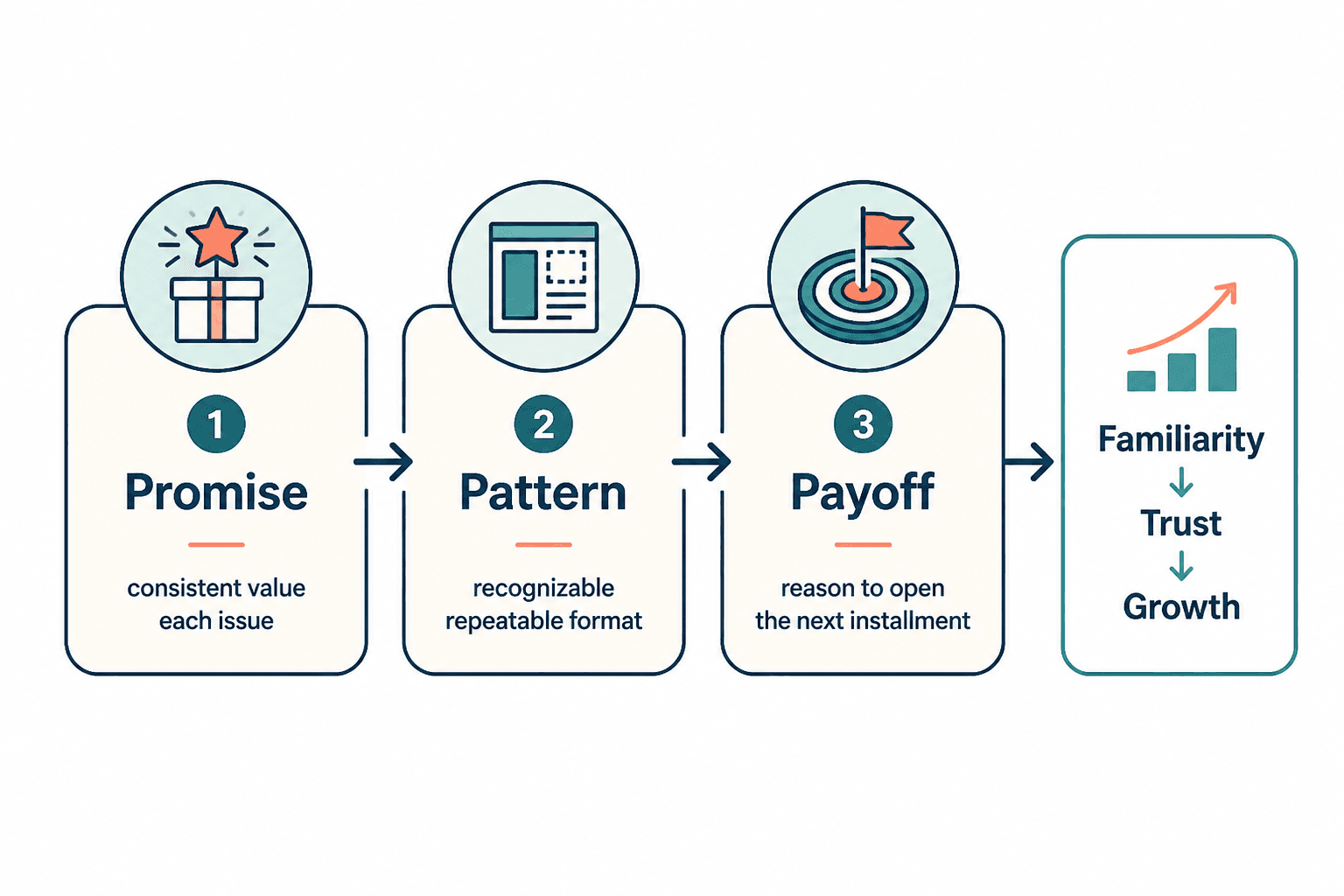
That is why series usually beat random standalone posts. A standalone can be strong, but a series gives your newsletter a shape. Shape matters. It gives readers a reason to return and gives you a way to stop negotiating with your own blank page every week.
Substack post ideas vs. series ideas
Use a post idea when the topic is self-contained: one lesson, one teardown, one opinion, one useful resource. Use a series idea when the topic has repetition built in: recurring mistakes, weekly analyses, monthly experiments, before-and-after rewrites, or a continuing set of examples.
A simple test:
- If the idea can be resolved in one sitting, make it a post.
- If the idea gets better when repeated with variation, make it a series.
- If the idea only exists because you are trying to “be consistent,” rethink it.
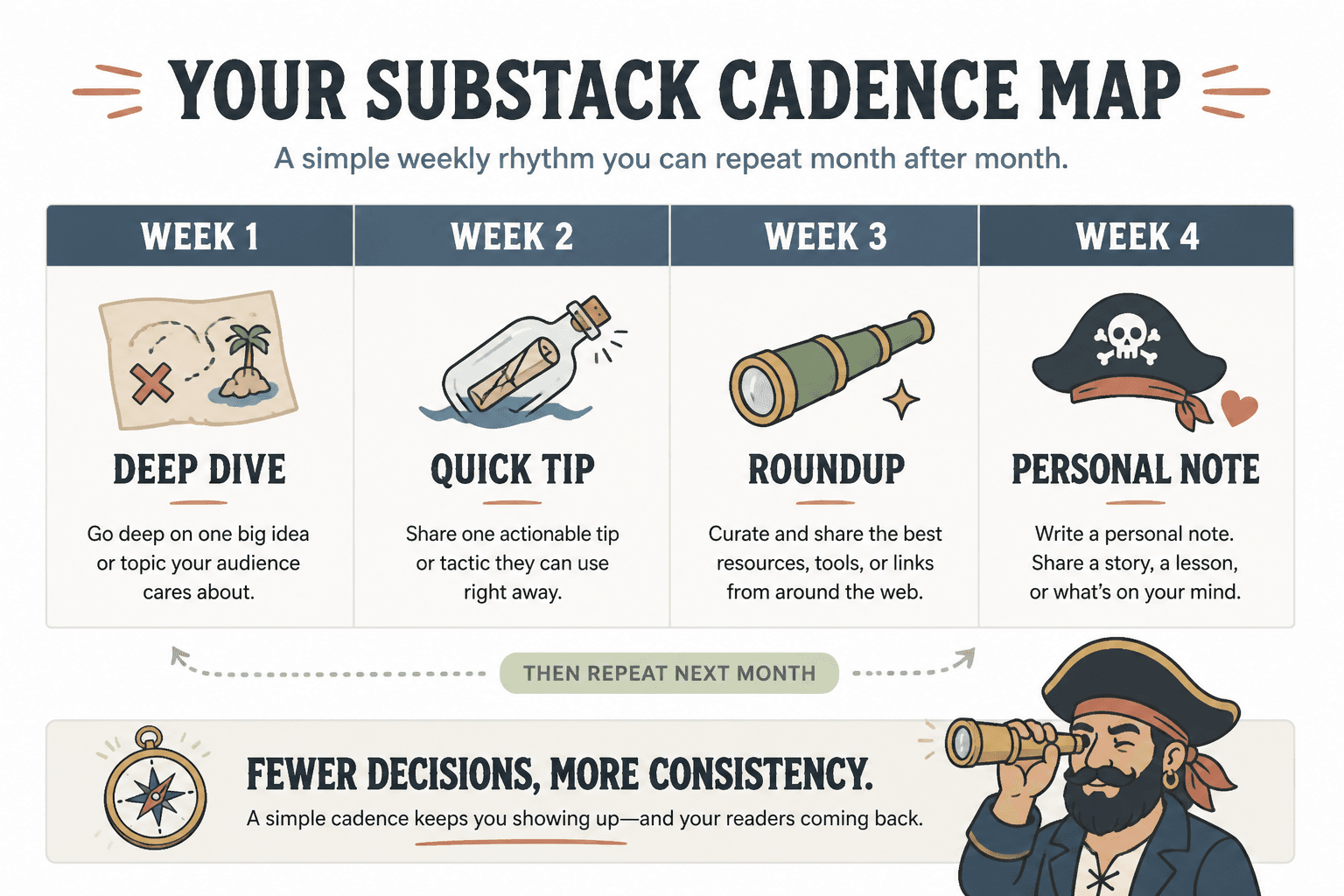
For a practical content-system view, the cadence guide on simple Substack issue cadence templates is useful once you know what you want to publish. A good idea still needs a schedule that does not insult your calendar.
12 Substack post ideas creators can adapt fast
These work well when you want something immediate, specific, and low-drama. Each one can be written as a standalone issue or turned into the start of a series later.
- A practical teardown. Break down a landing page, newsletter issue, product page, habit, workflow, or creator strategy.
- The mistake analysis. Show the error, explain why it happens, and offer a better move.
- Before-and-after rewrite. Take a weak draft and show how to improve it.
- A framework post. Name a simple model people can remember and reuse.
- A “what I’d do differently” post. Reflect on a common decision and show the better version.
- A curated roundup. Gather tools, examples, prompts, or references around one theme.
- A short case study. Explain what happened, what changed, and what it suggests.
- A myth-busting post. Pick one popular assumption and pressure-test it.
- A playbook post. Walk through a process step by step.
- An opinion with evidence. Make a clear claim and support it with examples.
- A reader Q&A. Answer one useful question in depth instead of collecting ten shallow ones.
- A resource post. Share templates, prompts, examples, or a checklist readers can use immediately.
If you write for coaches, consultants, or other service-based brands, the page on Substack posts and series examples for coaches, consultants, and personal brands has more angle-specific examples that translate well into practical newsletters.
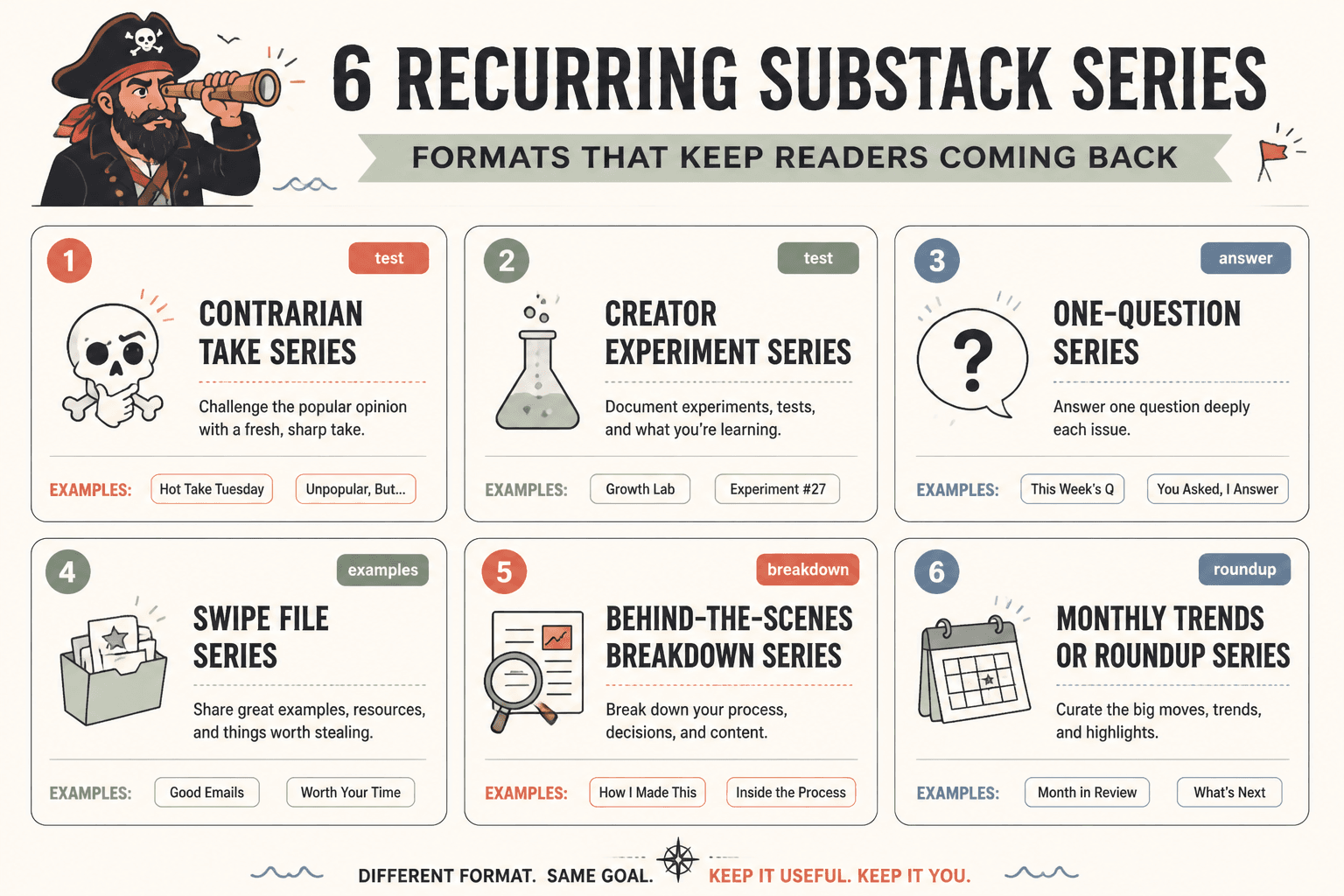
12 Substack series ideas creators can adapt fast
Series ideas work best when they create a stable editorial rhythm. A good series should feel obvious in hindsight. Readers should think, yes, of course this could be weekly.
- The weekly teardown. Analyze one page, issue, campaign, or creator move each week.
- The mistake-of-the-week series. Name one recurring error and fix it.
- The rewrite series. Improve one weak paragraph, headline, or section at a time.
- The framework library. Introduce one reusable model per issue.
- The examples file. Curate strong examples around a narrow theme.
- The question series. Answer one reader question per issue.
- The before-and-after series. Show how ideas improve when edited with intention.
- The behind-the-scenes series. Walk through your process, decision-making, or workflow.
- The mini-case-study series. Share small observations with one clear lesson each time.
- The prompt series. Give readers one prompt, one angle, and one way to use it.
- The roundup with a filter. Collect useful items, but through one specific lens.
- The seasonal series. Revisit one theme at recurring intervals: quarterly, monthly, or around launches.
For a broader editorial planning angle, the cadence guide on simple issue cadence templates is the natural next step. Series ideas are easier to sustain when the calendar is doing some of the labor.
How to choose the right kind of series
The best series usually comes from one of two places: the material you already have, or the questions your readers keep asking.
Pick based on your strongest raw material
If you already have:
- notes from client work,
- drafts that keep circling the same subject,
- screenshots of recurring problems,
- or examples you keep saving for later,
then you already have a series hiding in plain sight. The job is to find the pattern.
Pick based on reader intent
Some readers want education. Some want examples. Some want a point of view they can trust. A series works when the promise matches that intent clearly. If your audience wants practical help, a weekly teardown or rewrite series will probably outperform something moodier and less specific.
For a closer look at how series can connect to revenue without becoming dreary about it, see how to turn Substack posts and series into more leads or sales.
How to turn one idea into a usable series in 15 minutes
You do not need a grand editorial architecture. You need a repeatable sentence.
Try this structure:
- Name the promise. What does the reader reliably get?
- Name the pattern. What repeats in each issue?
- Name the payoff. Why should anyone keep reading?
- Name the format. Teardown, rewrite, roundup, Q&A, lesson, or example file.
For example, a series might become:
- Promise: one useful improvement every week
- Pattern: a weak draft gets rewritten
- Payoff: readers learn to spot the fix themselves
- Format: before-and-after rewrite
That is enough. More detail can come later, preferably after the first draft stops acting dramatic.
Examples by creator type
Different creators need different kinds of repeatability. The idea should fit the work, not the other way around.
For writers and editors
- Weekly teardown of a newsletter issue
- Rewrite of a weak paragraph or headline
- Examples file of strong openings
For coaches and consultants
- Client-pattern post
- Framework post
- Common mistake and fix
For educators and course creators
- Lesson-of-the-week series
- Prompt plus walkthrough
- Mini case study with application notes
For designers and strategists
- Before-and-after critique
- Pattern spotting in real examples
- Decision breakdown with visual references
If you are deciding whether your content plan needs more structure, the parent guide on Substack posts and series keeps the bigger picture in view. A good series is not just a content bucket. It is editorial positioning.
What strong Substack examples usually look like on the page
The strongest Substack posts and series often follow a simple sequence:
- Hook: open with a concrete problem, tension, or observation.
- Point: state what the reader will learn or get.
- Support: show an example, a breakdown, or a small proof.
- Payoff: make the takeaway easy to use.
- Next step: point to the next issue, template, or related guide.
That structure is boring in the best possible way. It keeps the writing from dissolving into “thoughts on a topic,” which is how many newsletters quietly become fog with a subscribe button.
Common mistakes to avoid
- Making every issue a fresh invention. If there is no pattern, there is no series.
- Choosing themes that are too broad. “Marketing” is not a series. “Landing page teardowns for solo creators” is.
- Using examples without a point. A screenshot is not an argument.
- Picking a cadence that fights your life. A brilliant monthly series beats a heroic weekly plan that collapses by issue three.
- Writing for consistency instead of usefulness. Readers do not subscribe to admire your calendar.
For help making the publishing rhythm realistic, revisit the cadence templates. For help improving the actual writing, use how to write better Substack posts and series.
Quick starter list: pick one and publish
If you want the shortest possible path from idea to draft, choose one of these:
- One weekly teardown
- One mistake-of-the-week post
- One before-and-after rewrite
- One framework issue
- One curated examples roundup
- One reader question answered clearly
Then write the first issue with the simplest version of the format you can tolerate. Fancy can wait. Published is useful.
Related guides
- Substack posts and series parent guide
- How to write better Substack posts and series
- Simple issue cadence templates
- Turn posts and series into more leads or sales
- Best AI tools for Substack posts and series
Substack gets easier when the idea has a shape. Examples are how you find that shape before the draft starts freelancing.