
Most people do not struggle with Substack because they cannot write.
They struggle because every post feels like a standalone performance, and every newsletter goes out with the same low-grade panic: “Is this useful enough, smart enough, interesting enough, strategic enough?” That is a miserable way to publish.
If you are a coach, consultant, or personal brand, Substack works better when you stop treating it like a weekly blank page and start treating it like a system. Good posts matter. But good series are what make your publication easier to sustain, easier to read, and much easier to remember.
This guide gives you practical Substack Posts and Series Examples for Coaches, Consultants, and Personal Brands, plus formats you can steal, adapt, and actually keep publishing. Not vague “share your journey” fluff. Real post types, repeatable series ideas, and examples that help you build trust without sounding like a guy shouting “value bomb” into a ring light.
If you want a broader foundation first, it also helps to read this guide to Substack posts and series and the wider email newsletter writing category. But for now, let’s keep it useful.
For the full path around this topic, head to the parent guide.
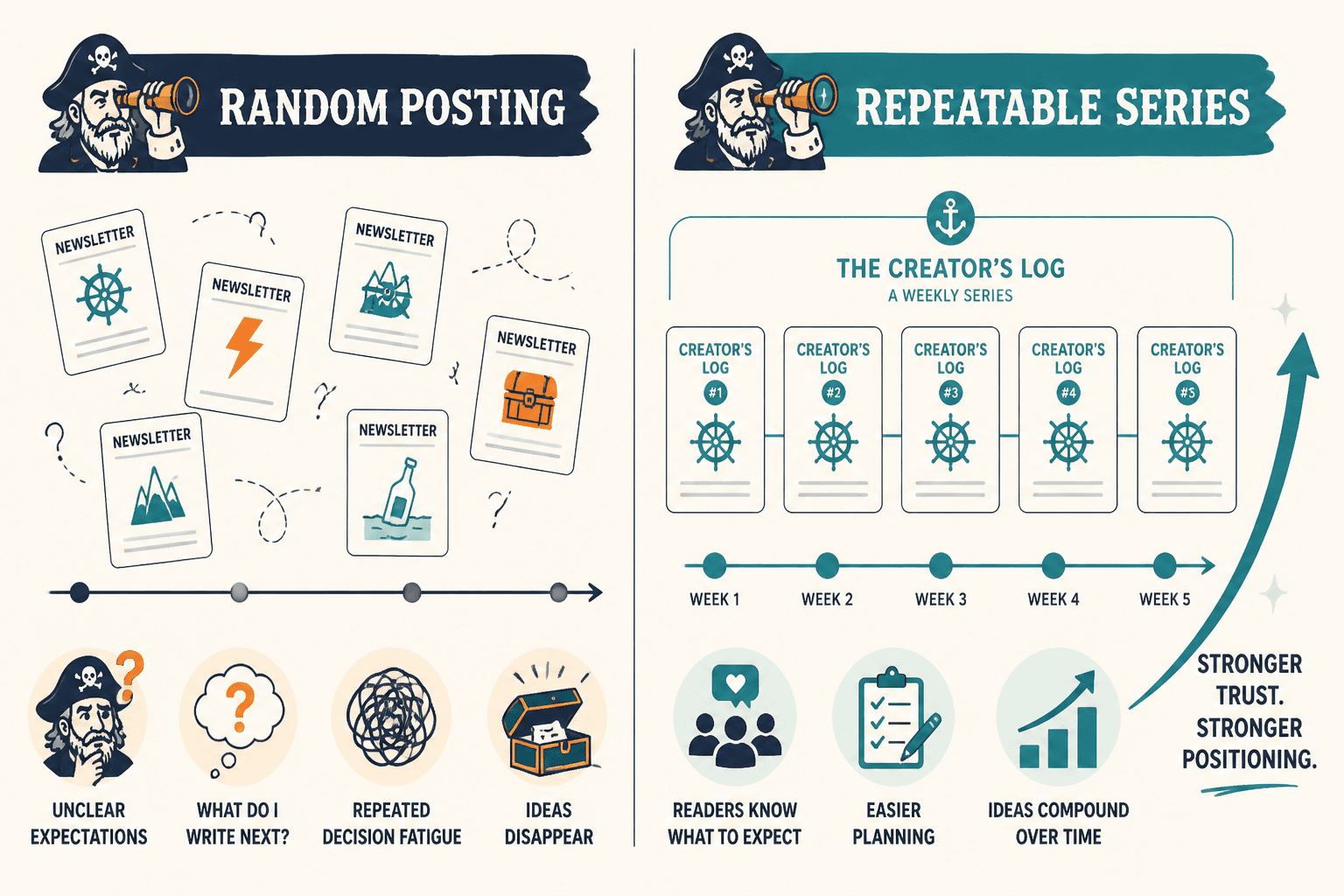
Why series beat random posting on Substack
A strong standalone post can absolutely work. But random posting creates three problems fast:
- Readers do not know what to expect from you
- You spend too much time deciding what to write next
- Your best ideas get buried instead of compounded
A series fixes all three.
It gives readers a reason to come back. It gives you a structure to think inside. And it lets you develop one useful angle over time instead of stuffing your entire brain into one oversized newsletter and calling it strategy.
For coaches, consultants, and personal brands, that matters even more because your content is not just entertainment. It is positioning. It is trust-building. It is often the bridge between “this person seems smart” and “I would probably hire them.”
What makes a good Substack post for a service-based brand
A good Substack post is not just “valuable.” That word has been abused beyond recognition. A good post usually does one or more of these things clearly:
- Teaches something specific
- Frames a problem in a sharper way
- Shows how you think
- Gives readers language they can reuse
- Offers proof, pattern recognition, or perspective
- Moves people one step closer to trusting your process
Notice what is missing: performative inspiration, generic productivity rambling, and diary entries disguised as thought leadership.
If your business depends on expertise, your newsletter should make that expertise easier to feel. Not just easier to claim.
The sweet spot
The best Substack posts for coaches and consultants sit in the overlap between useful, opinionated, and applicable.
Useful means the reader can do something with it. Opinionated means it sounds like a person with judgment, not a committee-built PDF. Applicable means it connects to real work, not abstract “mindset shifts” floating around without friction.
7 Substack post types that actually work
You do not need 47 formats. You need a handful that fit your expertise and can be repeated without making readers feel trapped in content Groundhog Day.
1. The practical teardown
Pick a common mistake in your industry and break down why it fails, what people misunderstand, and what to do instead.
Example: “Why most lead magnets fail before anyone downloads them”
This works well for consultants, conversion strategists, marketers, messaging coaches, sales coaches, and anyone whose value comes from seeing where things break.
2. The client-pattern post
Write about a recurring pattern you see across clients, prospects, or your industry. Keep it anonymous. Keep it specific.
Example: “The real reason smart consultants keep publishing content that gets polite silence”
This format works because it shows authority without needing to chest-thump about authority.
3. The framework post
Take something you repeatedly explain and turn it into a simple model.
Example: “The 4-part test I use to judge whether a newsletter topic is worth sending”
Frameworks are useful because readers remember them. They also make your thinking easier to repurpose into posts, talks, threads, and offers later.
4. The before-and-after rewrite
Show a weak piece of copy, positioning, content, or messaging. Then improve it.
Example: “Before and after: turning a vague coaching bio into something clients might actually trust”
These posts are gold because they are concrete. Readers can see the improvement, not just nod vaguely at advice.
5. The contrarian clarification
Take a popular piece of advice and explain what it gets wrong, or where it breaks down.
Example: “Be authentic is bad content advice if nobody understands what you actually do”
This is where a little sharpness helps. Not fake controversy. Just clean disagreement with receipts.
6. The field note
Share a short observation from recent work, a campaign, client conversations, sales calls, audience replies, or content testing.
Example: “A pattern I keep seeing in newsletters that grow slowly but convert well”
This style feels current without needing hot takes on every passing trend.
7. The useful opinion essay
This is not a rant for sport. It is a sharper point of view backed by explanation.
Example: “Most personal brands do not need more content ideas. They need stronger recurring angles.”
When done well, this kind of post builds loyalty because people start returning for your judgment, not just your tips.
Substack series examples for coaches, consultants, and personal brands
Now the useful part: actual series you can run.
You do not need to launch all of these. In fact, please don’t. That is how newsletters become abandoned content museums. Pick one core series and maybe one lighter recurring format around it.
1. “Common Mistakes I Keep Seeing”
Best for: strategists, consultants, editors, marketers, business coaches, operations people
Each issue covers one mistake, why it happens, what it costs, and how to fix it.
Example issue ideas:
- Why your welcome email sounds competent but forgettable
- The positioning mistake hidden inside “I help everyone” messaging
- Why your CTA is asking for too much, too soon
2. “Rewrite Clinic”
Best for: copywriters, messaging strategists, brand coaches, ghostwriters, marketing consultants
Each issue features a before/after rewrite of a bio, hook, landing page section, sales email, About page, or social post.
Simple structure:
- What the original was trying to do
- Why it was weak
- The rewrite
- The principle behind the improvement
This is one of the strongest authority-building formats because it demonstrates taste. Tools can imitate structure. Taste is the expensive part.
3. “Client Questions, Answered Properly”
Best for: coaches, consultants, educators, advisors
Take real questions clients ask and answer them with more depth than you would in a quick DM or call.
Example issue ideas:
- How often should you email your list if you do not want to annoy people?
- When should a consultant start building a newsletter?
- Should your personal brand content be broad or niche?
This works because it meets actual demand instead of forcing content topics out of thin air.
4. “Behind the Strategy”
Best for: consultants, fractional leaders, strategists, operators, brand advisors
Use this series to explain how you think through decisions, tradeoffs, audits, messaging, growth choices, or campaign planning.
Example issue ideas:
- How I decide what content belongs in a founder newsletter versus LinkedIn
- How I audit a weak offer before touching the copy
- What I look for before recommending a lead magnet
Readers who may buy high-trust services often want to see your thinking process, not just your conclusions.
5. “What Changed My Mind”
Best for: experienced operators, senior consultants, thoughtful coaches, creators with real scars and pattern recognition
Each issue covers an opinion or method you used to believe, why it made sense at the time, and what changed.
Example issue ideas:
- I used to think consistency mattered most. Now I think format clarity matters first.
- I used to push long newsletters harder. Now I care more about recurring sections.
- I used to treat content as audience-building. Now I also treat it as sales pre-qualification.
This format works because it feels human and credible at the same time. It shows growth without the fake vulnerability sludge.
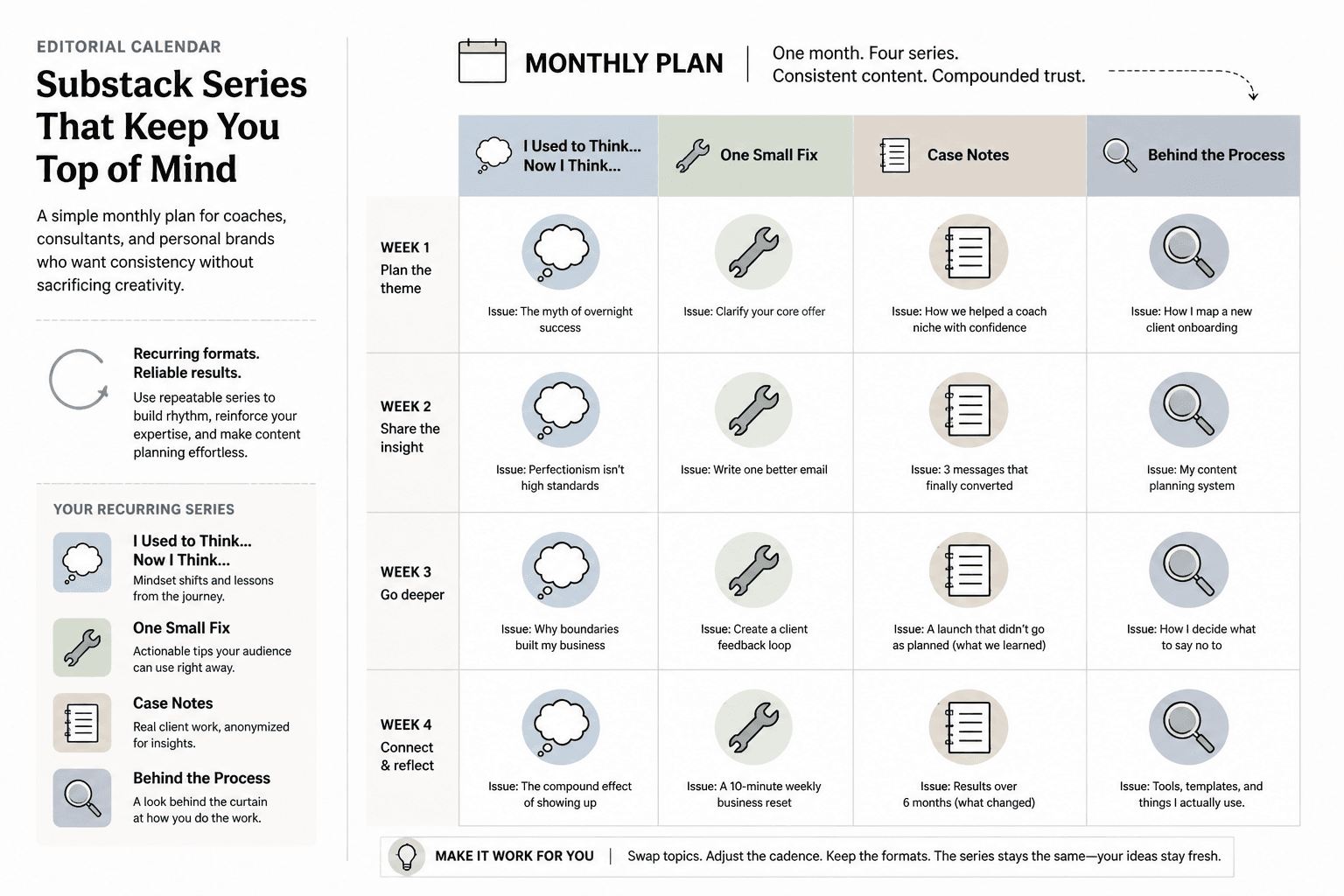
6. “One Small Fix”
Best for: busy audiences, high-frequency publishing, conversion-focused newsletters
Each issue gives one small but meaningful improvement readers can make that week.
Example issue ideas:
- Replace your vague headline with a problem-specific one
- Cut the first three sentences from your newsletter intro
- Add one proof point to your About page
These issues are short, easy to produce, and genuinely helpful. That is a strong combination.
7. “Case Notes”
Best for: consultants, service providers, strategic coaches, freelancers with client-based work
Share anonymized mini case studies with enough specificity to teach something.
Simple structure:
- The starting problem
- The mistaken assumption
- What changed
- The result or lesson
You do not need inflated revenue screenshots to make this useful. Often the interesting part is the decision-making, not the vanity metric.
Example weekly Substack series setups
If you want a repeatable system, here are three easy ways to structure it.
The bigger point is simple: clearer structure and clearer writing make the piece more useful. That is usually what makes the ending land better too.