Most product and service descriptions are not too short. They are too foggy, too padded, or too busy trying to sound impressive.
That is why short descriptions often win. Not because people suddenly hate detail, but because detail is only useful when it helps someone decide. A lot of longer copy does not do that. It just burns attention while saying the same vague thing three different ways.
When short product and service descriptions beat long ones, it is usually for a simple reason: the buyer already has decent context, and what they need next is clarity, not a paragraph marathon.
If you sell services, digital products, offers, packages, or anything tied to your expertise, this matters more than people think. The right short description can sharpen positioning, improve conversions, and make your site feel more confident. The wrong long one can make the whole offer feel weirdly slippery.
This article will show you when shorter descriptions work better, when they definitely do not, and how to write concise copy that still sells. Because “short” is not the goal. Clear is the goal. Short just happens to be one very effective way to get there.
Want the broader roadmap? Start with the parent guide.
Why short descriptions often perform better
Short copy works when it reduces friction.
That sounds obvious, but people miss it all the time. They assume more explanation automatically creates more trust. Sometimes it does. Often it just creates more work for the reader.
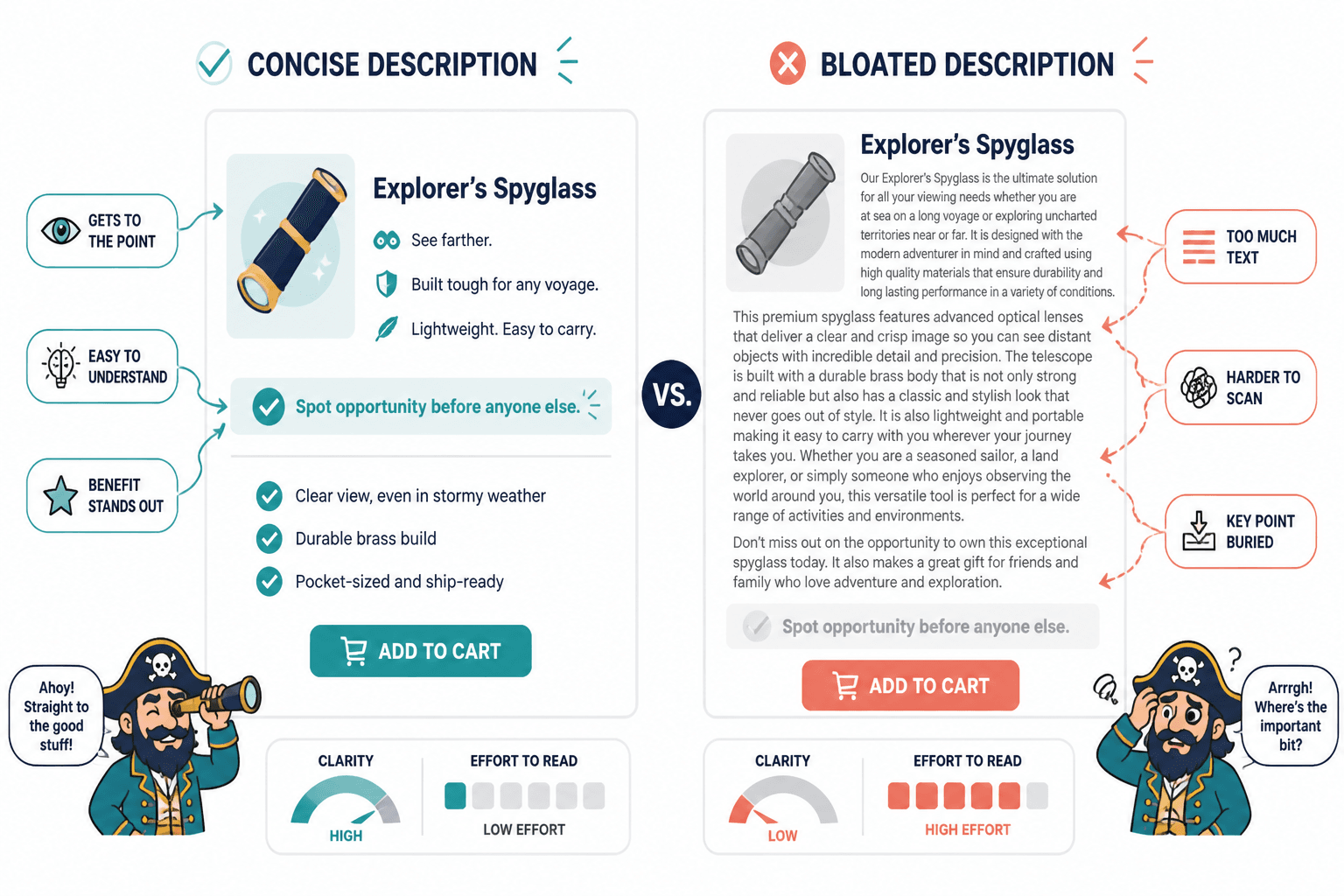
A short product or service description can outperform a long one because it does a few things very well:
- It gets to the point fast
- It makes the offer easier to understand
- It lowers the effort needed to evaluate the page
- It helps the strongest benefit stand out
- It keeps people moving instead of making them re-read mush
If someone lands on your page and cannot quickly answer “What is this, who is it for, and why should I care?”, longer copy usually makes the problem worse.
And yes, some brands absolutely hide weak positioning inside long descriptions. A bloated paragraph can look substantial while saying almost nothing. Classic trick. Still bad.
When short product and service descriptions beat long ones
There is no magic word count here. Short wins under specific conditions. If those conditions are present, brevity can be a conversion advantage instead of a risk.
1. The offer is already familiar
If people already understand the category, they usually do not need a mini essay.
For example:
- A discovery call
- A website copy audit
- A one-hour coaching session
- A Notion template
- An email welcome sequence template
- A brand messaging guide
In these cases, the buyer probably knows the general shape of the thing. What they need is what makes your version useful, different, or relevant.
A short description can do that beautifully if it names the audience, result, and angle without meandering.
2. The page already provides context elsewhere
Your description does not have to carry the whole sales job alone.
If the page already includes a strong headline, subhead, pricing section, FAQ, proof, screenshots, testimonials, or package breakdown, then the core description can stay lean. It just needs to do its job in the wider page structure.
This is where people get confused. They try to cram every possible detail into the description itself, even though the page already has supporting sections. The result is repetitive copy with the charm of a tax form.
3. The decision is low to medium friction
Shorter descriptions tend to work better when the purchase is not wildly complex.
If the price is moderate, the commitment is clear, and the outcome is easy to picture, concise copy usually helps. Readers do not need a dramatic guided tour. They need enough confidence to click.
This often applies to:
- Entry-level services
- Standalone templates
- Small digital products
- Introductory offers
- Defined consulting sessions
- Fixed-scope creative services
4. The offer has one clear outcome
The simpler the promise, the less copy you need.
If your service helps someone rewrite their homepage, improve their LinkedIn profile, clarify their positioning, or build a lead magnet, a short description can be enough because the result is fairly concrete.
Problems start when the offer tries to do twelve things for six audiences and still wants to be “short.” That is not concise. That is under-explained confusion.
5. The audience is scanning, not studying
A lot of visitors are not reading your page in a noble, attentive, literary state. They are scanning. Fast.
They are comparing tabs, checking prices, judging your credibility in seconds, and trying to decide whether this looks worth more of their time. Short descriptions respect that reality.
That does not mean dumbing things down. It means structuring copy for how people actually behave.
When short descriptions do not beat long ones
Short copy is not automatically better. Sometimes it loses because it leaves too many questions unanswered.
Longer descriptions usually earn their keep when the offer needs more trust, more explanation, or more nuance.
Use longer copy when the offer is complex
If you are selling a high-ticket consulting offer, a multi-stage service, a custom engagement, or anything with moving parts, a very short description can feel thin.
People may need more detail on process, scope, fit, outcomes, timeline, objections, and what happens next. If the buyer is making a bigger decision, more copy can reduce uncertainty.
Use longer copy when the category is unfamiliar
If your offer is new, niche, oddly named, or easy to misunderstand, you probably need more explanation.
A short description only works if the reader can quickly orient themselves. If they cannot, brevity starts feeling like vagueness wearing minimalist clothing.
Use longer copy when trust is not established yet
If your audience does not know you, and the offer asks for money, time, or access, they may need more proof and clarity before acting.
That does not mean writing a giant slab of sales copy. It means including enough detail to answer the obvious questions and calm the obvious doubts.
Short does not mean vague
This is where a lot of concise copy goes off the rails.
People cut words, but they do not improve meaning. So the final description is technically shorter and strategically worse.
Bad short descriptions tend to sound like this:
- “Strategic support for ambitious brands”
- “Helping businesses grow with clarity and confidence”
- “A transformative experience for founders ready to scale”
- “Done-for-you solutions tailored to your unique needs”
These are not concise. They are empty.
A good short description is specific enough to picture. It names the offer, the audience, the result, or the pain it solves. Usually at least two of those.
If your short description could sit on literally any consultant’s website without anyone noticing, it is not finished.
A simple framework for writing shorter descriptions that still sell
When you want a concise description, do not just trim. Rebuild it around the essentials.
Use this simple structure:
- What is it?
- Who is it for?
- What useful result does it help create?
- What makes this version different, easier, faster, clearer, or better?
You do not always need all four in one sentence. But if your page cannot answer them quickly somewhere nearby, the description probably needs work.
Formula options
Here are a few clean structures that work well for short product and service descriptions.
- [Offer] for [audience] who want [result]
- [Offer] that helps [audience] do [specific thing] without [friction/problem]
- [Offer]: [clear outcome] with [distinct angle or format]
- For [audience], this [offer type] helps you [result] in [timeframe/process/style]
Before-and-after examples
Here is where the difference gets obvious.
Example 1: Copy audit service
Before: A comprehensive strategic review of your brand messaging and website copy designed to identify gaps, uncover new opportunities, and provide tailored recommendations that support stronger audience connection and improved conversion performance.
After: A website copy audit for service businesses that shows what is confusing, weak, or quietly killing conversions.
The shorter version is clearer, more concrete, and much easier to process. It also sounds like it has a spine.
Example 2: LinkedIn profile rewrite
Before: Elevate your professional presence with a personalized profile optimization experience crafted to enhance credibility, communicate your unique value, and position you for meaningful business growth.
After: A LinkedIn profile rewrite that makes your expertise clearer, sharper, and easier for the right clients to trust.
Example 3: Digital template
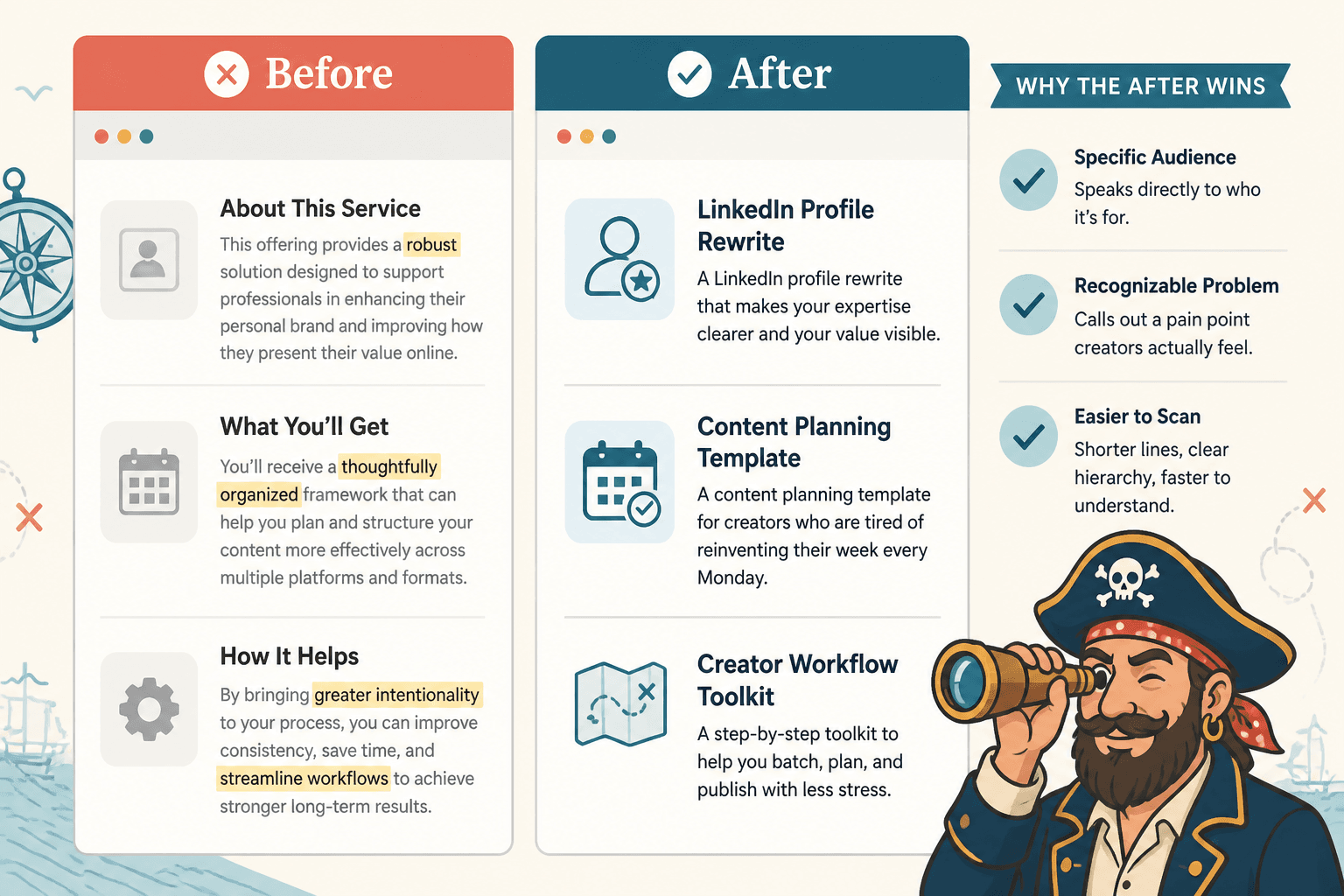
Before: This robust and thoughtfully organized template solution empowers creators to streamline their content planning workflows with greater intentionality, structure, and consistency across channels.
After: A content planning template for creators who are tired of reinventing their week every Monday.
Notice what is happening in these rewrites. The shorter copy is not simply “less.” It is more usable. It gives the reader something they can recognize and react to.
What to cut first when your description is too long
If your current copy feels padded, start here.
- Throat-clearing intros: “This offer is designed to…”
- Abstract benefit stacks: “clarity, confidence, visibility, and growth”
- Repetitive modifiers: “strategic,” “tailored,” “transformational,” “comprehensive”
- Obvious filler: words that make the sentence longer, not clearer
- Category explanation the audience already knows
- Multiple benefits saying the same thing
Then keep the parts that actually help someone decide:
- Specific audience fit
- Specific outcome
- Useful differentiation
- Clear format or scope
- Signals of trust or relevance
If you need help tightening vague copy, these product and service description clarity fixes will save you from a lot of common mess.
Where short descriptions work especially well on a page
Short descriptions are not just about total page length. They are often best used in specific spots.
- Service cards on a homepage or services overview page
- Product grids where people are comparing options
- Package summaries before the deeper details
- Bio-adjacent offer sections where the reader already knows who you are
- CTA sections where the job is to prompt a next step, not repeat the whole pitch
This is also why a layered page often converts better. You give people the short version first, then let them go deeper if they want. That is usually smarter than forcing everyone through the long version whether they need it or not.
For a broader look at strong structure, check the guide for creators who want better product and service description results.
How to know if your description should be shorter
Ask these questions:
- Does the reader already understand the type of offer?
- Is the outcome fairly easy to picture?
- Does the page provide supporting context elsewhere?
- Is the current copy repeating itself?
- Could the main point be understood faster with fewer words?
- Does the long version feel polished but oddly forgettable?
If the answer is yes to most of those, shorter probably has a good shot.
And if you are trying to decide on ideal length more broadly, this guide on how long product and service descriptions should be can help you avoid guessing.
A quick comparison: short vs long copy
| Situation | Shorter description usually works better | Longer description usually works better |
|---|---|---|
| Offer familiarity | The category is already understood | The category needs explanation |
| Decision friction | Low to medium | High |
| Outcome clarity | Clear and specific | Nuanced or multi-step |
| Trust level | Audience already knows you or has context | Audience needs more reassurance |
| Page structure | Other sections carry supporting detail | Description must do more of the heavy lifting |
| User behavior | Scanning and comparing | Researching and evaluating carefully |
Examples of strong short-description angles
If your copy still sounds mushy, one of these angles can help sharpen it.
- Pain-first: For clients who know something is underperforming and want it fixed
- Result-first: Best when the outcome is clear and desirable
- Audience-first: Useful when fit matters more than broad appeal
- Format-first: Helpful when the delivery style itself is a selling point
- Difference-first: Good when your method is simpler, faster, or more practical than alternatives
The bigger point is simple: clearer structure and clearer writing make the piece more useful. That is usually what makes the ending land better too.