
Most product and service descriptions sound like they were assembled by a committee of anxious marketers and one very tired robot.
You have seen the type. “Comprehensive solutions.” “Tailored excellence.” “Designed to empower your success.” Lots of words. Very little pulse. Technically polished. Emotionally dead.
The problem is not that your description needs to “sell harder.” It usually needs to sound more human, more specific, and much clearer about what the thing actually does for someone who might buy it.
If you want to know how to write product and service descriptions without sounding salesy or robotic, the fix is not cleverer adjectives. It is better framing. Better detail. Better empathy. Better decisions about what matters to the buyer and what is just filler wearing a blazer.
This is how to write descriptions that feel credible, useful, and persuasive without reading like a bad funnel page from 2019.
If you want the bigger picture, start with the parent guide.
Why most descriptions go wrong
Most weak descriptions fail in one of three ways:
- They are too vague to mean anything
- They try too hard to sound impressive
- They describe the offer from the business’s perspective instead of the buyer’s
That is how you get copy like “high-quality strategic support for growing brands.” Fine. Support doing what? For whom? Why this instead of the other twenty things calling themselves strategic?
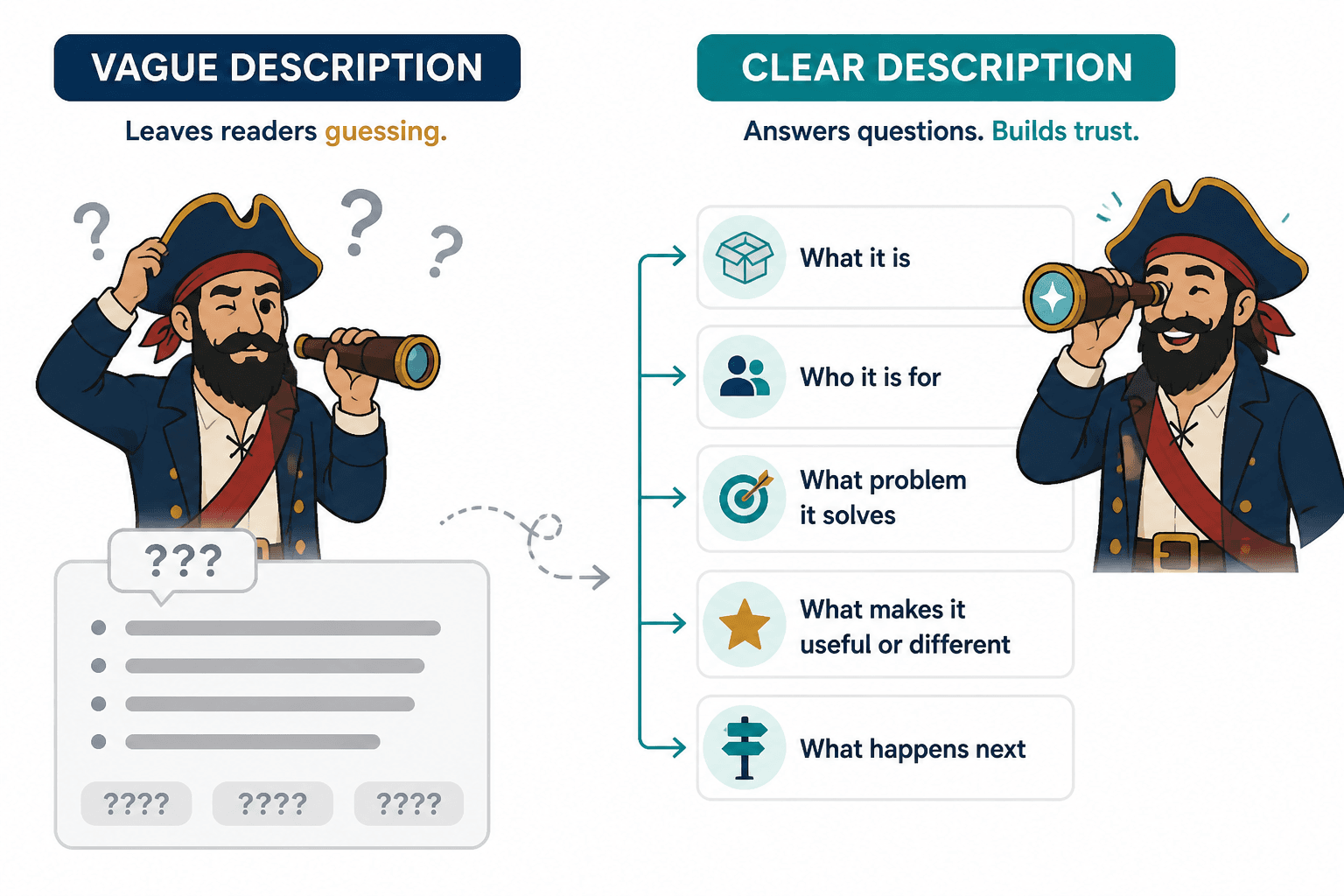
A good description does not just name the offer. It translates it. It helps the reader quickly understand:
- What this is
- Who it is for
- What problem it solves
- What makes it different or useful
- What happens next
If those five things are muddy, the whole description starts sounding generic, even if the actual offer is solid.
Start with what the buyer is trying to do
People rarely buy products or services because the wording was fancy. They buy because the offer feels relevant, understandable, and worth the trade.
So before you write anything, answer this question:
What is the buyer trying to get done, fix, avoid, improve, or become?
This one question cleans up a lot of mess. It pulls you away from internal jargon and toward actual buyer intent.
For example, if you sell website copywriting, the buyer is not trying to “elevate their digital presence.” They are probably trying to:
- Get more inquiries from the right people
- Explain their offer more clearly
- Stop sounding generic
- Improve conversions without turning the site into a circus
That language is already more useful because it reflects a real goal. It sounds like a human need, not a brochure in a hostage situation.
A simple starting formula
Use this as a rough base:
[Offer name] helps [specific person] do [specific outcome] without [common friction, confusion, or unwanted tradeoff].
Example:
“This messaging strategy package helps consultants and service-based founders explain what they do more clearly, so their website and content stop attracting vague interest and start pulling in better-fit leads.”
That is not poetry. Good. It is doing the much more important job of making sense fast.
Cut the phrases that instantly make your copy sound fake
Some phrases are not technically wrong. They are just overused to the point of meaninglessness. They make your descriptions sound machine-made even when a human wrote them.
| Weak phrase | Better direction |
|---|---|
| Tailored solutions | Say what gets tailored and why it matters |
| Results-driven | Name the result |
| High-quality service | Show what makes it good |
| Innovative approach | Explain what is different |
| End-to-end support | List what is included from start to finish |
| Designed to empower | Use plain English and say what changes for the buyer |
You do not need to ban every common phrase forever. But if a line could be pasted onto a skincare brand, a SaaS homepage, and a leadership coach’s landing page without changing a word, it is probably too generic.
Specific beats polished almost every time.
Describe the transformation, not just the container
A lot of descriptions get stuck describing the format of the offer instead of the value of it.
Format matters, sure. If something includes three calls, two reviews, a workshop, templates, or a dashboard, say that. But features alone rarely create desire. People want to understand what those parts actually do for them.
Here is the difference:
| Container-focused | Outcome-focused |
|---|---|
| Includes 4 coaching calls per month | Gives you weekly pressure-testing and clearer next steps, so you stop spiraling between ideas |
| Comes with a brand messaging workbook | Helps you pin down what to say on your site, in your bio, and in your content without vague filler |
| Offers custom website audits | Shows you exactly where your site is losing trust, clarity, or conversions |
The best descriptions connect the thing to the change.
If you need help sharpening that framing, it makes sense to pair this with service framing without sounding generic.
Use concrete language people can picture
Robotic copy often hides behind abstract nouns. Strategy. Transformation. Excellence. Alignment. Optimization. None of those are useless on their own, but too many of them in a row and the whole thing starts floating three feet above reality.
Concrete language grounds the description. It gives the reader something they can imagine, recognize, or compare against what they are dealing with now.
Abstract vs concrete
Abstract: “We help businesses improve brand clarity and audience engagement.”
Concrete: “We help service businesses explain what they do in plain English, tighten the messaging on key pages, and turn vague website visits into more qualified inquiries.”
The second one is stronger because it gives the reader more to hold onto. They can picture the website. They can picture the problem. They can picture the outcome.
That matters because buyers do not trust what they cannot quite understand.
Write like a person who knows the buyer, not like a catalog
You do not need to sound casual for the sake of it. You do need to sound like you understand the reader’s world.
That usually means using language they would actually say or recognize. Not every line has to be conversational, but if every sentence sounds processed, your copy starts losing trust.
For service businesses especially, a little human texture helps. Not forced quirk. Not fake relatability. Just signs of life.
Compare these:
Robotic: “Our comprehensive onboarding process ensures seamless integration and maximum alignment.”
Human: “The onboarding process is straightforward. We get clear on your goals, review what you already have, spot the weak points fast, and map out what happens next so nothing feels vague or dragged out.”
The second version is longer, yes. But it earns the space. It reduces uncertainty. It sounds like someone competent is speaking.
If your opening lines are especially limp, read how to start product and service descriptions without a weak opening. A lot of salesy copy begins by warming up for three sentences and saying nothing useful.
Stop trying to sound premium by being vague
This one catches a lot of smart businesses.
They worry that being too direct will make the offer feel simple or unsophisticated, so they reach for elevated language instead. The result is often copy that sounds expensive in the most unconvincing way possible.
Premium does not mean unclear. Premium usually sounds calmer, cleaner, more assured. It does not need twenty adjectives and a mood board’s worth of fog.
A strong high-end description often does three things well:
- It is precise about the problem
- It shows confidence without overclaiming
- It reduces friction by making the process and value feel obvious
That is a lot more persuasive than “bespoke transformational excellence.” Which, to be fair, does sound like it would cost money. Just not money spent wisely.
A practical structure for product and service descriptions
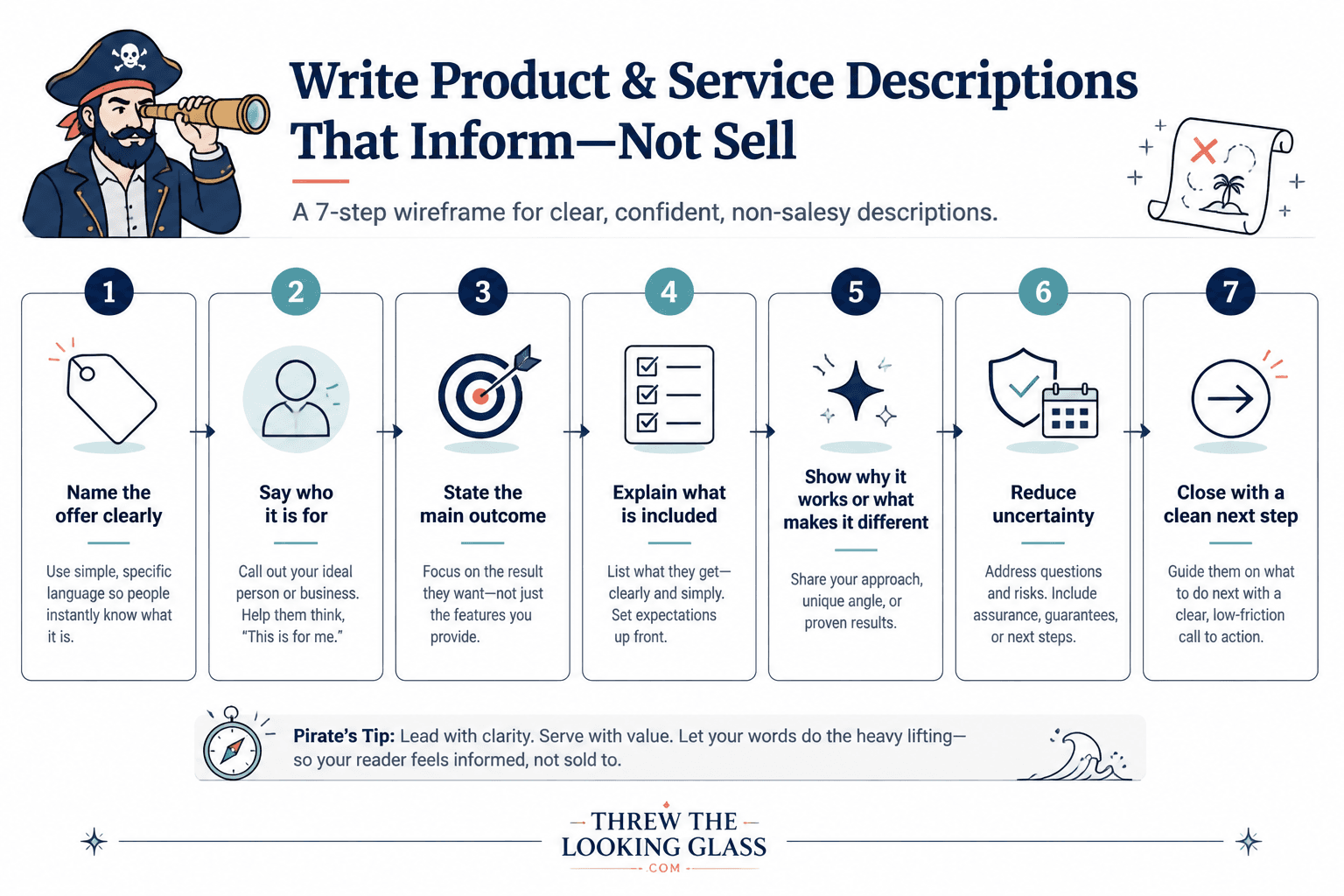
If you want a repeatable way to write better descriptions, use this structure.
- Name the offer clearly
Do not make people decode the title. - Say who it is for
Specific is usually better than broad. - State the main outcome
What does this help them do, get, fix, or avoid? - Explain what is included
Focus on the parts that make the value easier to understand. - Show why it works or what makes it different
Process, perspective, proof, or approach. - Reduce uncertainty
Timeline, expectations, fit, deliverables, communication, what happens next. - Close with a clean next step
Not a carnival-barker CTA. Just a clear move.
That structure works well on service pages, product pages, offer sections, sales pages, and even shorter homepage blocks.
Example: before and after
Before:
“Our signature consulting solution provides high-touch support for ambitious brands seeking scalable growth through custom strategy and implementation.”
After:
“This consulting package is for service businesses that have hit the point where word-of-mouth is not enough, but their marketing still feels scattered. We help tighten the message, fix the weak points in the customer journey, and build a simpler plan for turning attention into qualified leads.”
The second version is not trying to win a trophy for sounding important. It is trying to get the right person to say, “Ah. That is probably for me.”
Use proof and specificity instead of hype
If your copy feels too salesy, there is a good chance it is leaning on claims it has not earned.
Readers are pretty good at spotting inflated language. “Powerful.” “World-class.” “Proven.” “Revolutionary.” Maybe. But says who?
Whenever possible, replace hype with something more grounded:
- A specific outcome
- A clearer explanation of the process
- A constraint that makes the offer feel more believable
- A relevant example
- A client result, if you can support it honestly
For example:
Hype-heavy: “Our proven framework delivers exceptional results.”
Stronger: “The framework focuses first on offer clarity, buyer objections, and conversion friction, because those tend to be the points where most service pages quietly lose leads.”
Specificity is persuasive because it sounds like someone has actually done the work.
Match the tone to the offer, but keep it readable
Not every brand should sound breezy. Not every offer should sound intensely formal. But nearly every description benefits from sounding readable.
That means:
- Shorter paragraphs
- Clear sentences
- Less jargon
- More rhythm
- Less repetition
You can still sound polished, expert, premium, technical, warm, or direct. Readable does not mean simplistic. It means the buyer does not have to wade through syrup to understand what you are offering.
If you are refining a whole set of offer pages, how to write better product and service descriptions is a useful next read. It pairs well with this one because tone problems are often structure problems wearing nicer shoes.
How to make descriptions persuasive without turning them into a pitch parade
Persuasion is not the same as pressure.
A good product or service description does not need to hammer the reader with urgency, superlatives, and emotional theater. Usually, it just needs to reduce the right doubts.
Think about the questions buyers silently have:
- Is this for someone like me?
- Will this solve the problem I actually have?
- What exactly am I getting?
- Why this option instead of another one?
- What happens if I say yes?
If your description answers those questions well, it will usually feel more persuasive and less pushy.
And if your page needs to do a better job turning interest into action, read how to turn product and service descriptions into more leads or sales. Because clarity gets attention, but conversion still needs direction.
A quick editing test for salesy or robotic copy
Before you publish a description, run it through this quick filter.
- Would a real buyer understand this fast?
- Could this description belong to ten other businesses?
- Have I named a real outcome, not just a vague benefit?
- Does this sound like a person who understands the problem?
- Am I using hype where proof or detail would work better?
- Have I explained what happens next?
If too many answers are uncomfortable, good. That is the edit revealing itself.
The bigger point is simple: clearer structure and clearer writing make the piece more useful. That is usually what makes the ending land better too.