
The wrong assumption is that better Facebook posts are mostly a matter of “posting more” or “being more creative.” That is how people end up publishing a lot of content that politely exists and then vanishes. Better posts are usually simpler than that: they have a point, they sound human, and they give the reader a reason to keep going.
Facebook is not asking for a performance. It is asking for a post that feels worth a pause. That means fewer canned openings, fewer vague claims, and fewer endings that sound like they were approved by a committee of anxious content templates.
What “better” Facebook posts actually means
Better does not always mean longer, louder, trendier, or more “engaging” in the abstract. It usually means the post does a better job at the thing it was supposed to do.
- A conversation post should invite replies.
- A teaching post should make one idea easier to understand.
- A story post should move toward a clear point.
- An opinion post should say something with shape, not just noise.
- An offer post should connect the next step to a reason the reader actually cares.
That is the useful framing: a post is not “good” because it sounds polished. It is better when it fits its job and makes that job easier for the reader.
Why Facebook posts feel different from LinkedIn and X
Facebook is more conversational and relationship-driven than many other platforms. Readers are often seeing your post in the middle of a feed full of updates from people they know, groups they follow, and a handful of businesses trying their best not to sound like businesses.
That changes the writing. A Facebook post usually works better when it feels more direct, more human, and less packaged than a post you might write for a different platform. It can be useful, opinionated, funny, reflective, or promotional – but it should still sound like a person with a point.
If you want a broader framing for the role of posts in your overall content system, the parent guide on Facebook posts is the right companion piece.
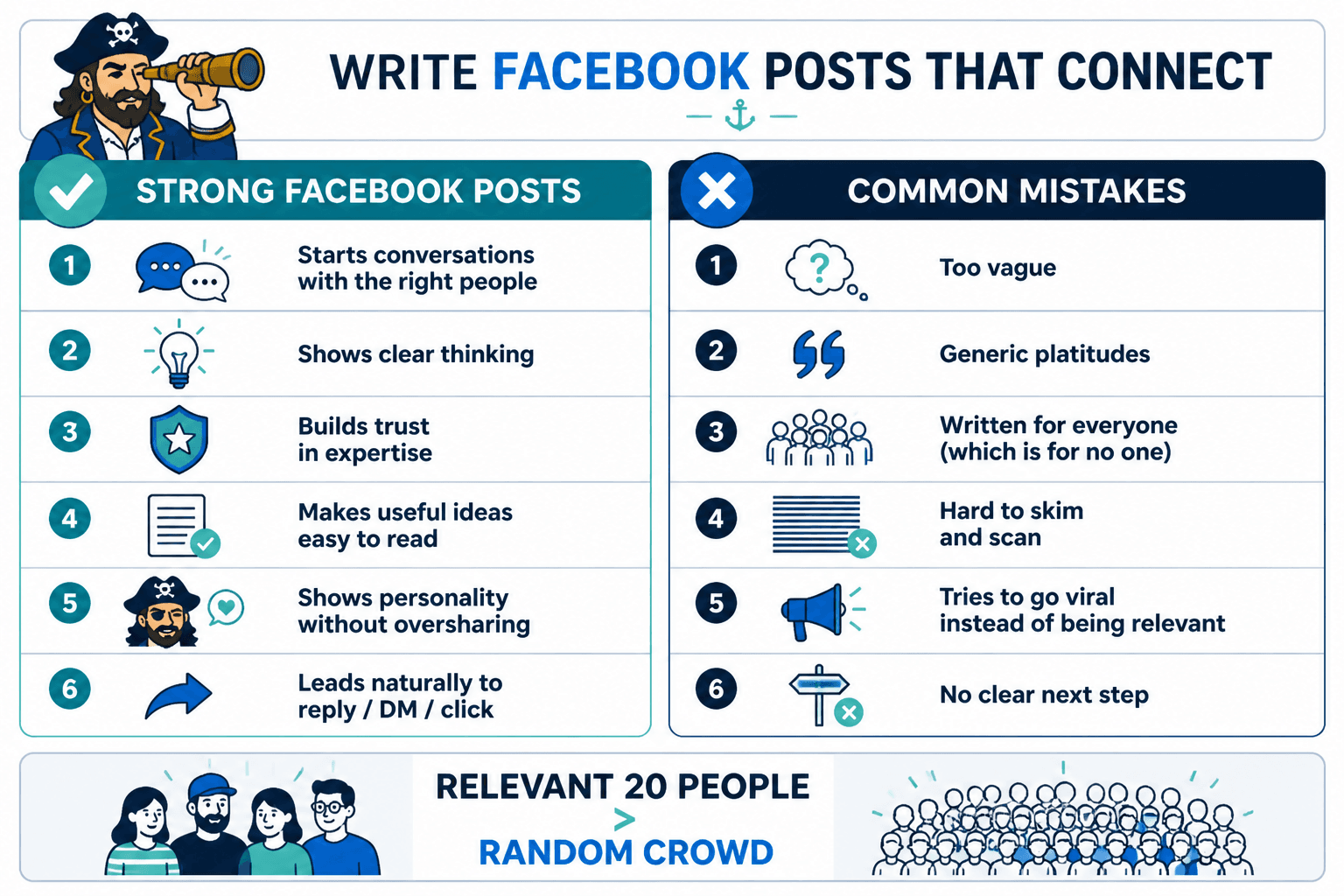
The 5 qualities of Facebook posts that get better results
1. They have a clear point
The reader should not need to solve what the post is about. If the point is buried under throat-clearing, the post loses momentum before it starts.
A clear point can be:
- a lesson learned
- a strong observation
- a useful tip
- a specific opinion
- a problem worth discussing
2. They sound like a person, not a content machine
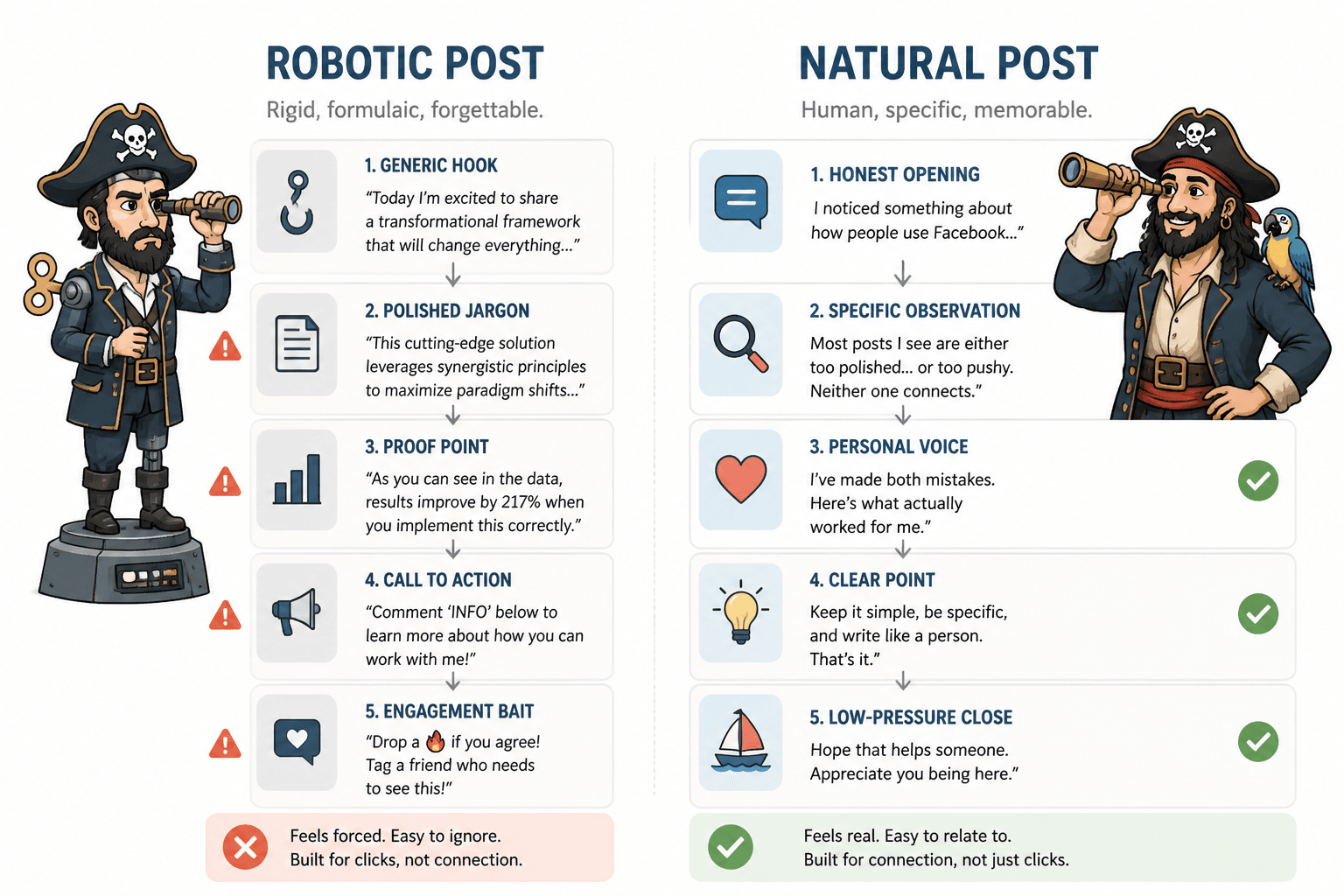
Robotic writing usually shows up when the post is trying too hard to sound “professional,” “valuable,” or “optimized.” That tends to produce sentences with no pulse.
Useful rule: write like you talk, then clean it up. Not the other way around. If the post sounds like it could have been generated by a motivational fax machine, keep editing.
If this is your main pain point, the sibling guide on how to write Facebook posts without sounding salesy or robotic goes deeper on the cleanup side.
3. They create something worth responding to
A good Facebook post does not always ask for comments directly, but it does leave room for a reaction. That might be agreement, disagreement, recognition, curiosity, or “yes, exactly, that’s the annoying part.”
Posts that are too complete can kill the conversation before it starts. Posts that are too vague do the same thing for a different reason.
4. They are easy to read
Facebook feeds reward clarity. Long blocks of text, weak structure, and buried ideas make people work too hard. And if the post makes people work too hard, they usually do the humane thing and scroll.
Easy to read does not mean simplistic. It means:
- short paragraphs
- clean sentence shape
- one main idea
- minimal filler
- no fake “setup” that delays the point
5. They match the relationship stage
A post to warm readers usually should not feel like a hard pitch. A post to engaged followers can be more direct. A post to a broader audience may need a little more framing. The same voice does not need to do every job at full volume.
That is why one template for every post tends to flatten results. The post should fit where the reader is, not where the writer wishes they were.
How to start Facebook posts without a weak opening
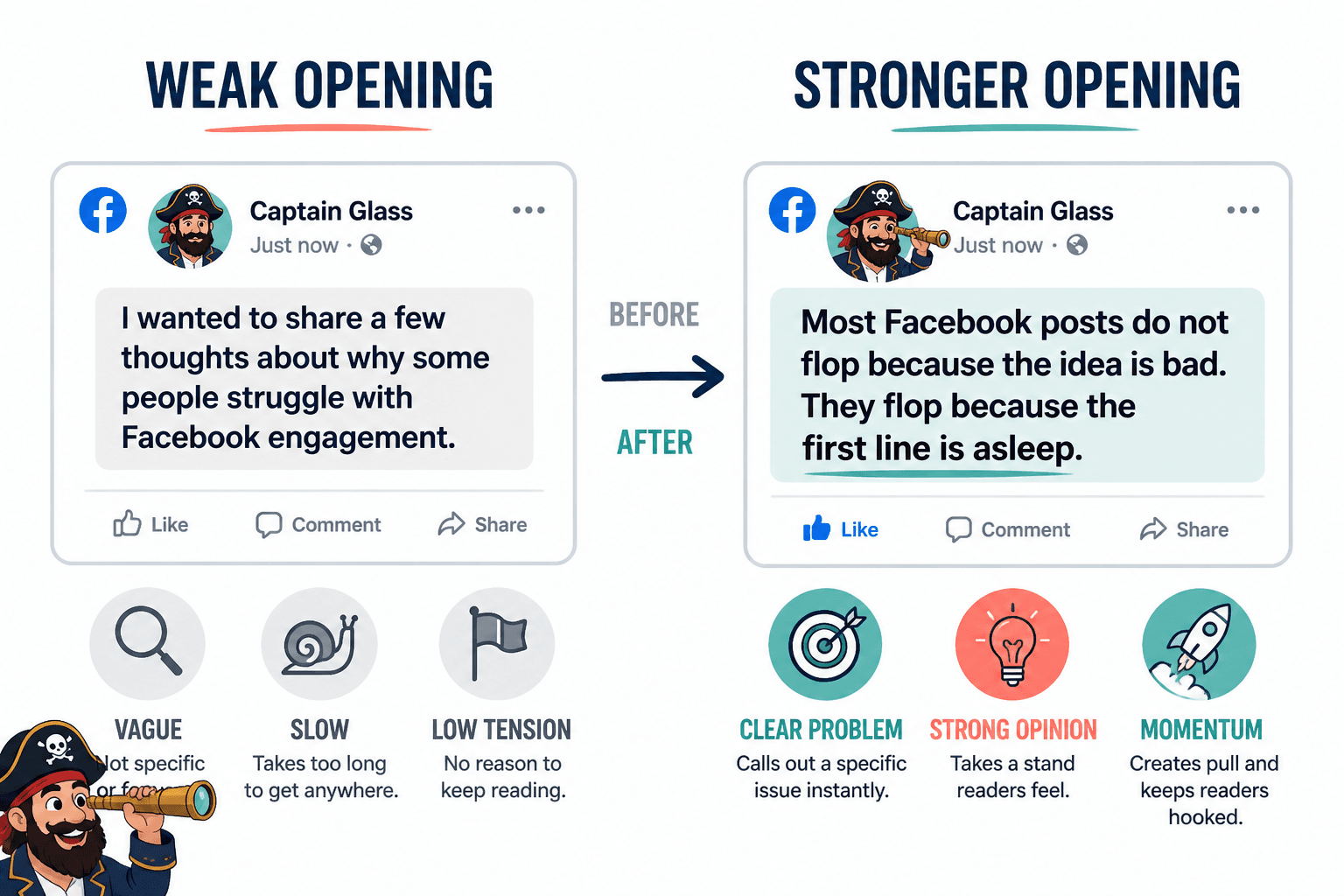
The opening line is not the whole post, but it does a lot of gatekeeping. Weak openings usually fail because they begin with generalities, apology energy, or a topic-shaped sentence that has no tension.
Stronger openings usually do one of these things:
- state the sharpest version of the problem
- show a specific observation
- start in the middle of a real moment
- lead with a clean opinion
- use contrast
A good test: if the first line could introduce almost any post on the same topic, it is probably too generic.
How to improve Facebook hooks without sounding generic
Hooks get generic when they open with a topic instead of a point. “Here’s how to improve your content” is a topic opening. “I stopped writing posts this way because it kept killing the point” is closer to a real hook.
Useful hook traits include:
- Specificity: name the real situation.
- Point of view: take a position instead of hovering over the topic.
- Natural language: avoid marketing perfume.
- Tension: show the problem, contradiction, or tradeoff.
A simple way to improve a hook is to ask: what is the most interesting part of this post, and why am I making the reader wait for it?
For more hook patterns, see how to improve Facebook posts engagement hooks without sounding generic.
How to keep Facebook posts from sounding salesy or robotic
Salesy writing usually tries to push too hard too soon. Robotic writing usually tries to sound “right” instead of sounding real. Both problems often come from the same fear: the writer wants the post to perform well before it has earned trust.
A cleaner approach:
- start with a point, not a performance
- use plain language first
- keep the offer connected to the topic
- remove phrases that sound copied from a “brand voice” worksheet
- let the post breathe a little
Sometimes the fastest fix is just cutting the line that sounds like it was written while glancing at a conversion spreadsheet.
How to rewrite boring Facebook posts
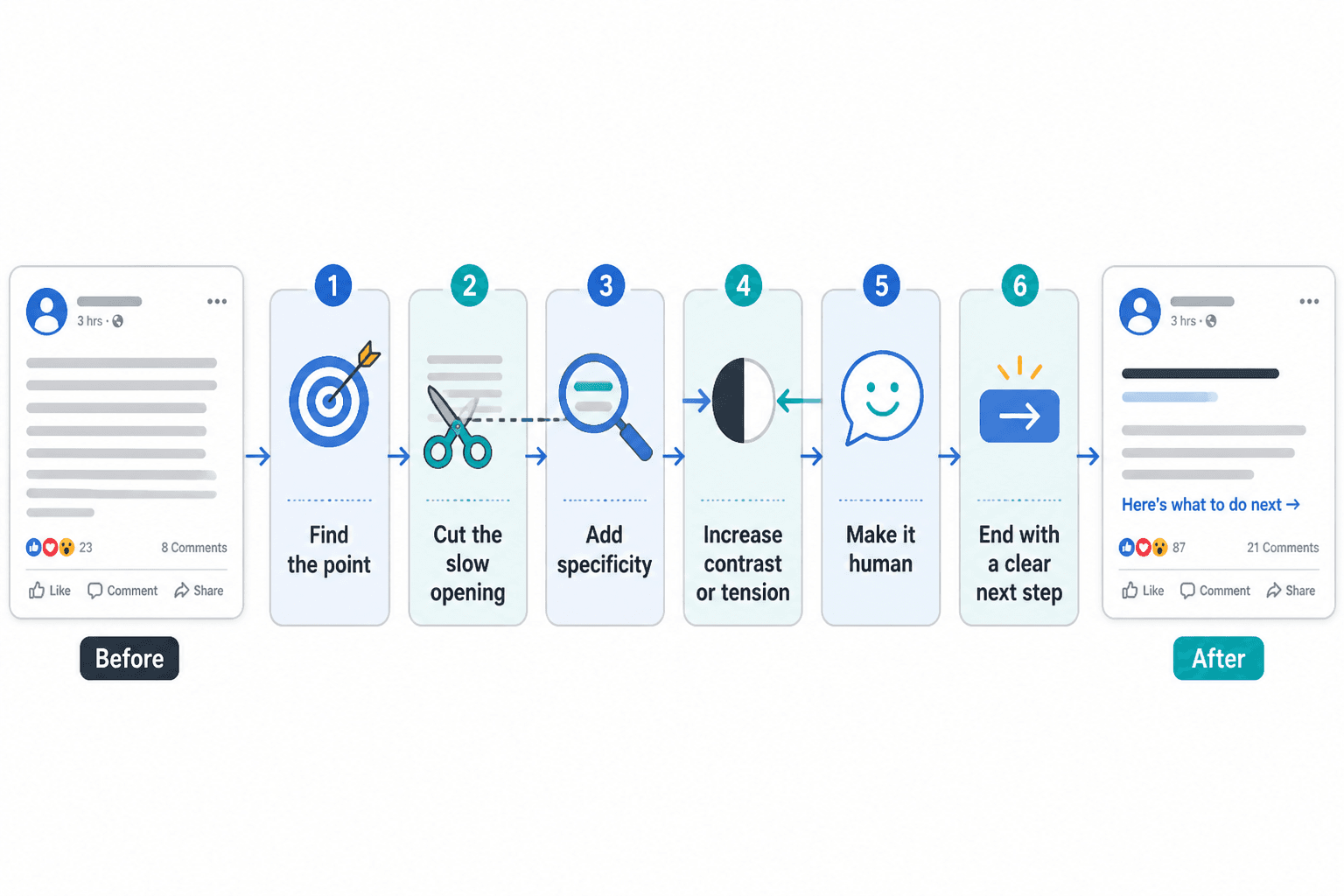
Most boring posts are not boring because the subject is bad. They are boring because the draft is drained of specificity and tension.
A fast rewrite process:
- Find the real point. What is the post actually saying?
- Cut the throat-clearing. Remove the warm-up that delays the point.
- Replace vague claims with concrete detail.
- Add contrast, tension, or opinion.
- Make the tone sound like a person.
If a draft feels flat, it often needs less explanation and more shape.
How long should Facebook posts be?
There is no single ideal length. The better question is: what does this post need to do?
Short posts work well when you want speed, punch, or quick response. Medium-length posts work well when you need a little explanation or proof. Longer posts can work when you have a story, strong opinion, or useful framework – but they have to earn their length.
- Short: quick take, one-liner, sharp observation, easy reply
- Medium: teaching, brief story, practical insight
- Longer: story, nuanced opinion, more complete lesson
If you want a tighter breakdown, read how long Facebook posts should be in 2026 and when short Facebook posts beat long ones.
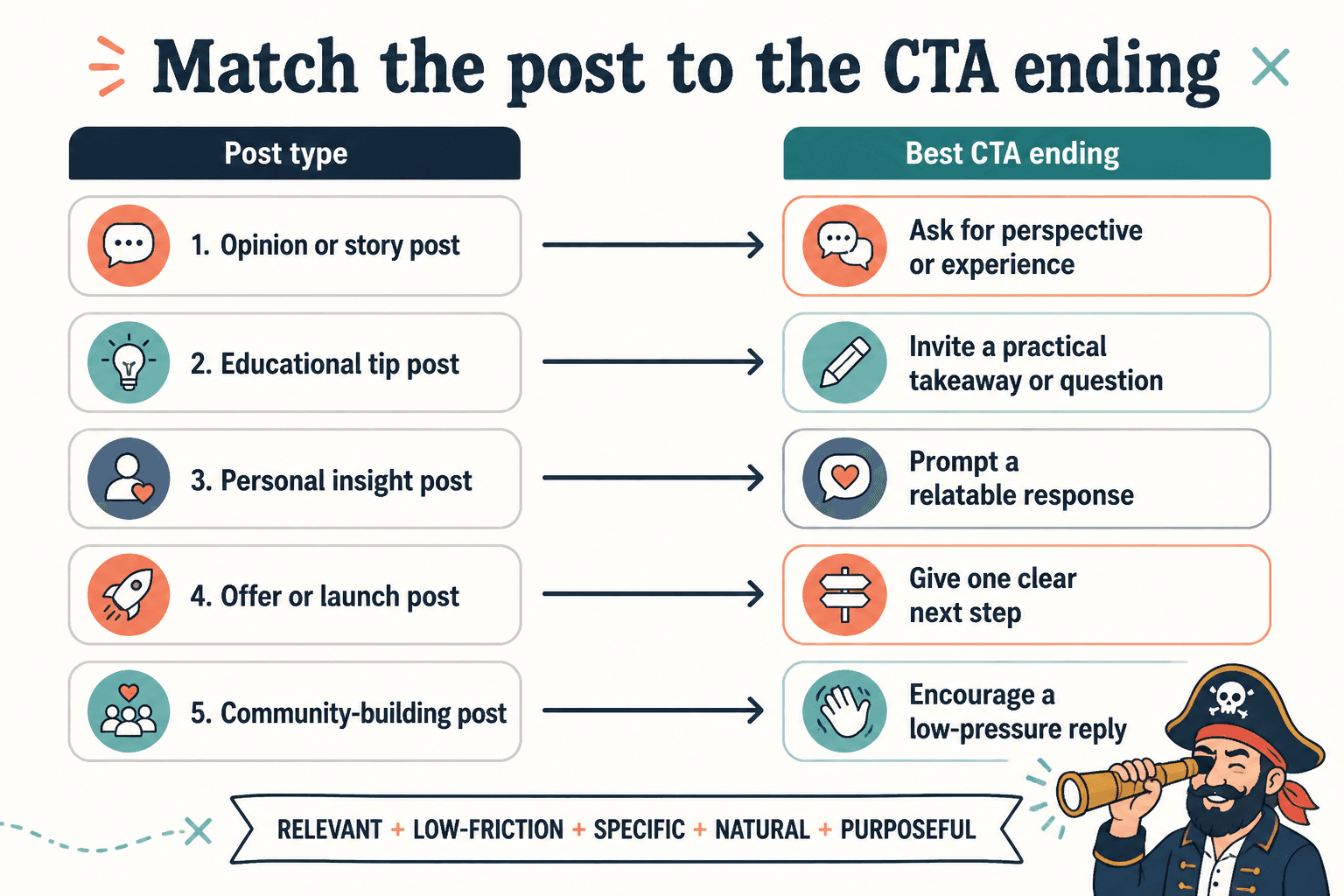
Better CTA endings for Facebook posts
Not every post needs a giant call to action. Some need a question. Some need a soft next step. Some just need to close cleanly instead of collapsing into “thoughts?” like a tired forum thread.
Useful CTA endings include:
- Conversation CTA: invite a real response
- Reflection CTA: ask the reader to compare with their own experience
- Soft lead CTA: point to the next useful step without pressure
- Action CTA: tell the reader exactly what to do next
- Community CTA: frame the post as a shared discussion
The best CTA is usually the one that fits the post’s job, not the one that sounds most “conversion optimized.” For more examples, see better Facebook CTA endings for personal brands.
A simple workflow for writing better Facebook posts
Here is the version that keeps the process sane:
- Choose one job for the post.
- Write the point in one plain sentence.
- Draft the opening with the sharpest angle available.
- Strip out anything that sounds vague, padded, or performative.
- Check that the body matches the opening.
- End with a CTA that fits the post’s purpose.
That workflow is not glamorous, which is one reason it works.
Facebook post types that are especially useful
Some formats make strong writing easier because they give the post a job immediately.
- Useful observation post: one specific insight the reader can use
- Short story with takeaway: a real moment shaped into a point
- Community question: designed to open discussion
- Opinion post with controlled edge: clear stance without gratuitous drama
- Short punchy post: compact, sharp, and easy to react to
If you want examples, the sibling guide on Facebook post ideas and examples for creators is a useful companion.
How to use old content to make better Facebook posts
Old content is often a better source than staring at a blank composer window. The trick is not to recycle the format; it is to extract the useful part and rewrite it for conversation.
Start with anything that still has a pulse:
- a useful sentence from an old post
- a point buried in a long article
- a common objection you answered before
- a story that still teaches something
- a comparison, warning, or lesson that aged well
Then strip the original packaging. A blog intro does not need to become a Facebook intro. A list section does not need to stay a list. The point is to make the idea feel fresh in the feed.
There is a fuller walkthrough in how to turn old content into better Facebook posts.
What to fix first when a Facebook post feels off
When a draft feels weak, do not start by tweaking adjectives like a nervous mechanic polishing the dashboard. Check the structure first.
- Does the post have one clear point?
- Does the opening earn attention?
- Is the tone human?
- Is there enough detail to feel real?
- Does the ending fit the goal?
Most fixes become obvious once the post stops pretending to be more complicated than it is.
Final practical rule
Better Facebook posts are rarely the result of more effort in every direction. They come from better decisions about point, opening, tone, length, and ending. Once those pieces are working, the post stops feeling like content labor and starts acting like a real message.
Start there. The algorithm can have its little opinions later.
Next: Facebook Posts Guide for Creators Who Want Better Results