
Most people do not ruin trust when they monetize X threads because they sell. They ruin it because the thread was obviously built as a thin excuse to sell in the first place.
You can feel the setup from a mile away. The hook promises insight. The middle says nothing new. The ending swerves into a pitch that lands like a guy at a networking event handing you a Calendly link before learning your name.
How to Monetize X Threads Without Wrecking Trust is really about one thing: making the thread useful enough, sharp enough, and relevant enough that the monetization feels like a logical next step instead of a trap door.
If you use X to attract clients, sell services, grow a newsletter, promote a product, or move people toward an offer, you do not need to pretend you are above making money. You just need to stop making the sale the only reason the thread exists.
Here is how to build threads that earn attention, create trust, and still convert without sounding needy, sneaky, or weirdly funnel-drunk.
For the main guide behind this topic, visit the parent guide.
Why monetized X threads lose trust so fast
X is a fast platform. People are skimming, judging, and deciding in seconds whether you are worth more of their attention. That means trust is fragile, especially in threads, where readers are investing more time than they would in a single post.
If they get to post 11 of 13 and realize the whole thing was just a sales tunnel in a fake moustache, they remember that. Maybe they mute you. Maybe they stop clicking. Maybe they keep following but quietly downgrade you into the category of “occasionally useful, mostly angling.” Not ideal.
The main trust-killers tend to be pretty consistent:
- The thread promises education but delivers teaser-level fluff
- The advice is generic and clearly written only to justify the CTA
- The pitch appears out of nowhere with no connection to the thread
- The offer is too aggressive for the amount of trust earned
- The writer acts like selling itself is the problem instead of bad selling
Monetization is not what feels gross. Mismatch feels gross.
If the value feels staged and the pitch feels inevitable, people do not feel helped. They feel handled.
That is the standard to keep in your head while writing: is this thread genuinely useful without the CTA? If the answer is no, fix the thread before you touch the monetization.
What good monetization in X threads actually looks like
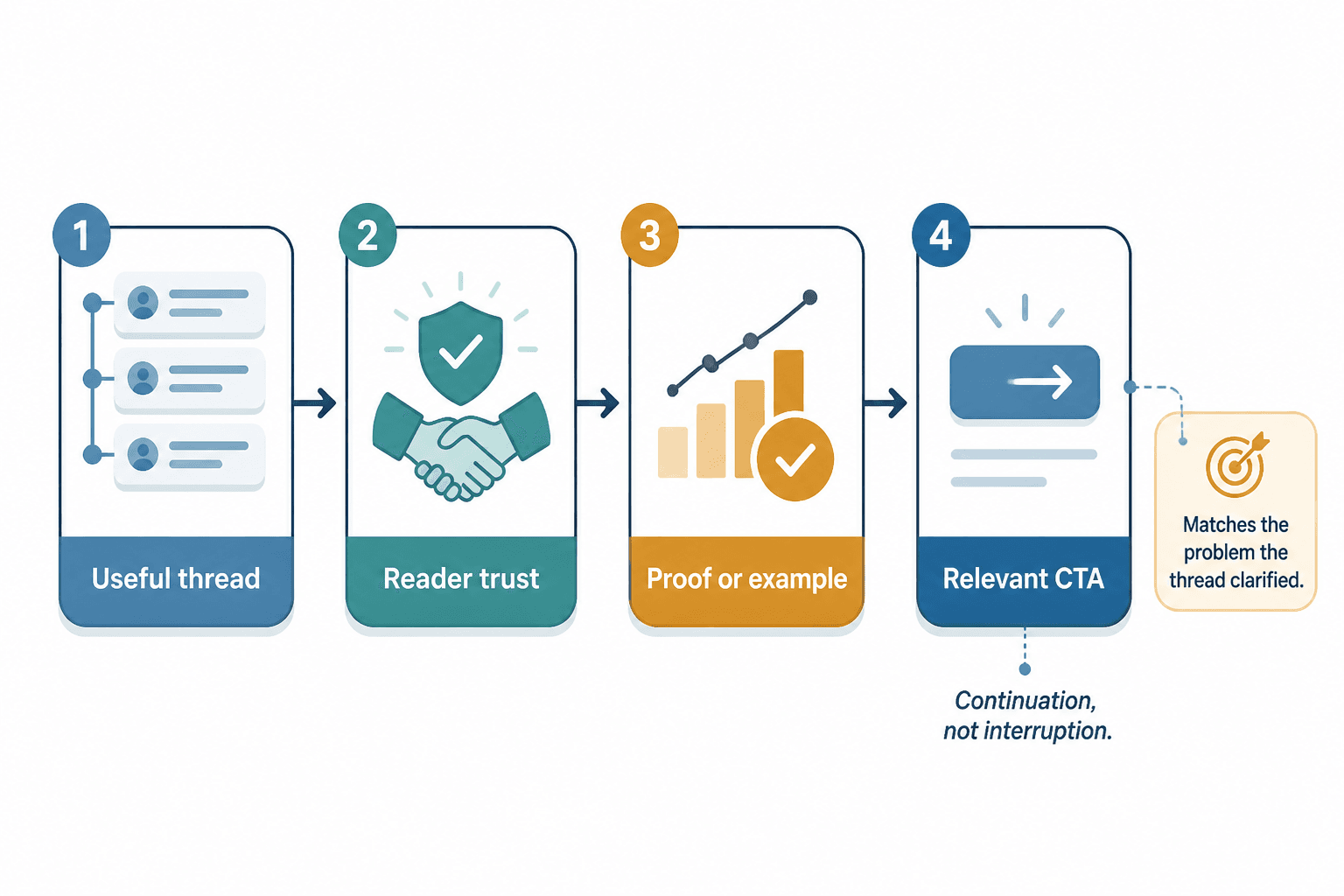
A good monetized thread does three things in order:
- It gives the reader something concrete they can use or understand better
- It proves the creator knows what they are talking about
- It offers a next step that matches the problem the thread just made clearer
That last part matters more than people think. The monetization should feel like continuation, not interruption.
If your thread shows founders why their content sounds polished but forgettable, then offering a messaging audit, content strategy call, or newsletter about sharper positioning makes sense. If your thread is about productivity habits and you end by pitching branding services, that is not monetization strategy. That is just hoping nobody notices the turn.
Readers are usually fine with being sold to when the offer feels relevant, proportionate, and earned. In fact, some people are actively looking for the next step. They just do not want to be dragged there by the ankle.
Start with the thread goal, not the sales goal
One of the easiest ways to wreck an X thread is to start with “how do I get people to buy?” and then reverse-engineer a thread around it. That usually creates brittle content. You can feel the strain in every post.
Start here instead: what should this thread do for the reader?
Usually the answer falls into one of a few buckets:
- Help them understand a problem more clearly
- Show them a better way to do something
- Challenge a bad assumption
- Give them a process, framework, or checklist
- Offer proof that your approach works
Then ask the second question: what next step would naturally help someone who found this useful?
That is where monetization belongs. Not at the start. Not steering the whole car. In the back seat, still important, but not grabbing the wheel.
A simple planning framework
- Thread promise: What useful outcome does the reader get?
- Audience fit: Who is this really for?
- Proof: Why should they trust your take?
- Next step: What is the most relevant action after reading?
- Offer strength: Is this a soft CTA, lead magnet, service, product, or conversation starter?
That framework will save you from building threads that read like cardboard content with a sales appendix attached.
The best ways to monetize X threads without getting salesy
You do not need one monetization method. You need the right one for the trust level, audience awareness, and complexity of what you sell.
Here are the cleanest options, from lightest touch to strongest ask.
1. Thread to profile to offer
This is the least pushy and often the most underrated.
You write a genuinely strong thread, then let the interested reader check your profile, bio, pinned post, or link. No dramatic pitch needed. This works well when your profile is already clear about who you help, what you offer, and what to do next.
Good for:
- Consultants
- Coaches
- Writers
- Freelancers
- Service businesses
Best CTA style:
If you want more on this, my profile has the full breakdown of how I help with this.
Quiet. Clean. No need to behave like a late-night infomercial host.
2. Thread to newsletter or free resource
This is often the smartest move if your offer needs more trust, more explanation, or more time.
A thread earns attention. A newsletter deepens the relationship. A free resource gives the reader a useful win. Then your email sequence, product ecosystem, or follow-up content can do the heavier selling later.
Good for:
- Course creators
- Educators
- Founders
- Personal brands
- People with longer sales cycles
Best CTA style:
If this helped, I have a free template that expands this into a step-by-step system. It is in my profile.
This works because the offer matches the thread. It gives more depth, not a random jump to “book a call.”
3. Thread to soft DM or reply conversation
This one can work beautifully and can also become unbearably annoying in the wrong hands.
A soft conversation CTA is useful when the thread addresses a problem that is nuanced, situation-specific, or tied to services. But the key word is soft. If you invite replies just to funnel people into canned sales DMs, people catch on fast.
Good CTA styles:
- Reply with a specific word if you want the checklist
- DM me if you want to see how this applies to your situation
- If you are stuck on this exact issue, happy to point you in the right direction
Bad version:
Comment “GROWTH” and I will personally reveal the secret framework behind my 7-figure content machine.
Please do not do that. Nobody needs more thread theatre.
4. Thread to direct offer
Yes, you can sell directly from an X thread. You just need to earn it.
This works best when:
- The thread is highly specific and clearly relevant to the offer
- You have enough proof to justify the ask
- The audience already knows what the problem costs them
- The offer is simple enough to understand quickly
For example, a thread breaking down why founder-led content underperforms could reasonably end with an offer for ghostwriting, content strategy, or messaging consulting.
But if you are going direct, do not suddenly become a different person in the final two posts. Keep the tone consistent. Keep the ask clear. Keep the pressure low.
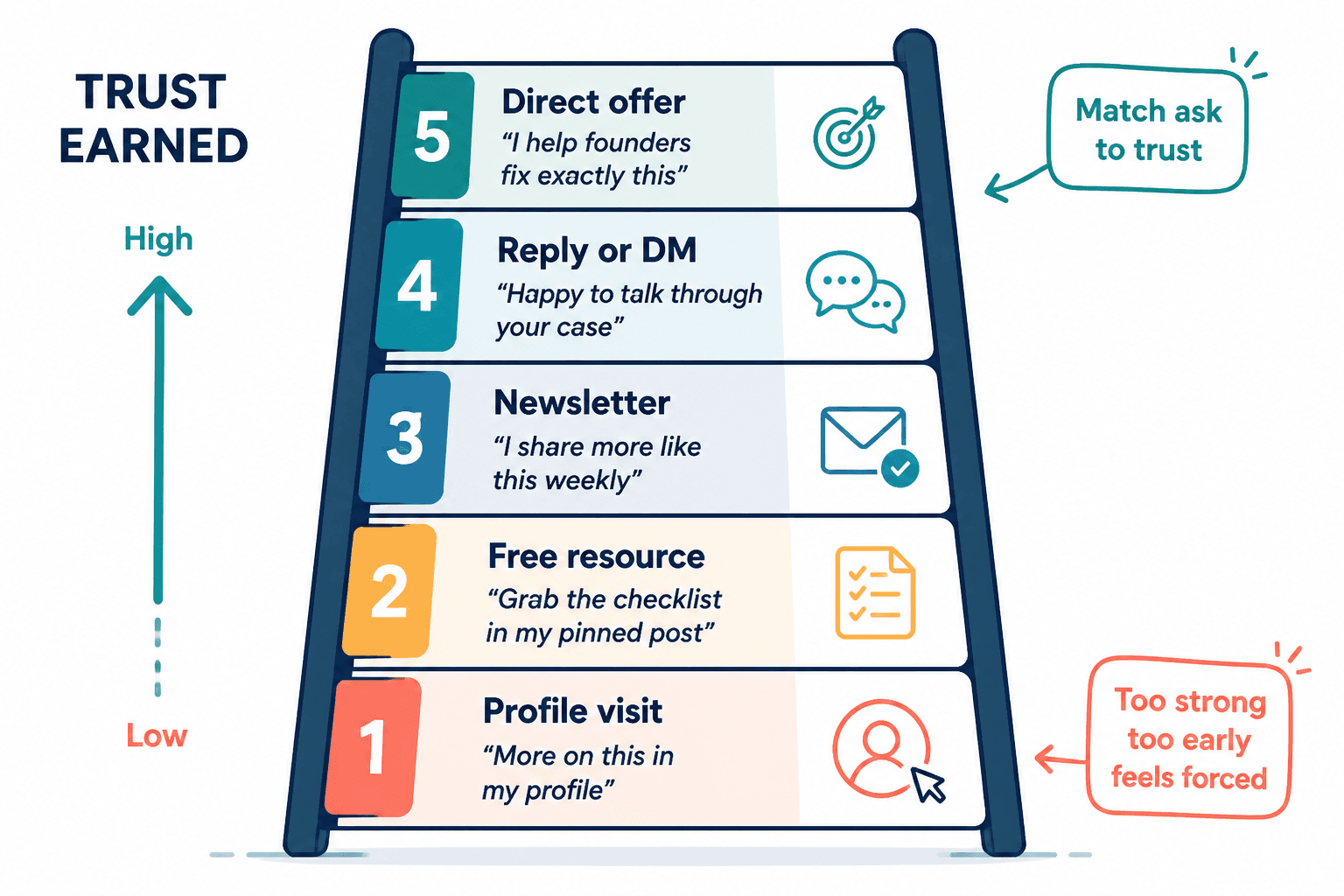
Match the CTA to the trust level you have actually earned
This is where a lot of people go wrong. They write one decent thread and act like they have earned the right to propose marriage.
Different offers require different levels of trust. A small ask can come earlier. A bigger ask needs more evidence, more specificity, and more relationship.
| Trust earned | Best CTA type | Example |
|---|---|---|
| Low | Profile visit | More on this in my profile |
| Low to medium | Free resource | Grab the checklist in my pinned post |
| Medium | Newsletter | I share more like this weekly |
| Medium to high | Reply or DM | Happy to talk through your case |
| High | Direct offer | I help founders fix exactly this |
If you skip too far ahead, the monetization feels forced. Not because offers are bad, but because you are asking for more commitment than the thread justified.
Think of trust like pacing. Readers do not mind moving forward. They mind being shoved.
Build threads that can sell because they are strong, not because the CTA is loud
Better monetization starts earlier than the CTA. It starts in the thread itself.
Weak threads need pushy CTAs because the content did not do enough work. Strong threads create desire for the next step almost by accident. The reader thinks, “This person gets it. What else have they got?” That is a much better sales environment than “Please book now, spots are limited, my dog is crying.”
Here is what makes a monetizable thread stronger.
Clear problem selection
Choose problems your ideal buyer actually cares about, not vague content topics that attract everyone and convert no one.
Too broad:
10 lessons about marketing
Better:
Why your X threads get bookmarks but no leads
The second one attracts a more commercial problem. That makes monetization easier because the thread is already closer to buyer intent.
Specific insight
Do not write threads full of advice people have heard 400 times. Generic tips may get nods. They rarely get action or trust.
Instead of:
Be authentic, provide value, and stay consistent.
Try:
Most threads do not fail because the writing is bad. They fail because the reader cannot tell who the advice is for, why it matters now, or what to do with it.
That sounds more like someone who has seen the problem up close. Trust likes texture.
Useful proof
Proof does not always mean giant revenue screenshots. In fact, those are often doing too much.
Useful proof can be:
- A before-and-after example
- A pattern you have observed repeatedly
- A client result described clearly
- A process you use
- A direct comparison between weak and strong execution
This matters because monetization lands better when people can see that your advice is grounded in something other than vibes and confidence.
A thread structure with momentum
If the thread drags, the CTA suffers. Not because the CTA changed, but because attention died three posts earlier.
A simple structure that works well:
- Sharp hook with a clear problem or tension
- Quick setup explaining why it matters
- Main points in logical sequence
- Specific examples or proof
- Clean takeaway
- Relevant next step
If you want help with the front of the thread, this guide on how to start X threads without a weak opening will help you stop losing readers before the thread has a chance to earn anything.
And if your thread voice keeps drifting into polished corporate oatmeal, read how to write X threads without sounding salesy or robotic. Monetization gets much easier when the thread sounds like a person with a brain, not a content blender.
How to write CTAs that do not make the whole thread feel fake
A good CTA on X is usually short, relevant, and proportionate. It does not need a drumroll.
Here are a few CTA styles that work better than the usual desperate nonsense.
CTA style 1: The natural extension
If you want the full version of this process, I broke it down in my pinned resource.
Why it works: it offers more depth on the same topic.
CTA style 2: The qualified offer
If you are a founder trying to turn threads into inbound leads, this is exactly what I help clients build.
Why it works: it names the audience and the outcome clearly. No puffed-up “DM me for growth.”
CTA style 3: The low-pressure invitation
If this is the part you are stuck on, feel free to message me and I can point you toward the right next step.
Why it works: it opens a door without pretending every reply is a life-changing breakthrough.
CTA style 4: The newsletter bridge
I write about this every week for people building trust-based content businesses. Link is in my profile if you want more.
Why it works: it is clear who it is for and what they will get.
What does not work nearly as well:
- Fake urgency
- Overwritten mini-sales pages at the end of the thread
- Acting coy about the offer
- Using the final three posts to suddenly become hyper-markety
- Vague asks like “reach out if this resonates”
Specific beats dramatic. Relevant beats loud. Clear beats clever.
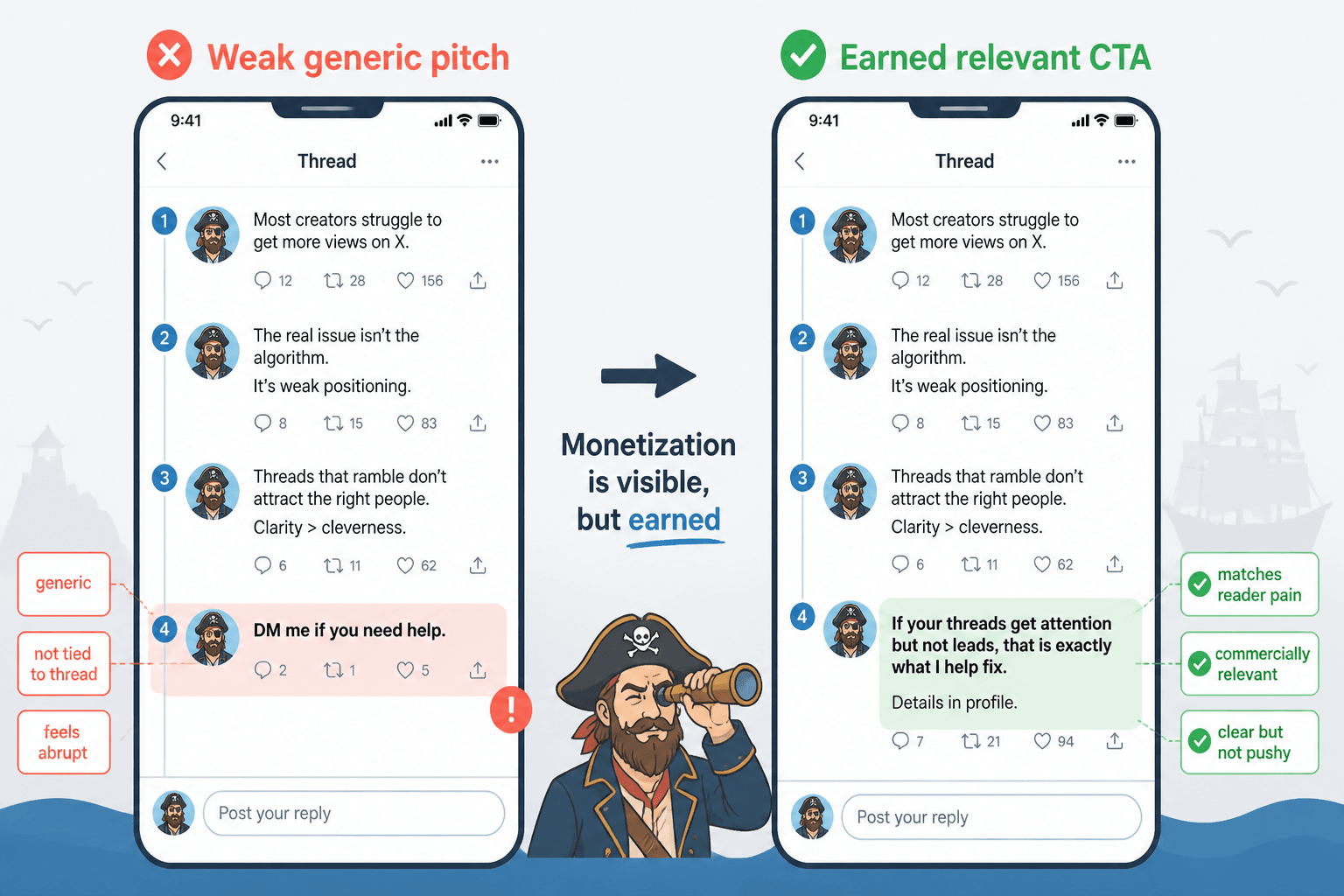
Before and after: monetizing a thread badly vs well
Bad version
Hook: 7 lessons from growing on X
Main thread: generic tips about consistency, authenticity, and adding value
Final CTA: I help people scale to six figures with my proprietary framework. DM “THREADS” now.
Why it fails:
- The hook is broad and forgettable
- The content does not build trust or specificity
- The offer is disconnected from the advice
- The CTA is stronger than the thread earned
Better version
Hook: Most X threads do not fail because the writing is bad. They fail because the reader never sees a reason to care past post 2.
Main thread: breakdown of weak openings, poor sequencing, no proof, and weak relevance to buyer pain
Final CTA: If you are using X to attract clients and your threads are getting attention but not leads, that is exactly what I help fix. Details are in my profile.
Why it works:
- The problem is sharper
- The advice is commercially relevant
- The CTA matches the issue raised in the thread
- The ask is clear without being pushy
See the difference? The better version does not hide the monetization. It just earns it.
The bigger point is simple: clearer structure and clearer writing make the piece more useful. That is usually what makes the ending land better too.