
The bigger point is simple: clearer structure and clearer writing make the piece more useful. That is usually what makes the ending land better too.
X threads can get attention fast. That does not mean they automatically turn into leads, clients, or sales. A thread with 200 bookmarks and no clear next step is still just a well-dressed dead end.
That is the real problem with a lot of thread strategy. People obsess over hooks, formatting, and “viral” structure, then bolt on some clumsy pitch at the end and wonder why nothing converts. The thread did its job. The funnel did not.
The best funnel ideas to pair with X threads are simple, relevant, and low-friction. They fit the thread topic, match the reader’s intent, and move people one step closer without making the whole thing feel like a disguised ad. That is the balance: useful enough to earn trust, clear enough to guide action.
Here’s how to build that kind of funnel, which thread-to-funnel pairings work best, and what to stop doing if your threads are getting attention but not producing anything useful for the business behind them.
To see how this fits into the wider strategy, open the parent guide.
Why most X thread funnels underperform
Most underperforming funnels have one of three problems:
- The offer does not match the thread
- The ask comes too early or too aggressively
- The next step has too much friction
If your thread is about fixing weak positioning and your CTA sends people to a generic homepage, that is not a funnel. That is a detour. If the thread gives beginner-level advice and the CTA jumps straight to “book a strategy intensive,” that is not a smooth conversion path. That is a trust faceplant.
X is a fast platform. People are scanning. They are curious, skeptical, distracted, and one tap away from leaving. So the funnel paired with your thread needs to respect that context. It should feel like the obvious next move, not a suspiciously expensive left turn.
A good thread builds interest. A good funnel catches it before it leaks all over the floor.
What a good funnel pairing actually does
Before getting into specific funnel ideas, it helps to get clear on the job. A thread funnel should do four things:
- Match intent: the next step should feel directly related to what the reader just consumed
- Reduce friction: asking for too much too soon kills momentum
- Build trust: the thread opens the door; the funnel should deepen credibility
- Create movement: attention is nice, but the next step should lead somewhere useful
That “somewhere useful” depends on your business model. A creator selling low-ticket products needs a different thread funnel than a consultant booking discovery calls. A coach building an email list has different priorities than a freelancer trying to start more qualified conversations.
So no, there is not one perfect funnel for every X thread. Convenient, but false. What you want instead is a handful of pairings that make sense for your offer, audience, and sales cycle.
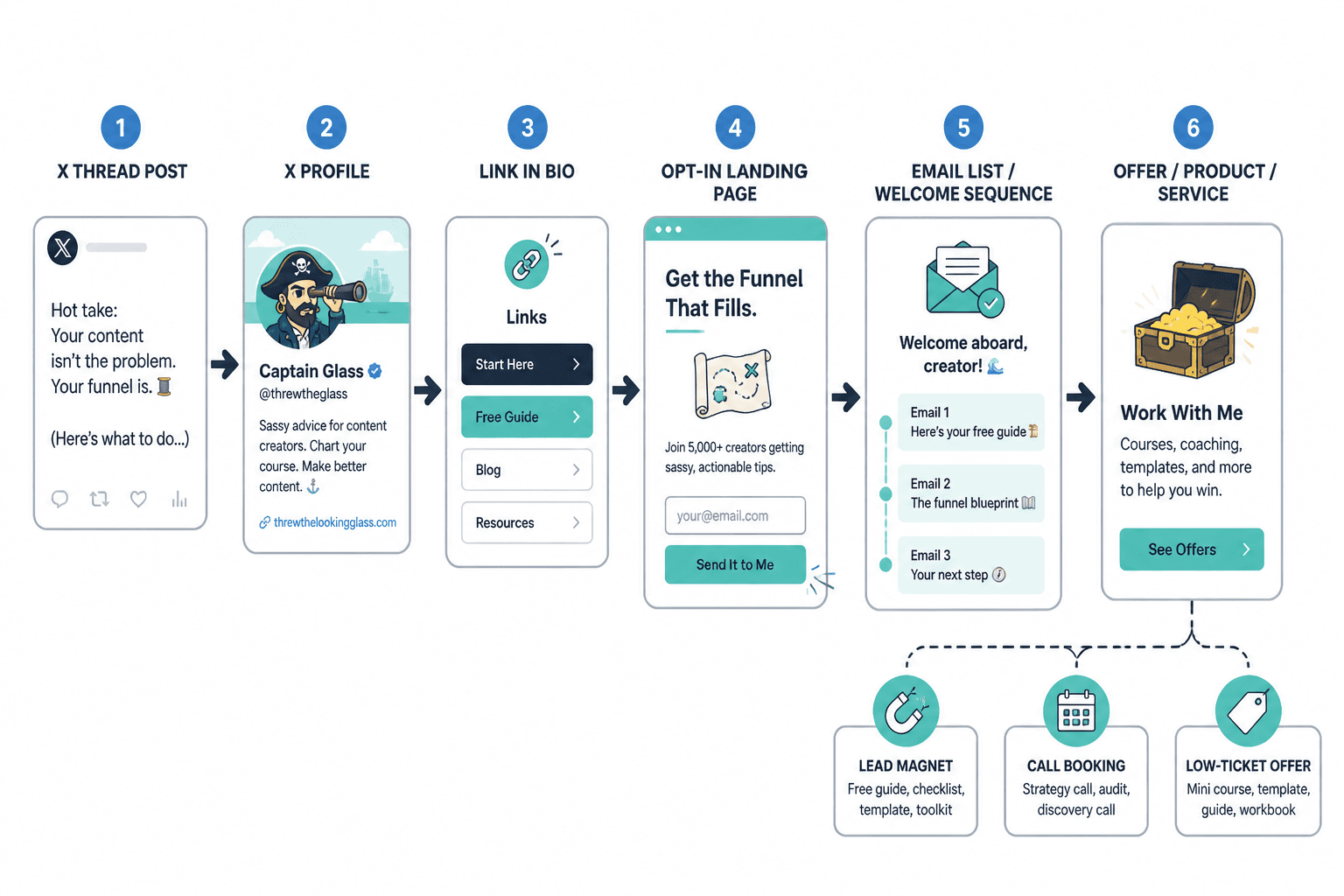
Best funnel ideas to pair with X threads
These are the most reliable options for creators, coaches, consultants, solo founders, and personal brands. Not the flashiest. The most usable.
1. Thread to lead magnet
This is one of the cleanest funnel pairings when your thread teaches something practical.
If the thread surfaces a problem, framework, or process, the lead magnet can go deeper with a checklist, template, swipe file, mini guide, or worksheet. The key is continuity. The freebie should feel like an extension of the thread, not a random email bribe.
Best for: list building, trust building, lower-ticket audiences, longer sales cycles
Good examples:
- Thread: “7 mistakes making your X threads unreadable” → Lead magnet: “X Thread Editing Checklist”
- Thread: “How I structure authority-building content in 20 minutes” → Lead magnet: “Weekly Content Planning Template”
- Thread: “Why most consultants sound identical online” → Lead magnet: “Positioning Prompt Pack”
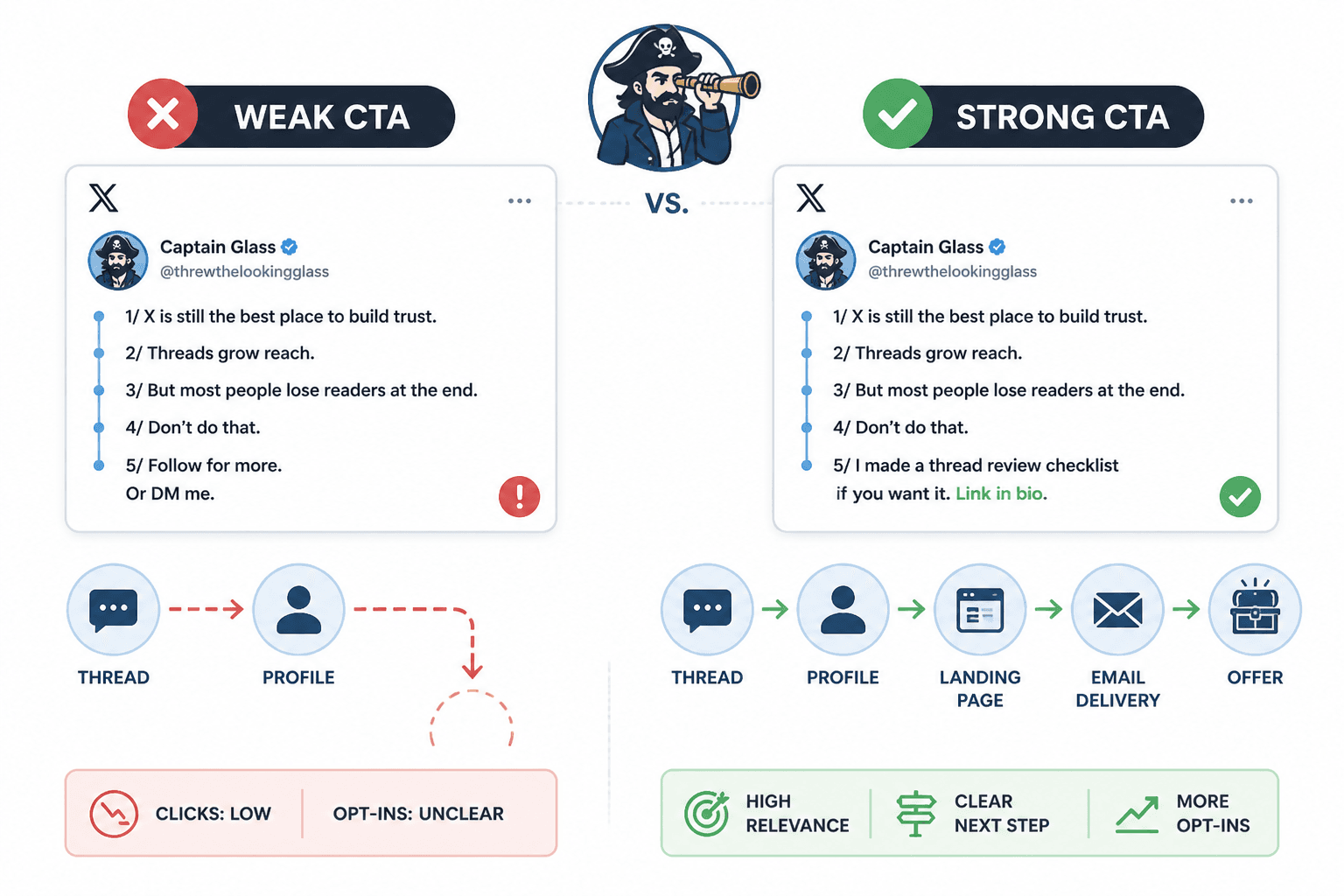
Stronger CTA: “If you want the checklist I use before posting threads, it’s in my bio.”
Weaker CTA: “DM me ‘THREAD’ and I’ll send you something special.”
The second one is not always terrible, but it often creates unnecessary manual work and makes the whole thing feel a bit performative. Unless conversations are the actual goal, a clean opt-in usually wins.
2. Thread to newsletter
If your threads attract people who want regular insights, a newsletter is a strong next step. It works especially well when the thread gives a sharp idea but leaves room for ongoing depth.
This pairing is less about instant conversion and more about compounding attention into a durable audience. Threads are rented attention. Email is not. That is why this funnel keeps showing up for smart creators who got tired of building on somebody else’s mood swings.
Best for: writers, educators, strategists, creators with recurring ideas, authority building
Works best when:
- Your thread has a strong point of view
- You publish consistently enough to make subscribing worth it
- Your newsletter has a clear promise, not just “more thoughts”
Example CTA: “I write about content, positioning, and audience growth every week. If you want the longer version, it’s in my bio.”
Simple. Calm. No tap-dancing.
3. Thread to profile to pinned offer
This one is underrated because it is less direct, but it can work beautifully on X.
Instead of stuffing the thread with a sales ask, you let the thread spark interest, then use your profile and pinned post to do the heavier conversion work. This is often a smarter move when the thread is likely to get shared, quoted, or discovered by people who do not know you yet.
The thread’s job is to make people curious enough to click. Your profile’s job is to answer:
- Who are you for?
- What do you help with?
- Why should someone trust you?
- What should they do next?
If your profile is vague, this funnel collapses. If your pinned post is weak, same story. But when those pieces are tight, this can be one of the cleanest thread funnels because it feels natural, not forced.
For more on thread strategy itself, readers would naturally benefit from X threads and related resources in social media writing and X/Twitter writing.
4. Thread to free resource to nurture sequence
This is the grown-up version of thread to lead magnet.
Instead of throwing people onto a list and then forgetting they exist until launch week, you give them a relevant free resource and follow it with a short nurture sequence that deepens the original topic, builds trust, and introduces the paid offer when it makes sense.
Best for: service providers, consultants, coaches, course creators, higher-trust offers
Simple sequence example:
- Thread on weak content hooks
- CTA to a free hook guide
- Email 1: deliver guide + quick win
- Email 2: explain common mistakes
- Email 3: show example transformation
- Email 4: invite reader to service, audit, product, or waitlist
This works because it respects timing. You are not trying to harvest a sale from one hit of attention. You are building a small, sensible bridge from interest to trust to offer.
5. Thread to low-ticket product
If the thread solves a painful problem and your audience already knows you a bit, pairing it with a low-ticket product can work surprisingly well.
The trick is relevance and price sanity. A thread about writing better hooks can absolutely sell a $19 template pack. It probably should not jump straight to a $2,000 program unless the thread is reaching a very warm audience and the rest of your profile does a lot of heavy lifting.
Best for: digital products, templates, workshops, mini offers, creators with audience-product fit
Strong pairings:
- Thread on thread structure → Thread template pack
- Thread on profile mistakes → Bio rewrite guide
- Thread on content workflow → Content system mini product
This is also where your offer quality matters more than your CTA cleverness. A weak low-ticket product is still weak, even if the thread gets applause.
6. Thread to consultation or discovery call
This can work well, but people misuse it constantly.
A direct thread-to-call funnel makes sense when the thread demonstrates expertise around an expensive, urgent, or business-critical problem. It makes much less sense when the thread is broad, beginner-friendly, or aimed at cold audiences who barely know what you do.
Best for: consultants, agencies, premium freelancers, service businesses with clear offers
Good use case: A consultant posts a thread breaking down why most B2B landing pages leak conversions, includes examples, and ends with a soft invitation to book a page teardown.
Bad use case: A generic “10 mindset lessons” thread ending with “book a call.” No. Absolutely not.
If you use this funnel, your CTA should be calm and qualified:
- “If you want help applying this to your brand, details are in my bio.”
- “I do a limited number of audits each month. If that is relevant, the booking page is pinned.”
Notice what is missing: desperation.
7. Thread to waitlist
If your offer is not live yet, or if you want to validate interest before building it, a waitlist can be a smart move.
This works best when the thread makes a clear case for the problem and your future offer promises a focused solution. It is especially useful for creators launching cohorts, communities, mini-courses, playbooks, or productized services.
Best for: pre-launch validation, offer testing, audience research, soft demand building
Example: A thread about why most solo consultants struggle to turn expertise into repeatable content could lead to a waitlist for a content system workshop.
The waitlist page should answer basic questions clearly:
- What is it?
- Who is it for?
- What problem does it solve?
- Why join early?
Do not make people join a mysterious waitlist for a vague future thing. Mystery is overrated in marketing. Clarity usually pays better.
8. Thread to soft DM conversation
This one can work, but it needs restraint.
If your thread sparks a very specific pain point, inviting replies or DMs can open quality conversations. This is more useful for service providers and consultants than for broad-scale audience growth. It is also better when the topic is nuanced enough that people may want context-specific help.
Best for: consultants, high-ticket services, niche operators, audience research
Better CTA: “If this is a problem in your business, feel free to DM me. Happy to point you in the right direction.”
Worse CTA: “Comment FUNNEL and I’ll DM you the secret.”
The second one feels like it escaped from a growth hack Facebook group in 2021. You do not need that energy.
Use DM funnels when conversation is genuinely useful. Not because you want to cosplay as an automation funnel with human faces taped on top.
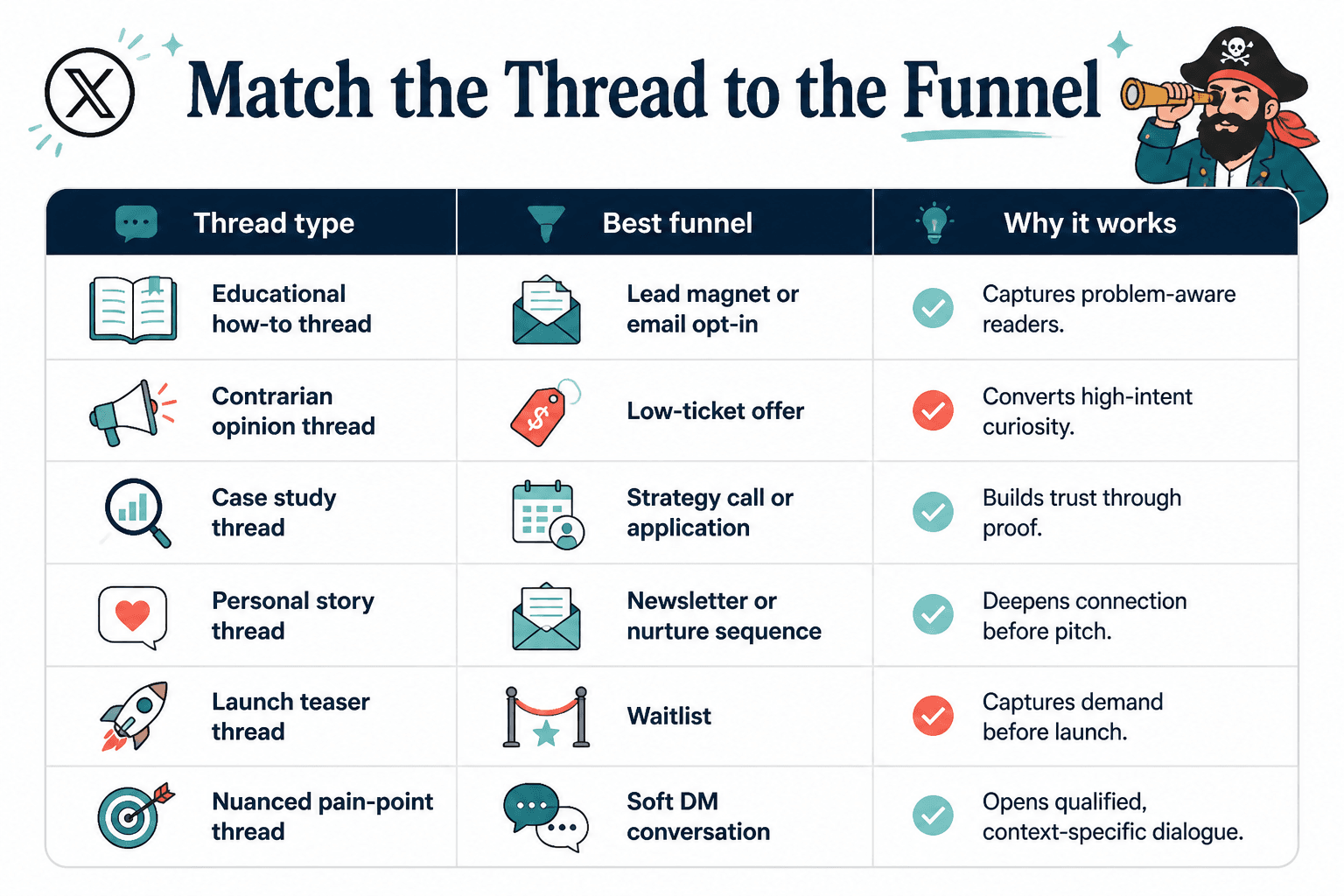
How to choose the right funnel for your thread
Pick based on three things: thread intent, audience temperature, and offer complexity.
| Thread type | Best funnel match | Why it fits |
|---|---|---|
| Educational how-to thread | Lead magnet or newsletter | Builds trust and extends the lesson |
| Opinion thread with strong positioning | Newsletter or profile to pinned offer | Turns interest into ongoing attention |
| Problem-aware thread for service buyers | Consultation or audit | Works when the pain is urgent and valuable |
| Framework thread | Template, guide, or low-ticket product | Natural next step with practical payoff |
| Pre-launch topic validation thread | Waitlist | Captures demand before launch |
| Nuanced pain-point thread | Soft DM conversation | Opens qualified, context-specific dialogue |
A lot of funnel problems disappear once the pairing makes sense. You do not need a more manipulative CTA. You need a better match.
And if you are still refining what kinds of threads work for your audience, these related reads can help: best X threads ideas and examples for creators, best templates and tools for X threads, X threads for creators with small audiences, and best AI tools for X threads.
How to write thread CTAs without wrecking the thread
A lot of CTAs fail because they suddenly sound like somebody else wrote them. The thread is sharp, useful, specific. Then the final post turns into “If this resonated and you are ready to take your business to the next level…” and the whole thing dies in a puddle of webinar syrup.
Your CTA should sound like a natural continuation of the thread. Usually that means:
- Keep it short
- Make the next step obvious
- Tie it directly to the thread topic
- Avoid over-selling
- Use calm confidence, not infomercial fumes
Examples of better X thread CTAs
- “I put the full checklist in my bio if you want it.”
- “If you want more content like this, my newsletter goes deeper.”
- “If this is something you need help fixing, my audit link is pinned.”
- “I turned this into a template pack because people kept asking for it. It’s in the bio.”
- “Working on something around this. Waitlist is open if you want first access.”
Not fancy. Effective.
Common mistakes when pairing funnels with X threads
The offer is too far away from the thread topic
If the thread is about one thing and the CTA pushes something loosely related at best, conversion drops. People clicked for a reason. Respect it.
The funnel asks for too much too soon
Cold audience + educational thread + direct pitch for expensive service = avoidable disappointment.
The thread exists only to set up the pitch
People can smell this. If the thread feels padded, obvious, or suspiciously shaped around the offer, trust drops. The thread should be useful on its own. The funnel is the next step, not the only point.
No profile support
You can write a great CTA, but if the profile is vague and the pinned post is a graveyard of old promotions, people will bounce. On X, your funnel often includes the profile whether you planned for that or not.
No nurture after capture
If someone joins your list from a thread and then hears nothing useful for two weeks, that is not a funnel. That is a collection hobby.
Using the same CTA on every thread
Not every thread should push the same offer. Different topics can feed different paths. Relevance beats consistency when consistency turns lazy.
A simple funnel structure most creators can use
If you want something practical and manageable, start here:
- Write a thread on a specific problem your audience cares about
- Offer a highly relevant next step: checklist, guide, newsletter, audit, or template
- Make sure your profile reinforces what you do and where to go next
- Send people to a clean landing page or pinned post
- Follow up with email, nurture, or a clear offer path
Example:
- Thread: “Why your X threads get polite likes but no real traction”
- CTA: “I made a thread review checklist if you want it. Link in bio.”
- Landing page: quick opt-in with clear promise
- Email 1: checklist delivery
- Email 2: examples of good vs weak thread structure
- Email 3: invite to template pack or audit
That is a funnel. Not glamorous. Very workable.
The bigger point is simple: clearer structure and clearer writing make the piece more useful. That is usually what makes the ending land better too.