
Most X threads do not fail because the writer lacks ideas. They fail because the idea gets stretched, the structure falls apart halfway through, and the tool stack turns into a little productivity shrine instead of something useful.
That is the real problem with hunting for the best templates and tools for X threads. People want a shortcut, which is fair. But a thread template cannot rescue a muddy point, and a fancy tool cannot save 14 posts that should have been 5.
What can help is a clean system: a few reliable thread templates, a few tools that actually reduce friction, and enough judgment to know when not to turn an ordinary thought into a scroll marathon.
This guide will help you build exactly that. You will get practical thread templates, tool categories that are genuinely worth using, examples of what each one is for, and a simple way to decide what belongs in a thread versus a single post. If you write threads to grow attention, trust, replies, email signups, or leads, this will make the process cleaner and much less annoying.
If you want a broader foundation first, start with the main X threads guide or browse more on social media writing and X/Twitter writing.
For the main guide behind this topic, visit the parent guide.
What makes a good X thread template useful
A good thread template does one job well: it gives your idea shape without making everything you write sound factory-made.
That means the best templates and tools for X threads are not the ones that promise virality. They are the ones that help you organize momentum. On X, threads work when each post earns the next one. There needs to be a reason to keep reading.
A useful thread template usually includes:
- A strong opening post with a clear promise, opinion, or tension
- A logical sequence, not random points stacked vertically
- One idea per post
- Enough specificity to feel worth the reader’s time
- A clean ending with a takeaway, CTA, or next step
A bad template usually does the opposite. It starts vague, repeats itself, bloats the middle, and then ends with a limp pitch that feels taped on by a marketing intern from 2019.
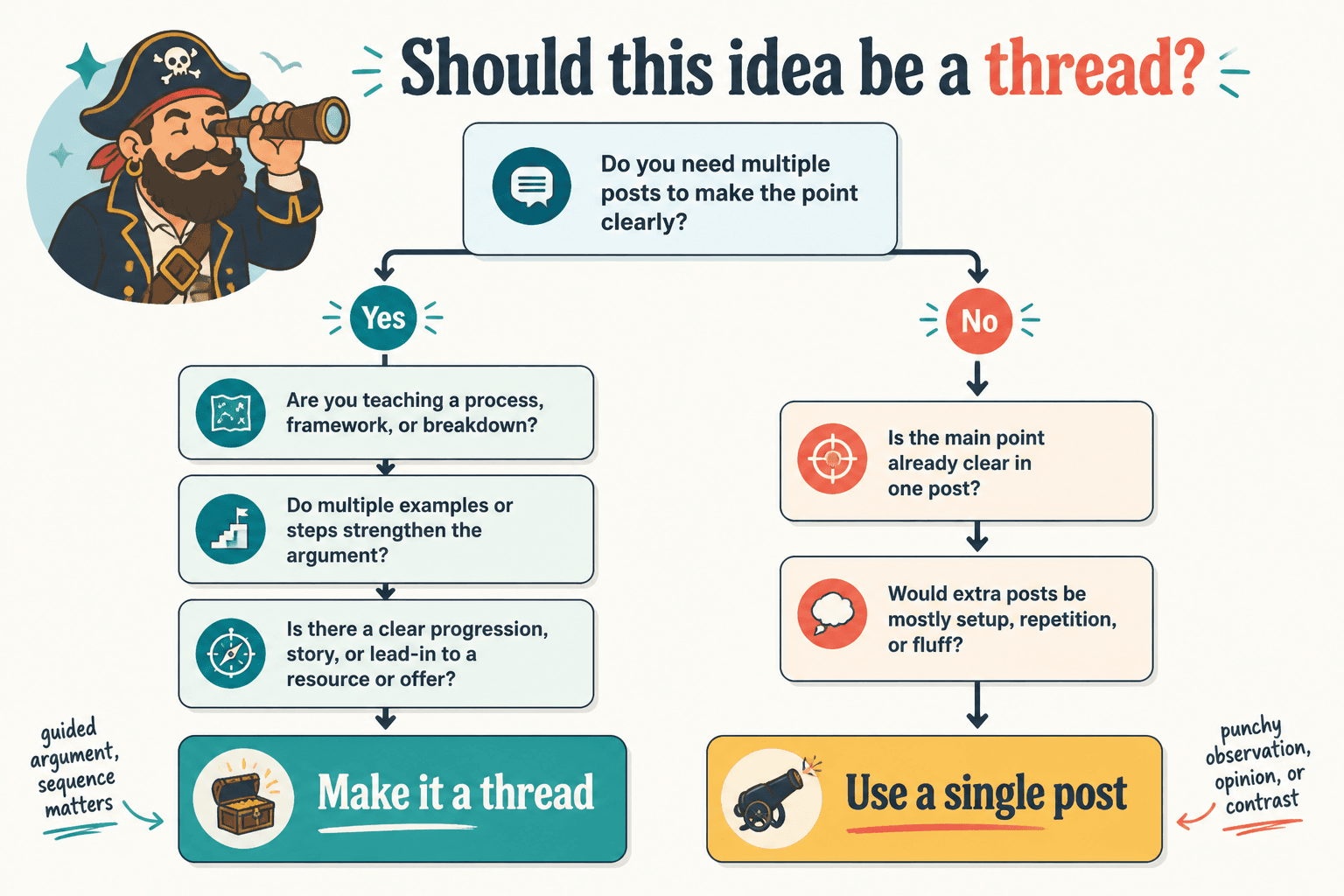
When to use a thread instead of a single post
Not every idea deserves a thread. Some ideas want one sharp post and nothing else. If you need 11 posts to say something that could have survived as one sentence, the issue is not your reach. It is your editing.
Use a thread when:
- You need sequence to make the point land
- You are teaching a process, framework, or breakdown
- You have multiple examples that strengthen the same argument
- You are telling a story with a clear progression
- You want to lead naturally to a resource, article, or offer
Use a single post when:
- The main point is already clear in one shot
- The added posts would just be explanation fluff
- The “thread” would mostly be setup and repetition
- You are making a punchy observation, opinion, or contrast
This matters because the best templates and tools for X threads only help if the format itself makes sense. A thread is a guided argument. It is not a content costume for weak ideas.
Best X thread templates that actually work
You do not need 47 templates. You need a handful that match the kinds of things you regularly talk about. Here are the ones worth keeping.
1. The teachable framework thread
Best for: coaches, consultants, marketers, writers, and creators explaining a repeatable process.
Structure:
- Hook with the result or problem
- Name the framework
- Explain step 1
- Explain step 2
- Explain step 3
- Add common mistake or nuance
- Wrap with takeaway or CTA
Template:
- Post 1: Most people struggle with [result] because they focus on [wrong thing]. Here is the simple framework I use for [better outcome].
- Post 2: Step 1: [Name it]. This matters because…
- Post 3: Step 2: [Name it]. Here is where people usually mess it up…
- Post 4: Step 3: [Name it]. If you skip this, the whole thing gets weaker…
- Post 5: The big mistake: [mistake]
- Post 6: The better approach: [fix]
- Post 7: If you want [outcome], start with [first action].
Filled example:
Most creators do not have a consistency problem. They have an idea-packaging problem.
Here is the 3-part framework I use to turn one raw idea into a strong X thread:
1. Find the sharp point
2. Build the sequence
3. Cut anything that repeats itself
2. The mistake-to-fix thread
Best for: educational content, audits, conversion advice, and punchier expert positioning.
This one works well because it creates tension fast. People want to know if they are making the mistake, and more importantly, how to stop.
Structure:
- Call out the mistake
- Explain why it hurts results
- Show what most people do
- Show what to do instead
- Give an example or rewrite
- Close with practical action
Template:
- Post 1: A lot of people are doing [thing] wrong on X. The problem is not effort. It is this.
- Post 2: The mistake: [mistake]
- Post 3: Why it fails: [reason]
- Post 4: What people assume instead: [bad assumption]
- Post 5: Better approach: [solution]
- Post 6: Example: [before/after]
- Post 7: Next time, do [specific action]
3. The mini case study thread
Best for: consultants, freelancers, operators, service providers, and anyone who wants authority without sounding like a brochure.
This format is underrated because it combines story, proof, and method. It is much stronger than random advice floating around with no evidence attached.
Structure:
- Hook with result or change
- Brief context
- The problem
- The key shift
- Actions taken
- Outcome or lesson
- CTA or related resource
Template:
- Post 1: We changed [thing] and got [result]. Here is what actually made the difference.
- Post 2: Context: [short setup]
- Post 3: The problem was not [obvious thing]. It was [real issue].
- Post 4: So we changed [specific shift].
- Post 5: Then we did [action 1], [action 2], [action 3].
- Post 6: Result: [result or clear lesson]
- Post 7: If your [thing] is underperforming, check [specific area first].
4. The opinion thread
Best for: personal brands with a clear point of view.
This is where a lot of people get sloppy. A good opinion thread is not just “here is my hot take” followed by fog. It needs an argument. It needs stakes. It needs examples or reasoning. Otherwise it is just performative certainty in public.
Structure:
- State the opinion clearly
- Explain why you believe it
- Challenge the common belief
- Support with examples or logic
- Add nuance
- End with a memorable conclusion
Template:
- Post 1: Unpopular opinion: [clear opinion]
- Post 2: Most people think [common belief]
- Post 3: I disagree because [reason 1]
- Post 4: Also because [reason 2]
- Post 5: Example: [proof or observation]
- Post 6: The nuance: [where it does not apply]
- Post 7: Better question: [reframe]
5. The curated resource thread
Best for: creators who want saves, shares, and authority through curation.
Curation works when there is a theme and a reason behind the list. Random resources thrown together are not a thread. They are a junk drawer with line breaks.
Structure:
- State the outcome
- Set the filter or criteria
- Share each resource with one line of context
- Highlight who each is best for
- Wrap with next action
Template:
- Post 1: If you want [outcome], here are [number] resources worth your time.
- Post 2: I picked these because [criteria].
- Post 3: Resource 1: [name] — best for [use case]
- Post 4: Resource 2: [name] — useful when [use case]
- Post 5: Resource 3: [name] — strongest feature is [feature]
- Post 6: Resource 4: [name] — skip it if you need [other thing]
- Post 7: Start with [best starting point]
If you want more concrete thread ideas after this, the examples in Best X Threads Ideas and Examples for Creators pair nicely with these structures.
How to choose the best tools for X threads without overcomplicating your life
You do not need a giant stack. You need a few tools that help at the right stage of the process.
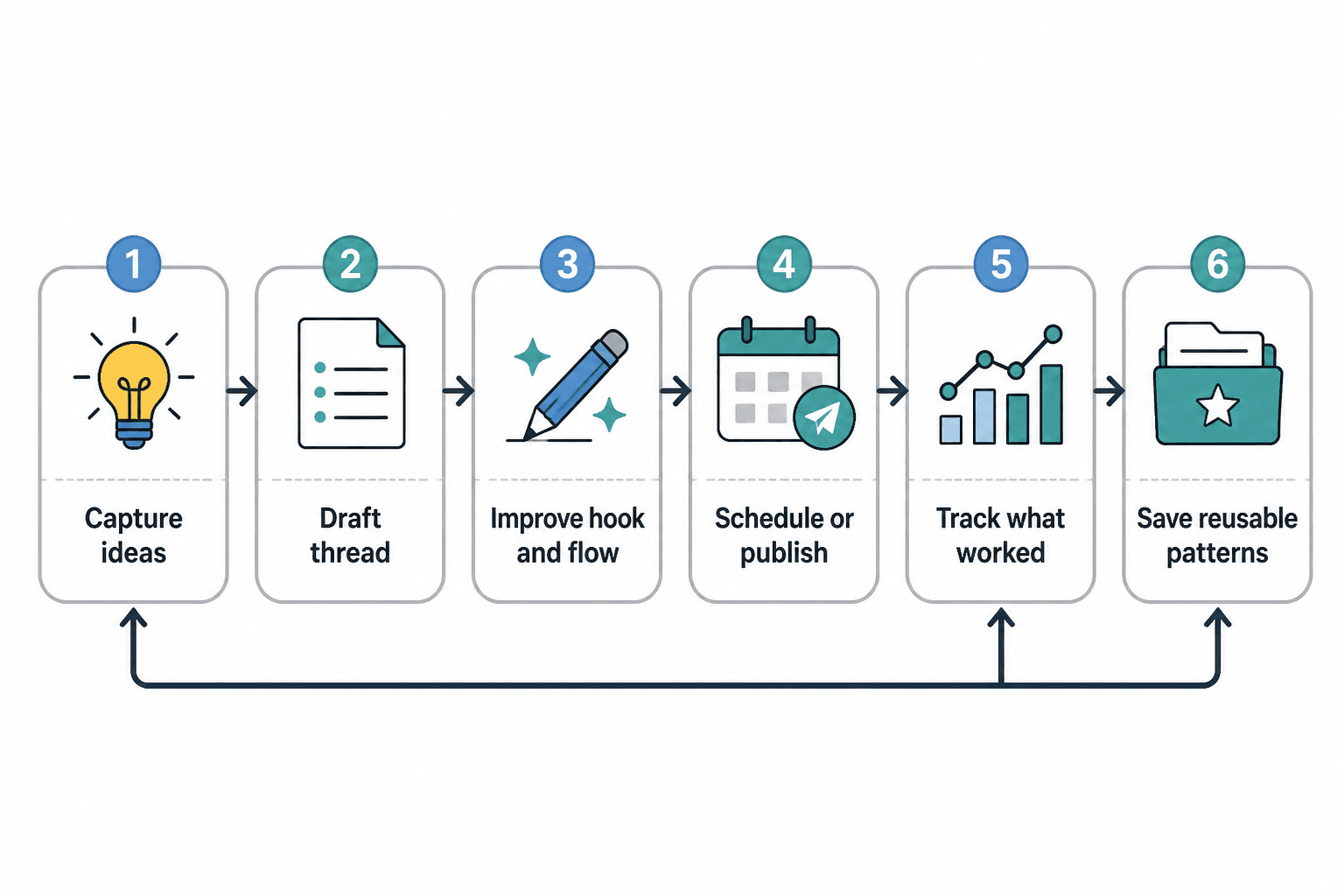
That process usually looks like this:
- Capture ideas
- Draft the thread
- Improve the hook and flow
- Schedule or publish
- Track what worked
- Store reusable formats and winning patterns
The best tools for X threads support one or two of those jobs well. The worst ones promise to automate your voice, your strategy, and your brain. That tends to end exactly how you would expect.
Best tool categories for X threads
Instead of pretending there is one perfect app for everyone, here is the more honest version: the right tool depends on what part of thread writing slows you down.
1. Idea capture tools
Use these if your main problem is losing ideas or forgetting good thread angles before you sit down to write.
Good for:
- Saving raw observations
- Collecting thread starters
- Tagging ideas by topic
- Storing hooks, examples, and replies worth developing
What to look for:
- Fast capture on mobile and desktop
- Simple tagging or folders
- Easy search
- Low friction, so you actually use it
If your current system requires three clicks, a category matrix, and a mood board, there is a decent chance the system is now the hobby.
2. Drafting and outlining tools
These help you build the thread before it goes into X or a scheduler.
Good for:
- Sequencing posts
- Rearranging points
- Testing different openings
- Keeping one post to one idea
- Cleaning up pacing
What to look for:
- Easy line-by-line editing
- Character awareness
- Drag-and-drop or simple reordering
- Clean drafting interface
This is often the best place to work from templates. A simple outline tool plus a saved thread structure is usually enough.
3. AI-assisted writing tools
Used well, these can speed up brainstorming, rewrites, angle generation, and variation testing. Used badly, they produce smooth, lifeless thread paste that sounds like every other “creator” trying to teach a lesson they barely believe.
AI tools are good for:
- Generating hook variations
- Turning notes into draft structures
- Finding tighter phrasing
- Summarizing long source material into thread-ready sections
- Creating multiple CTA options
They are not good for:
- Knowing your audience automatically
- Giving you taste
- Creating trust from scratch
- Making a weak point interesting
- Replacing your actual opinion
If you want a deeper breakdown of that category, read Best AI Tools for X Threads.
4. Scheduling and publishing tools
These matter if you write in batches, manage multiple accounts, or want cleaner publishing than manually pasting a thread together every time.
Good for:
- Scheduling threads ahead of time
- Previewing how the sequence reads
- Managing a content queue
- Tracking basic post performance
- Reusing evergreen threads later
What to look for:
- Reliable thread formatting
- Simple queue management
- Decent analytics
- Draft storage
- Team or solo workflow fit
More on this side of the stack here: Best Thread Tools and Creator Ops Tools for X Threads.
5. Analytics and review tools
Use these if you want to improve thread performance based on patterns rather than vibes.
Good for:
- Finding your strongest hooks
- Spotting which thread lengths perform best for your audience
- Comparing educational threads vs opinion threads
- Identifying good repurposing candidates
- Learning what earns replies, saves, and profile visits
Just do not obsess over every small fluctuation. Analytics should improve judgment, not turn you into a haunted spreadsheet goblin.
A practical thread workflow using templates and tools together
Here is a simple system that works well for most creators and solo brands.
Step 1: Capture thread-worthy ideas
Store ideas in a note app, document, or creator CRM. Keep it simple. Save observations, objections, frameworks, client questions, mistakes you keep seeing, and little phrases that could become hooks.
A strong raw idea usually sounds like one of these:
- People keep doing X, but the real issue is Y
- Here is the process I use for Z
- Most advice about X is too broad
- I changed one thing and got a better result
- There are 3 parts to this that people skip
Step 2: Match the idea to a template
Do not start writing blindly. Ask what shape the idea wants.
- Process? Use the framework template.
- Common error? Use mistake-to-fix.
- Proof-based lesson? Use mini case study.
- Strong point of view? Use opinion thread.
- Useful round-up? Use curated resource thread.
Step 3: Write the hook last or rewrite it hard
Most first-post problems happen because the writer starts with a soft setup and never revisits it. Your opening post needs to earn attention fast.
Weak hook:
I have been thinking a lot lately about what makes a good X thread.
Better hook:
Most X threads lose readers by post 3 because the writer mistakes “more” for “momentum.”
That second one has an actual point. It gives the reader something to react to.
Step 4: Trim the middle
This is where most thread quality is won or lost. Cut repeated points. Merge weak posts. Remove anything that only exists to make the thread look more substantial. Readers are not impressed by length. They are impressed by payoff.
Step 5: End with a clean next action
The bigger point is simple: clearer structure and clearer writing make the piece more useful. That is usually what makes the ending land better too.
Threads usually land better when each step builds cleanly and the ending makes the whole point feel worth the read.