
Most people do not repurpose old content for X threads. They drag it out of a folder, break it into pieces, add numbers, and call it strategy.
That is how you get threads that feel like recycled blog crumbs. Technically organized. Deeply skippable.
If you want to know how to turn old content into better X threads, the job is not to shrink a blog post or copy-paste a LinkedIn carousel into tweet form. The job is to rebuild the idea for the way people actually read on X: fast, skeptical, distracted, and very willing to leave after one weak post.
Done well, old content gives you a head start. You already have the insight, examples, proof, and structure. You just need to turn that raw material into a thread with a stronger hook, tighter sequencing, and a payoff worth sticking around for.
This is how to do that without sounding generic, bloated, or like you asked an AI tool to turn your last newsletter into “an engaging thread.” That phrase alone has done enough damage.
To see how this fits into the wider strategy, open the parent guide.
Why most repurposed X threads feel flat
X threads are not mini blog posts. They are guided reading experiences built from short units of attention.
That means the structure has to do more work. Every post has to pull the reader forward. Every section needs momentum. And the opening has to earn curiosity quickly, not after four throat-clearing tweets about context.
Old content usually fails on X for three reasons:
- It was written for a different reading speed
- It relies on longer setup before the useful part appears
- It contains too much explanation and not enough movement
A strong article can survive a slow opening if the headline is good. A thread usually cannot. A newsletter can wander a little if the voice carries it. A thread usually should not. X is less forgiving, which is annoying, but also useful. It forces clarity.
If your old content has one sharp point, one useful argument, or one strong framework, you probably have the bones of a good thread. If it has six points, three side quests, and a winding personal story, it needs surgery first.
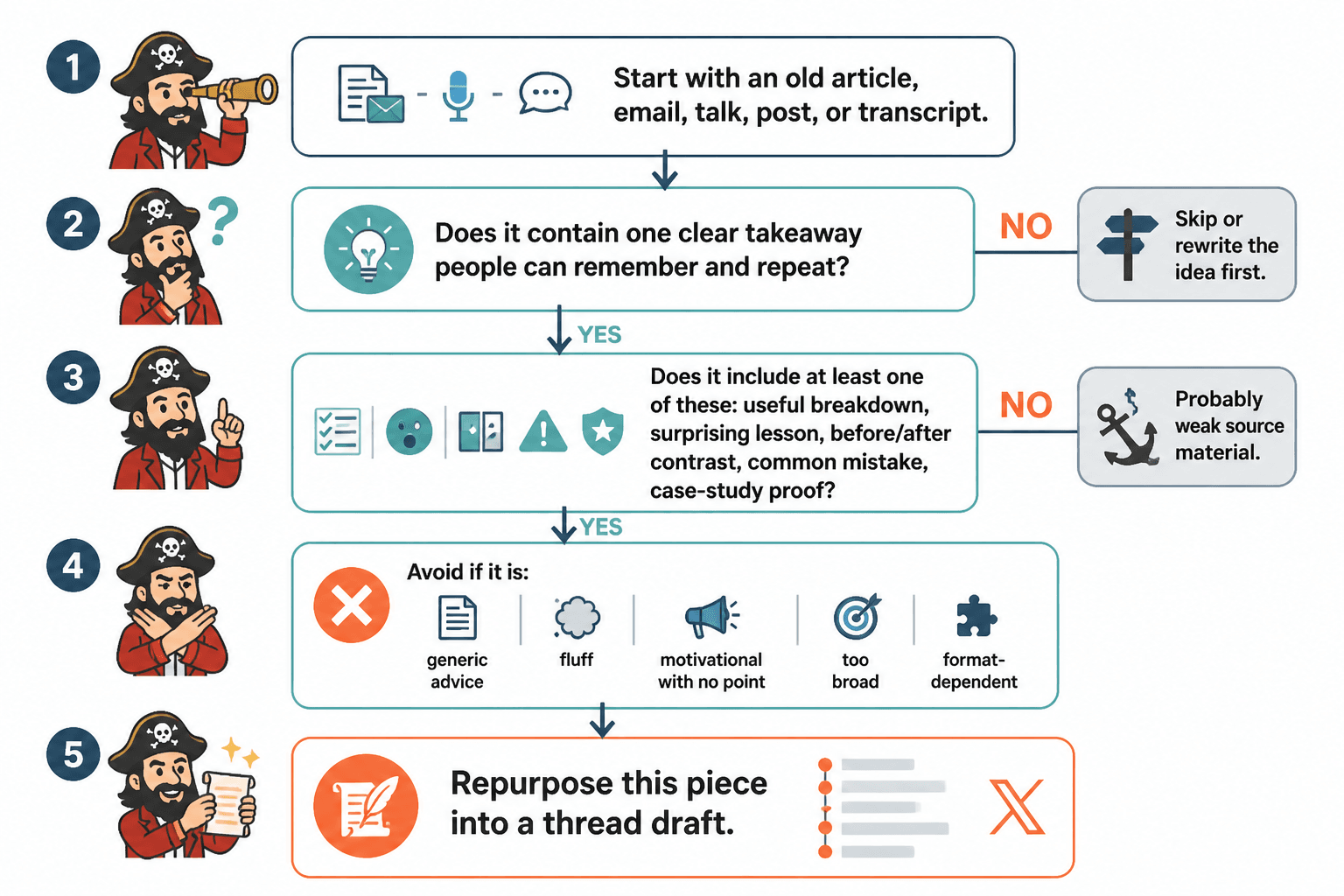
Start with content that deserves a second life
Not every old piece of content should become a thread. Some pieces were fine once and should now rest in peace.
The best source material usually has at least one of these:
- A strong opinion with a clear angle
- A practical framework
- A useful breakdown or process
- A surprising lesson from experience
- A clear before/after contrast
- A mistake people keep making
- A case-study style lesson with receipts
The weaker source material usually looks like this:
- Generic advice lists
- Thought leadership fluff
- Motivational posts with no real point
- Overly broad blog posts trying to rank for everything
- Content that only made sense because of the original format
Before you repurpose anything, ask one question: What is the actual takeaway a reader should remember and repeat?
If you cannot answer that in one sentence, the thread will probably drift.
Find the thread inside the old content
Your old article, post, talk, email, or video transcript is not the thread. It contains the thread.
So first, strip it down. Pull out the strongest usable parts and ignore the rest.
What to extract from the original piece
- The sharpest core claim
- The most useful sub-points
- Any examples, proof, or mini case studies
- Any clear steps or sequence
- The most quotable lines
- The most practical takeaway
At this stage, do not worry about tweet count. Just create a rough pile of useful material.
Then cut anything that depends on long setup, repeated explanation, or background the reader does not actually need. If a point only works after 700 words of context, it probably needs to be reframed or dropped.
A simple extraction example
Say your old content is a 1,500-word article on why creators struggle to get leads from content.
The thread is probably not “Here is my article, but smaller.”
The thread might be one of these instead:
- Why useful content gets attention but not leads
- 5 places your content funnel quietly leaks trust
- The difference between content people like and content that moves them
- 3 reasons your CTA gets ignored even when the post performs well
Same source. Different thread angles. Better outcome.
Pick one angle, not all of them
This is where a lot of repurposed threads become soup.
People try to preserve every nuance from the original content, as if removing two sub-points would be a moral failure. It would not. It would be editing.
A better X thread usually has one dominant angle:
- One argument
- One framework
- One mistake pattern
- One process
- One lesson set
That does not mean it has only one idea. It means all supporting points serve the same destination.
If your source content has multiple good ideas, great. Make multiple threads. That is called getting your money’s worth.
Rewrite the hook for X, not for the original format
The opening post matters more than the rest of the thread, because nobody reaches the rest of the thread if the first post shrugs.
A lot of old content starts slowly. That is survivable in an article. It is fatal in a thread.
Your hook should do at least one of these fast:
- State a sharp problem
- Challenge a common assumption
- Promise a clear payoff
- Create tension with contrast
- Show the cost of getting this wrong
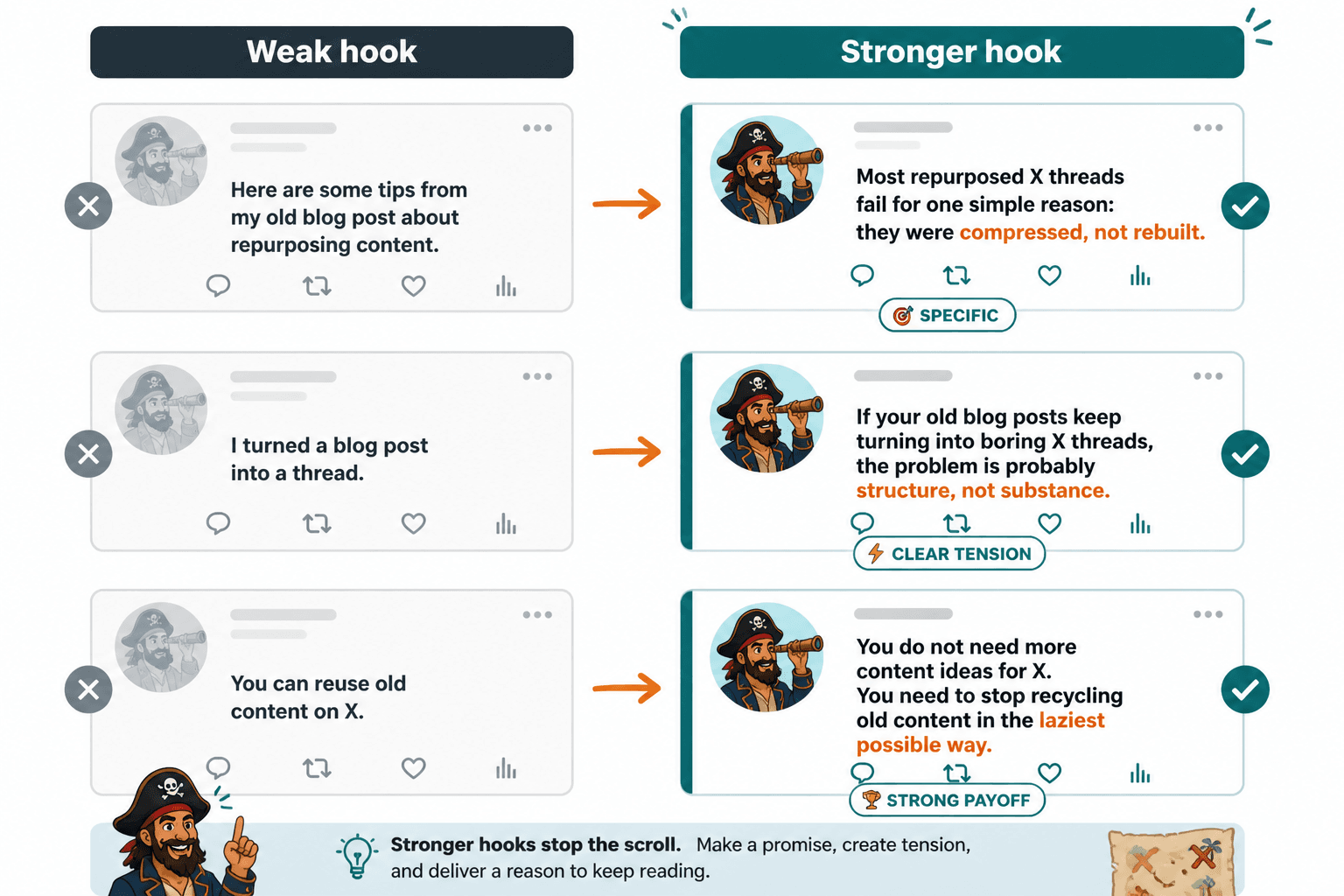
Weak hook from old content
I have been thinking a lot lately about how content creators can make better use of older material across different platforms.
No one is stopping for that. It says nothing with confidence.
Stronger thread hooks
- Most repurposed X threads fail for one simple reason: they were compressed, not rebuilt.
- If your old blog posts keep turning into boring X threads, the problem is probably structure, not substance.
- You do not need more content ideas for X. You need to stop recycling old content in the laziest possible way.
Sharper. More specific. More likely to earn the next click.
If you want more help with openings and sequencing, this guide on how to write better X threads pairs well with this one.
Turn long content into a thread sequence that actually moves
Once you have the angle and hook, build the thread like a guided argument.
Do not think in terms of “tweet 1, tweet 2, tweet 3.” Think in terms of sections with jobs.
A reliable thread structure for repurposed content
- Post 1: Hook with tension and payoff
- Post 2: Clarify the problem or frame the argument
- Posts 3–6: Deliver the main points in logical order
- Posts 7–9: Add examples, proof, or contrast
- Final post: Give the takeaway and next step
That is not a law. It is a useful skeleton. The point is to maintain momentum.
Each post should make the next one easier to read. If a post feels like a detached note you could move anywhere, the sequence probably is not tight enough.
What good thread movement sounds like
Notice the difference between these transitions:
- Flat: “Another important thing to consider is…”
- Better: “That mistake gets worse when you repurpose the opening too.”
- Flat: “Here is tip 3.”
- Better: “Now the part most people skip: cutting the good sentences that no longer serve the thread.”
The second version creates continuity. The first sounds like a content vending machine.
If thread structure is something you want to sharpen further, read how to improve X threads thread structure without sounding generic.
Cut harder than feels comfortable
Old content almost always contains too much material for one thread.
That is fine. Good, actually. You want surplus. It gives you options. What you do not want is the repurposing habit where every decent sentence from the original gets preserved like a family heirloom.
Cut:
- Slow setup
- Repeated definitions
- Side points that distract from the angle
- Polite filler between stronger points
- Explanations the audience already knows
- Any sentence that sounds smart but says very little
Keep:
- Specific observations
- Clean examples
- Useful contrast
- Simple steps
- Short proof points
- Lines people might screenshot or quote
X rewards compression, but not emptiness. The goal is not to make every post tiny. The goal is to make every post necessary.
Add examples so the thread does not feel recycled
One easy way to make old content feel new is to change the proof.
Maybe the article had one long example. In the thread, use three shorter ones. Maybe the original content stayed abstract. In the thread, add a before/after rewrite. Maybe the source piece relied on theory. In the thread, add a tiny practical scenario.
This matters because readers can smell lazy repurposing. They may not say it out loud, but they feel when something was merely resized.
Example: from article paragraph to thread post
When creators repurpose old content, they often preserve too much context from the original piece, which weakens the pacing and makes the repurposed version less effective on fast-moving platforms.
That is not wrong. It is just dense.
Thread version:
One of the fastest ways to ruin a thread:
keeping all the setup from the original article.
X readers do not need the scenic route.
Same point. Better shape for the platform.
Match the CTA to the thread, not your wishlist
A repurposed thread should not end with a random sales pitch stapled on like an afterthought.
The CTA needs to match the value and intent of the thread. If the thread teaches, your CTA can extend the learning. If it builds authority, your CTA can point to a related resource. If it warms leads, then yes, maybe it can point toward an offer. But earn it.
Good CTA options for repurposed threads:
- Invite the reader to follow for similar breakdowns
- Point to a deeper related article
- Offer a resource, template, or guide
- Ask a sharp question that continues the conversation
- Direct interested readers toward a relevant offer
Weak CTA options:
- “DM me if you need help” after a generic thread
- Hard pitching a service unrelated to the thread
- Asking for follows, likes, reposts, comments, and newsletter signups all at once
- Adding fake urgency where none exists
If your goal is conversion, this article on how to turn X threads into more leads or sales will help. And if your endings feel limp, better X threads CTA endings for personal brands is worth your time.
The bigger point is simple: clearer structure and clearer writing make the piece more useful. That is usually what makes the ending land better too.