
Wasted trust is expensive. A LinkedIn article that gets attention but never moves a reader toward a next step burns time, creates busywork, and leaves sales looking like a separate job you have to do later. The fix is not to make the article louder. It is to make the path after the article obvious, relevant, and worth following.
That is the real game here: not “How do I squeeze a pitch into an article?” but “How do I write something useful enough that the right reader is willing to keep going?” For the broader content framework, see the parent guide on LinkedIn articles. If you also need topic ideas, the companion piece on LinkedIn article ideas and examples is the cleaner starting point.

Why LinkedIn articles need a different conversion path than LinkedIn posts
LinkedIn posts are often built for fast attention. Articles are usually slower, denser, and more intent-driven. That difference matters. A post can create curiosity. An article has a better chance of creating confidence.
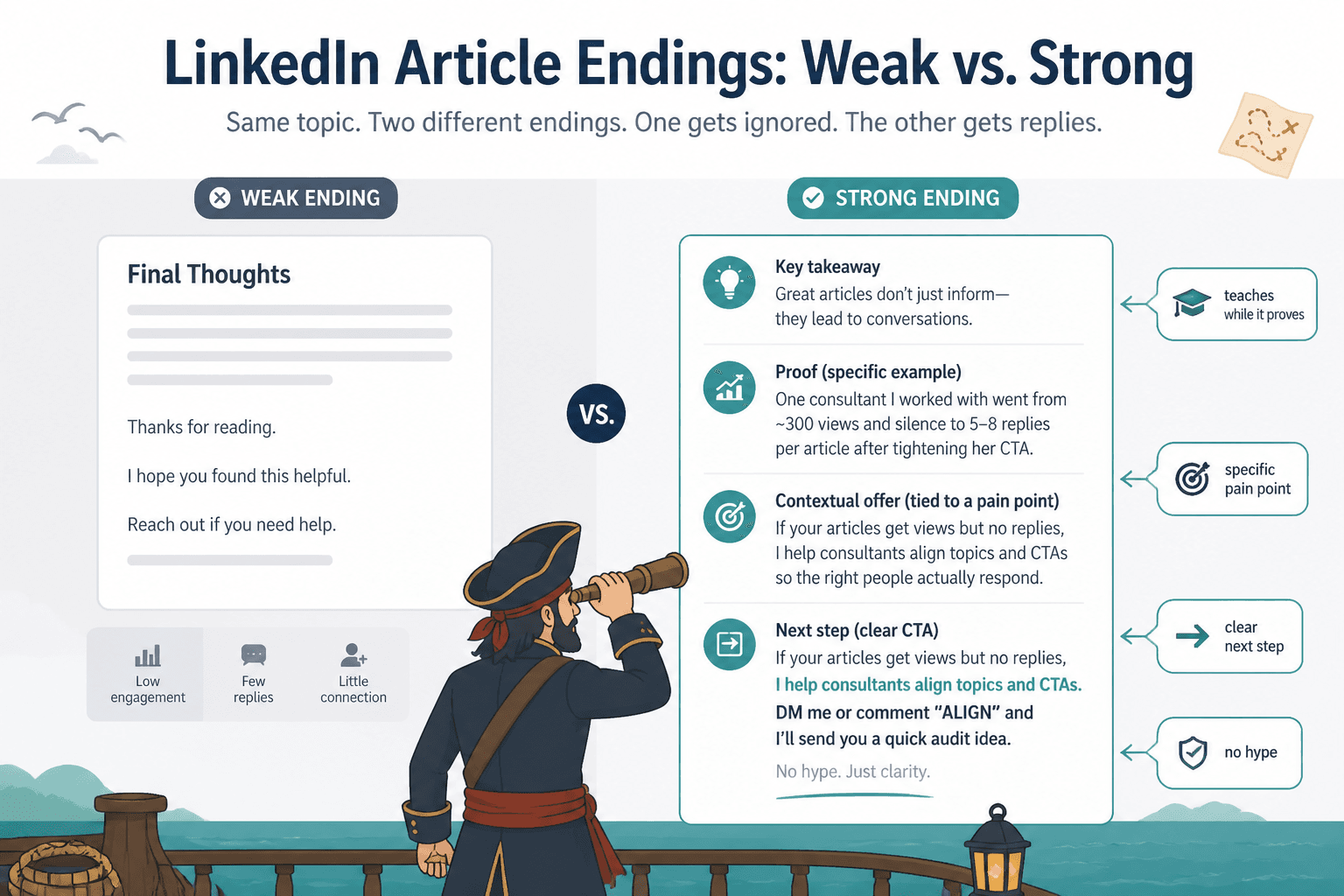
That makes the conversion job different too. A good article usually does not try to close the sale on the spot. It sets up the next step so the reader can move from interest to consideration without feeling cornered. That may mean a lead magnet, a short diagnostic, a booking call, or a related article that keeps the buyer in your lane a little longer.
In other words: the article is not the finish line. It is the part of the path where the reader decides whether you seem worth trusting.
What actually turns an article into revenue
Four things do most of the work:
- Relevance: the topic needs to connect to a real problem your offer solves.
- Specificity: the article should describe a real situation, not vague motivation wallpaper.
- Proof: examples, process, reasoning, and evidence make the offer feel real.
- One clear next step: the reader should not have to guess what to do after reading.
If any of those are missing, the article may still get likes. It just will not pull much weight in the funnel.
Choose article topics with commercial adjacency
The easiest articles to monetize are not always the boldest ones. They are the ones that sit close to a problem people already pay to solve.
Commercial adjacency means the topic naturally points toward a service, product, consultation, course, or diagnostic. For example:
- A hiring consultant writing about why job descriptions repel strong candidates.
- A copywriter writing about weak positioning on service pages.
- A strategist writing about lead quality problems after “good” content starts attracting the wrong audience.
The article does not need to scream “buy now.” It just needs to be close enough to the offer that the next step feels useful instead of random.
The best funnel ideas to pair with LinkedIn articles
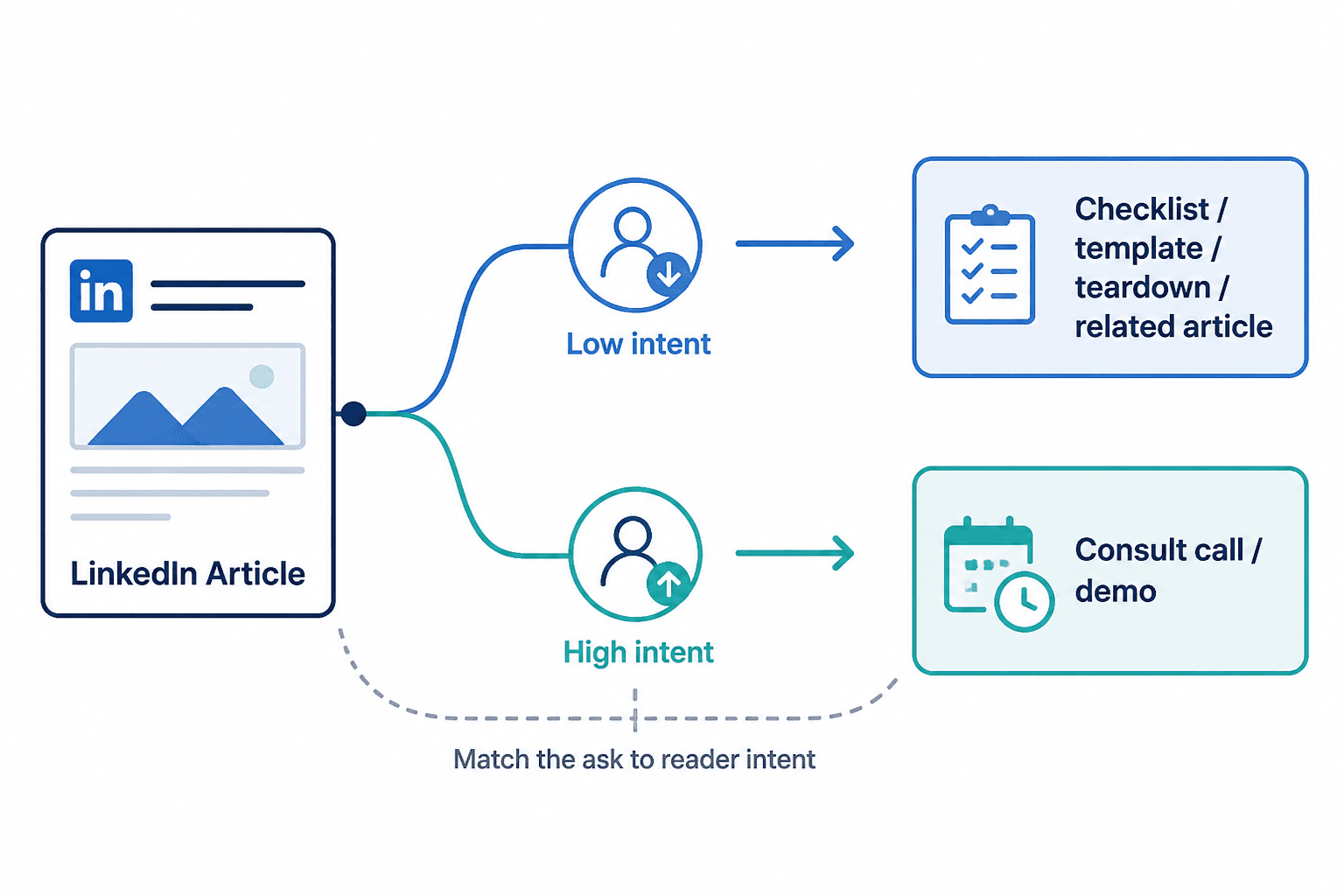
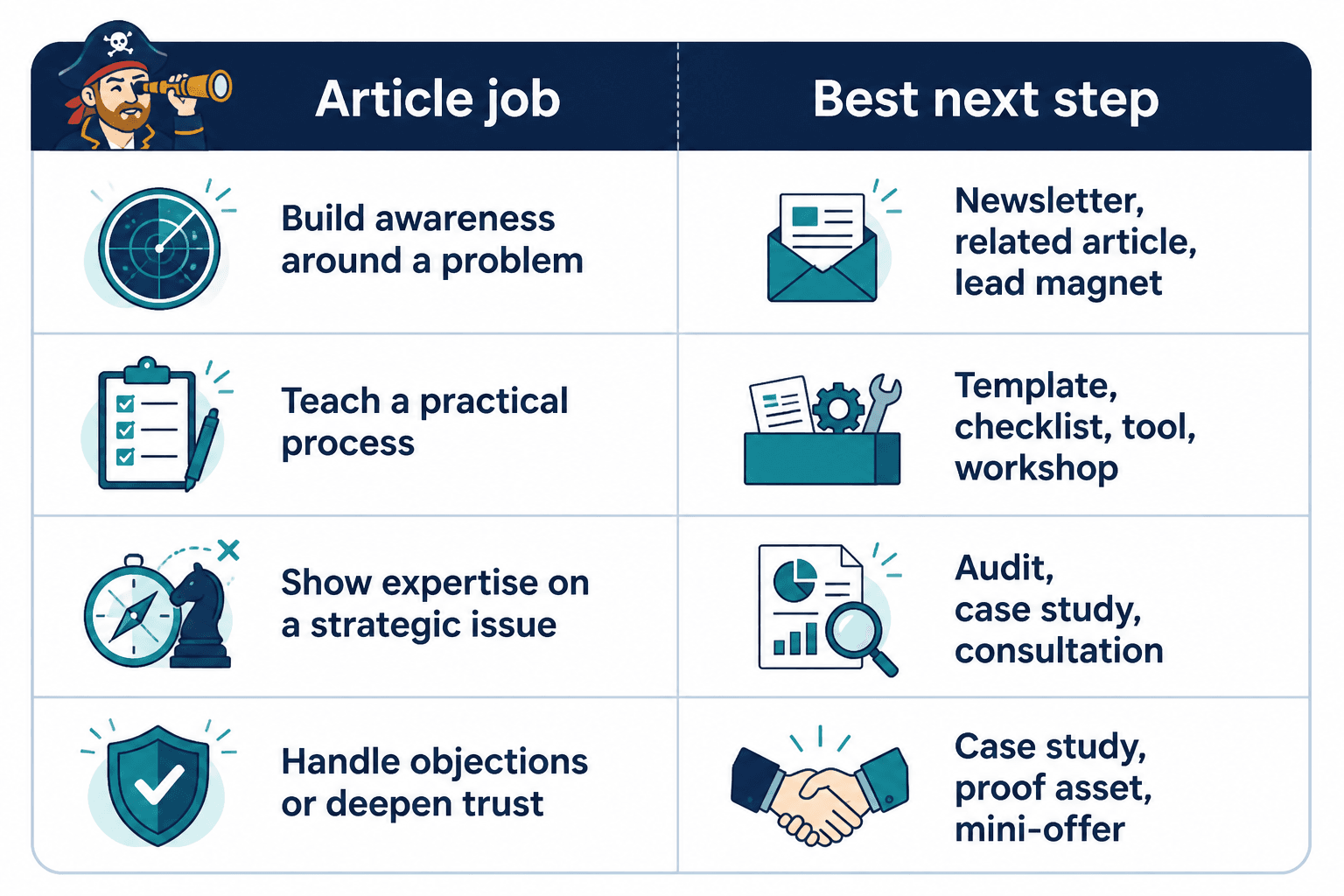
Different articles deserve different next steps. A single CTA for everything is tidy in the worst way.
1. Article to lead magnet
This is the cleanest option when the article solves part of a problem but not all of it. The article does the teaching. The lead magnet gives the reader a practical next layer: checklist, template, worksheet, teardown, or decision guide.
Use this when the article attracts curious readers who are not ready to talk yet but are willing to exchange an email for something genuinely useful.
2. Article to newsletter
If the topic naturally leads into ongoing education, invite readers to keep following the conversation. This works well for audience building and long-game trust.
It is less direct than a lead magnet, but it can be a stronger fit when the article is part of a larger expertise narrative. A newsletter CTA also feels lighter, which can help if the topic is early-stage and the audience needs more time.
3. Article to related article cluster
This is the underrated option. Sometimes the best conversion is not a form fill. It is helping the reader stay in the right lane long enough to understand the problem properly.
If the article answers one part of a broader buying question, link to the next related article. That keeps the reader moving, reduces bounce, and builds authority without forcing an immediate ask.
It is also a good bridge from educational content to commercial content when the audience is not ready for the offer yet.
4. Article to low-friction diagnostic or audit
If your service starts with assessment, this is often the strongest fit. A low-friction diagnostic gives the reader a concrete next step that feels useful rather than salesy.
Examples include a quick scorecard, a short audit form, a self-check, or a “find the gap” tool. The point is to move from passive reading to a small action that qualifies interest.
5. Article to case study or proof asset
Sometimes the reader does not need more education. They need proof. In that case, the next step should show what changed, how it changed, and what the work looked like.
This works especially well when the article explains a problem and the next asset demonstrates the result. That sequence is often more persuasive than a direct pitch.
Write the article like a real article, not a teaser for your offer
The fastest way to kill trust is to make the article feel like a pretext. Readers can smell that from a scroll away.
Better structure:
- State the problem clearly.
- Show the cost of ignoring it.
- Explain the mechanism or mistake.
- Offer a usable framework or insight.
- Then introduce the next step.
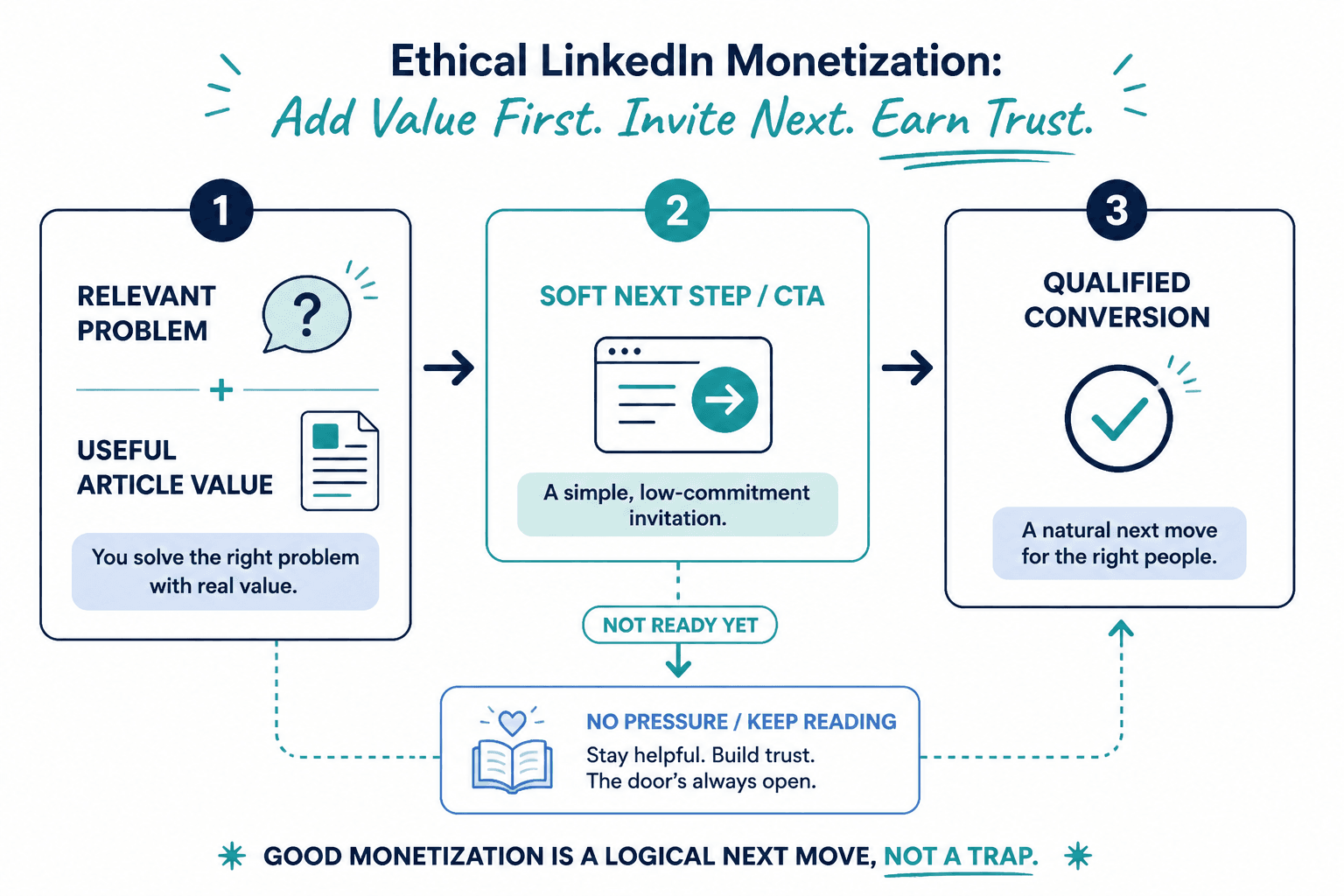
That order matters. The article should stand on its own. The CTA should feel like the natural next move, not the real reason the piece exists.
If you want a trust-first version of this approach, the companion guide on monetizing LinkedIn articles without wrecking trust goes deeper on the tone and sequencing side.
Make the CTA feel earned
A CTA works better when it matches the effort the reader already gave you. If the article is thoughtful, the next step should be specific and proportional.
Good CTA patterns:
- “If you want the checklist, download it here.”
- “If this is the problem you are facing, use the audit here.”
- “If you want the full framework, read the next article.”
- “If you want help applying this to your situation, book a call.”
Weak CTA patterns:
- “Follow me for more.”
- “DM me if you want to know more.”
- “Check out my stuff.”
- “Let’s connect.”
The second group is not evil. It is just lazy. And lazy conversion usually costs more than it saves.
Where to place the CTA
Most articles do better with a single primary CTA near the end. That keeps the piece readable and avoids turning every paragraph into a sales hallway.
That said, a small contextual mention earlier in the article can work if it is genuinely useful. For example, if you reference a framework that also exists as a checklist or diagnostic, a brief internal link can help the reader take the next step without waiting for the final paragraph.
A simple layout:
- Middle of article: optional supporting link if the reader needs a related resource.
- End of article: primary CTA to the lead magnet, audit, call, case study, or newsletter.
Do not scatter the CTA everywhere. Readers are not goldfish. They notice when the article is trying too hard.
A simple pre-publish checklist
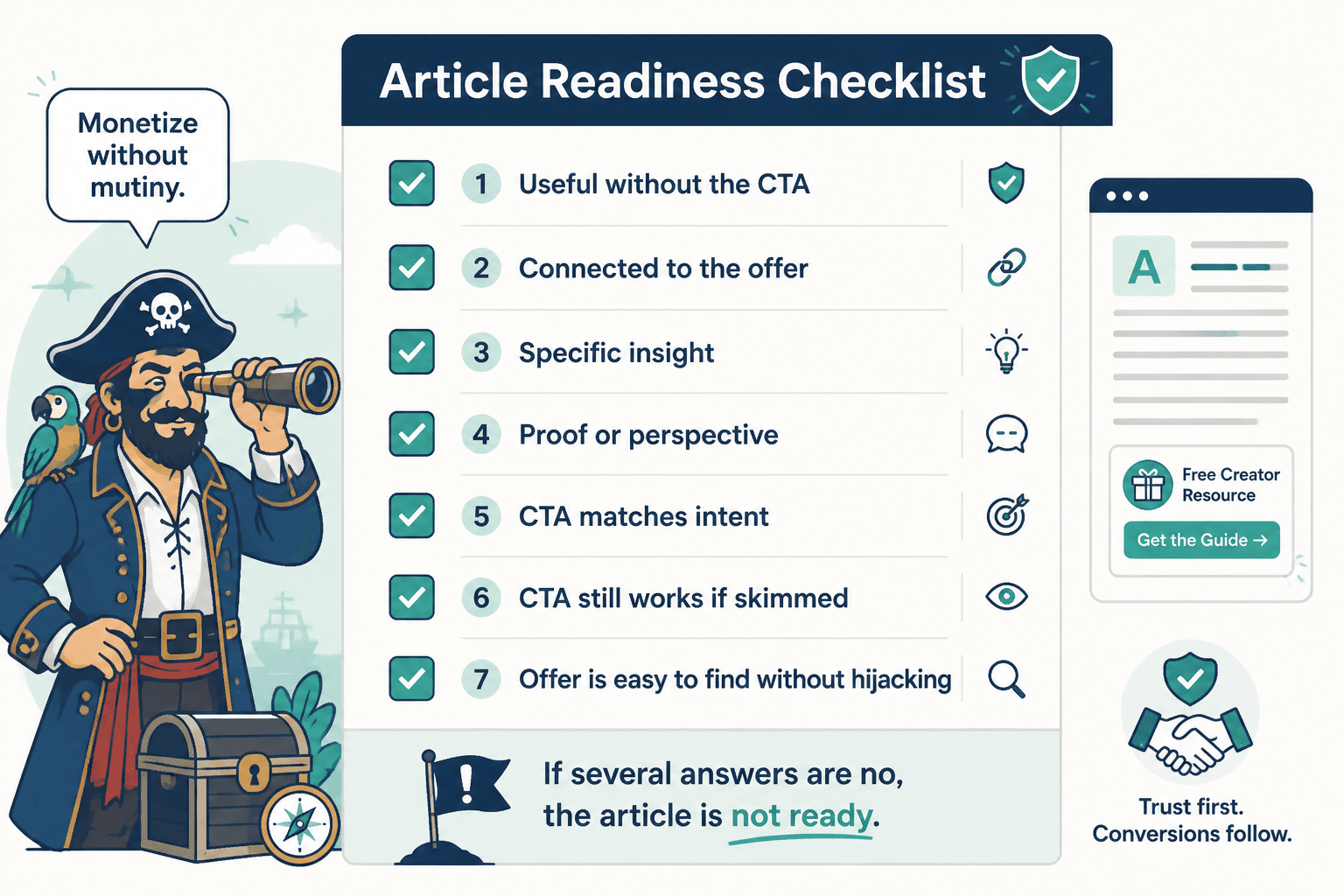
Before publishing, check the article against this list:
- Does the topic connect to a real business problem?
- Is the next step clearly tied to the article’s promise?
- Would the article still be useful if the reader ignored the CTA?
- Is there enough proof, specificity, or process to build confidence?
- Did you choose one main conversion path instead of three competing ones?
- Is the CTA specific, low-friction, and honest about what happens next?
If the answer to any of those is no, revise before you publish. Fixing the conversion path after the fact is possible, but it is a lot less charming than getting it right the first time.
Common mistakes that weaken trust or conversion
- Publishing broad topics with no commercial angle. Interesting is not the same as monetizable.
- Making the article sound like an ad. Readers do not reward obvious trapdoors.
- Offering too many next steps. A confused reader usually does nothing.
- Hiding the CTA inside weak phrasing. Clarity converts better than coyness.
- Choosing the wrong funnel for the reader’s intent. A case study may outperform a lead magnet, or vice versa, depending on the stage.
For a broader menu of next-step structures, the companion article on funnel ideas for LinkedIn articles is the natural pairing here.
A practical way to think about the whole system
Use the article to earn attention. Use the offer to convert that attention. Use the next step to keep the right people moving.
That is the whole pattern.
When the article is specific, the CTA is relevant, and the follow-through is clear, the page stops acting like content for content’s sake. It becomes part of a sales path that does not feel embarrassed about being a sales path.
Related reading
- How to Write Better LinkedIn Articles
- Best LinkedIn Article Ideas and Examples for Creators
- Best AI Tools for LinkedIn Articles
- How to Monetize LinkedIn Articles Without Wrecking Trust
Start with one article, one reader problem, and one next step. That is usually enough to turn “good content” into something with a pulse.