
Most people publish LinkedIn articles like they are the finish line.
Write the article. Hit publish. Maybe share it once. Then wait for authority, leads, and polite inbound inquiries to float gently from the sky.
That is not a funnel. That is posting and hoping with better formatting.
The best funnel ideas to pair with LinkedIn articles are not complicated, but they do need to match what the article is actually doing. A strong article can build trust, show expertise, answer bigger questions, and attract people who are further along than casual post readers. But if there is no next step, that trust just kind of wanders off.
Here’s how to pair LinkedIn articles with simple, sane funnels that move readers from “this is useful” to “I’d actually like to hear more from this person” without turning your article into a disguised sales brochure.
If you want the broader context on how articles fit into LinkedIn content strategy, it helps to start with the main LinkedIn articles guide. Articles are not just longer posts. They work better when they lead somewhere.
To see how this fits into the wider strategy, open the parent guide.
Why LinkedIn articles need a different funnel than LinkedIn posts
Posts and articles do different jobs.
Posts are great for reach, reactions, quick credibility hits, and starting conversations. Articles are better for depth, searchability, authority, and handling questions that need more than 900 characters and a brave amount of line breaks.
That matters because the person who reads a full article is usually showing stronger intent than someone who glances at a post. They are giving you more time, more attention, and more trust. Your funnel should respect that.
A weak article funnel usually looks like one of these:
- No CTA at all
- A generic “follow me for more” tacked on at the end
- A hard sales pitch that feels wildly early
- A lead magnet that barely relates to the article
- A booking link dropped on cold readers with zero bridge
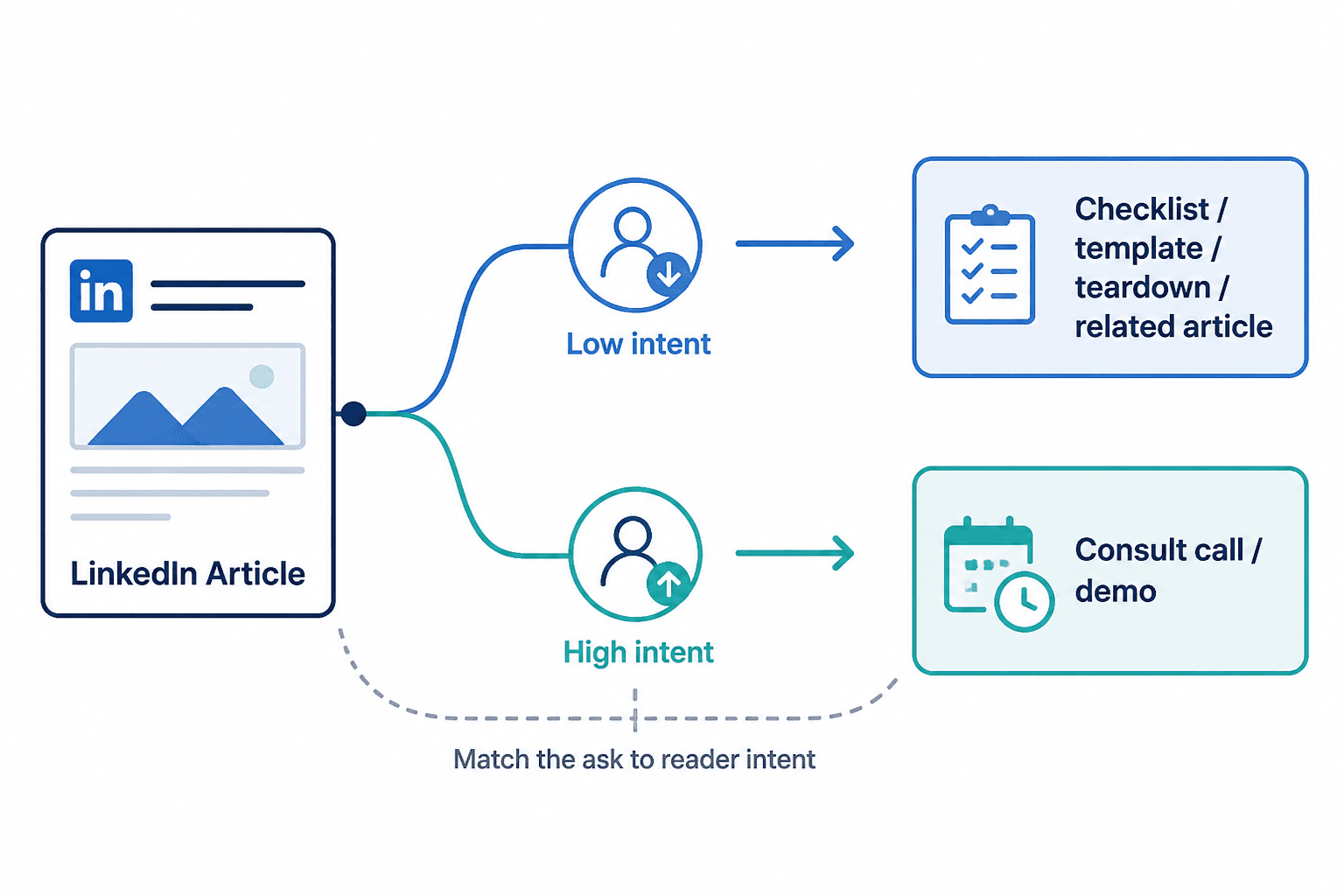
The better approach is simple: match the next step to the reader’s level of intent.
Someone who just read your article on fixing a LinkedIn profile probably does not want an immediate “book a strategy intensive” push. They may want a checklist, a teardown, a template, or another useful piece of content first. Someone who just read your article on enterprise messaging strategy and is clearly a qualified buyer might be perfectly open to a call.
Context matters. Fancy funnel diagrams matter a lot less.
What a good LinkedIn article funnel actually does
Before the funnel ideas, here is the standard you want.
A good funnel paired with a LinkedIn article should do four things:
- Fit the article topic. The next step should feel like the obvious continuation, not a random side quest.
- Match reader intent. Do not ask for more commitment than the article has earned.
- Reduce friction. Make the next step easy to understand and easy to take.
- Move trust forward. The funnel should deepen belief, not cash it in too early.
That means your CTA is not just a CTA. It is a bridge. It should answer one quiet question in the reader’s mind: “What should I do next if this was useful?”
The best funnel ideas to pair with LinkedIn articles
These are the best funnel ideas to pair with LinkedIn articles because they are practical, low-drama, and easy to align with real buyer journeys.
1. Article to lead magnet
This is one of the safest and most flexible options.
If your article teaches the “what” and “why,” the lead magnet can deliver the “how,” the template, the checklist, the audit tool, the swipe file, or the worksheet. That is a natural progression.
Best for:
- Coaches
- Consultants
- Service providers
- B2B creators
- Personal brands building an email list
Good examples:
- Article: How to write a sharper LinkedIn About section
- Lead magnet: 10 high-converting About section templates
- Article: Common content strategy mistakes founders make
- Lead magnet: Content planning worksheet for founder-led brands
- Article: How consultants can use case studies on LinkedIn
- Lead magnet: Case study outline and client proof checklist
What makes this work is relevance. Not just “free thing available.” The free thing should solve the next problem the article naturally creates.
Simple CTA example: “If you want the template version of this, I put the full checklist into a free download you can use on your own profile.”
2. Article to newsletter
If your article is part of a broader expertise area, sending readers to your newsletter makes a lot of sense.
This works especially well when your business depends on long-term trust rather than immediate conversion. Readers who finish thoughtful LinkedIn articles are often happy to keep hearing from you, if the promise is clear enough.
Best for:
- Writers
- Educators
- Strategists
- Consultants with longer sales cycles
- Creators building owned audience channels
The key is to avoid vague newsletter CTAs like “subscribe for more insights.” Nobody wakes up craving more insights. They want a useful result.
Better CTA:
“I send one practical email a week on content strategy, positioning, and lead-gen systems for service businesses. If this article helped, that’s the best place to keep going.”
Short. Clear. No funnel cologne.
3. Article to related article cluster
Not every funnel has to go straight to email or sales. Sometimes the best move is to keep the reader in your content ecosystem a little longer.
This works well when you are building authority in a niche and want to move readers through a sequence of related ideas before asking for anything bigger.
For example, if someone reads an article on funnels for LinkedIn articles, sensible next reads might include LinkedIn article ideas and examples, templates and tools for LinkedIn articles, LinkedIn articles for creators with small audiences, or AI tools for LinkedIn articles.
This kind of internal flow does two useful things:
- Builds trust before asking for a bigger commitment
- Helps readers self-select into your core expertise areas
It is not glamorous, but it works. A reader who consumes three strong pieces is often warmer than one who downloaded a random checklist and forgot your name ten minutes later.
4. Article to low-friction diagnostic or audit
This is a smart middle step when the reader likely needs tailored help, but a direct sales call would be too abrupt.
A diagnostic offer gives the reader a focused, useful next step with lower psychological resistance. It feels more concrete than “book a call” and more personal than “download this PDF.”
Examples:
- Mini LinkedIn profile audit
- Content funnel scorecard
- Messaging teardown request
- Email sequence review form
- Article topic fit assessment
Best for:
- Consultants
- Done-for-you providers
- Strategists
- Agencies
- Coaches with high-ticket offers
The important bit is that the audit has to be real. If it is just a fake consult trap wearing a fake moustache, people can tell.
Better CTA: “If you want a second set of eyes on your article funnel, I offer a short audit where I’ll point out the biggest conversion gaps.”
Worse CTA: “Book a free value-packed growth acceleration call and let’s unlock your content opportunities.”
No one trusts that sentence. Not even the person who wrote it.
5. Article to case study or proof asset
Sometimes your reader is interested, but not convinced. They do not need more theory. They need proof.
That makes article-to-case-study a strong funnel path, especially for service businesses selling outcomes that require confidence and trust.
Example flow:
- Reader finds your article on improving LinkedIn authority
- At the end, you offer a case study showing how that strategy helped a consultant generate better leads
- The case study links to a booking page or inquiry form
This works because it follows the reader’s natural progression:
- Interesting idea
- Can you prove it
- Could this work for me
- What is the next step
If your article is high-level, the proof asset is often the thing that tips it into actual business value.
6. Article to consultation or application
Yes, this can work. No, it should not be your default for every article.
A direct article-to-call funnel works best when:
- The article addresses an expensive or urgent problem
- The audience is already fairly aware
- The service is clear and specific
- The article demonstrates real expertise and credibility
- The CTA frames the call around a concrete outcome
Good fit examples:
- B2B messaging strategist writing for SaaS founders
- Executive coach writing for leadership teams
- LinkedIn ghostwriter writing for consultants already trying to generate leads
Bad fit examples:
- Broad educational article with no real proof
- Early-stage creator with low trust and no clear offer
- CTA asking cold readers to make a big decision too fast
A decent CTA here sounds like this:
“If you want help building this into your own LinkedIn content funnel, you can apply to work with me here. I’ll take a look and tell you if it’s a fit.”
Notice what it does not sound like. It does not sound desperate. It does not sound inflated. It does not sound like a webinar registration page from a tragic era of the internet.
7. Article to webinar, workshop, or training
This is useful when the topic needs more demonstration, examples, or live explanation than an article can comfortably handle.
It works well for nuanced topics like:
- Content systems
- Positioning strategy
- Lead generation workflows
- Offer design
- Messaging breakdowns
The article does the qualification work. The training does the deeper teaching and trust-building work.
Just make sure the training is not a 42-minute runway to a pitch. People are getting better at spotting that shape from orbit.
If you use this funnel, the article should create enough tension that the workshop feels like the logical next level, not a random event promotion.
8. Article to productized service or paid mini-offer
This is an underrated option.
If your audience likes practical, bounded help, a small paid offer can outperform a generic consultation CTA. It is clearer, lower-risk, and easier to buy.
Examples:
- LinkedIn article teardown
- Profile rewrite sprint
- Hook pack review
- Content funnel audit
- Messaging diagnosis session
This works especially well when the article already shows your thinking process. Readers can see your method, then buy a lighter version of your help.
For some businesses, this is the cleanest bridge between authority content and higher-ticket services.
How to choose the right funnel for your LinkedIn article
You do not need seven funnel paths. You need one that fits.
Here is a practical way to choose.
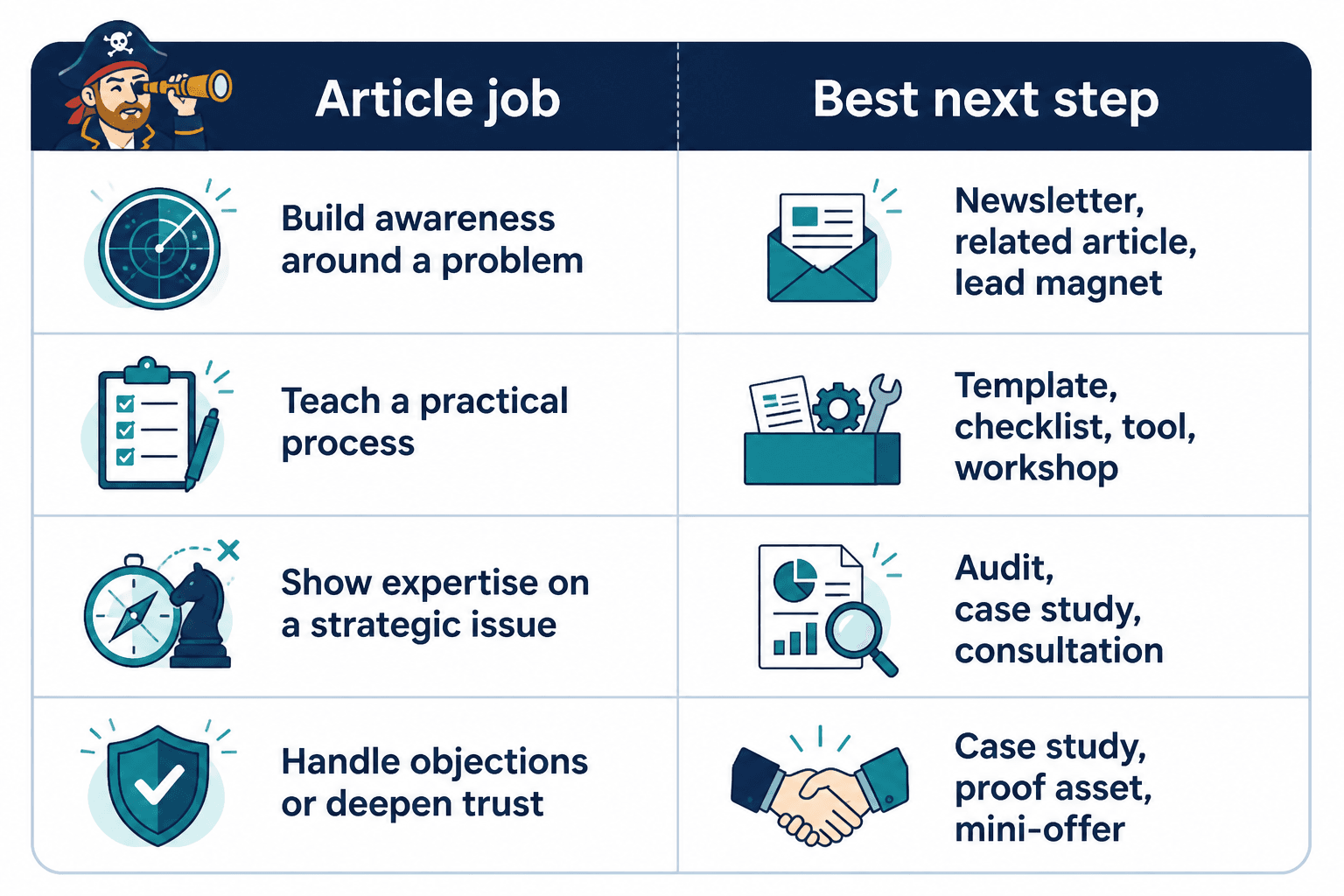
Match the funnel to the article’s job
| Article job | Best next step |
|---|---|
| Build awareness around a problem | Newsletter, related article, lead magnet |
| Teach a practical process | Template, checklist, tool, workshop |
| Show expertise on a strategic issue | Audit, case study, consultation |
| Handle objections or deepen trust | Case study, proof asset, mini-offer |
| Attract qualified leads for a service | Application, diagnostic, productized service |
Match the funnel to audience temperature
Cold reader? Ask for a small next step.
Warm reader? You can ask for more.
If the article is likely to reach people who do not know you yet, a newsletter, related content path, or free resource is usually smarter than a booking CTA.
If the article is being read by people already in your niche, already aware of the problem, and already evaluating help, a consultation or audit can work very well.
Match the funnel to your business model
This sounds obvious, yet people still pair articles with random next steps that have nothing to do with how they actually make money.
If your business runs on email nurturing, build the email list.
If your business runs on consults, route readers toward a diagnostic or application.
If your business runs on productized services, offer a tight paid next step.
Do not bolt on a webinar funnel because somebody online said webinars convert. A funnel should support your business, not cosplay as someone else’s.
How to place CTAs inside LinkedIn articles without making them gross
You do not need to plaster CTAs every three paragraphs like a nervous direct-response marketer.
For most LinkedIn articles, these placements are enough:
- A light contextual CTA near the middle, if relevant
- A stronger CTA at the end
- Occasional natural internal links to related content
The CTA should feel earned by the content around it.
Here are a few clean approaches.
Soft CTA inside the article
“If you want to make this easier, I’ve put the full framework into a simple worksheet.”
Authority CTA at the end
“If you’re working on your LinkedIn content strategy, you might also find these related resources useful.”
Service CTA at the end
“If you want help building this for your brand, I offer a focused audit and implementation plan.”
Keep it direct. Keep it relevant. Keep the reader’s context in mind.
Mistakes that ruin article funnels
A decent article can still underperform if the funnel attached to it is clumsy. These are the usual problems.
Using a CTA that does not match the topic
If your article is about writing better LinkedIn articles and your CTA is for a generic productivity toolkit, you have broken the thread. Relevance beats novelty.
Pitching way too early
An article is not permission to sell aggressively. It is a chance to earn the next bit of trust. There is a difference.
No clear next step
Readers should not have to guess what to do after reading. If the article helped, guide them. Nicely. Like a functioning adult.
Offering too many next steps
Do not end with a buffet of seven links, three offers, and a follow request. Pick the main path. Support it with one or two related options at most.
Treating every article like a sales page
The bigger point is simple: clearer structure and clearer writing make the piece more useful. That is usually what makes the ending land better too.
LinkedIn articles work best when the structure makes the main idea easy to follow and easy to act on. Clearer writing usually carries more weight than heavier formatting.