
A draft is open in one tab, three headline options are fighting in the notes app, and the working title still sounds like it was written by a committee that has never met a reader. That is usually the moment people go hunting for “better ideas,” when what they really need is a few grounded examples that show what a usable LinkedIn article actually looks like once the fog clears. Examples matter because they turn vague intent into something a creator can write, edit, and publish without turning the whole thing into a mood board for procrastination.
This guide is for that stage of the work: the messy middle between “I should write something for LinkedIn” and “here is a draft that does not sound like recycled confidence.” It pulls together practical LinkedIn article ideas, the kinds of examples that are worth adapting, and a few simple structures that help the whole thing hold together.
If you want the bigger publishing system behind this page, start with the parent guide on writing better LinkedIn articles. If you are trying to choose the right format before you draft, the related page on LinkedIn article structure examples is a useful companion. For angle work, the page on authority angle templates does a lot of the heavy lifting.
Why LinkedIn article examples help creators write faster
Most creators do not need more abstract advice about “writing valuable content.” They need to see the shape of a good article before they start drafting. A strong example gives you three things at once:
- the topic shape,
- the angle,
- and the level of specificity the reader can actually use.
That matters on LinkedIn because articles are doing a different job than short posts. A post can get away with a quick point or a sharp observation. An article needs more room to explain the why, show the how, and make the reader trust the point enough to keep going. The best examples do not just “sound polished.” They reduce uncertainty.
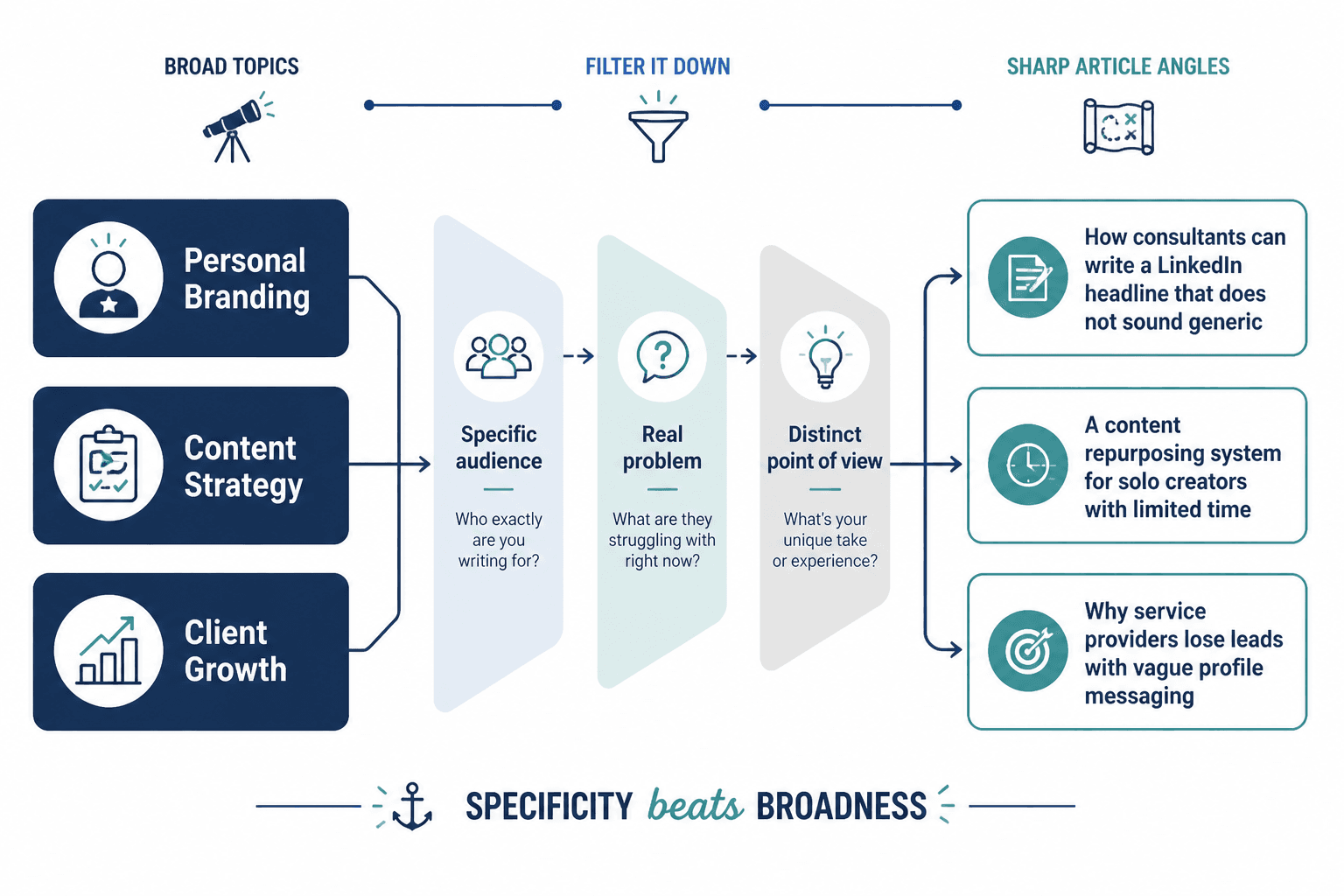
That is also why broad topic ideas usually underperform. “How to build a personal brand” sounds important and says almost nothing. “How a consultant can use one LinkedIn article to answer five recurring buyer questions” sounds smaller, clearer, and much easier to write.
What makes a LinkedIn article idea worth publishing
A usable LinkedIn article idea usually has four qualities:
- Specific reader: one audience, not “everyone who creates content”
- Clear payoff: the reader knows what they will get from finishing
- Real tension: a problem, decision, misconception, or tradeoff
- Adaptability: the idea can become a useful article without needing fake drama
If an idea does not have at least two of those, it is probably too soft to carry a whole article. That does not mean it is bad. It usually means it needs a sharper angle.
A useful test: can you explain the article in one sentence without using the phrase “thought leadership”? If yes, you are probably close. If no, the idea may still be in witness protection.
How to choose a LinkedIn article idea fast
When creators get stuck, they often try to pick the “best” topic in the abstract. That is a trap. The better move is to choose the idea that is easiest to make specific.
- Start with a recurring question. What do people keep asking, misunderstanding, or hesitating about?
- Choose one reader. Pick a role, stage, or situation.
- Choose one outcome. What should the reader think, do, or avoid after reading?
- Choose one structure. Framework, example stack, myth correction, process breakdown, and so on.
If the topic still feels broad after that, narrow the audience again. “Creators” is not a reader. “Creators who want to turn articles into leads without publishing a manifesto every Tuesday” is much closer to useful.
LinkedIn article ideas and examples creators can adapt
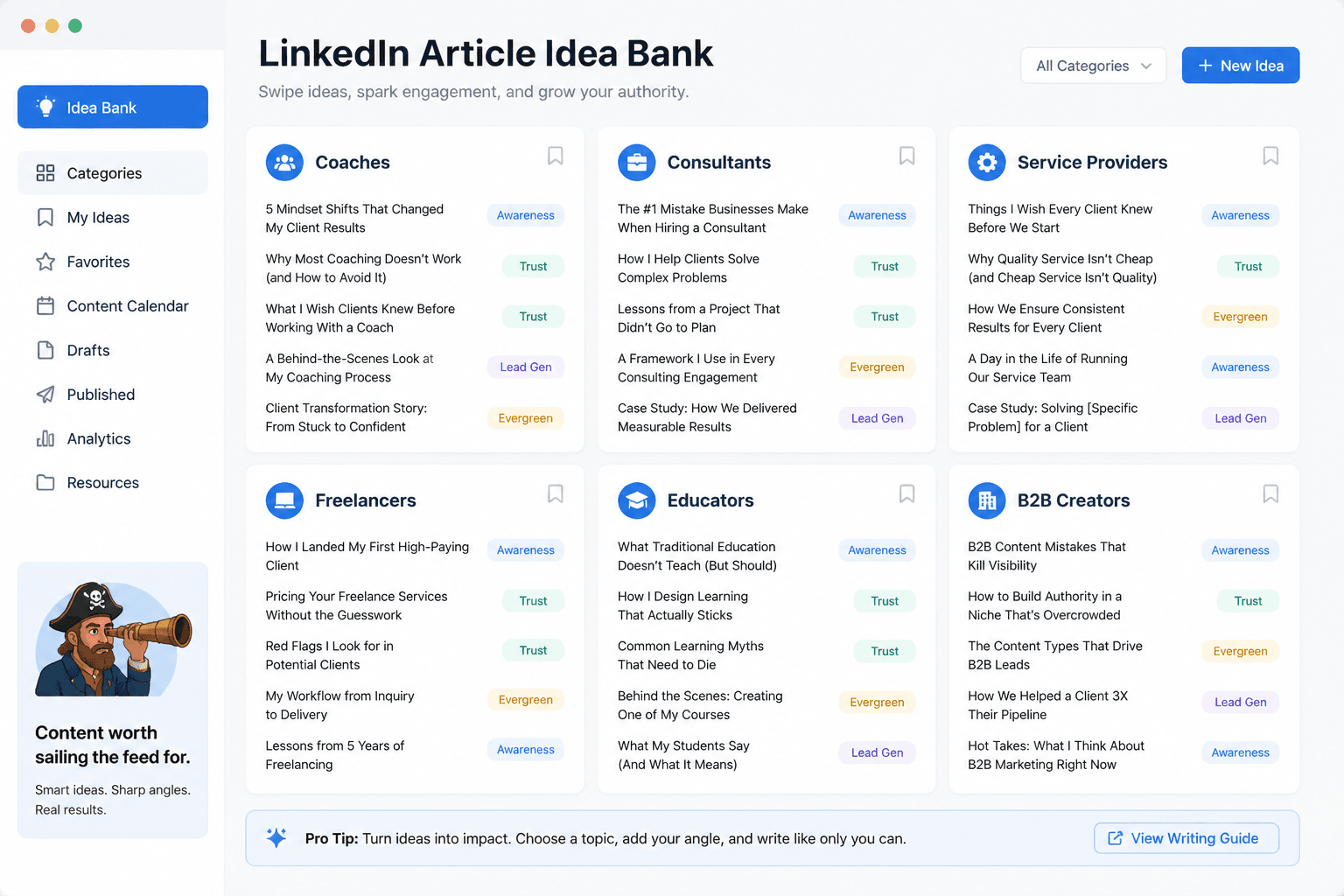
The examples below are written as adaptable patterns, not as finished scripts. Treat them like a menu, not a museum exhibit.
1. The how-I-think article
Best for: coaches, consultants, freelancers, and creators who want to build trust without pretending to have magic answers.
What it does: shows the reasoning behind a decision, process, or point of view.
Example idea: “How I decide which content ideas deserve a full LinkedIn article and which ones should stay a short post.”
Why it works: readers get context, not just advice. They can borrow the thinking even if their own business is different.
Simple structure:
- the decision you are trying to make
- the filters you use
- the tradeoff you accept
- one example
- what you would tell a beginner
2. The myth-correcting article
Best for: creators who have a clear opinion and can explain why common advice falls short.
What it does: challenges a popular assumption and replaces it with something more useful.
Example idea: “Why LinkedIn articles do not need to be long to be useful.”
Why it works: good myth-correcting articles create tension fast. Readers already recognize the bad advice, which gives you a strong opening.
Simple structure:
- state the myth
- show why it sounds reasonable
- explain where it breaks down
- offer a better rule
- show a short example
3. The process breakdown
Best for: creators who have a repeatable workflow and want to show it without turning it into a lecture.
What it does: walks the reader through how something gets done.
Example idea: “My simple process for turning one LinkedIn article into a week of posts.”
Why it works: it is concrete. Process articles tend to feel more trustworthy because they show work instead of just announcing conclusions.
Simple structure:
- the raw input
- the steps in order
- the decision points
- what gets reused later
- what usually gets skipped
4. The buyer-question article
Best for: people using LinkedIn articles to support leads, sales, or trust-building.
What it does: answers one question a buyer is likely to ask before saying yes.
Example idea: “What a client should expect from a creator who writes LinkedIn articles for lead generation.”
Why it works: this format meets the reader where they actually are, not where your content calendar wishes they were.
Simple structure:
- state the question plainly
- explain why it matters
- answer it in practical terms
- show what good looks like
- note the common mistake
For more on that end of the funnel, see how to turn LinkedIn articles into more leads or sales.
5. The lesson-from-experience article
Best for: creators who have made the mistake, tested the thing, or watched the pattern repeat enough times to talk about it cleanly.
What it does: turns a real lesson into a practical takeaway.
Example idea: “The lesson I keep relearning about writing articles that actually get finished.”
Why it works: readers do not need a dramatic origin story. They need a lesson with a useful edge.
Simple structure:
- the situation
- what went wrong or surprised you
- the lesson
- what changed after that
- how the reader can apply it
6. The framework article
Best for: creators who can organize a messy topic into a repeatable model.
What it does: gives the reader a simple way to remember or apply the idea.
Example idea: “My 3-part framework for choosing a LinkedIn article topic that is actually worth the time.”
Why it works: frameworks make content feel usable without becoming bloated. They also travel well into future posts.
Simple structure:
- name the framework
- define each part
- show how the parts work together
- give one example
- show the mistake the framework prevents
7. The comparison article
Best for: creators weighing tools, formats, methods, or content approaches.
What it does: helps the reader decide between two or more options.
Example idea: “LinkedIn posts vs LinkedIn articles: when to use each one as a creator.”
Why it works: people love a good comparison because it saves them from having to do the whole mental spreadsheet themselves.
Simple structure:
- state the decision
- define each option
- compare them by use case
- give a recommendation by scenario
- end with the simplest rule
If the topic is tool-heavy, the companion page on best AI tools for LinkedIn articles may also be useful to readers.
8. The example stack article
Best for: creators who want to show variety without losing focus.
What it does: gathers a handful of examples around one theme.
Example idea: “7 LinkedIn article ideas for creators who want to sound useful, not promotional.”
Why it works: example stacks are easy to scan and easy to repurpose. They also give readers a sense of range.
Simple structure:
- one short framing intro
- the examples, each with one-sentence explanation
- a closing note on when to use them
LinkedIn article structure examples that pair well with these ideas
Once the idea is solid, structure does the rest of the work. A weak structure makes even a decent topic feel scattered. A strong structure gives the reader a reason to stay with you.
Common structure patterns that work well for LinkedIn articles include:
- Problem → mistake → fix for practical teaching
- Framework for repeatable thinking
- Before → after for transformation or revision
- Example stack for topic range and scanability
- Argument for a clear opinion with evidence
If you want a deeper breakdown of those patterns, use the sibling page on LinkedIn article structures creators can adapt fast.
How to turn one LinkedIn article into more content
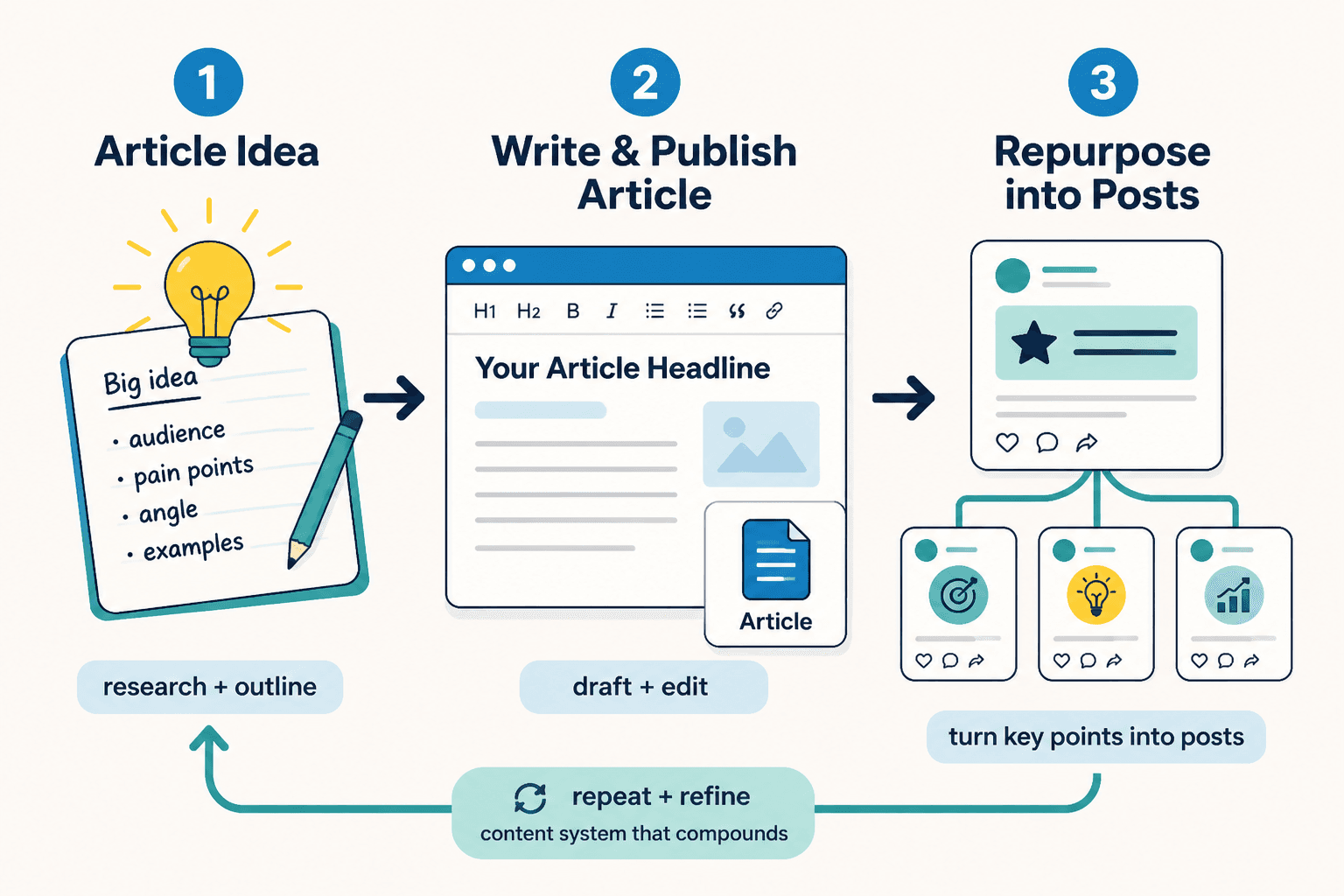
A good article should not disappear into the archive like a polite ghost. One useful LinkedIn article can produce several smaller pieces of content if you plan for it.
- pull one takeaway into a short post
- extract one example into a carousel or text post
- turn the framework into a checklist
- reuse the intro as a hook for another platform
- pull the closing lesson into a separate opinion post
That is especially useful if you write for visibility and lead flow at the same time. One article can do both jobs if the angle is specific enough and the structure does not collapse under its own enthusiasm.
For the practical repurposing side, the companion article on turning LinkedIn articles into leads or sales is the better next stop.
Common mistakes that make article ideas feel thin
Thin ideas usually have one or more of these problems:
- Too broad: the topic sounds important but says nothing specific
- Too clever: the angle is trying to impress before it helps
- Too generic: it could belong to any creator in any niche
- Too inflated: the idea needs fake urgency to seem publishable
- Too many jobs: the article is trying to teach, sell, inspire, and prove expertise all at once
The fix is usually simple: narrow the reader, narrow the outcome, and cut one layer of ambition. Not forever. Just enough to make the article easier to write honestly.
A quick way to draft stronger LinkedIn article ideas
Use this small prompt set when you are stuck:
- What question keeps showing up?
- Who is asking it?
- What do they need to understand first?
- What is the simplest useful angle?
- What proof, example, or breakdown would make it feel real?
If you can answer those five questions, you probably have a workable idea. If not, the topic may need a narrower lens before it becomes an article instead of a slogan with paragraphs.
Wrap-up
The best LinkedIn article ideas are not the loudest ones. They are the ones that are specific enough to write and useful enough to keep a reader moving. Examples help because they show the difference between a topic that merely sounds serious and an article that actually earns attention.
If you want to keep building from here, use the LinkedIn articles parent guide for the broader system, then move into structure, authority angle, and lead-generation pages as needed. The point is not to publish more for the sake of volume. The point is to publish articles that know what they are doing.