
Most LinkedIn articles do not fail because the writer lacks expertise. They fail because the angle is mushy.
The creator knows their subject. The article has decent advice. The formatting is fine. But the piece still lands like a polite shrug because it is trying to be broadly useful instead of clearly authoritative.
If you are busy, this gets worse. You do not have time to sit there inventing a fresh premise every week. So you either do not publish at all, or you publish something so generic it could have been written by a networking event in a blazer.
That is where simple LinkedIn article authority angle templates for busy creators help. Not because templates magically make you sound smart, but because they give your expertise a cleaner frame. And framing matters more than people want to admit.
Here is how to choose stronger authority angles, use templates without sounding templated, and turn half-formed expertise into LinkedIn articles that actually build trust. If you want the bigger picture on strategy, it also helps to read the broader LinkedIn articles guide and this more detailed guide for creators who want better results.
To see how this fits into the wider strategy, open the parent guide.
What an authority angle actually is
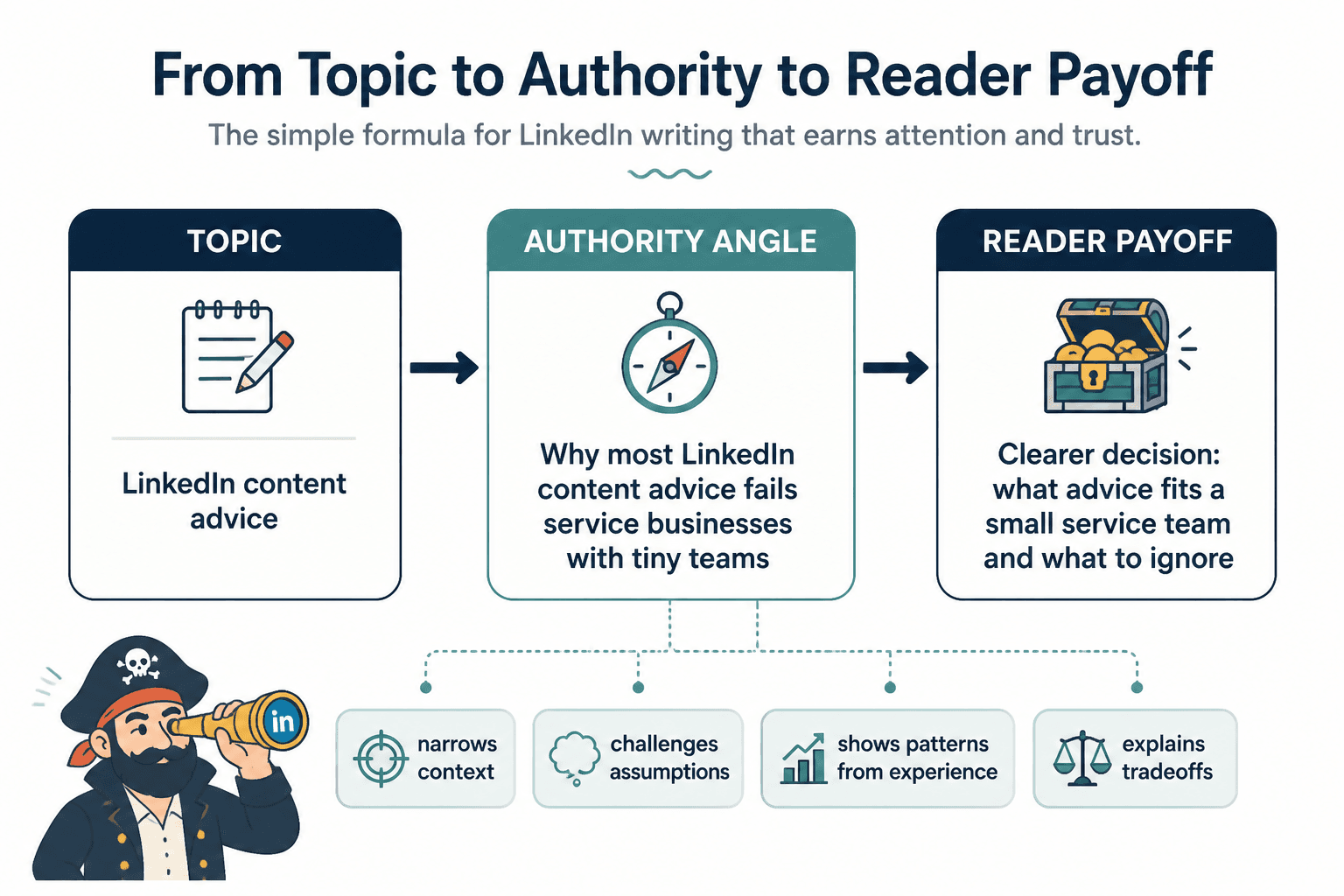
An authority angle is the lens that makes your article feel like it came from someone with real experience, not just access to a keyboard.
It is not the topic.
“LinkedIn content strategy” is a topic.
“Why most LinkedIn content advice fails service businesses with tiny teams” is an authority angle.
See the difference? The second one implies judgment, pattern recognition, and a point of view. It sounds like someone has seen the mess up close.
Strong authority angles usually do at least one of these:
- Narrow the context
- Challenge a lazy assumption
- Show a pattern from experience
- Explain tradeoffs, not just tips
- Translate expertise into a clearer decision
That is what makes readers trust you. Not “5 tips.” Not “everything you need to know.” Not a title so wide it could swallow a small city.
Why LinkedIn articles need a sharper angle than LinkedIn posts
Posts can get away with speed. Articles cannot.
A short LinkedIn post can win with one sharp observation, one decent story, or one strong line. A LinkedIn article asks for more time. That means the reader quietly expects more substance, more structure, and more evidence that you are worth listening to.
So if the angle is vague, the article feels padded almost immediately.
This is also why articles work best for creators who have a real opinion, repeatable process, or body of experience they can unpack. They are better for authority than posts because they can hold nuance, examples, and search-friendly ideas for longer. But that only works if the article has a clear reason to exist.
If you want article formats that match that deeper style, this piece on LinkedIn article structures and examples is worth keeping nearby.
How busy creators should choose an authority angle fast
You do not need a genius flash. You need a repeatable filter.
When choosing an angle for a LinkedIn article, ask four quick questions:
- What does my audience keep getting wrong?
- What do I know from doing this, not just reading about it?
- What specific context can I narrow this to?
- What decision or belief will this article help the reader change?
If you can answer those, you usually have the bones of a real angle.
For example, instead of writing “How to write better LinkedIn articles,” you could write:
- Why most LinkedIn articles sound smart but build no trust
- The simplest LinkedIn article structure I recommend to busy consultants
- What personal brands should stop doing in LinkedIn articles
- How to turn client questions into stronger LinkedIn article topics
- When a LinkedIn article should be opinionated, and when it should not
Each one creates more authority because each one implies a lived point of view.
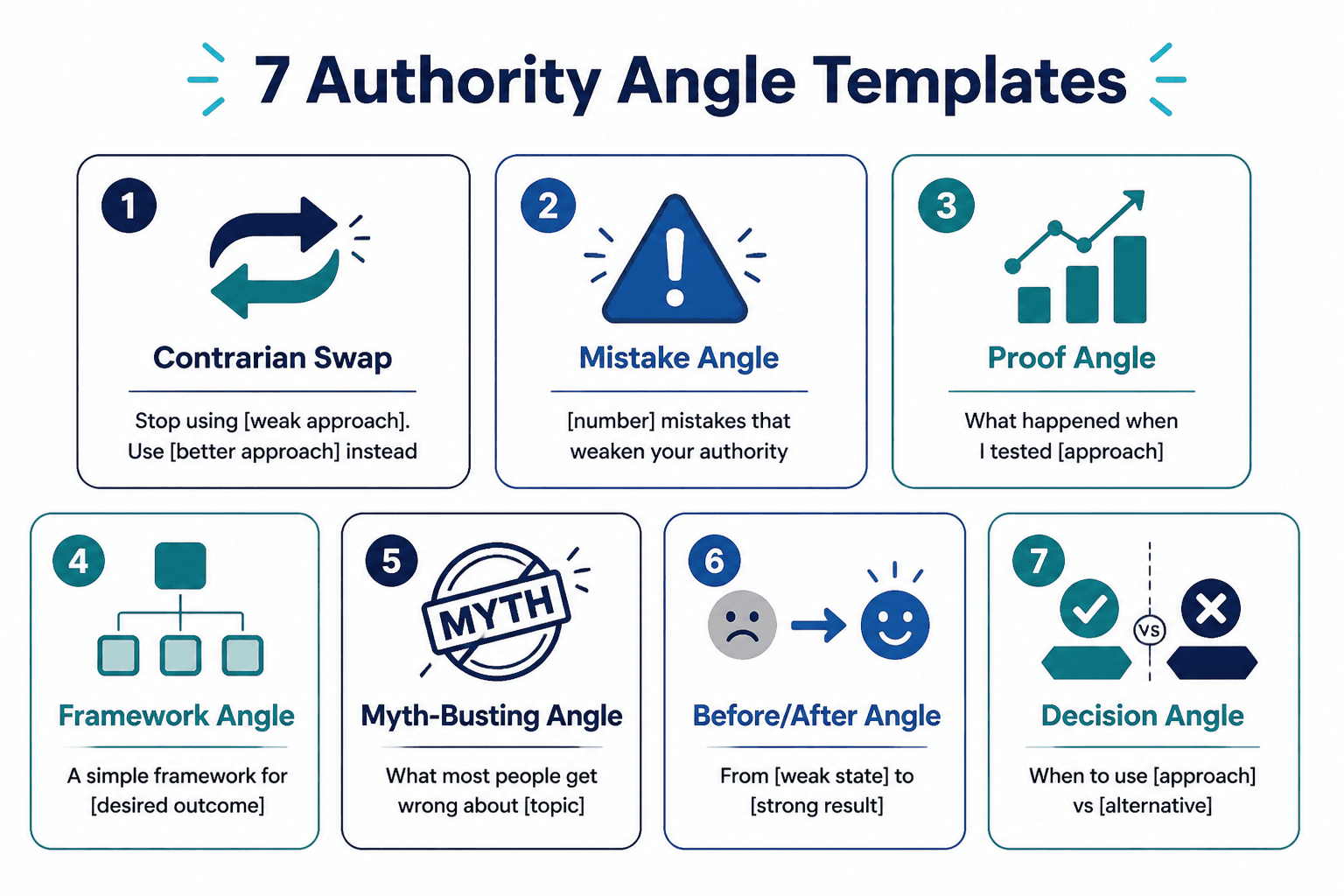
7 simple LinkedIn article authority angle templates for busy creators
These are not fill-in-the-blank gimmicks. They are angle frameworks you can reuse without sounding like a content factory.
1. The “what people get wrong” angle
Use this when your audience follows common advice that sounds right but produces weak results.
Template: What most people misunderstand about [topic] and what works better instead
Examples:
- What most creators misunderstand about LinkedIn authority and what works better instead
- What coaches get wrong about educational content on LinkedIn
- What most personal brands misunderstand about “valuable content”
Why it works: it signals discernment. You are not just repeating advice. You are sorting bad assumptions from useful ones.
2. The “from experience” angle
Use this when you have repeated exposure to the same problem through client work, your own business, audits, editing, consulting, or content analysis.
Template: After [time frame / number / type of experience], here is what I have learned about [specific topic]
Examples:
- After editing 100 founder articles, here is what I learned about weak authority signals
- After a year of writing LinkedIn content for experts, here is what actually earns trust
- After reviewing dozens of creator profiles, here is why their article strategy stalls
This works especially well when you can include patterns instead of chest-thumping. The point is not “look how impressive I am.” The point is “I have seen enough of this to give you a cleaner map.” Big difference.
3. The “specific audience, specific problem” angle
Use this when broad advice is the problem.
Template: How [specific audience] can improve [specific outcome] without [common pain or bad tactic]
Examples:
- How busy consultants can build LinkedIn article authority without publishing every week
- How solo founders can write deeper LinkedIn articles without sounding corporate
- How creators can turn scattered expertise into stronger LinkedIn articles without hiring a ghostwriter
Narrowing the audience often makes the article immediately more useful. It also makes your positioning clearer, which is rarely a bad side effect.
4. The “behind the process” angle
Use this when your authority comes from how you think, not just what you know.
Template: The process I use to [achieve outcome] and why it works better than [common approach]
Examples:
- The process I use to plan LinkedIn articles in under 30 minutes
- The system I use to turn client calls into authority content
- The article workflow I recommend when creators are short on time
Process angles are useful because they make your expertise feel tangible. Readers can see how your brain organizes the work.
5. The “tradeoff” angle
Use this when the real answer is not “do this,” but “choose wisely between these two things.”
Template: The tradeoff between [approach A] and [approach B] in [specific context]
Examples:
- The tradeoff between short LinkedIn posts and long LinkedIn articles for authority
- The tradeoff between polished thought leadership and conversational credibility
- The tradeoff between SEO-friendly articles and personality-driven articles on LinkedIn
Tradeoff articles feel more credible because they avoid fake certainty. They sound like someone who understands nuance, which is what expertise usually looks like in the wild.
6. The “before you do X, do Y” angle
Use this when your audience is rushing into tactics before fixing the obvious underlying issue.
Template: Before you [common tactic], fix this part of [topic] first
Examples:
- Before you publish more LinkedIn articles, fix your angle first
- Before you repurpose blog posts into LinkedIn articles, fix the opening
- Before you try to build authority on LinkedIn, fix your audience clarity
This angle works because it interrupts the usual “just do more content” nonsense. Sometimes the issue is not effort. It is direction.
7. The “use this instead” angle
Use this when you can replace weak habits with stronger alternatives.
Template: Stop using [weak approach] in your LinkedIn articles. Use [better approach] instead
Examples:
- Stop writing broad educational LinkedIn articles. Use focused authority angles instead
- Stop publishing listicles with no point of view. Use argument-led articles instead
- Stop treating LinkedIn articles like longer posts. Use stronger structure and proof instead
This one needs a little restraint. It can get shouty fast. But when used well, it creates a clear contrast and a practical shift.
How to turn a weak article idea into a stronger authority angle
Here is the simplest way to improve an article idea: ask what the article is actually trying to prove.
A lot of weak ideas are not wrong. They are just unfinished.
| Weak topic | Why it is weak | Stronger authority angle |
|---|---|---|
| How to write LinkedIn articles | Too broad, no point of view | How busy creators can write LinkedIn articles that build authority without wasting a full day |
| LinkedIn article tips | Sounds generic and forgettable | 5 LinkedIn article choices that quietly weaken your authority |
| Content strategy for LinkedIn | Huge topic, vague outcome | The content strategy I would use if LinkedIn articles were my main authority channel |
| Personal branding on LinkedIn | Overloaded and fluffy | Why most personal branding advice makes LinkedIn articles less believable |
Notice what changed:
- The audience became clearer
- The claim became more specific
- The point of view became visible
- The payoff became easier to understand
That is the job.
A fast writing structure for authority-based LinkedIn articles
Once you have the angle, do not overcomplicate the article. Busy creators usually need a structure that keeps them from drifting into ramble mode.
Use this:
- Open with the mistake, tension, or misconception.
Show the reader the exact problem behind the topic. - State your point of view early.
Give them the argument, not a scenic route. - Break down 3 to 5 key points.
These can be mistakes, principles, examples, or decisions. - Add proof or pattern recognition.
Use observations, examples, client patterns, or practical logic. - End with a next step.
Tell the reader what to change, test, or improve.
This is simple on purpose. Most creators do not need a more complex framework. They need one they will actually use.
If you want more formats to rotate through, look at these LinkedIn article structures creators can adapt fast.
The bigger point is simple: clearer structure and clearer writing make the piece more useful. That is usually what makes the ending land better too.