
Repurposing content for LinkedIn articles sounds efficient because it is efficient. In theory. In practice, a lot of people take something that already exists, paste it into LinkedIn, change three sentences, and then wonder why it lands with all the force of wet cardboard.
The problem is not repurposing itself. The problem is lazy repurposing. LinkedIn articles are not just blog posts shoved into a different tab, and they are definitely not old newsletters wearing a thin blazer and pretending to be professional thought leadership.
If you keep publishing repurposed articles that get ignored, this is usually why. The format is wrong. The angle is too broad. The intro is sleepy. The examples are stale. The CTA is either missing or acting like it came from a funnel template somebody downloaded in 2019.
Here’s how to spot the LinkedIn Articles Content Repurposing Mistakes That Hurt Performance, fix them, and turn old content into something that actually fits the platform, builds authority, and gives readers a reason to keep going.
If you want the broader foundation first, it helps to read LinkedIn articles guidance here alongside this piece. Repurposing works better when the original article strategy is not already crooked.
To see how this fits into the wider strategy, open the parent guide.
The biggest mistake: treating repurposing like copy-paste with minor makeup
This is the main one. Most underperforming repurposed LinkedIn articles are not bad because the original content was bad. They are bad because nobody adapted them properly.
Different content formats do different jobs. A blog post might rank. A newsletter might nurture. A podcast transcript might capture raw thinking. A LinkedIn article needs to signal expertise, hold attention in a business context, and feel worth reading on-platform.
That means a straight port usually fails. The structure, pacing, examples, and opening often belong to the original channel, not to LinkedIn.
Repurposing is not moving content. It is re-shaping content for a new context.
That one distinction saves a lot of mediocre publishing.
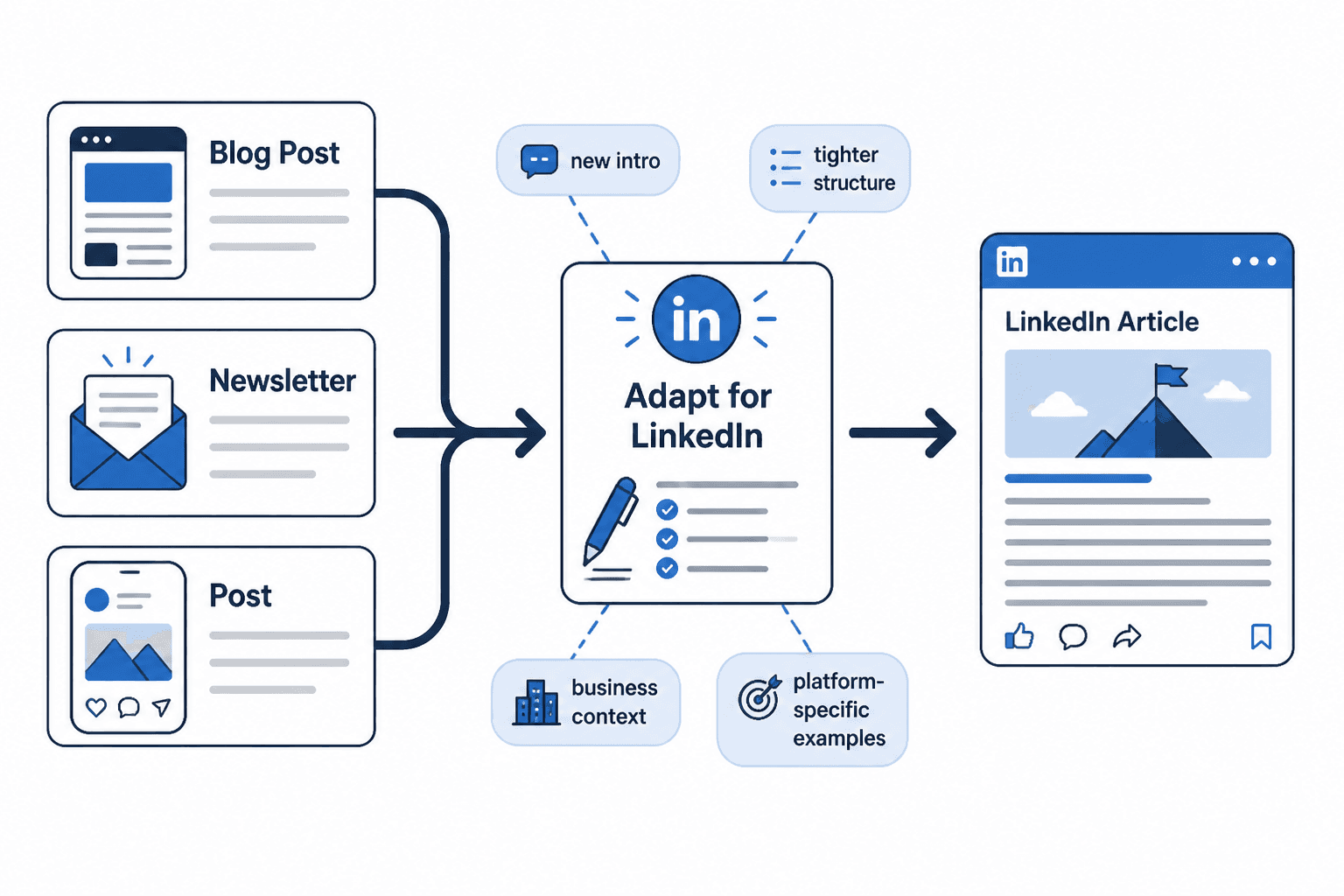
LinkedIn Articles Content Repurposing Mistakes That Hurt Performance most often
Let’s get concrete. These are the mistakes that quietly kill performance, even when the source material had real value.
1. Keeping the original intro when it does not fit LinkedIn
A blog intro might be built for search. A newsletter intro might be warm and rambling. A webinar transcript might spend 400 words clearing its throat. None of that helps your LinkedIn article.
LinkedIn article intros need to get to the tension fast. They should tell the reader why this matters, what usually goes wrong, and what they’ll get if they continue.
Weak repurposed intro:
Content repurposing has become an important part of modern digital marketing strategies for businesses and entrepreneurs looking to maximize the value of their content efforts.
That sentence says almost nothing, just very formally.
Stronger LinkedIn-ready intro:
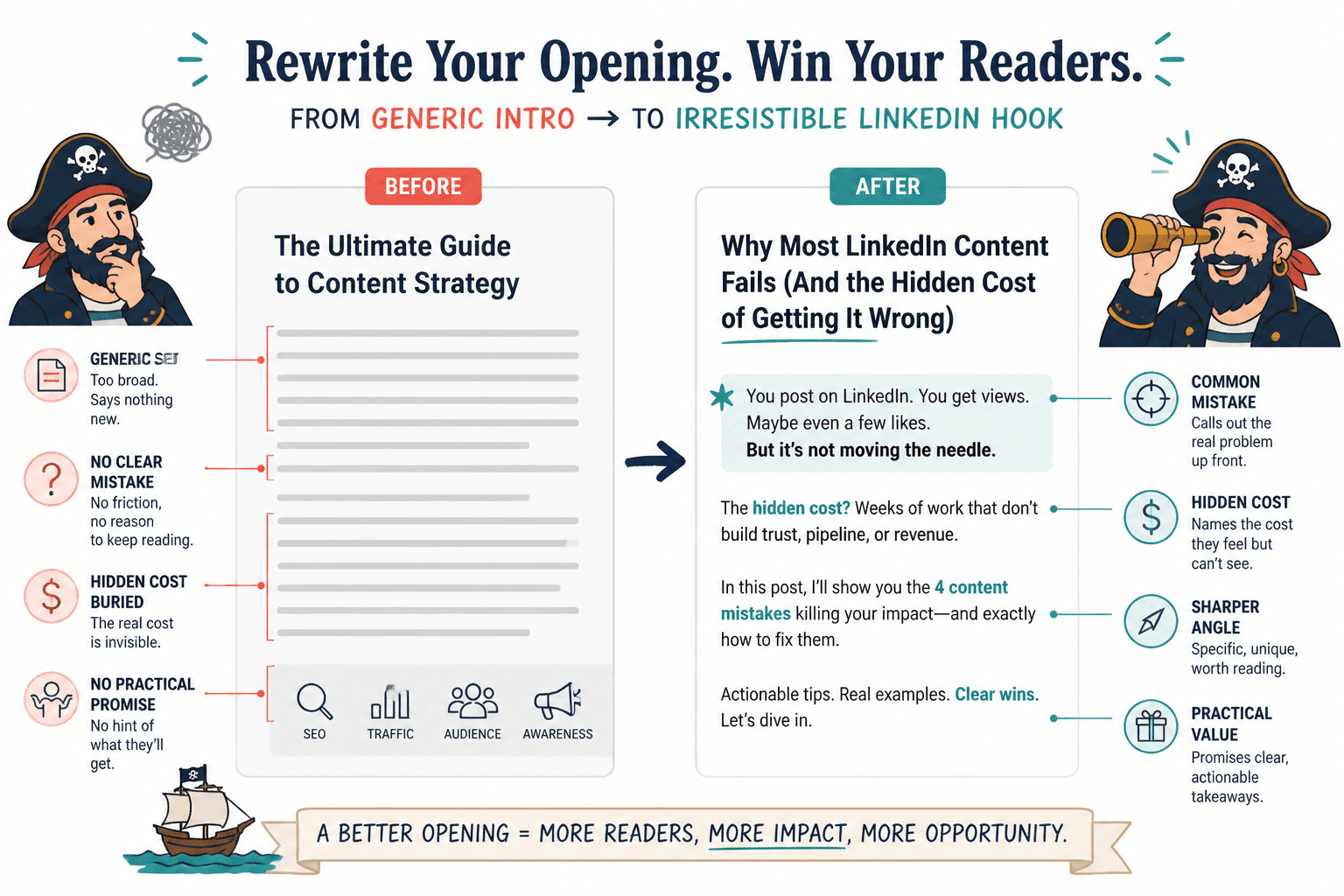
A lot of repurposed LinkedIn articles fail for a boring reason: they were never rewritten for LinkedIn in the first place. They were moved, not adapted.
Same topic. Better entry point. More tension. Less beige.
2. Repurposing broad topics instead of sharp angles
Broad content often travels badly. “How to do content marketing” might have worked as a general blog post once. As a LinkedIn article, it usually disappears into the swamp.
What performs better is a tighter angle with a clear audience and problem.
- Too broad: “How to Use Content Marketing for Business Growth”
- Better: “Why Your Educational Content Gets Saved but Still Does Not Sell”
- Too broad: “Best Practices for Personal Branding”
- Better: “3 Personal Branding Habits That Make You Sound Generic on LinkedIn”
If the original piece is too wide, do not repurpose the whole thing. Extract one stronger sub-idea and rebuild around that.
3. Leaving in references that belong to the old format
This one is surprisingly common. You can tell when someone repurposed carelessly because the article still says things like:
- “In this week’s podcast episode…”
- “As I said on the webinar…”
- “Below, you can see the chart from my slide deck…”
- “Subscribers already know…”
None of that is automatically fatal, but if the article depends on old context the LinkedIn reader does not have, it starts feeling imported instead of written for them.
When you repurpose, remove the scaffolding of the original format. Keep the useful thinking. Drop the channel leftovers.
4. Publishing thin rewrites that add no fresh value
If your repurposed article is just the original piece with a cleaner intro and some trimmed paragraphs, it may still be too thin. LinkedIn articles need a reason to exist.
That reason can be:
- a new angle
- better examples
- platform-specific context
- stronger structure
- updated lessons
- a practical framework the original lacked
A good repurposed article should feel like a more useful version of the source, not a duplicate with tidier hair.
If you need help tightening weak material before republishing it, this guide on how to rewrite boring LinkedIn articles is a useful next stop.
5. Keeping examples that are too old, too vague, or too generic
Examples are often the first thing to age badly. A repurposed article can have a decent idea and still feel dead because the proof is bland.
Bad example:
Many businesses have seen success by repurposing their content across channels.
That is not an example. That is a fog machine.
Better example:
A consultant might turn a high-performing newsletter on discovery call mistakes into a LinkedIn article focused on one angle: the questions that make prospects trust you less, not more. Same raw idea. Sharper use case.
The more specific the example, the easier it is for the reader to transfer the lesson to their own work.
6. Ignoring reader intent on LinkedIn
People do not approach every platform with the same mindset. On LinkedIn, readers are often scanning for useful expertise, relevant perspective, practical strategy, and credibility signals. They are not looking for a bloated blog voice or a soft lifestyle essay pretending to be business advice.
So when you repurpose content, ask a sharper question than “Can this be reused?” Ask, “Why would a LinkedIn reader care about this version?”
If your answer is vague, the article probably is too.
7. Turning the article into a dumping ground for everything you know
This happens when someone repurposes a pillar blog post, keeps every subsection, and creates an article that tries to cover an entire universe.
LinkedIn articles do not need to be tiny, but they do need shape. One main promise. A clean argument. Useful proof. A next step. Not an accidental ebook.
If the source content contains five ideas, pick one. If it contains ten, definitely pick one.
Depth is good. Sprawl is not.
8. Using the same CTA the original content used
A repurposed CTA often feels bolted on because it was written for another channel’s goal.
Examples:
- A webinar registration CTA at the end of an evergreen article
- A “reply to this email” CTA inside a LinkedIn article
- A hard sales CTA after an educational piece that did not earn it
Your article CTA should match the reader’s likely level of trust and the article’s job.
| Article type | Better CTA |
|---|---|
| Educational authority piece | Read a related article or follow for more sharp practical content |
| Problem-aware piece | Check a deeper guide on that exact issue |
| Case-study style article | Learn the process or book a relevant next step if appropriate |
| Top-of-funnel article | Move to a profile, resource, or related article rather than a hard pitch |
A decent CTA feels like a logical next move, not a trap door into a sales funnel.
How to repurpose content into stronger LinkedIn articles instead
If the mistakes above are the problem, here is the fix. This process works well for turning old content into a LinkedIn article that actually fits the platform.
Step 1: find the strongest usable idea
Do not start with the whole piece. Start with the most relevant idea inside it.
- What point still feels true?
- What angle would matter to a professional audience now?
- What part can you support with examples, proof, or practical steps?
Sometimes the best LinkedIn article is one section of a longer original piece, not the full thing.
Step 2: rewrite the opening from scratch
Do not “lightly edit” the old intro. Rewrite it. A fresh opening forces you to clarify the actual point and frame it for the LinkedIn reader.
Good opening ingredients:
- the common mistake
- the hidden cost
- the sharper angle
- the promise of practical value
That alone improves a shocking amount of repurposed content.
Step 3: cut anything that only existed for the old format
Remove:
- podcast and webinar filler
- search-padding intros
- newsletter-specific references
- repetitive transitions
- outdated examples
- explanations your LinkedIn audience does not need
This is where a lot of clarity comes from. Most repurposed content is not weak because the core idea is weak. It is weak because old baggage is still hanging off it.
Step 4: add platform-appropriate proof and examples
LinkedIn readers respond well to practical examples, clear logic, observed patterns, and grounded opinion. Add those deliberately.
Useful proof can include:
- before-and-after rewrites
- common client patterns
- mistakes you repeatedly see in the market
- simple frameworks
- specific examples by creator type
You do not need fake data theater. You do need substance.
Step 5: tighten the structure for scannability and depth
LinkedIn articles can go deeper than posts, but they still need to be readable. Use clean subheads. Keep paragraphs short. Break dense sections with examples or lists when useful. Do not stack giant blocks of text and call it authority.
A good article feels substantial without feeling swollen.
Step 6: give the article a real next step
Once the article is useful, decide what it should lead to. Not every article needs a sales pitch. In fact, many should not have one.
A better next step might be another helpful article. For example, if you are refining older material, this guide on turning old content into better LinkedIn articles fits naturally. If the reader needs broader article strategy, this article on writing better LinkedIn articles is the more useful move.
The bigger point is simple: clearer structure and clearer writing make the piece more useful. That is usually what makes the ending land better too.