
Most creator funnels do not fail because the tech is broken.
They fail because the messaging sounds like it was assembled from a swipe file, three webinars, and a panic attack about conversions.
You have seen the symptoms: vague lead magnets, painfully polished CTAs, profile copy that promises “helping creators grow and scale,” and landing pages that say a lot without saying anything. The funnel exists. It just has no pulse.
If you want to learn how to improve creator platform funnels without sounding generic, the fix is not making everything louder, longer, or more optimized. It is making each step clearer, sharper, and more specific to the kind of person you actually want to attract.
This is about building a funnel that feels like a coherent path instead of a pile of content with a form stuck on the end. One that earns trust, sounds like a real person, and gives people a reason to keep moving.
Want the broader roadmap? Start with the parent guide.
Why creator funnels start sounding generic so fast
Because most people build them backward.
They start with the asset, the opt-in, or the automation. Then they pour in whatever copy sounds “professional.” Which usually means broad claims, flat promises, and zero personality.
Generic funnels are usually built on generic thinking:
- “I help people grow online”
- “Here is my free guide”
- “Book a call to learn more”
- “Sign up for actionable insights”
None of that is technically wrong. It is just forgettable. And forgettable does not convert very well.
A strong creator funnel is specific about the audience, the problem, the shift, and the next step. It does not need to sound clever. It needs to sound usable.
If your funnel copy could belong to a mindset coach, a copywriter, a business consultant, and a crypto newsletter at the same time, it is too vague.
What a creator platform funnel actually needs
Before you rewrite anything, get clear on the basic job of the funnel.
A creator platform funnel is not just “post content and hope.” It is a sequence. Someone sees you, understands what you do, gets a useful next step, and moves into a deeper level of trust.
At minimum, most funnels need these parts:
- Attention: posts, threads, articles, short videos, comments
- Positioning: profile, bio, pinned post, featured links
- Capture: lead magnet, newsletter signup, waitlist, booking page
- Nurture: emails, follow-up content, case studies, proof
- Conversion: consultation, offer page, product, membership, service
The problem is not that creators do not have these pieces. It is that the pieces often sound like they were written by five different people trying very hard not to offend anyone.
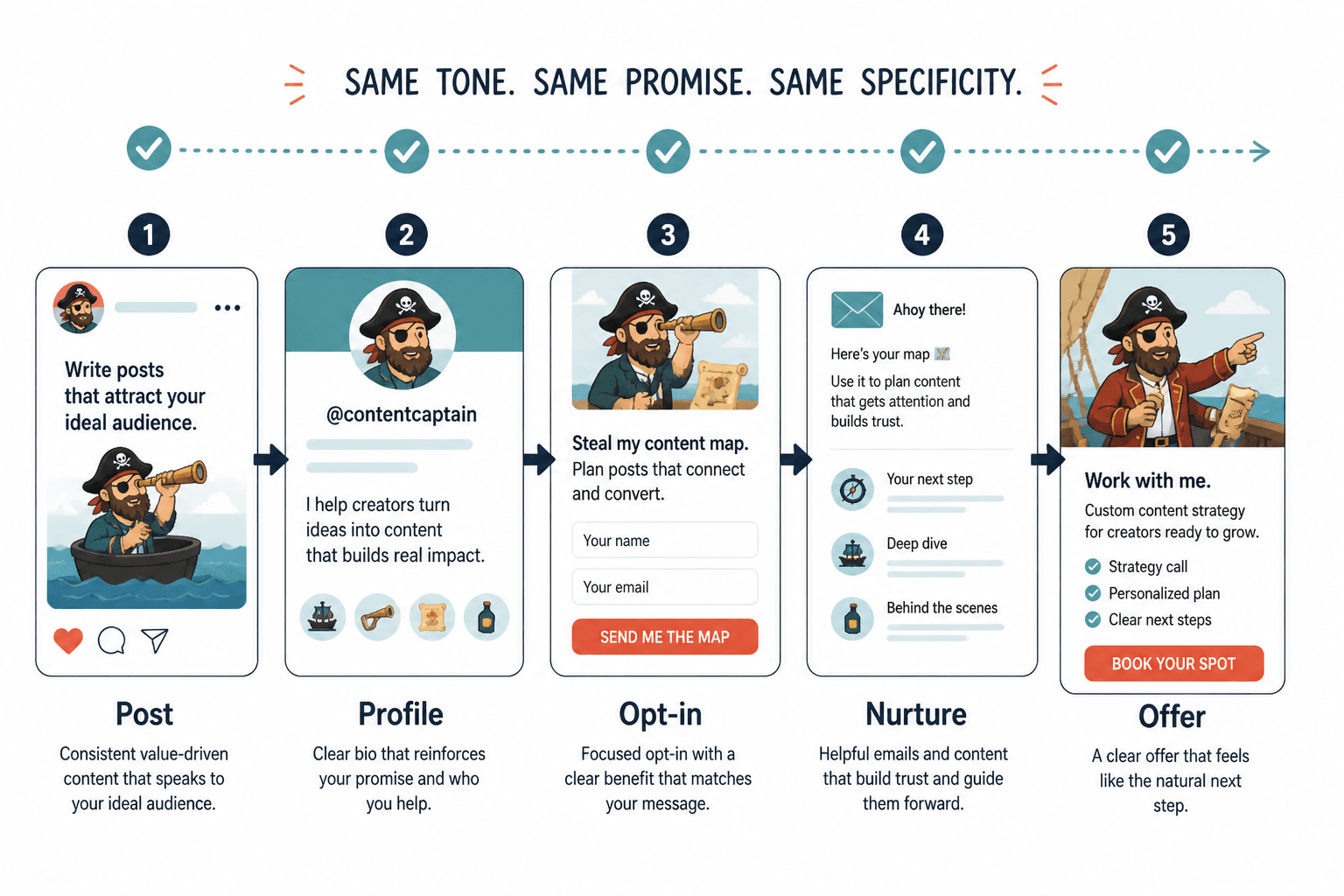
Your funnel should feel connected. The tone, promise, and level of specificity should carry through from post to profile to opt-in to sale. Not perfectly polished. Just consistent enough that people do not feel like they walked into a different business halfway through.
How to improve creator platform funnels without sounding generic
Here is the practical part. These are the fixes that make funnels feel sharper and more trustworthy without turning them into weird bro-marketing theater.
1. Tighten the audience instead of inflating the promise
A lot of generic copy is really just audience confusion wearing a blazer.
When you are not clear who the funnel is for, you reach for broad outcomes. More growth. More freedom. More alignment. More impact. Very moving. Also not very useful.
Try this instead:
- Name the kind of person
- Name the situation they are in
- Name the result they want next
Weak: I help creators grow their audience and monetize online.
Stronger: I help service-based creators turn useful content into leads, email subscribers, and booked calls without posting like a full-time influencer.
That second version is not flashy. Good. Flashy is overrated. It is clear who it is for and what kind of growth it means.
2. Match the CTA to the stage of trust
One of the easiest ways to make a funnel feel generic is asking for too much too soon.
If someone just discovered you through a post, “book a strategy call” is often a ridiculous jump. That is not a funnel. That is a trapdoor.
Better next steps usually look like this:
- Read this related article
- Grab the checklist
- Join the newsletter
- Reply if you want the template
- See how I structure this process
As trust increases, your CTA can ask for more:
- Apply to work together
- Book a consult
- View the offer
- Join the program
This sounds obvious, yet plenty of funnels still go from “here is one good tip” to “buy my high-ticket transformation” in one click. Calm down.
If you want help making the asks themselves sound less stiff, this piece on how to write creator funnels without sounding salesy or robotic is worth reading next.
3. Make each step answer one obvious question
A solid funnel reduces uncertainty step by step.
That means each stage should answer one practical question in the reader’s mind:
- Post: Is this relevant to me?
- Profile: What do they actually help with?
- Lead magnet or page: Is this useful enough to give my email for?
- Email sequence: Are they credible and consistent?
- Offer page: Is this the right next step for my problem?
When creators get too generic, they often try to answer all five questions at once. The result is cluttered messaging and very little movement.
Keep each step focused. One job. One clear next move.
4. Use specifics where everyone else uses adjectives
Generic copy leans on adjectives because adjectives are easy. Strategic. Authentic. High-converting. Sustainable. Magnetic. Premium. Human. None of these words do much heavy lifting on their own.
Specifics do.
| Generic | Better |
|---|---|
| Get clarity on your brand | Figure out what to say in your bio, pinned post, and CTA so people know what you do in under 10 seconds |
| Build a sustainable funnel | Create a simple path from post to email list to booked call without needing daily content |
| Attract aligned clients | Bring in prospects who already understand your positioning before they ever reach your inbox |
| Improve your messaging | Turn vague content into sharper hooks, proof, and offer language that actually sounds like you |
Specific language is not just more persuasive. It is easier to trust.
5. Stop treating the lead magnet like a generic bribe
A lot of creator funnels still rely on the same old move: throw a free PDF at the problem and hope it feels valuable enough.
The issue is not that lead magnets are bad. The issue is that many of them are painfully interchangeable.
Weak lead magnet names:
- The Ultimate Content Guide
- Personal Branding Blueprint
- My Free Funnel Framework
Sharper lead magnet names:
- 5 Creator Funnel Fixes for People Getting Attention but Not Leads
- The 10-Minute Profile Rewrite Checklist for Service-Based Creators
- A Simple Post-to-Email Funnel for Coaches Who Hate Daily Posting
The more tangible the payoff, the less generic the funnel feels. People do not want “resources.” They want useful help with a clear outcome.
If your funnel starts with a weak opening, the whole thing drags. This guide on how to start creator funnels without a weak opening can help tighten that first step.
6. Build message continuity from platform to platform
This is where many platform funnels get weird.
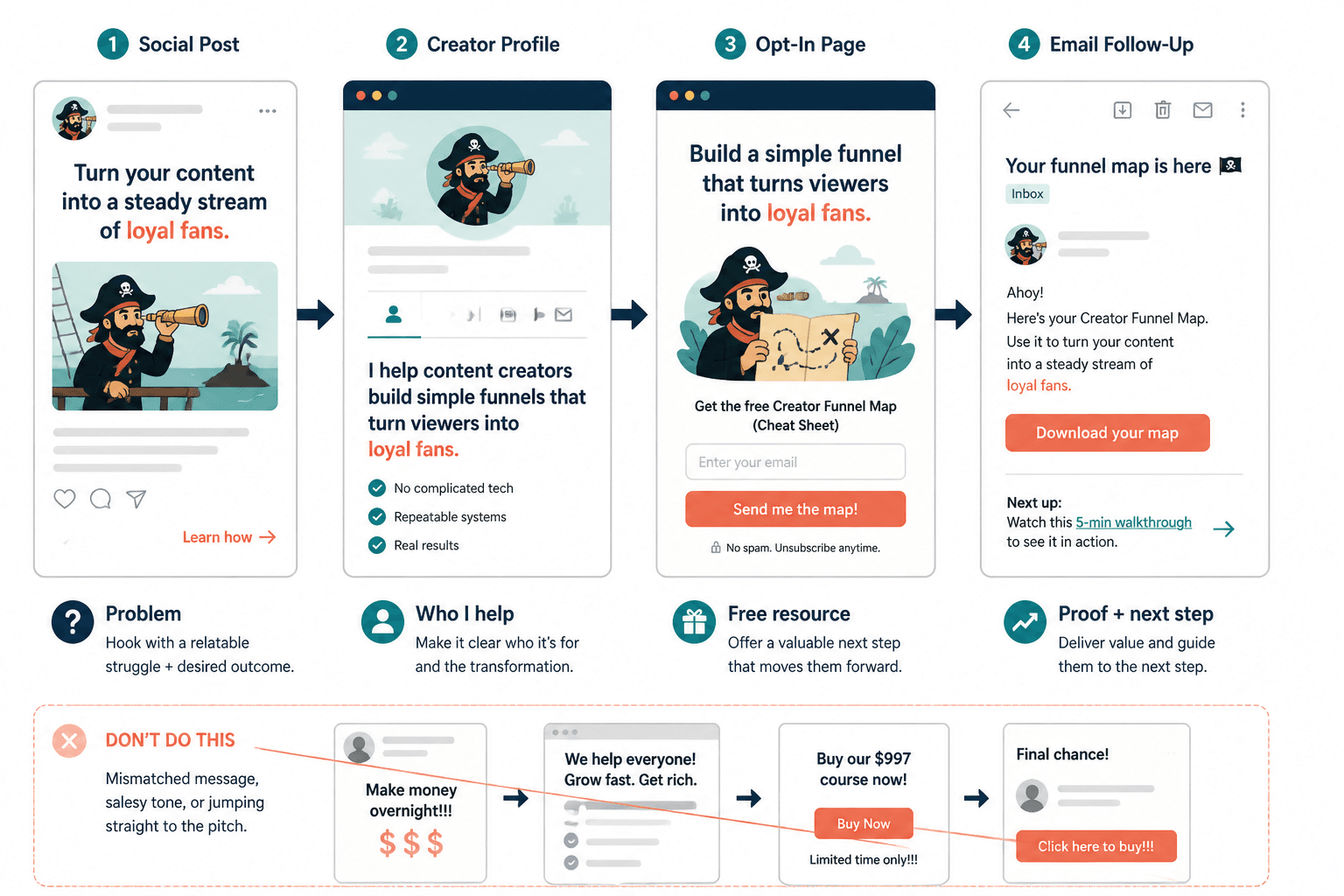
Your LinkedIn post sounds smart and practical. Your profile sounds vague. Your landing page sounds like a webinar ad. Your emails suddenly sound like a productivity monk with a Stripe account. It is a mess.
Message continuity means the same core promise carries across the funnel, adapted to the format.
- Your post introduces the problem clearly
- Your profile reinforces who you help and how
- Your opt-in page deepens the same promise
- Your emails expand the point with proof and examples
- Your offer presents the paid version of that same transformation
Not identical wording. Consistent direction.
If one step sounds broad and the next sounds hyper-salesy, people feel the shift instantly. Trust drops. And not in a dramatic analytics-dashboard way. More in a silent, boring way where they simply leave.
7. Use proof that sounds lived-in, not inflated
Generic funnels often try to compensate with generic proof.
Things like:
- Trusted by many creators
- Hundreds impacted
- Results-driven process
- Proven system
That kind of language feels suspiciously polished because it is all surface and no texture.
Better proof sounds more concrete:
- Used this framework to turn profile visits into consultation requests without changing the offer
- Helped a creator simplify a four-step funnel into one article, one freebie, and one clear CTA
- Improved subscriber quality by tightening the lead magnet promise instead of increasing posting frequency
You do not always need giant numbers. You do need evidence that your process works in real conditions.
8. Rewrite the dead phrases that flatten your funnel
There are a few phrases that instantly make creator funnels sound beige.
- Unlock your potential
- Scale with ease
- Authentic brand growth
- Actionable insights
- Take your business to the next level
- Value-packed resource
- Done-for-you strategy
These phrases are not just overused. They hide the actual point.
When editing funnel copy, ask:
- What does this phrase really mean?
- Can I replace it with a concrete result?
- Would my ideal buyer say it this way?
- Does this sound like me, or like a random funnel template?
If you are sitting on a pile of copy that feels flat, read how to rewrite boring creator funnels. That is usually faster than trying to “optimize” weak language one sentence at a time.
A simple creator funnel structure that does not feel generic
If you want a clean starting point, use this:
- Create one strong content entry point. Pick a problem your audience already feels.
- Point to a clear next step. Newsletter, checklist, template, article, or booking page.
- Make the opt-in narrowly useful. Solve one small but meaningful problem.
- Send a short nurture sequence. Clarify your approach, show proof, explain the offer naturally.
- Present one relevant conversion path. Do not offer six different things unless you enjoy confusion.
Example:
- Post: Why useful content gets ignored when the positioning is vague
- CTA: Get the profile rewrite checklist
- Opt-in page: A 10-minute checklist to make your profile clearer, more credible, and easier to convert from
- Email 1: The three profile mistakes killing trust
- Email 2: Before and after profile examples
- Email 3: How this connects to your broader creator funnel
- Offer: Funnel messaging audit or strategy service
Notice what is missing: vague aspiration soup. The funnel is built around one practical tension and one logical next move.
Platform-specific tweaks that make funnels feel more human
Keep the tone useful and direct. Your post can be professional without sounding embalmed. Lean on practical insights, lived proof, and simple CTAs. If your LinkedIn funnel sounds like a conference brochure, fix that first.
Use more personality and conversation. Facebook funnels often work better when the entry point feels like a real observation or story rather than polished thought leadership. A warmer tone can still lead somewhere strategic.
X / Twitter
Creator funnels get better when the path feels simpler and the writing makes each next step obvious. A cleaner message usually fixes more than extra funnel complexity ever will.
Creator funnels get better when the path feels simpler and the writing makes each next step obvious. A cleaner message usually fixes more than extra funnel complexity ever will.