
Most people do not ruin trust with LinkedIn articles because they sell. They ruin it because they sell too soon, too vaguely, or too obviously.
You can absolutely monetize LinkedIn articles. In fact, if you write useful articles that attract the right readers and never connect them to an offer, you are not “being generous.” You are usually just leaving the job half done.
The trick is simple, but not always easy: your article has to create trust before it asks for action. It needs to feel like a smart piece of thinking from someone who knows their stuff, not a long preamble to “book a call” dressed up in business-casual content.
This is how to monetize LinkedIn articles without wrecking trust: write articles that are genuinely useful, make the commercial path relevant, and give readers a next step that feels like a continuation of the value, not a bait-and-switch.
If your current approach is “teach a little, pitch a lot,” we need to fix that. If your current approach is “never mention my offer because I do not want to seem salesy,” we need to fix that too.
For the main guide behind this topic, visit the parent guide.
Why monetizing LinkedIn articles goes wrong so often
LinkedIn articles sit in a weird spot. They are not as fast or casual as posts, and they are not quite the same as a full article on your own site. They tend to attract readers who want substance, not quick dopamine.
That is exactly why they can work so well for monetization. Articles give you more room to show how you think, what you know, and how you solve problems. That is trust-building gold.
And yet people blow it in predictable ways:
- They write a thin article that says nothing new, then tack on a hard pitch
- They over-teach generic basics with no positioning, so readers learn but never remember who it came from
- They hide the offer so completely that interested readers have nowhere to go
- They use a CTA that sounds like it escaped from a funnel template in 2019
- They publish articles that are really sales pages wearing fake glasses
Trust breaks when readers feel manipulated, rushed, or underfed. If the article promises insight and delivers a brochure, people notice. Quietly, sure. But they notice.
What trust-friendly monetization actually looks like
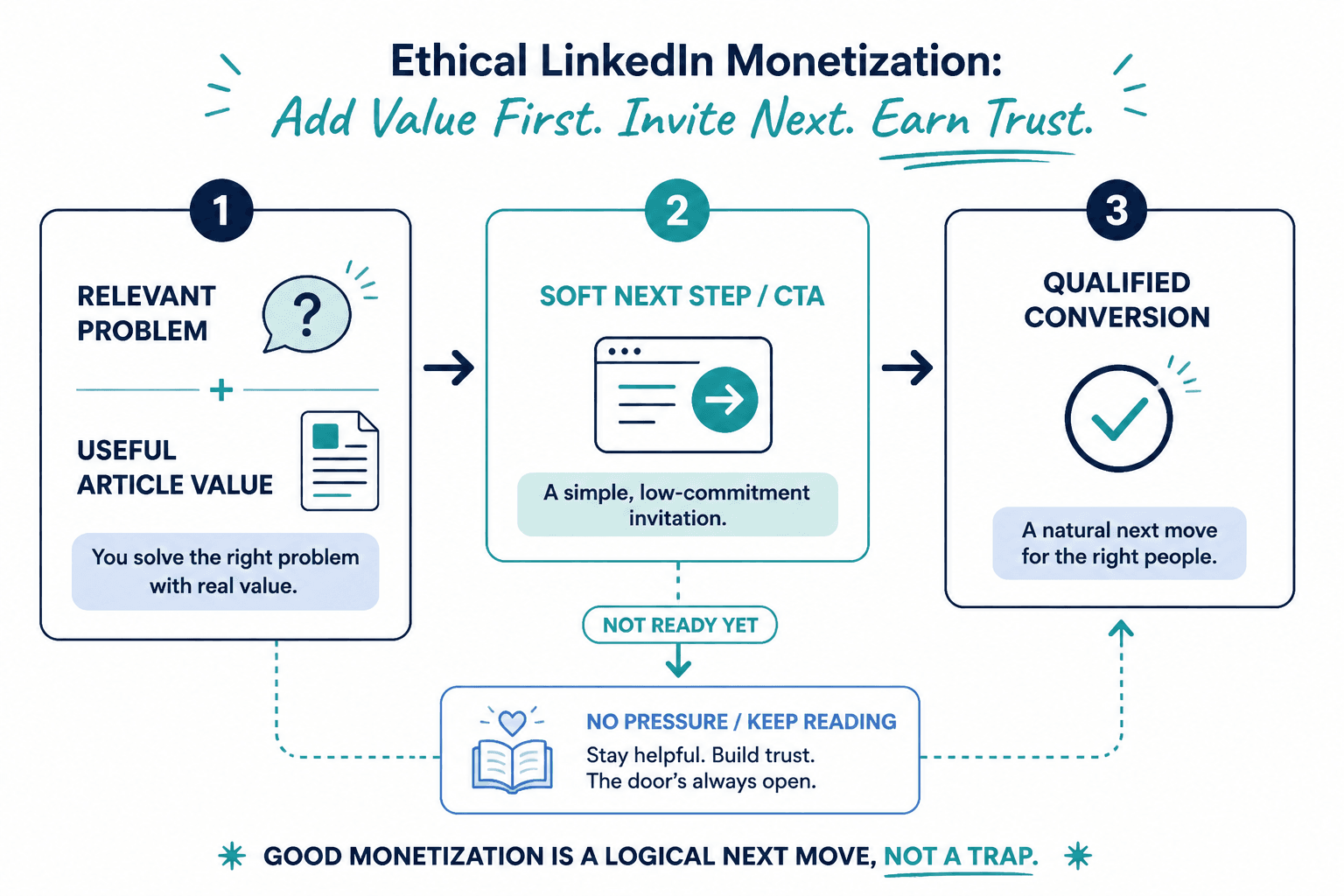
A trustworthy LinkedIn article does three jobs in order:
- Prove relevance by speaking to a real problem your audience actually cares about
- Deliver value with specifics, examples, structure, and usable thinking
- Offer a next step that matches the problem and the reader’s level of intent
That last part matters more than most people think. The monetization step should feel like the logical next move for someone who wants help going further. Not everyone will want that. Fine. Your CTA is not there to pressure everyone. It is there to help the right reader continue.
Good monetization feels like alignment. Bad monetization feels like a trap door.
Start with an article topic that naturally supports an offer
If you want to monetize LinkedIn articles without wrecking trust, do not begin by asking, “How do I squeeze a pitch into this?” Start by asking, “What problem can I help solve that naturally connects to what I sell?”
That sounds obvious. It is also where a lot of people get lazy.
Your article topic should sit near your commercial value, not in a random educational side alley. If you are a messaging consultant, an article on “how to clarify your homepage promise” makes sense. An article on “five productivity habits for founders” might get attention, but it is a much weaker bridge to your service unless productivity is actually part of the offer.
Choose article topics with clear commercial adjacency
- A sales consultant writes about why most discovery calls stall in the first ten minutes
- A brand strategist writes about how vague positioning kills referrals
- A copywriter writes about the homepage sections that quietly lose conversions
- A coach writes about the belief traps that make smart experts sound generic online
- A LinkedIn ghostwriter writes about why expert articles fail before the second paragraph
These topics build trust and create demand. They help the reader understand the problem more clearly and see why expert help might be useful. That is much cleaner than writing broad advice and then trying to force your offer into the ending.
If you need help shaping stronger article topics in the first place, this guide on writing better LinkedIn articles and the broader LinkedIn articles hub are worth keeping nearby.
Write the article like a real article, not a teaser for your offer
This is where trust is either built or quietly strangled.
Your LinkedIn article should be good enough that a reader gets value even if they never buy from you. Not because generosity is magical. Because quality is proof. A useful article signals competence. A vague article signals marketing intent with a weak disguise.
That means your article needs real substance:
- A sharp point of view
- Specific examples
- Useful distinctions
- Clear structure
- Practical takeaways
- A point that goes beyond recycled platform advice
One of the easiest ways to wreck trust is to under-deliver in the body and over-perform in the CTA. If the article is fluffy and the pitch is polished, readers can smell the ratio problem.
This is also why the opening matters so much. A weak intro makes the whole thing feel slower, safer, and more self-serving. If your article starts with three paragraphs of throat-clearing before getting to the point, you are already spending trust badly. For that, this piece on starting LinkedIn articles without a weak opening will help.
Use monetization paths that fit reader intent
Not every reader of a LinkedIn article is ready to buy. Some are curious. Some are problem-aware. Some are actively looking for help. If you only offer one heavy sales action, you miss people who would have taken a smaller next step.
The best way to monetize LinkedIn articles without wrecking trust is to match the CTA to the reader’s likely intent.
Best next-step options for LinkedIn articles
| Reader state | Best CTA | Why it works |
|---|---|---|
| Curious but not ready | Read a related article | Keeps trust building without pressure |
| Problem-aware | Download a useful resource or framework | Moves them deeper into your world naturally |
| Considering solutions | Join your newsletter | Good for longer trust-building cycles |
| Actively evaluating help | Book a call or apply for your service | Works when the article has shown strong relevance and proof |
| Warm and engaged | Reply, message, or comment for specifics | Creates a softer conversion path |
A lot of creators default to “book a call” because it sounds like monetization. Sometimes it is. Sometimes it is just friction in a blazer.
If the article tackles an early-stage problem, a softer CTA usually works better. If the article speaks directly to a painful, expensive issue and includes real proof, a direct CTA can absolutely make sense. Context decides. Not your enthusiasm for selling.
Make the CTA feel earned
A trust-friendly CTA does not appear out of nowhere. It follows from the article’s argument.
That means the body of your article should set up the next step naturally. If you spend 1,800 words explaining why messaging gaps are killing conversions, then invite readers to get help fixing their messaging, that tracks. If you spend 1,800 words on general content consistency and then pitch executive coaching, the bridge is a bit rickety.
Weak CTA versus earned CTA
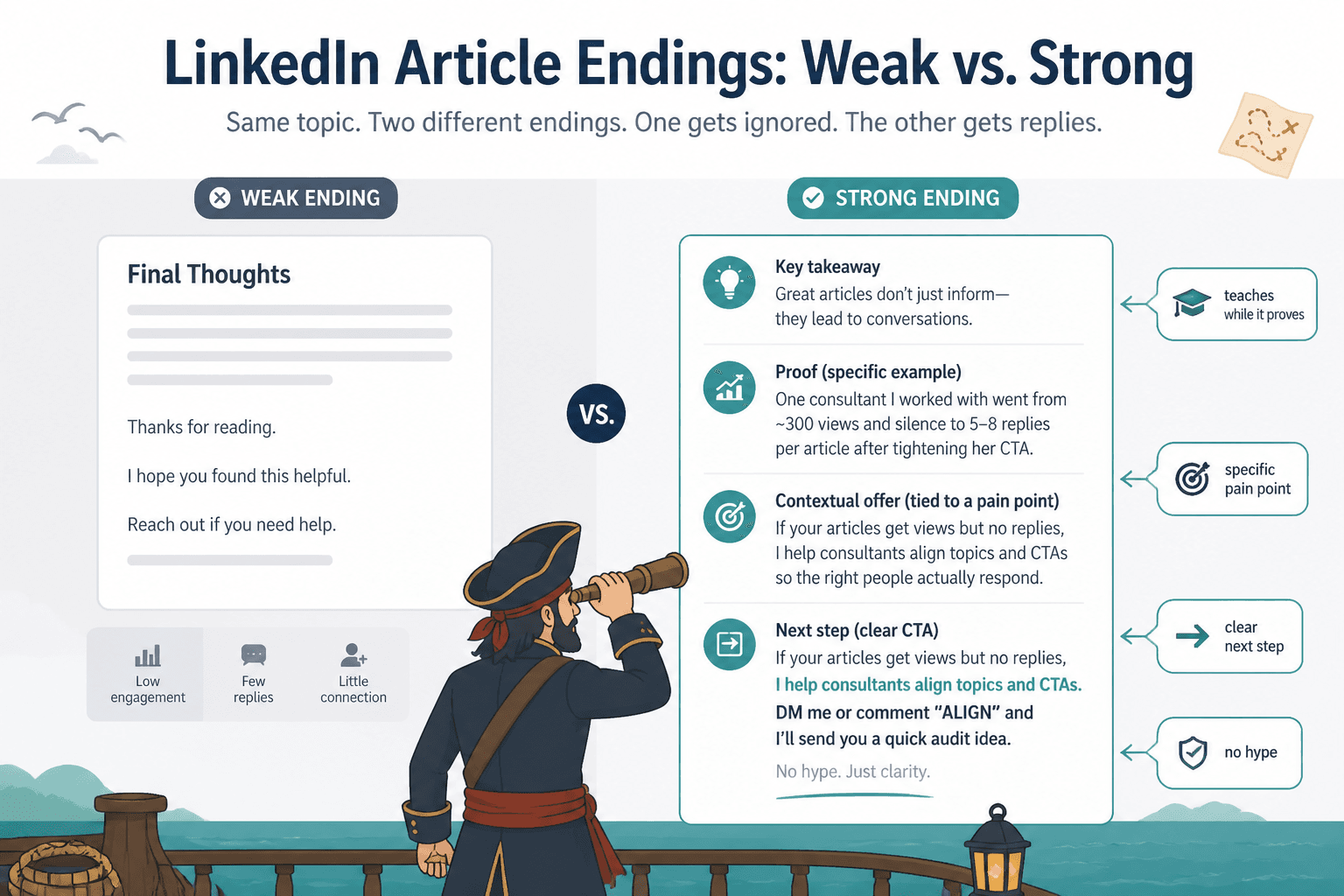
Weak: “If this resonated, book a free call to learn how we can scale your business.”
Better: “If your LinkedIn articles are getting polite views but not leading to conversations, I help consultants turn expert content into clearer trust-building assets that generate leads. You can explore that here.”
The second one works because it matches the article, names the problem, and offers a relevant next step. It does not sound like a sales robot trying to use the word “resonated” as a crowbar.
Simple CTA formula
- Name the reader problem
- Connect it to your offer
- Give one clear next action
For example:
- If your articles are useful but not converting, I help service businesses fix the trust-to-sale gap in their content funnel. You can learn more here.
- If you want your LinkedIn articles to generate better-fit leads, start with this guide on turning LinkedIn articles into more leads or sales.
- If your content sounds polished but oddly lifeless, this article on writing LinkedIn articles without sounding salesy or robotic will help before you try to monetize harder.
Use proof without turning the article into a chest-thumping parade
Trust grows faster when readers can see evidence that your ideas work. But there is a difference between proof and peacocking.
Good proof supports the point. Bad proof interrupts the article to remind readers that you are very impressive, actually.
Useful forms of proof inside LinkedIn articles
- A short case example
- A before-and-after positioning shift
- A client pattern you see repeatedly
- A result framed with context, not hype
- A specific mistake you helped fix
For example, instead of saying, “I have helped many founders succeed,” say something like:
One consultant I worked with had articles getting decent views but almost no replies, clicks, or inbound interest. The problem was not the writing quality. It was that every article ended with a generic “reach out if you need help” line. Once the topics and CTAs were aligned to specific service pain points, the articles started creating actual sales conversations.
That lands better because it teaches while it proves. It is not just trying to impress the room.
Do not hide the offer so well that nobody can find it
Some people hear “do not be salesy” and respond by becoming commercially invisible.
That is not noble. It is just ineffective.
If someone reads your article, gets value, thinks “this person clearly understands my problem,” and then has no obvious next step, you created trust and then abandoned the conversion path. Readers should not need detective skills to figure out how to work with you.
Where to place monetization cues in a LinkedIn article
- A brief contextual mention in the article body, if relevant
- A stronger CTA in the conclusion
- Your LinkedIn profile headline and About section
- A featured link or clear profile destination
- Related internal article links that move readers toward commercial intent
You do not need to shove the offer into every third paragraph. Please do not. But the route from article to next action should exist and be easy to follow.
This is also why your article strategy should connect with the rest of your content ecosystem. If someone likes this article, they should be able to move into related reading through your social media writing resources, narrower LinkedIn writing guides, and your own more specific service-adjacent pieces.
Pick monetization models that suit LinkedIn articles
LinkedIn articles work especially well for trust-based offers. That usually means services, consulting, coaching, retainers, workshops, audits, or lead magnets that move readers toward those offers.
They can also support productized services, paid newsletters, courses, and digital products. But the closer the offer is to expertise and transformation, the more naturally articles tend to help.
Offers that commonly fit well
- Consulting calls
- Strategy retainers
- Messaging audits
- LinkedIn profile or article reviews
- Done-for-you writing services
- Workshops and trainings
- Email list signups tied to a nurture sequence
- Downloadable frameworks or templates that lead to paid help
The key is that the offer should feel like the next layer of help, not a random monetization object placed at the bottom of the page because revenue is nice. Revenue is nice. Readers still deserve coherence.
A simple structure for monetizing LinkedIn articles without wrecking trust
If you want a practical article format, use this:
- Open with the real problem
Make the reader feel accurately seen fast. - Explain what people usually get wrong
Build contrast and show you understand the landscape. - Teach the useful solution
Give specific steps, examples, or a framework. - Add proof or context
Show that this approach works in the real world. - Bridge to the next step
Connect the article problem to your offer naturally. - Use a clear CTA
One action. No clutter. No weird pressure.
Here is what that bridge might sound like in practice:
If this sounds familiar, your issue probably is not effort. It is that your articles are doing the teaching but not the conversion work. I help experts fix that gap by turning authority content into trust-building lead assets. If you want help with that, the next step is here.
Clean. Relevant. No fake urgency. No weird intensity. No “spots are filling fast” nonsense unless that is actually true and materially relevant.
Common mistakes that quietly kill trust
1. Treating the article like a very long ad
If every section subtly points back to how great your service is, the article starts to feel sticky in a bad way. Readers came for insight, not a hostage situation.
2. Giving generic advice and expecting premium leads
Generic content may get polite agreement. It does not usually create buyer trust. Strong leads want to see sharp thinking, not recycled “be consistent and add value” wallpaper.
3. Using needy CTAs
“Comment YES” and “DM me the word GROWTH” can work in some contexts, sure. They can also make a thoughtful article feel like it ended inside a cheap webinar ad. Use with caution. Actually, more than caution. Taste.
4. Making the offer feel bigger than the article
If the article gives small, vague value and the pitch asks for a big commitment, the balance is off. The trust account is underfunded.
5. Writing in a polished-but-hollow AI voice
Nothing kills trust faster than content that sounds technically correct and spiritually absent. If your article feels like it was assembled from productivity dust and thought-leadership lint, people will not say that out loud. They will just not convert.
If that is creeping into your writing, fix the voice first. Then monetize. Not the other way around.
How to know if your article is ready to monetize
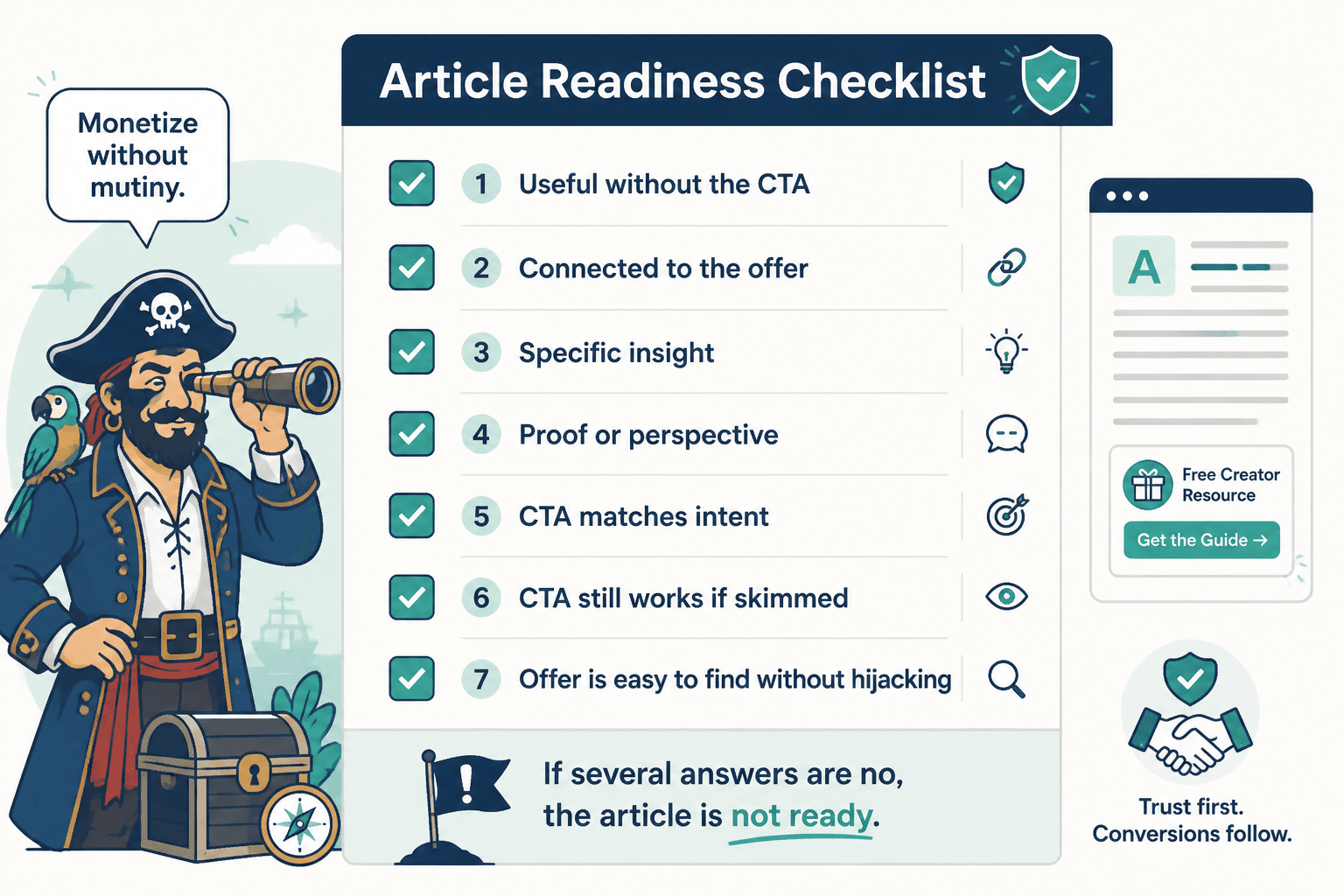
Before publishing, run it through this quick filter.
- Is the article genuinely useful without the CTA?
- Does it speak to a problem connected to your offer?
- Does it include specific insight, not just broad advice?
- Have you shown proof, perspective, or lived pattern recognition?
- Does the CTA match the article’s topic and reader intent?
- Would the CTA still make sense if someone only skimmed the ending?
- Is the offer easy to find without hijacking the article?
If several of those answers are no, the article is not ready. Do not try to solve a weak article with a stronger pitch. That is one of the oldest content mistakes on the internet, and LinkedIn is absolutely not immune.
A practical example of a trust-safe monetization path
Say you are a consultant who helps B2B founders improve messaging and lead generation.
Your LinkedIn article topic might be: why expert-led articles get views but no client conversations.
The article could:
- Explain the difference between attention content and trust-building authority content
- Show three reasons articles fail to create demand
- Give a small framework for stronger article-to-offer alignment
- Share a short example of fixing a weak CTA path
- End with a CTA to a messaging audit, article teardown, or a related lead resource
That works because the monetization is built into the logic. The reader does not feel tricked. They feel helped, then guided.
And if they are not ready to buy, you still have options. Link them to a deeper related article. Invite them to follow your work. Move them toward another trust asset. Monetization is often a sequence, not a single dramatic conversion moment.
The bigger point is simple: clearer structure and clearer writing make the piece more useful. That is usually what makes the ending land better too.