
Most weak LinkedIn article openings do not fail because they are too short. They fail because they spend 4 paragraphs warming up to a point that should have shown up in the first 2 sentences.
You have probably seen this version before: a polite general statement, a vague observation about the industry, maybe a line about how “content matters,” and then, eventually, the article starts. By that point, the reader is already mentally elsewhere, possibly pretending to care while clicking away.
If you want to learn How to Start LinkedIn Articles Without a Weak Opening, the fix is not “be more clever.” It is being more direct. A strong LinkedIn article opening gets to the actual tension fast, makes the reader feel seen, and gives them a reason to keep going without sounding like a cheap headline factory.
This is especially important on LinkedIn, where articles need more authority and structure than posts. A decent post can survive on personality and timing. An article needs a real entrance. It has to feel worth the reader’s attention.
Here’s how to open LinkedIn articles in a way that sounds sharp, credible, and worth reading, without drifting into generic blog sludge.
For the main guide behind this topic, visit the parent guide.
Why most LinkedIn article openings feel weak
The usual problem is not bad grammar or bad formatting. It is hesitation.
People treat the opening like they need to politely escort the reader into the topic. So they add context, background, scene-setting, and broad statements nobody could reasonably disagree with. It feels safe. It also feels forgettable.
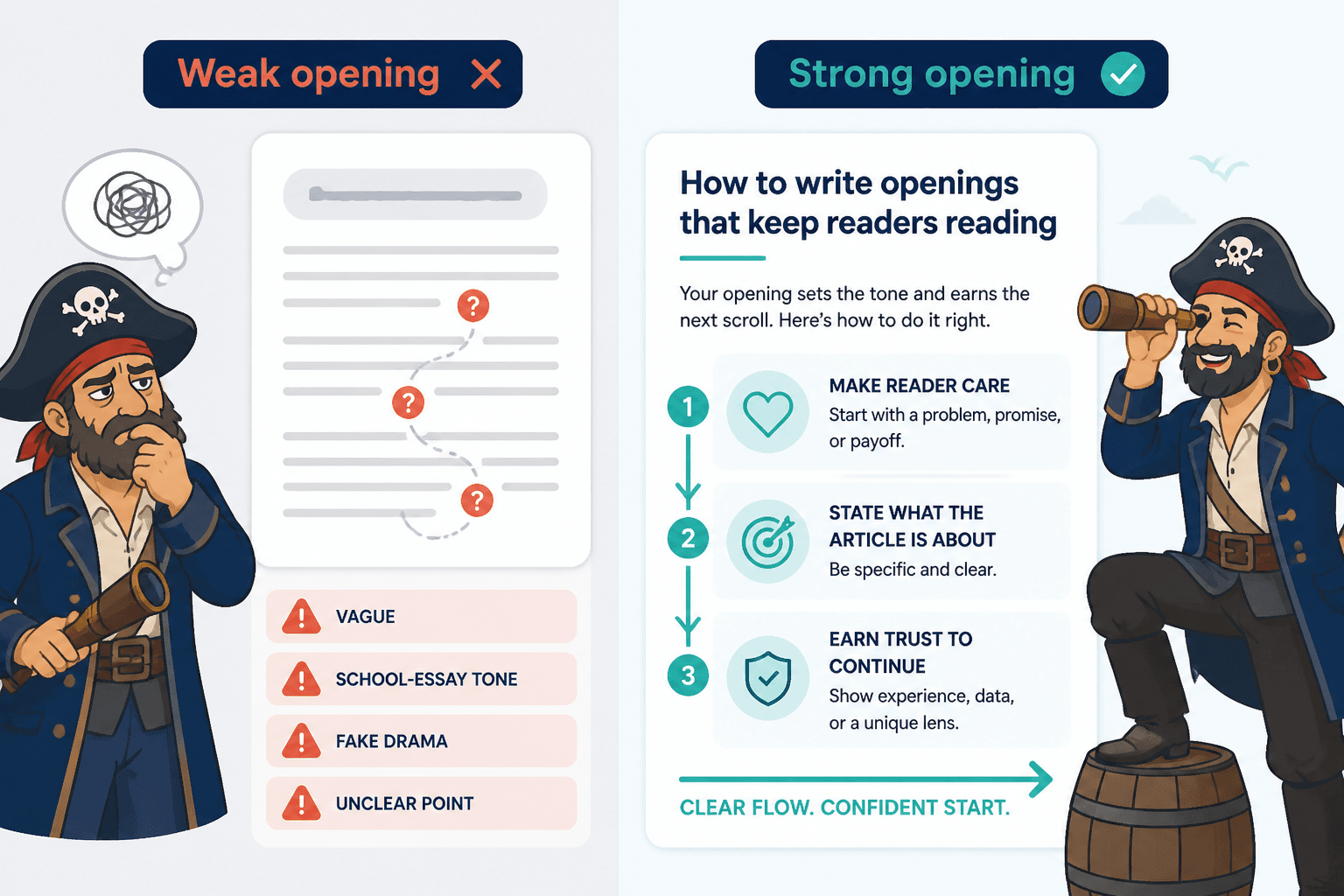
A weak opening usually has one or more of these issues:
- It starts too broad
- It says something obvious
- It delays the real point
- It sounds like a school essay
- It tries to sound professional instead of useful
- It uses fake drama instead of real tension
LinkedIn articles are not academic papers, and they are not sleepy corporate blog posts either. They sit in a useful middle ground: more depth than a post, more personality than a white paper, and more structure than a rant typed between calls.
That means your opening needs to do three things quickly:
- Make the reader care
- Signal what this article is actually about
- Earn enough trust to keep their attention
If the intro does not do that, the rest of the article has to work much harder than it should.
What a strong LinkedIn article opening actually does
A strong opening is not just “interesting.” That word gets abused. Plenty of openings try to sound interesting and end up sounding inflated.
A strong opening is specific, relevant, and intentional. It creates momentum. It tells the reader, very quickly, “This is about a real problem, and this article might actually help.”
Usually, that means leading with one of these:
- A common mistake
- A frustrating pattern
- A false assumption
- A sharp contrast between what people think works and what actually works
- A practical problem with business consequences
Notice what is missing from that list: grand statements about the future of content, fake vulnerability monologues, and dramatic “nobody tells you this” nonsense. You do not need any of it.
How to Start LinkedIn Articles Without a Weak Opening: a simple structure
If you want a usable framework, keep it simple. A good LinkedIn article opening often works like this:
- Name the real problem
- Sharpen it with a consequence, tension, or contrast
- Show the reader what they will get from reading
That is enough. You do not need a theatrical setup.
1. Name the real problem fast
Start where the friction is. What is going wrong? What are people doing badly? What misunderstanding keeps producing mediocre results?
Examples:
- Most LinkedIn articles lose readers in the first paragraph because the writer spends too long “introducing” a point that should already be on the page.
- A lot of smart professionals write article openings that sound polished but say almost nothing.
- If your LinkedIn article starts with generic background, you are making readers work before you have earned the right to ask.
Those openings work because they begin with the problem, not with an awkward preamble about the importance of thought leadership. Which, to be honest, is a phrase that should probably be left in 2019.
2. Add tension or consequence
Once you name the problem, raise the stakes a little. Not with melodrama. Just enough to make the cost clear.
For example:
- Weak openings make good ideas look average.
- If the first paragraph feels generic, the rest of the article has to fight for attention.
- Readers will not wait around while you slowly approach your own point.
This works because it gives the article shape. The reader does not just know what the topic is. They know why it matters.
3. Give a clean promise
Now tell the reader what they are going to get. Not in a stiff “this article will explore” way. Just make the payoff clear.
Examples:
- Here’s how to open LinkedIn articles in a way that feels sharper, more credible, and much harder to ignore.
- Let’s fix that with a few opening structures that get to the point without sounding aggressive or gimmicky.
- This guide will help you write intros that actually pull readers into the article instead of politely losing them.
That is the opening. Problem, tension, promise. Clean. Fast. Useful.
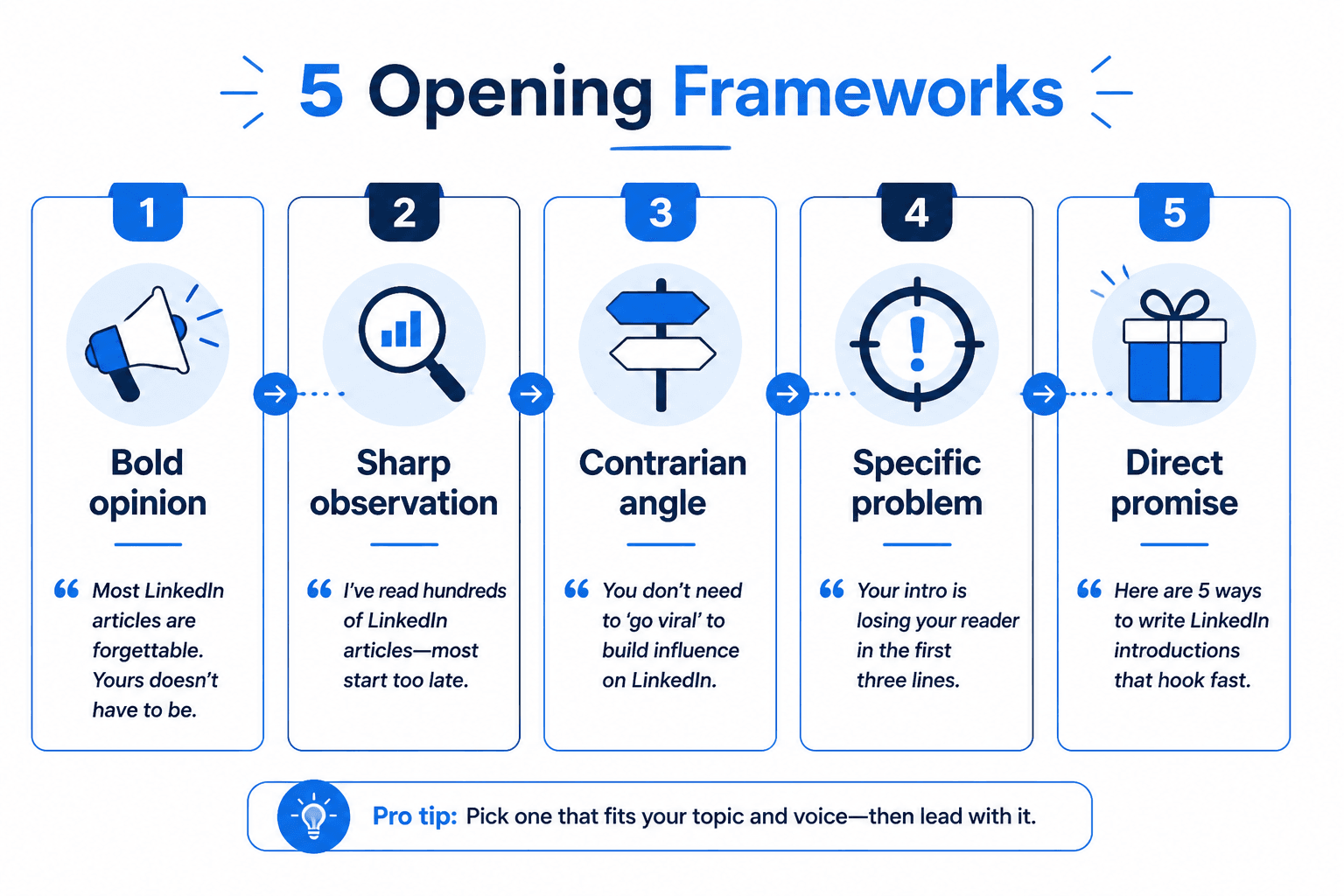
5 opening approaches that work better than generic intros
You do not need one universal formula. Different topics need different angles. But these opening styles are reliable for LinkedIn articles because they create relevance without sounding forced.
1. The common mistake opening
This is one of the easiest and most useful ways to start. You identify a thing people keep doing wrong and explain why it hurts the result.
Most LinkedIn articles do not fail because the ideas are weak. They fail because the opening is vague, padded, and trying too hard to sound professional.
Why it works: it creates instant recognition. The reader either sees themselves in it or sees other people in it. Either way, they keep reading.
2. The false belief opening
This one is great when the topic involves bad advice or lazy assumptions.
A lot of people think a LinkedIn article should begin with broad industry context. Usually, that just means the article starts saying nothing in a very polished voice.
Why it works: it sets up contrast. Contrast is attention. It gives the reader something to mentally push against.
3. The specific frustration opening
Start with the annoying thing your reader keeps experiencing.
You spend an hour writing a LinkedIn article, and somehow the first three paragraphs still read like you are clearing your throat in business-casual.
Why it works: it sounds human. It also gets you out of bland explanatory mode.
4. The useful contrarian opening
Not fake contrarian. Useful contrarian. There is a difference.
The best way to make a LinkedIn article sound more authoritative is usually not adding more context. It is cutting the weak context you never needed.
Why it works: it surprises without becoming clickbait. It also positions you as someone with a clear point of view.
5. The direct promise opening
If the topic is practical enough, you can simply lead with what the reader wants to fix.
If your LinkedIn article intros sound generic, this is how to make them sharper, more specific, and actually worth reading.
Why it works: speed. Sometimes the cleanest option is the best one.
Weak opening vs stronger opening examples
The easiest way to spot the problem is to see it. Here are a few before-and-after rewrites.
Example 1
Weak: LinkedIn has become an increasingly important platform for professionals looking to build their brand and share insights with their network.
Stronger: A lot of LinkedIn articles open with broad statements like this one, and that is exactly why so many of them get ignored.
Why the rewrite works: it skips the obvious and gets to the problem.
Example 2
Weak: Writing compelling article introductions can be challenging, especially in a crowded content environment.
Stronger: If your LinkedIn article intro sounds like it was approved by three committees, readers will assume the rest is just as lifeless.
Why the rewrite works: it has personality, tension, and a clear consequence.
Example 3
Weak: In this article, we will discuss several strategies for creating stronger LinkedIn article openings.
Stronger: Here are five ways to start LinkedIn articles that feel sharper from the first line and do not lose readers before the useful part begins.
Why the rewrite works: it removes the classroom tone and gives the reader a direct payoff.
What to cut from your opening immediately
If your intro feels weak, the fastest fix is usually subtraction.
Cut these first:
- Dictionary-definition energy: “Leadership is the ability to guide others…” No.
- Broad industry statements: “Content plays a critical role in modern business.” Everyone survives this sentence. Nobody enjoys it.
- Throat-clearing: “I’ve been thinking a lot lately about…” Get to the thing.
- Empty transitions: “Before we begin…” You already began.
- Overexplaining the topic: If the title says it, the first paragraph does not need to slowly restate it.
- Fake depth: “We live in a world where attention is currency.” Please don’t.
A good editing pass for intros is brutal and simple: if a sentence does not create clarity, tension, relevance, or momentum, it probably does not belong there.
A quick rewrite process for stronger LinkedIn article intros
If you already have a draft and the opening feels limp, use this process.
- Find the real point. What is the article actually trying to help the reader understand, avoid, or do?
- Identify the friction. What problem, mistake, or false assumption makes that point matter?
- Move that friction to the top. Put it in the first or second sentence.
- Cut the warm-up. Delete any sentence that only exists to sound smooth or professional.
- Add a useful promise. Tell the reader what they will get if they continue.
- Read the intro out loud. If it sounds like corporate narration, rewrite it until it sounds like someone with a brain wrote it.
This process is especially useful if your draft started as a rough idea and gradually got coated in “proper article” language. That happens a lot. Writers know the point, but the intro tries to act respectable before becoming useful.
Respectfully, the reader does not care about your respectable intro. They care about whether this article will help.
How LinkedIn article openings differ from LinkedIn post openings
This matters because people often use the same instincts for both, and the formats are not the same.
LinkedIn posts can be more abrupt. They can open with a punchy opinion, a short personal observation, or a compact hook. Articles need a little more grounding. Not more fluff. More structure.
A good article opening should still be direct, but it also needs to support depth. It has to feel like the start of a useful argument or explanation, not just a post stretched past its natural lifespan.
The bigger point is simple: clearer structure and clearer writing make the piece more useful. That is usually what makes the ending land better too.