
Most people asking how long LinkedIn articles should be in 2026 are really asking a different question: how much do I need to write before people take me seriously?
Fair question. Wrong framing.
LinkedIn articles do not work better because they are longer. They work better when the length matches the job. If the article needs 700 words to make a sharp point, dragging it to 2,000 just makes it feel like a conference handout nobody wanted. If the idea needs depth, examples, and proof, 500 words will make you sound thin.
So, how long should LinkedIn articles be in 2026? Usually somewhere between 800 and 1,800 words for most creators, consultants, coaches, founders, and experts. Shorter can work. Longer can work. But that middle range is where most useful, readable, authority-building LinkedIn articles tend to land without becoming bloated.
This guide will help you pick the right length based on your goal, topic, audience, and article structure, so you stop guessing and start publishing pieces people actually finish.
To see how this fits into the wider strategy, open the parent guide.
How Long Should LinkedIn Articles Be in 2026? The practical answer
Here is the clean version.
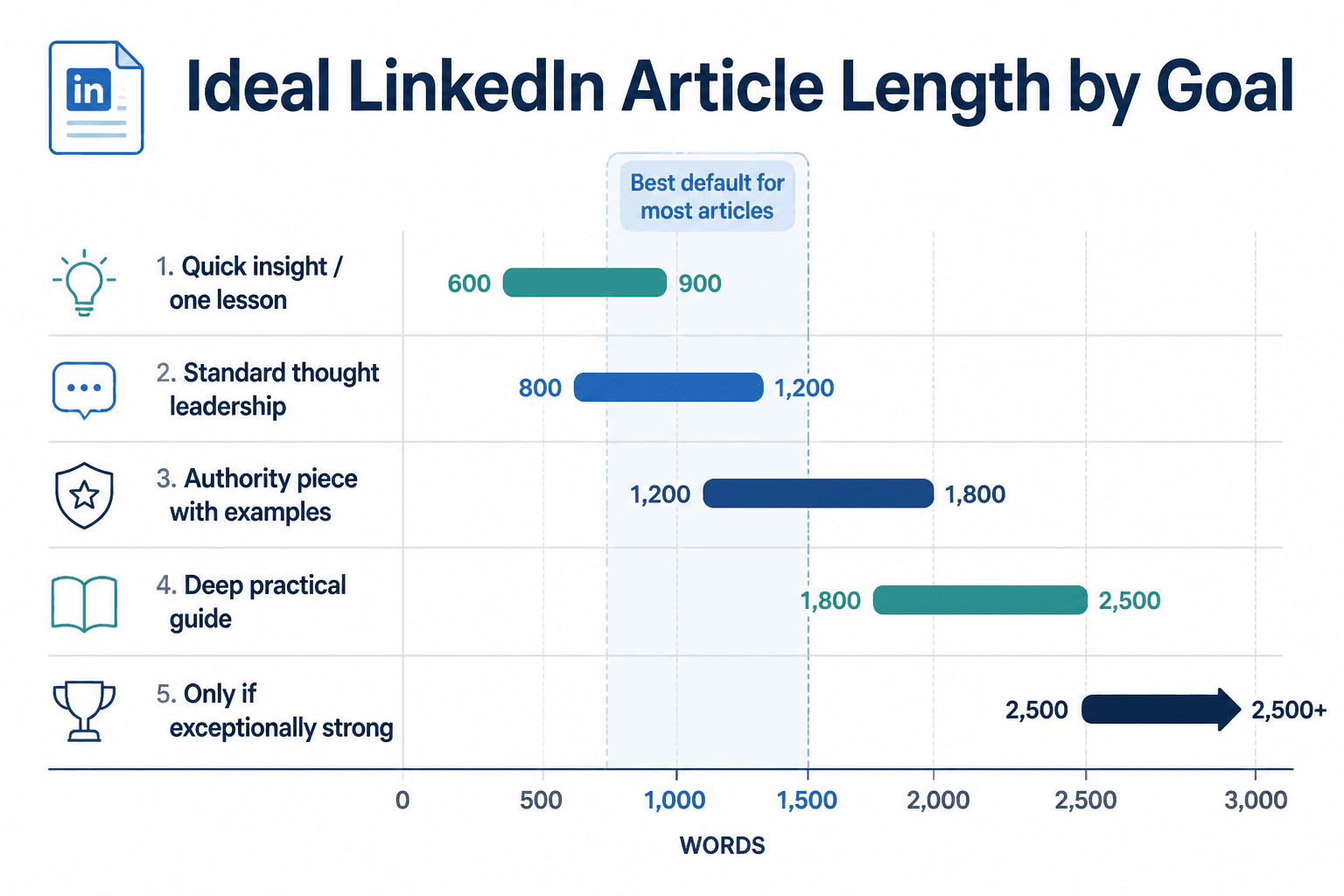
- 500 to 800 words: good for narrow ideas, opinion pieces, quick frameworks, or one clear lesson
- 800 to 1,200 words: strong default range for most LinkedIn articles
- 1,200 to 1,800 words: ideal for deeper authority pieces with examples, process, and nuance
- 1,800 to 2,500 words: useful when the topic genuinely needs depth, proof, and multiple sections
- Over 2,500 words: only worth it if the piece is unusually strong, highly practical, and tightly structured
If you want one default recommendation, use this: aim for 1,000 to 1,500 words unless you have a good reason not to.
That range gives you enough room to say something intelligent, include examples, and build trust without sounding like you stapled three blog posts together out of guilt.
Why there is no magic word count
Because LinkedIn articles are not judged by length in a vacuum. They are judged by whether the article earns attention and keeps it.
A short article can do that beautifully if the point is crisp. A long article can do it too, if the structure is strong and the content actually helps. But a padded article dies slowly. You can feel it by paragraph four. The writer is still talking, and somehow saying less.
The right length depends on a few things:
- how complex the idea is
- how much proof the reader needs
- how aware the audience already is
- whether the goal is reach, trust, leads, or authority
- how strong your examples are
- whether you are explaining one point or building an argument
This is why broad advice like “long-form always wins” or “nobody reads long articles anymore” is mostly content-creator folklore. People read useful things. They skip padded things. The platform changes. That part does not.
Choose article length based on the job it needs to do
For quick authority: 600 to 1,000 words
If your goal is to publish a clean, useful take that shows you know what you are talking about, this range works well.
Good fit topics include:
- one mistake people keep making
- one framework with a brief explanation
- a strong opinion with supporting points
- a short breakdown of what works now
- a focused lesson from client work or industry patterns
This is often enough for consultants, coaches, and service providers who want to build credibility without writing a mini thesis every week.
If you are tempted to push one of these to 1,800 words, ask yourself a rude but useful question: am I adding value, or am I narrating my own certainty?
For strong educational pieces: 1,000 to 1,500 words
This is the sweet spot for most LinkedIn articles in 2026.
It gives you room to:
- open with a clear problem
- explain the idea properly
- include examples or mini case points
- add nuance without rambling
- end with a useful next step or CTA
If you are writing educational content that supports your positioning, this range is usually enough. It reads like a thoughtful article, not a rushed post pretending to be one.
For deeper trust-building: 1,500 to 2,200 words
Use this range when the reader needs more than tips. Maybe you are breaking down a process, making a nuanced argument, comparing approaches, or teaching something with moving parts.
This length can work especially well for:
- high-consideration services
- complex B2B topics
- deep positioning pieces
- contrarian articles that need evidence
- articles designed to rank in search and support authority
But there is a catch. If you go longer, structure matters more. Readers will tolerate depth. They will not tolerate wandering.
What usually makes LinkedIn articles too long
Most articles are not too long because the writer had too much to say. They are too long because the writer did not decide what the article was actually about.
Here is where bloat usually sneaks in:
- Throat-clearing intros: three paragraphs of setup before the point arrives
- Repeating the same lesson: saying one idea five slightly different ways
- Overexplaining obvious points: readers do not need a TED Talk on why clarity matters
- Weak examples: generic filler dressed as proof
- Trying to cover everything: one article turns into a badly behaved content buffet
- AI expansion sludge: decent draft, then puffed up until it sounds politely dead inside
If your article feels long but not rich, that is the issue. Not word count. Density.
What makes a shorter LinkedIn article work
Short LinkedIn articles beat long ones when they do one thing very well.
They usually have:
- a clear, specific promise
- a sharp opening
- one central idea
- tight supporting points
- at least one concrete example
- a clean finish
If you want to go deeper on that, read when short LinkedIn articles beat long ones. A lot of writers assume shorter means weaker. Not true. Shorter just means you have to know your point before you start typing.
In fact, shorter articles can sometimes perform better for busy professional readers because they respect time. The trick is making them feel complete, not undercooked.
How to decide the right length before you write
Here is a simple way to choose your target length before the draft starts mutating.
1. Define the article’s actual goal
Ask: what is this article supposed to do?
- teach one lesson
- build authority on a topic
- shift how the reader thinks
- show your process
- support a service or offer
- rank for a search-driven question
The clearer the job, the easier the length decision.
2. Count the proof points you actually need
If the claim is simple and believable, you may only need one example.
If the claim is more nuanced, more skeptical readers will need more support. That usually means more words, but useful words.
3. Pick one scope, not three
A lot of article bloat comes from topic creep.
Example:
- Too broad: How to use LinkedIn articles to grow your business
- Better: How to write LinkedIn articles that build authority with buyers
- Even better: How consultants can use LinkedIn articles to turn expertise into trust
Tighter scope usually means tighter length.
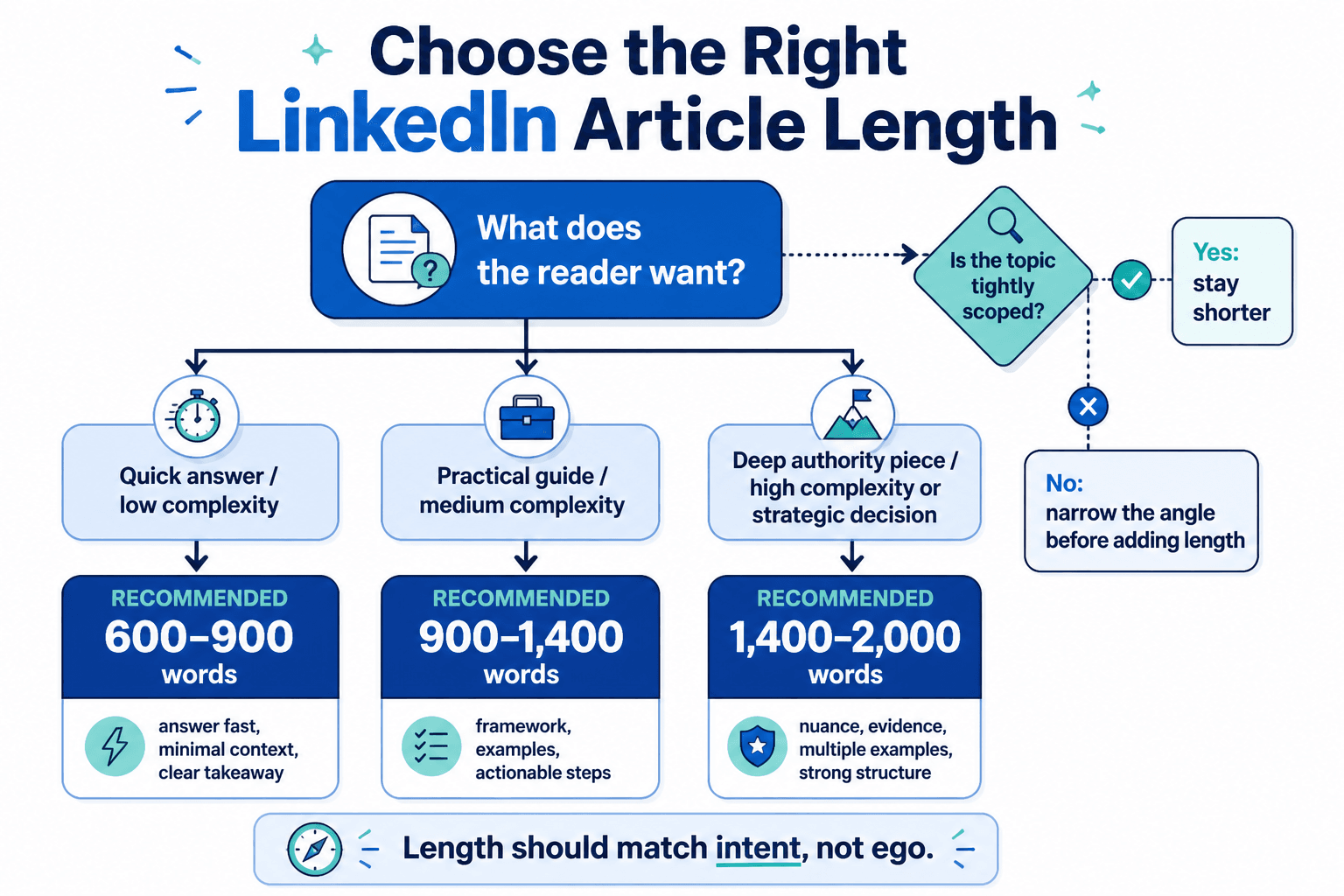
4. Match the length to reader intent
If someone is looking for a quick answer, do not bury it under 14 scenic paragraphs. If they want a detailed guide, do not hand them a snack and call it strategy.
Search intent matters here. If someone searches “How Long Should LinkedIn Articles Be in 2026?” they want a practical answer, not a literary experience.
A simple structure that keeps length under control
If your LinkedIn articles keep ballooning, the problem is often structure, not discipline.
Use this simple framework:
- Opening: name the problem fast
- Core answer: give the practical answer early
- Explanation: show why that answer makes sense
- Examples or use cases: make it real
- Action step: tell the reader what to do next
That structure works for most authority articles and stops you from wandering into side quests you do not need.
If your openings tend to sag, read how to start LinkedIn articles without a weak opening. A weak intro does not just hurt attention. It also inflates the article because you spend too many words warming up to your own point.
LinkedIn article length by content type
| Content type | Recommended range | Why it works |
|---|---|---|
| Quick opinion article | 600 to 900 words | Enough for a point, context, and a takeaway |
| Educational how-to article | 1,000 to 1,500 words | Best balance of depth and readability |
| Framework or method breakdown | 1,200 to 1,800 words | Lets you explain steps and examples clearly |
| Case-study style article | 1,200 to 2,000 words | Needs context, proof, and lessons |
| Thought leadership piece | 800 to 1,400 words | Strong enough to persuade without dragging |
| Search-focused evergreen article | 1,500 to 2,500 words | Works if the topic truly needs thorough coverage |
These are guidelines, not laws carved into a content stone tablet. But they are useful starting points.
If you want more reach, length is not your first problem
A lot of people obsess over article length because it feels measurable. Tidy. Safe. But article performance usually depends more on these:
- the opening
- topic relevance
- clarity of the headline
- strength of the idea
- specificity
- readability
- whether the article gives people a reason to care
A mediocre 2,300-word article will not outperform a sharp 950-word one just because it ate more word count for breakfast.
If you want your articles to work harder, focus on making them better, not merely longer. This is where how to write better LinkedIn articles becomes more useful than chasing arbitrary length targets.
How to tell if your draft is too short or too long
Your draft is too short if:
- it makes a claim without supporting it
- the takeaway feels obvious or generic
- you mention a framework but do not explain how to use it
- the reader would still have major unanswered questions
- the article reads like a stretched social post
Your draft is too long if:
The bigger point is simple: clearer structure and clearer writing make the piece more useful. That is usually what makes the ending land better too.
LinkedIn articles work best when the structure makes the main idea easy to follow and easy to act on. Clearer writing usually carries more weight than heavier formatting.