
People love asking how long a LinkedIn article should be as if there is a magic number hiding in a content cave somewhere. There isn’t. And a lot of decent articles get ruined because the writer assumes “more depth” automatically means “more words.” It usually does not.
When short LinkedIn articles beat long ones, it is usually for a very simple reason: the shorter piece respects the reader’s time, gets to the point faster, and delivers one clear idea without stuffing it with polite fluff and recycled throat-clearing.
That does not mean short is always better. It means short wins when the idea is focused, the reader wants a practical answer, and the writer knows how to stop talking once the useful part is done. A shocking concept, apparently.
If you publish LinkedIn articles to build authority, attract the right people, and give your expertise a home that lasts longer than a post, this matters. The goal is not to write the longest thing your keyboard can survive. The goal is to write the right-sized article for the job.
Here’s how to tell when a short LinkedIn article will outperform a long one, what “short” should actually do, and how to avoid publishing a tiny article that feels more like a stretched post than a useful piece of authority content.
To see how this fits into the wider strategy, open the parent guide.
What counts as a short LinkedIn article?
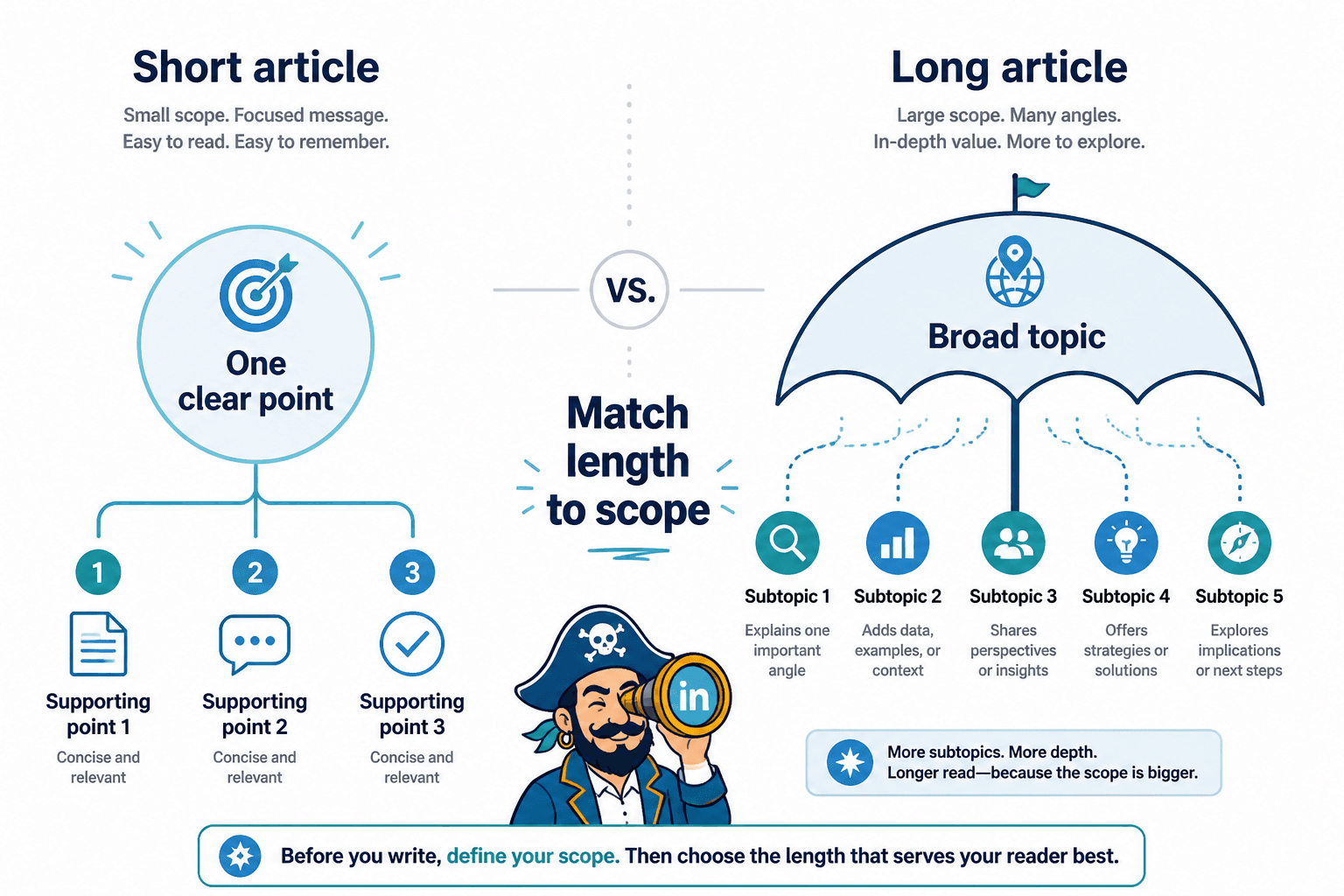
For most creators, consultants, coaches, and service businesses, a short LinkedIn article usually falls somewhere in the 600 to 1,200 word range. Not because the algorithm whispered it from the clouds, but because that is often enough room to explain one sharp idea properly without drifting into padding.
A long LinkedIn article might run 1,500 words and up, especially when you are covering strategy, process, examples, objections, and a next step. That can work beautifully. But only if the subject actually needs the extra room.
If you want a fuller breakdown of ideal ranges, this guide on how long LinkedIn articles should be covers that in more detail. For this piece, the important part is simpler: short articles win when they are complete, not when they are merely brief.
When short LinkedIn articles beat long ones
Short LinkedIn articles tend to beat long ones in a few very predictable situations. Not because people have lost the ability to read, but because most readers are scanning for relevance first. Depth only matters after clarity.
1. When the reader wants a fast answer to a specific problem
If someone is searching for a practical answer like “how to improve a LinkedIn article intro” or “how to structure a client-winning article CTA,” they usually do not need your full philosophy of communication, three side quests, and an origin story.
They want the answer. A short article can serve that much better than a long one because it removes friction. It says, here is the problem, here is what works, here is how to do it, now go fix it.
That kind of article earns trust because it feels useful immediately. It proves you can solve a problem without making the reader work through six paragraphs of scene-setting first.
2. When the article covers one idea, not a whole ecosystem
A lot of writers force articles to become bigger than the idea can support. One clean point gets inflated into a bloated “ultimate guide,” and by the middle, the article is basically repeating itself in nicer shoes.
Short articles beat long ones when the topic is narrow enough to stay sharp. Examples:
- One mistake people make in article intros
- One structure for teaching a framework
- One reason articles fail to convert readers into profile visits
- One way to make article headlines less vague
- One format for turning client lessons into authority content
That kind of focused article feels stronger because it has a spine. It knows what it is about. It does not wander around the subject hoping to accidentally sound substantial.
3. When clarity matters more than comprehensiveness
Comprehensive is overrated when the reader really needs clarity.
That is especially true on LinkedIn, where readers often discover articles between meetings, mid-scroll, or after seeing your profile and wanting a fast sample of how you think. A shorter article can act like a strong handshake. A long article can do that too, but only if it earns the extra attention.
If your article exists to establish expertise fast, a concise, well-structured piece often performs better than a giant one because the payoff arrives sooner. The reader gets evidence of your judgment without needing to commit half their afternoon.
4. When the writer is better at insight than endurance
This one stings a little, but here we are.
Some people have strong ideas and weak stamina. Their best thinking comes in clean, pointed bursts. Once they try to stretch the piece, the quality drops. The examples get repetitive. The language gets foggy. The article starts sounding like it was assembled by committee in a beige conference room.
If your strongest writing happens when you stay tight, then shorter LinkedIn articles may beat longer ones simply because they preserve your sharpness. Better a crisp 850-word article than a 2,100-word article with 900 words of filler wearing a fake mustache.
5. When the article is meant to support, not replace, your other content
Not every LinkedIn article needs to be the final word on a topic. Sometimes the article’s job is to deepen trust after someone finds you through posts, comments, your profile, or your newsletter.
In that case, a short article can work brilliantly. It gives the reader a clean, useful taste of your expertise, then points them toward the next relevant piece. That is especially useful if you are building a library of related content around a niche.
For example, a short article about article length can naturally lead readers to broader resources on how to write better LinkedIn articles, examples from strong LinkedIn article ideas, or more guidance in your wider LinkedIn articles hub.
Why short LinkedIn articles often feel stronger
A good short article has pressure in the right places. It opens fast. It stays on track. It creates less room for fluff, less room for repetition, and less room for that dreadful “I am writing because I think I should be writing” tone.
That makes it easier for the article to do a few things well:
- Make a clear argument
- Deliver one useful lesson
- Hold the reader’s attention
- Show your expertise without overexplaining
- Create momentum toward a next step
The shorter piece also forces discipline. You have to know the point. You have to choose the best example instead of every example. You have to stop pretending that adding three extra subheadings automatically creates depth.
Depth is not the same as length. A short article with a sharp idea has more authority than a long article full of polite repetition.
When long LinkedIn articles are still the better choice
Now for the part that saves this from becoming one of those “short content is the future” sermons.
Long LinkedIn articles still beat short ones when the reader genuinely needs depth, proof, nuance, or a step-by-step process. If the topic involves decisions, implementation, objections, or strategy, forcing it into a short format can make the article feel thin.
Longer articles usually make more sense when you are covering:
- A complete framework or methodology
- A detailed how-to process with multiple steps
- A nuanced opinion that needs examples and counterpoints
- A comparison between approaches, tools, or content formats
- A search-driven topic where the reader expects fuller coverage
If the article would become vague or underdeveloped when shortened, keep it long. Just make sure the extra length earns its keep. If you suspect you have written a long article that mostly repeats itself in different jackets, this guide on rewriting boring LinkedIn articles will help you tighten it up.
How to know if your article should be short
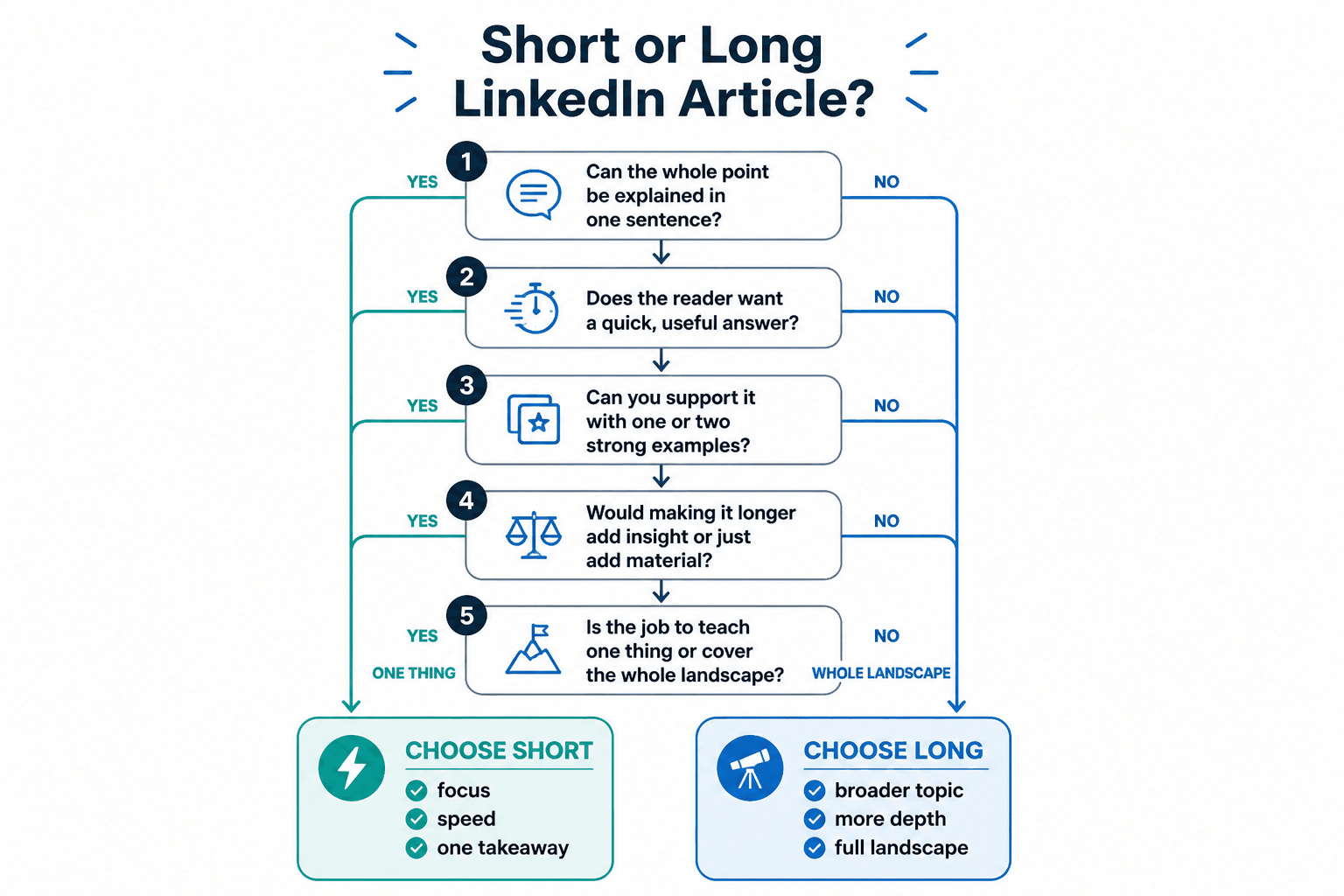
Here is the practical test. Before you write, answer these five questions.
- Can the whole point be explained clearly in one sentence?
If not, the topic may be too broad for a short article. - Does the reader likely want a quick, useful answer?
If yes, shorter often works better. - Can you support the point with one or two strong examples?
If yes, you probably do not need 2,500 words. - Would making it longer add insight or just add material?
Material is not the same thing as value. - Is the article’s job to teach one thing or cover the whole landscape?
One thing usually wins in a shorter format.
If most answers point toward focus, speed, and one clear takeaway, short is probably the right move.
What a strong short LinkedIn article actually looks like
A short article still needs structure. It cannot just be a regular LinkedIn post that wandered into a headline and put on loafers.
Here is a simple structure that works well:
- Open with the actual problem.
Name the mistake, frustration, or false assumption quickly. - State the core point early.
Tell the reader what is true or what works instead. - Explain why it matters.
Add context, contrast, or a useful distinction. - Give one to three examples.
This is what keeps the article from feeling thin. - End with a practical next step.
Tell the reader what to do, check, rewrite, test, or avoid.
That is enough for a clean, useful article in the 700 to 1,100 word range. Tight, but not skeletal.
A quick example
Say your topic is: “Why most LinkedIn article intros lose the reader.”
A weak long version might spend 400 words explaining why content matters, another 300 defining intros, then eventually arrive at the point that most intros are too vague.
A better short version would do this:
- Open by saying most intros fail because they delay the point
- Show a weak intro example
- Rewrite it with a stronger opening
- Explain the pattern
- End with a quick editing checklist
Done. Useful. Memorable. No padded nonsense.
Mistakes people make when trying to write shorter LinkedIn articles
Writing shorter does not mean cutting randomly until the article looks efficient. That usually creates a different kind of bad.
Mistake 1: Confusing short with underdeveloped
If the article makes a claim but does not explain it, support it, or show the reader how to use it, it is not concise. It is unfinished.
Mistake 2: Publishing a post disguised as an article
LinkedIn articles should still offer more depth and staying power than regular posts. If your article is basically 250 words and a broad opinion, it probably belongs in the feed, not in article format.
Mistake 3: Removing examples to save space
Examples are often the part that makes the idea believable and usable. Cut repetition, not proof.
Mistake 4: Ending abruptly with no next step
Even a short article needs a landing. Give the reader a test, a rewrite prompt, a checklist, or a related article to continue with.
Mistake 5: Thinking shorter automatically means better
Nope. Better means better. Short is just a format decision. If your topic needs more room, give it more room and write it properly.
A simple rule for choosing short vs long
Use a short LinkedIn article when the reader needs one clear answer.
Use a long LinkedIn article when the reader needs a complete understanding.
That is the cleanest rule I know for this. It is not fancy, but it works.
The bigger point is simple: clearer structure and clearer writing make the piece more useful. That is usually what makes the ending land better too.