
Most soft CTAs are not soft. They are just vague, limp, and wearing polite shoes.
You have seen them everywhere: “Let me know your thoughts.” “Feel free to reach out.” “Comment below.” “DM me if this resonates.” They are not offensive. They are not aggressive. They are also usually doing absolutely nothing.
If you want to know how to write better soft CTAs without sounding generic, the fix is not making them cuter or more casual. The fix is giving them a real job. A soft CTA should still guide the reader toward a next step. It just does it without sounding like a funnel goblin.
This is where a lot of creators, consultants, and personal brands get stuck. They do not want to sound pushy, so they write CTAs that are technically harmless and strategically useless. Or they try to sound natural and end up using the same tired line as everyone else on the internet.
Here’s how to make your soft CTAs clearer, sharper, and much more likely to get replies, clicks, and conversations from actual humans.
For the broader learning path, visit our parent guide.
What a soft CTA is supposed to do
A soft CTA is a low-pressure next step. It invites instead of shoving. It opens a door instead of dragging someone through it by the collar.
That does not mean it should be weak.
A good soft CTA usually does one of these:
- Starts a conversation
- Encourages a small action
- Moves the reader to a relevant next step
- Helps qualify interest
- Creates momentum without forcing commitment
In other words, “soft” describes the tone, not the usefulness.
If your CTA sounds pleasant but gives the reader no clear reason to act, it is not soft. It is unfinished.
Why most soft CTAs sound generic
They sound generic because they are detached from the actual content.
People write a useful post, article, or landing page, then slap on a default ending they have seen a hundred times before. The CTA is not built from the reader’s likely reaction. It is pasted on like a waiting-room plant.
Here are the usual problems:
- It asks for a response that is too broad
- It could fit literally any topic
- It does not match the reader’s stage of awareness
- It sounds overly polished or weirdly corporate
- It asks for action without giving a reason
- It does not tell the reader what they will get by responding
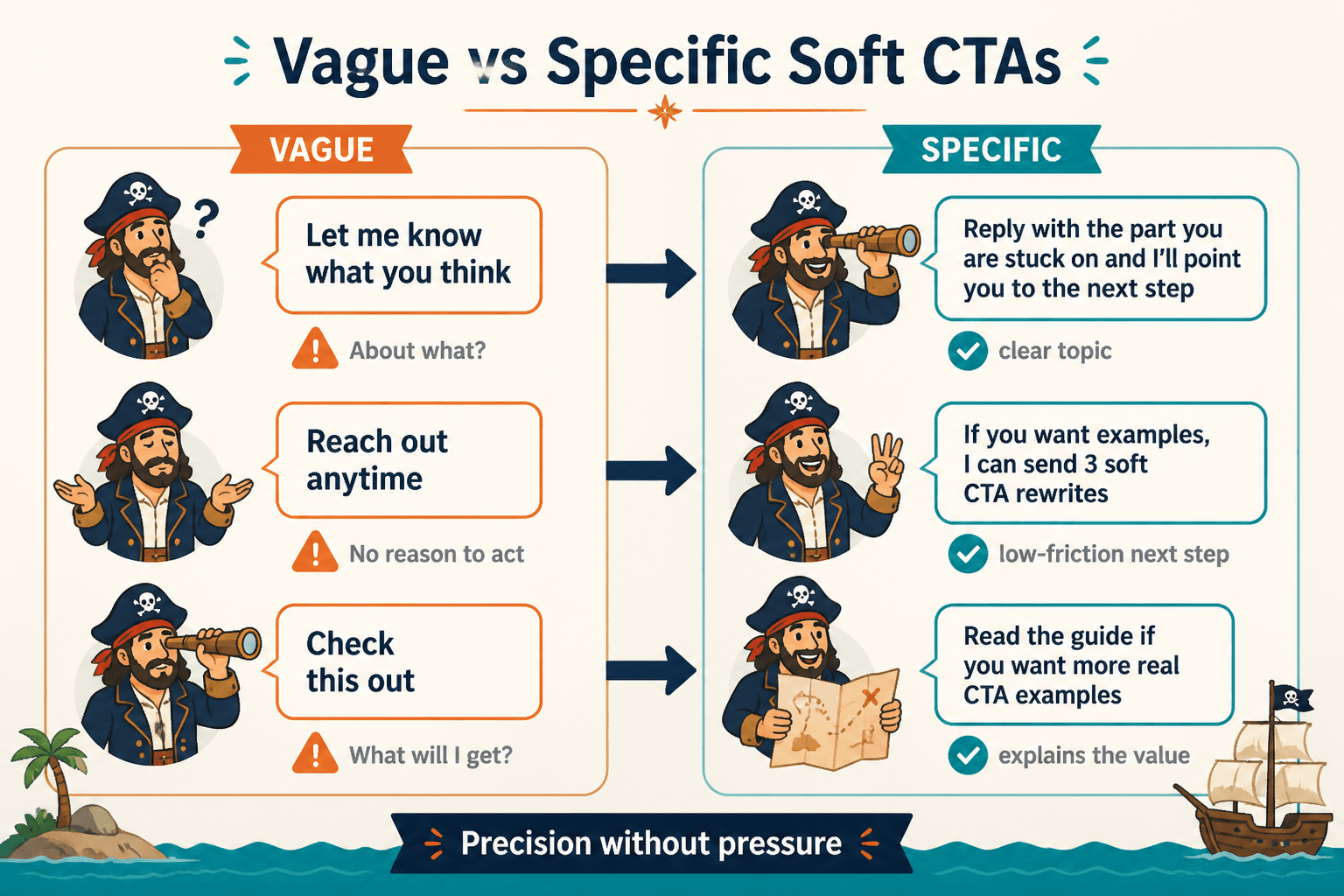
“Let me know what you think” is the perfect example. About what, exactly? Why would I? What kind of response are you looking for? The line is not evil. It is just lazy.
If you want stronger CTA writing across your content, this is also where articles like How to Write Better CTA Writing and the broader CTA Writing Guide for Creators Who Want Better Results can help. But for soft CTAs specifically, the main job is precision without pressure.
How to write better soft CTAs without sounding generic
The easiest way to improve a soft CTA is to stop treating it like a closing line and start treating it like the next logical move.
That means your CTA should come from the reader’s likely state after reading the piece. Are they curious? Stuck? Skeptical? Interested but not ready? Do they need a small prompt, a low-friction next step, or a reason to reply?
1. Match the CTA to the reader’s most likely next thought
If your reader just learned something practical, they may be ready to test it. If they read a strong opinion piece, they may be ready to respond. If they landed on a service page, they may need a low-pressure way to explore fit.
So instead of ending with a generic invitation, answer the question they are already about to ask.
Bad soft CTA: “Let me know your thoughts.”
Better soft CTA: “If you are stuck between being clear and sounding too salesy, start by rewriting your last CTA to ask for one specific action, not vague engagement.”
The second one still feels low pressure. But it gives the reader something useful to do.
2. Ask for a specific kind of response
Broad asks get broad silence.
If you want comments, shape the comment. If you want replies, guide the reply. If you want DMs, give people a reason and a format.
For example:
- Instead of “What do you think?” try “Which of these mistakes shows up most in your CTA writing?”
- Instead of “DM me if interested” try “If you want help tightening your homepage CTA, send me the word ‘homepage’ and I’ll tell you what I’d fix first.”
- Instead of “Reach out anytime” try “If you are not sure whether your CTA is too soft or too salesy, send over the line you are using.”
Notice what changed. The asks are smaller, clearer, and more grounded in a real situation.
3. Make the action feel relevant, not ritualistic
A lot of CTAs read like they are there because content is supposed to have one. Readers can smell that. They know when you are ending with “comment below” because some content template told you to.
The CTA should feel earned by the piece. If you wrote a post about rewriting weak offers, a smart CTA might invite readers to test one line. If you wrote a guide to homepage messaging, your CTA might point them toward the next useful resource. If you wrote a personal opinion post, a conversation CTA makes more sense than a link push.
Relevance does a lot of the work that hype usually tries and fails to do.
4. Give the reader a reason to act now
This does not mean fake urgency. Nobody needs “limited spots” stapled to a post about website copy.
It means making the next step feel useful right now. The best soft CTAs reduce friction by making the payoff immediate, obvious, or easy.
Examples:
- “If your current CTA sounds polite but forgettable, rewrite it before you publish your next post.”
- “If this page is already live, check the final button text first. That is usually where the mush is hiding.”
- “If you want a cleaner starting point, use one of the examples below and adapt it to your offer.”
These work because they attach the CTA to a useful moment, not some abstract future.
5. Sound like a person, not a funnel template
If your soft CTA sounds like it came from a course sales page in 2019, people will treat it with the respect it deserves.
A lot of weak CTA writing fails on tone before it even fails on strategy. The wording gets too polished, too careful, or too “professional” in the dead-eyed sense of the word.
Compare these:
Generic: “If this resonates, feel free to connect.”
Better: “If you are trying to fix this in your own content, start here.”
Generic: “I’d love to hear your thoughts in the comments.”
Better: “Which one do you see more: CTAs that sound too timid, or CTAs that sound like they were written by a webinar robot?”
Generic: “Reach out if you’d like support.”
Better: “If you want a second set of eyes on your CTA copy, send me the line that feels off.”
The stronger versions sound more human because they are more concrete. Human voice is not just contractions and casual wording. It is specificity.
A simple framework for better soft CTAs
If you need a repeatable way to improve CTA writing, use this:
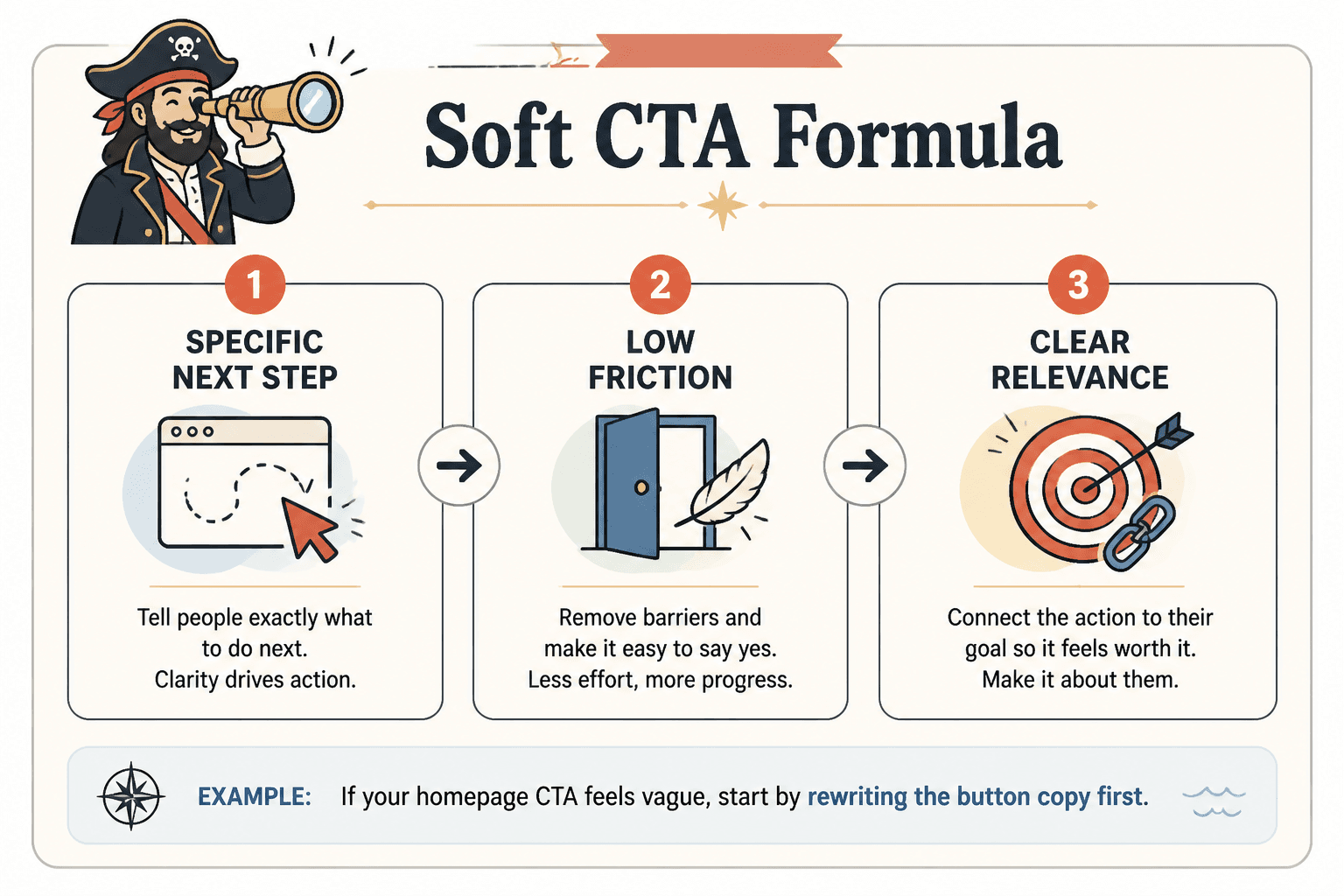
- Name the next logical action. What should the reader do after this?
- Lower the pressure. Make it feel optional, easy, or useful.
- Add specificity. Tell them what kind of response or action you want.
- Make the payoff clear. Why bother?
That gives you a practical formula:
Soft CTA formula: specific next step + low friction + clear relevance
For example:
- “If your bio still says a lot without saying much, rewrite the first line before you touch anything else.”
- “If you want, send me your current CTA and I’ll tell you where it goes vague.”
- “If this is the part your homepage keeps fumbling, start with the button copy, not the hero headline.”
- “If you are testing softer calls to action, try asking for one tiny response instead of a full commitment.”
That is the difference between a CTA that blends into the wallpaper and one that quietly moves things forward.
Before-and-after soft CTA rewrites
Sometimes the fastest way to learn this is to watch the mush get removed.
Example 1: Social post CTA
Before: “What do you think?”
After: “Which part of CTA writing trips you up more: sounding too salesy or sounding too vague?”
Why it works: It narrows the response and gives people an easy way in.
Example 2: Service page CTA
Before: “Get in touch to learn more.”
After: “If your website is getting polite traffic and weak action, send me your homepage and I’ll tell you what the CTA is doing wrong.”
Why it works: It makes the invitation feel practical and tied to a real problem.
Example 3: Newsletter CTA
Before: “Reply and let me know if this helped.”
After: “Reply with the CTA you are currently using if you want a quick gut-check on whether it sounds clear or just polite.”
Why it works: It gives the reply a purpose.
Example 4: Lead magnet CTA
Before: “Download now.”
After: “If writing CTAs keeps turning into vague mush, grab the template and steal a cleaner starting point.”
Why it works: It speaks to the problem, not just the asset.
If your current endings feel flat, a dedicated rewrite pass helps. That is exactly where How to Rewrite Boring CTA Writing becomes useful. Often the issue is not that the CTA exists. It is that it says nothing precise with any confidence.
Soft CTA types that actually work
You do not need one soft CTA. You need the right type for the situation.
| CTA type | Best for | Example |
| Conversation CTA | Posts, emails, opinion pieces | “Which of these mistakes do you see most?” |
| Diagnostic CTA | Services, audits, consulting | “Send me the line you are using and I’ll tell you where it goes fuzzy.” |
| Micro-action CTA | Educational content | “Rewrite your current button text before you change anything bigger.” |
| Resource CTA | Lead magnets, guides, templates | “If you want a cleaner starting point, grab the template.” |
| Path CTA | Articles and site content | “If this is useful, read How to Write CTA Writing Without Sounding Salesy or Robotic next.” |
Different content needs different exits. One of the easiest mistakes in conversion copy is using the same friendly-but-empty CTA everywhere and hoping context will save it.
What to avoid if you want your soft CTA to feel fresh
- Vague verbs. Words like connect, engage, reach out, and share can work, but they often hide weak intent.
- Default endings. If the CTA could go under any post on any topic, it is probably too generic.
- Overly warm filler. “I’d absolutely love to…” is usually just verbal packing foam.
- Fake softness. “No pressure” right before a hard pitch still feels like a pitch.
- Low-context asks. Do not ask people to DM you without saying what for.
- Polite nothingness. Friendly is good. Fog is not.
This matters because soft CTAs usually live in trust-based content. They show up in posts, articles, newsletters, landing pages, and bios where the relationship is still warming up. If the CTA feels generic there, it weakens everything around it.
That is also why it helps to understand the bigger category structure around conversion copy. If readers need more support, you can naturally point them toward the broader conversion copy section or the more specific CTA writing hub.
Quick checklist for writing a soft CTA that does not sound generic
The bigger point is simple: clearer structure and clearer writing make the piece more useful. That is usually what makes the ending land better too.
CTA writing works best when the next step feels specific, natural, and easy to trust. A clearer ask usually outperforms a louder one.