
Most website bio and profile copy sounds like it was assembled by a committee of LinkedIn clichés, half-digested brand strategy, and one mildly stressed robot.
You have seen it. “I help visionary entrepreneurs unlock aligned growth through authentic storytelling and strategic transformation.” Which is impressive if your goal is to say many words while communicating almost nothing.
The problem is not that people want to sound professional. It is that they confuse professional with vague, polished, and weirdly bloodless. So their website bio ends up sounding either too salesy, too stiff, or like they fed three decent thoughts into a blender and hit purée.
If you want to know how to write website bio and profile copy without sounding salesy or robotic, the fix is not “be more authentic” and other fluffy nonsense. It is much simpler than that. You need clearer positioning, more specific language, better proof, and a voice that sounds like an actual person with a functioning brain.
This article will help you write bio and profile copy that sounds confident without puffing itself up, credible without reading like a résumé dump, and persuasive without turning into a mini webinar funnel. If your current bio feels bland, try-hard, or suspiciously AI-scented, this is the cleanup job.
For the broader learning path, visit our parent guide.
What website bio and profile copy is actually supposed to do
A website bio is not there to impress random strangers with your adjective collection.
It has a job. A few jobs, really:
- Tell the right people who you help
- Make your work easier to understand
- Build enough trust to keep reading or click something
- Show some personality, so you do not sound interchangeable
- Nudge the reader toward the next step
That is it. Your bio does not need to tell your full life story. It does not need to prove you are deep. It does not need to sound like a keynote intro. It needs to reduce confusion and increase trust.
Good bio and profile copy works because it answers the questions readers are already asking in their heads:
- Who is this person?
- What do they actually do?
- Who is it for?
- Can I trust them?
- Do I like the way they think?
- What should I do next?
If your copy misses those, it usually starts compensating with hype. And hype is what makes it sound salesy.
Why bios sound salesy or robotic in the first place
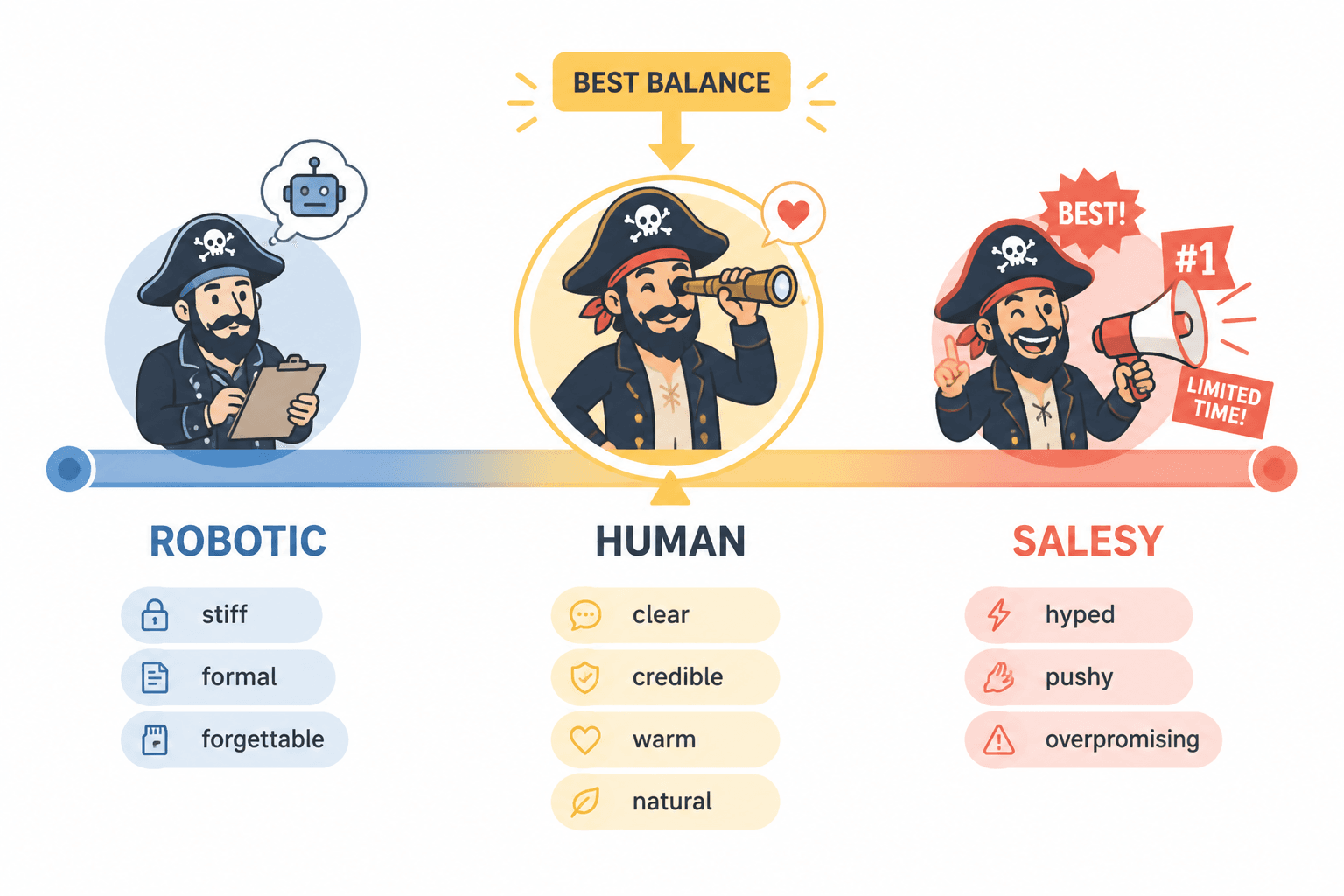
People usually mess this up in one of two directions.
The salesy version
This one leans too hard on promises, intensity, and conversion language. It sounds like every sentence is trying to close a deal before the reader has even figured out what you do.
It often includes things like:
- Big claims with no proof
- Buzzwords instead of specifics
- Overwritten transformation language
- Forced urgency
- Way too much “you” language jammed into every line
“I empower ambitious founders to scale with clarity, confidence, and magnetic messaging.”
That sentence is trying very hard. It is also not saying much.
The robotic version
This one is technically clear-ish but completely lifeless. It reads like a formal HR profile or a cautious conference brochure.
It often includes:
- Third-person voice when it is not needed
- Dry lists of experience
- Overly polished wording
- No point of view
- No natural rhythm
“Jane Smith is a marketing consultant with over 12 years of experience helping businesses optimize communications strategies across multiple channels.”
Fine. Competent. Also incredibly easy to forget.
The sweet spot is somewhere in the middle: clear, grounded, credible, and human.
The simplest structure for better bio and profile copy
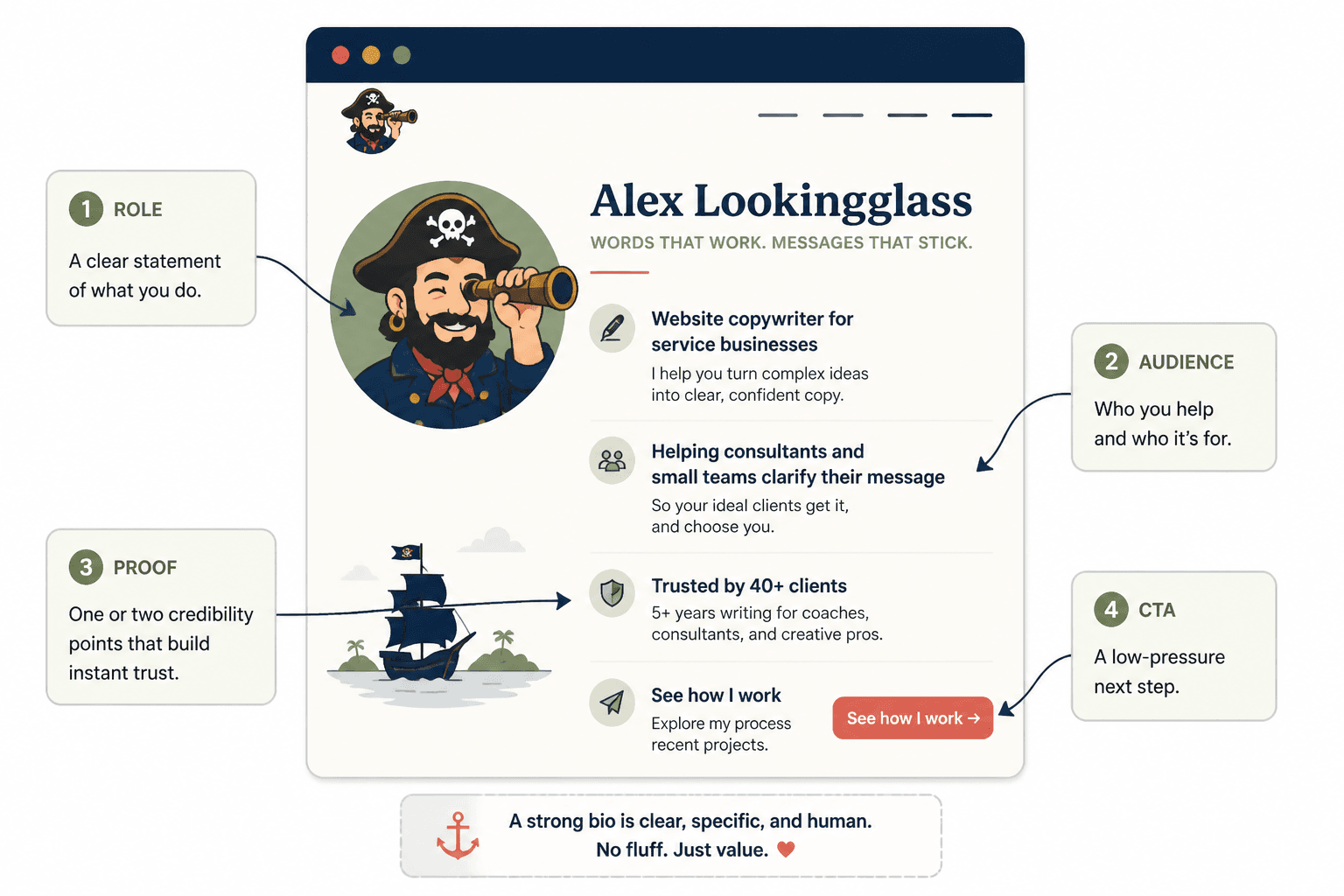
If you are staring at a blank page and overcomplicating this, use this structure:
- Who you are
- Who you help
- What you help them do
- Why people trust you
- What to do next
That structure works on homepages, about pages, team pages, sidebars, profile sections, speaker pages, and personal brand sites. You can make it shorter or longer, but the bones stay the same.
A basic fill-in framework
Try this:
I’m [name], a [role] who helps [specific audience] do [specific result] without [specific frustration or unwanted approach].
I’ve [proof, experience, result, or credibility marker].
My work focuses on [how you think, what you care about, or what makes your approach different].
If you’re looking for [relevant next step], [CTA].
Not glamorous. Very useful.
A filled-in example
I’m Maya, a messaging strategist for coaches and consultants who are good at what they do but tired of sounding like everybody else online.
I help clients turn fuzzy expertise into sharp website copy, stronger offers, and content people actually remember. Over the last five years, I’ve worked with solo businesses, boutique agencies, and subject-matter experts who needed clearer positioning without the usual brand-theater nonsense.
My approach is simple: say something real, make it easier to understand, and stop hiding your best point behind polished fluff.
If you want clearer words that sell without sounding greasy, start here.
That works because it is specific, believable, and written like a person.
How to make your bio sound more human
Human-sounding copy is not about sprinkling in a quirky phrase and calling it voice. It usually comes from better choices at the sentence level.
1. Write like you talk when you are being clear, not casual to the point of chaos
You do not need to sound ultra-formal to sound credible. In fact, a lot of stiff copy reads less trustworthy because it feels manufactured.
Use contractions when they fit. Use plain words. Keep the rhythm natural. If a sentence sounds like something nobody would actually say out loud, it probably needs a rewrite.
Bad:
I am passionate about supporting businesses in achieving sustainable brand differentiation.
Better:
I help businesses stand out without stuffing their copy with empty brand fluff.
2. Cut empty intensifiers
Words like deeply, truly, passionately, aligned, authentic, and transformational are not always bad. They just get used as emotional wallpaper.
If the sentence still works after removing them, remove them.
Weak:
I’m deeply passionate about helping purpose-driven entrepreneurs create authentic brands.
Stronger:
I help service businesses clarify their brand so their site sounds sharper and sells more cleanly.
3. Use specifics where people usually use fog
Specificity is one of the fastest ways to stop sounding robotic. Generic copy sounds machine-made because it could apply to almost anyone.
Replace vague labels with real ones:
- “entrepreneurs” becomes “coaches, consultants, and solo service businesses”
- “grow online” becomes “turn website visitors into inquiries”
- “strategic messaging” becomes “clearer homepage copy, offers, and email capture pages”
- “results-driven” becomes actual results, examples, or proof
4. Let your point of view show a little
A bio does not need to be neutral. A little opinion is often what makes it memorable.
That does not mean becoming loud for sport. It means showing how you think.
For example:
- “I don’t write polished nonsense just to make brands feel expensive.”
- “I’m more interested in clarity than cleverness.”
- “I like websites that sound smart without sounding inflated.”
That kind of line gives the reader a feel for your standards. It also makes you less forgettable.
How to make your bio less salesy without making it weak
This is where a lot of people overcorrect. They cut all persuasion and end up with something flat. You do not need less persuasion. You need cleaner persuasion.
A good bio can absolutely sell. It just does it through clarity, relevance, and proof instead of chest-thumping.
Lead with what you do, not how magical it is
Readers trust concrete work more than abstract promises.
Too salesy:
I create transformational messaging experiences that elevate your brand to its next level.
Better:
I write homepage, about page, and offer copy for experts who want their websites to sound clear and convert better.
Use proof instead of adjectives
If your bio says you are trusted, experienced, strategic, sought-after, results-driven, innovative, or dynamic, congratulations on owning a keyboard. Readers still need evidence.
Use proof like:
- Years in business
- Types of clients
- Relevant outcomes
- Notable projects
- Published work
- Clear process experience
- A concise credibility line
For help with those trust-building lines, it makes sense to pair this with better credibility lines for personal brands.
Make the CTA feel like a next step, not a trap door
A salesy bio often collapses at the end because the CTA suddenly starts yelling.
Not great:
Book your free breakthrough call now and start scaling with confidence.
Better:
If you want your website to sound clearer and pull more weight, you can start with my copy audit.
Or:
If that sounds like your kind of approach, take a look at how I work.
Low pressure often converts better than forced intensity, especially when the reader is still deciding if you are credible or just very online.
A practical rewrite process for website bios
If your current bio is a mess, do not try to “polish” it first. That is how bloated copy survives. Strip it down.
Use this process:
- Highlight the one sentence that most clearly says what you do
- Cut anything vague, repetitive, or self-important
- Add audience specificity
- Add one or two proof points
- Add one line of personality or point of view
- End with a useful next step
Before and after example
Before:
I’m a passionate brand strategist dedicated to helping visionary entrepreneurs unlock the power of their authentic voice and create aligned businesses that thrive. With a unique blend of strategy, creativity, and heart-centered guidance, I empower clients to step into their next level with confidence.
After:
I’m a brand strategist for solo business owners who need clearer messaging, stronger positioning, and a website that does not sound like recycled internet fluff.
I help coaches, consultants, and creatives figure out what to say, how to say it, and how to make their brand easier to trust. My work combines strategy with sharp copy, so the end result is not just prettier words. It is a business people understand faster.
If your brand feels fuzzy, I can help you clean it up.
Same general business. Much better signal.
If you want a more detailed cleanup method, read how to rewrite boring bio and profile copy for websites.
What to include in different types of website bios
Not every bio needs the same length or depth. A homepage intro and a full about-page profile are doing different jobs.
| Bio type | What it should include |
|---|---|
| Homepage short bio | Role, audience, value, one trust marker, CTA |
| About page intro | Clear positioning, approach, personality, proof, next step |
| Sidebar or footer bio | Short role statement, audience fit, one link or CTA |
| Team profile | Role, expertise, relevant credibility, light personality |
| Speaker or press bio | Authority, topic focus, credentials, media-friendly clarity |
If you are writing the opening line specifically, this guide on how to start bio and profile copy for websites without a weak opening will help.
Common lines to stop using
The bigger point is simple: clearer structure and clearer writing make the piece more useful. That is usually what makes the ending land better too.