
Most personal brand credibility lines are trying way too hard.
They puff themselves up with vague authority, stack empty credentials, or use that polished “trust me, I am excellent” tone that somehow makes them less believable. You have probably seen versions of it: “trusted by industry leaders,” “passionate thought leader,” “helping ambitious founders thrive.” Sounds professional. Says almost nothing.
Better website credibility lines for personal brands do a simpler job. They reduce doubt. They make a reader think, “Okay, this person seems legit, relevant, and worth listening to.” That is it. Not a Broadway audition for authority.
If your website bio, homepage, about page, or profile section needs stronger trust signals, this is where to fix it. We’ll cover what a credibility line actually needs to do, what makes one weak, and how to write lines that sound sharp, specific, and human. If you are still shaping your overall positioning, this will also pair well with bio and profile copy for websites.
For the main guide behind this topic, visit the parent guide.
What a credibility line is actually supposed to do
A credibility line is the short piece of copy that supports trust near your name, headline, intro, offer, or call to action. It is not your whole bio. It is not your life story. It is a compact trust cue.
Good credibility lines answer one or more of these questions fast:
- Why should I trust you?
- Why are you relevant to this problem?
- Who have you helped?
- What results or experience back this up?
- Why should I keep reading instead of bouncing?
That means your line does not need to sound impressive in a vacuum. It needs to make sense in context. A consultant helping B2B founders may need a different credibility line than a ghostwriter, coach, designer, or speaker. The point is not to sound generally important. The point is to sound specifically trustworthy to the right person.
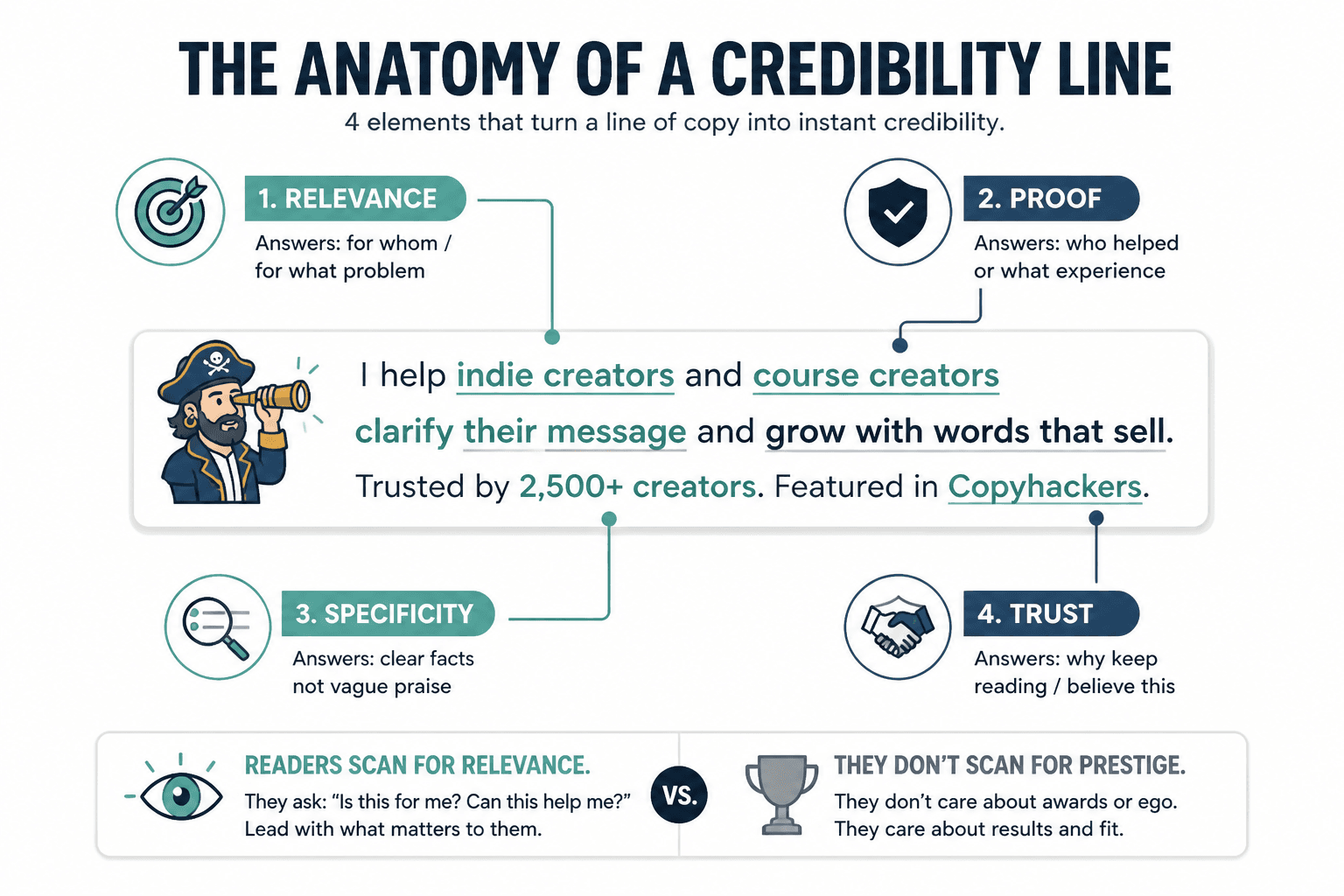
That distinction matters more than people think. A lot of personal brands write credibility lines for an imaginary room full of judges. Actual readers are not grading your prestige. They are scanning for relevance.
Why most website credibility lines fall flat
Usually because they are built from borrowed business clichés instead of real proof.
Here is what weak credibility lines tend to do:
- Use broad praise words instead of specifics
- Try to impress everyone
- Lead with status that does not help the buyer
- Hide behind abstractions like “impact,” “transformation,” or “innovation”
- Sound like they were run through a professionalism filter until all life left the body
Examples of weak lines:
- Trusted by leading brands
- Helping visionaries unlock their next level
- Internationally recognized expert and thought leader
- 10+ years of excellence in strategic growth
- Passionate about helping businesses succeed
None of these are illegal. They are just flimsy. They create the shape of credibility without giving the reader much to hold onto.
And yes, “10+ years” can help. But years alone are not proof. Plenty of people have spent 10 years being average in public.
What strong credibility lines usually include
You do not need every ingredient below in one sentence. In fact, cramming all of them in often makes the line worse. But the best credibility lines usually pull from a few of these:
- Specific role or expertise: what you actually do
- Relevant audience: who you help or have helped
- Proof: recognizable clients, measurable outcomes, volume, experience, or credentials
- Scope: number of projects, years, industries, or people served
- Positioning: what makes your angle different
- Clarity: language normal people can understand in one pass
A good line often works because it quietly answers doubt without sounding defensive.
Weak credibility says, “Please be impressed.” Strong credibility says, “Here is why I am relevant.”
Five credibility line angles that work better than vague self-praise
1. Client or audience proof
If you have worked with people your ideal client would recognize or respect, say so plainly.
- Messaging strategist for SaaS founders, consultants, and lean B2B teams
- Writer behind content used by coaches, operators, and seven-figure service brands
- Trusted by consultants, educators, and personal brands building authority online
This works best when the audience named is relevant, not random. “Featured in 27 publications” may sound nice, but if your buyer cares more about client outcomes than media mentions, that line might not be pulling enough weight.
2. Outcome proof
Results are strong credibility signals when they are believable and tied to the work you do.
- Helped consultants clarify their positioning and turn site traffic into better leads
- Built website copy systems that improved conversion quality, not just click volume
- Writes sales pages and bios that make expertise easier to trust and easier to buy
You do not always need hard percentages here. In some services, especially strategic or messaging work, a sharp explanation of the result is better than a suspiciously neat stat.
3. Volume or scope proof
Sometimes trust comes from seeing that you have done the thing many times.
- Reviewed hundreds of personal brand websites across coaching, consulting, and service businesses
- Worked on 150+ bios, about pages, and homepage rewrites for expert-led brands
- Spent 8 years helping solo businesses explain what they do without sounding generic
This angle is useful when your clients may not know your past brands or employers, but they do care that you are not guessing.
4. Credential proof, used carefully
Credentials can help, but only if they matter to the buyer. Too many personal brands lead with degrees, certifications, or titles that feel disconnected from the actual buying decision.
- Certified executive coach for founders navigating growth, visibility, and leadership pressure
- Former in-house content lead for B2B brands now building authority-led websites
- Ex-agency strategist helping experts simplify their message and sharpen conversion copy
That last one often works better because it translates the credential into relevance. Nobody is buying your résumé. They are buying confidence that you can help.
5. Point-of-view credibility
This one is underrated. Sometimes the strongest credibility line is not just what you have done, but how clearly you see the problem.
- For experts whose websites sound polished but still fail the “why should I care?” test
- Helping personal brands replace vague authority copy with proof people can actually trust
- Clear website messaging for people with real expertise and no interest in sounding like a funnel bro
This works best when your point of view is crisp and earned. Not edgy for sport. Just clear enough that the right people think, “Yes, that is exactly the issue.”
How to write better website credibility lines for personal brands
Here is the practical process.
Step 1: Pick the doubt you need to reduce
Before writing anything, ask: what is the main hesitation a good-fit reader might have here?
- Do they doubt your expertise?
- Do they doubt your relevance to their industry?
- Do they doubt that you have done this before?
- Do they doubt that your work gets real results?
- Do they doubt that you understand their kind of problem?
Your credibility line should address the biggest doubt, not every possible doubt. One clear job beats five sloppy ones.
Step 2: Gather proof before you write
People often try to write credibility copy from thin air. Bad move. Start by listing your actual raw material.
- Years of experience
- Number of clients or projects
- Notable client types
- Past roles or industries
- Specific outcomes
- Published work or media mentions
- Relevant certifications or training
- Known methods or specialties
Then ask which proof a buyer would care about most. Not which proof flatters you most. Different game.
Step 3: Turn proof into a sentence normal people can read
This is where a lot of otherwise smart people drift into copy fog. Keep the line readable. If it sounds like a conference speaker bio, trim it.
Useful structure options:
- [What you do] for [who], backed by [proof]
- [Role] who has helped [audience] achieve [result]
- [Specific expertise] for [specific people] who need [specific outcome]
- [Past experience or scope], now helping [audience] with [problem]
Examples:
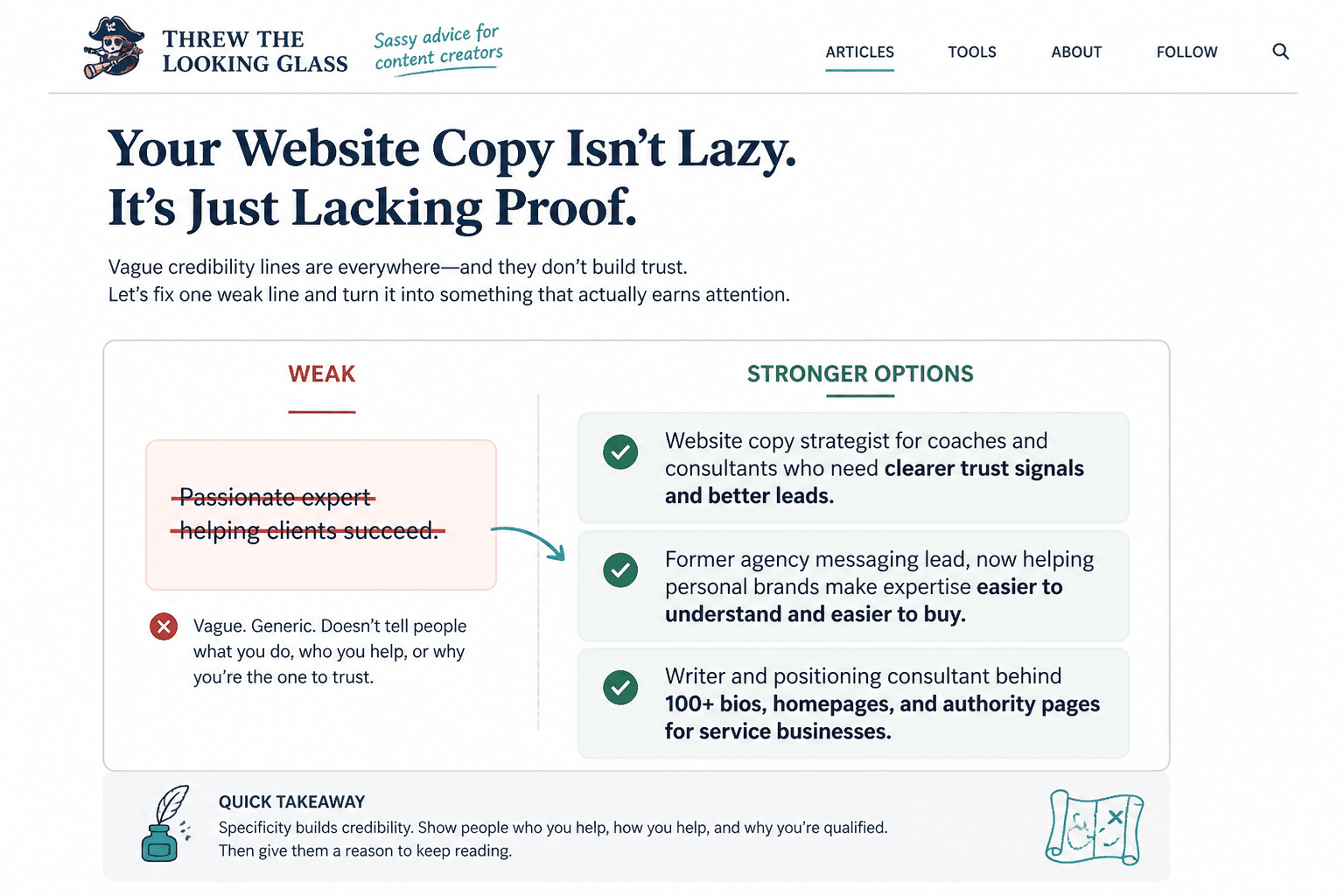
- Website copy strategist for coaches and consultants who need clearer trust signals and better leads
- Former agency messaging lead, now helping personal brands make expertise easier to understand and easier to buy
- Writer and positioning consultant behind 100+ bios, homepages, and authority pages for service businesses
Notice the tone. Clean. Specific. No chest-beating. No performance of excellence.
Step 4: Remove anything that sounds inflated
Now trim the puffery.
Words and phrases to treat with suspicion:
- world-class
- renowned
- visionary
- leading expert
- transformational
- high-impact
- dynamic
- trailblazing
- trusted by many
Can some of these be technically true? Sure. Do they usually make the line stronger? Not really. Strong proof does not need a tuxedo.
Step 5: Match the line to the page
A homepage credibility line should usually be faster and broader. An about page can go a little deeper. A services page may need proof tied directly to outcomes. A sidebar bio may need to be more compressed.
Do not copy the same line everywhere just because it technically fits. Context matters.
Before-and-after rewrites
Here is where the difference gets obvious.
Example 1
- Weak: Helping ambitious entrepreneurs scale with confidence
- Better: Messaging strategist for consultants and founders who need sharper positioning and better-fit leads
The second line gives us an actual role, actual audience, and actual problem.
Example 2
- Weak: Trusted expert featured across multiple platforms
- Better: Writer and advisor helping personal brands turn scattered expertise into clear website copy that builds trust faster
The weak version hints at authority but leaves the reader doing all the interpretation. The better version says what the person does and why it matters.
Example 3
- Weak: Passionate coach empowering leaders worldwide
- Better: Executive coach for founders and senior operators navigating growth, visibility, and harder leadership decisions
Specific beats flattering. Almost every time.
Example 4
- Weak: 15 years of excellence in marketing and branding
- Better: Brand strategist with 15 years in messaging and positioning for expert-led service businesses
Same rough proof. Less fluff. More usable.
A simple formula you can actually use
If you want a repeatable structure, use this:
I help [specific audience] with [specific problem or outcome], backed by [proof, scope, or relevant experience].
Examples:
- I help coaches and consultants turn vague website bios into clearer trust-building copy, backed by 100+ profile and homepage rewrites.
- I help founder-led businesses sharpen their website messaging and credibility, drawing on 8 years in content strategy and conversion copy.
- I help personal brands sound more specific, trusted, and buyable online, without the polished corporate fog.
If that feels too long, shorten it by cutting anything decorative first. Keep the useful bits.
Where to place credibility lines on your website
Better website credibility lines for personal brands work best when they appear where doubt shows up.
- Homepage hero: a short proof cue under your main headline
- About page intro: a stronger trust-setting line near the top
- Service pages: proof tied to the outcome of that service
- Bio block: a compact summary of relevance and credibility
- CTA sections: a final trust nudge before asking for action
You do not need to carpet-bomb the site with credibility claims. A few sharp, relevant lines in the right places work better than repeating “trusted expert” in six slightly different fonts.
The bigger point is simple: clearer structure and clearer writing make the piece more useful. That is usually what makes the ending land better too.