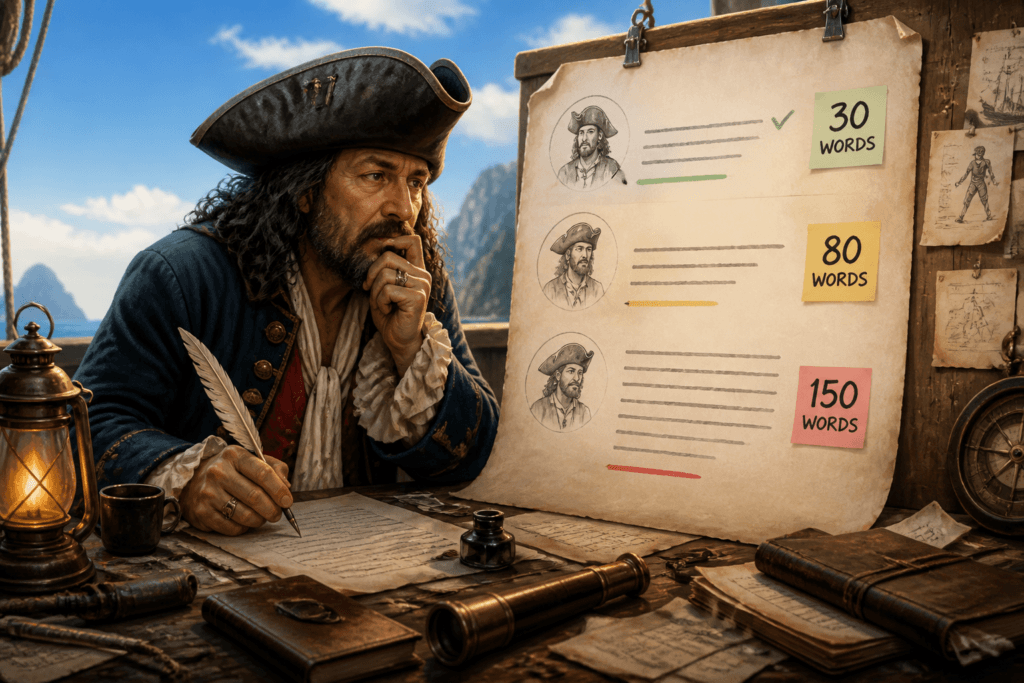
Most website bio and profile copy is not too short or too long. It is just the wrong length for the job.
That is the real answer to how long website bio and profile copy should be in 2026. People keep hunting for a magic word count, as if 87 words means “credible” and 214 words means “trustworthy but strategic.” It does not work like that. A bio is not a school essay. It is a conversion asset wearing a slightly more personal outfit.
If your bio is too short, people do not know who you help, what you actually do, or why they should trust you. If it is too long, they start skimming, miss the point, and quietly leave. Both are common. Neither is impressive.
Here’s the useful version: your website bio and profile copy should be long enough to create clarity, trust, and a next step, but short enough that a busy stranger can still get the point fast. In 2026, that usually means writing in layers, not dumping your life story into one beige slab of text.
This guide will help you choose the right length based on page type, audience intent, and what the bio actually needs to do. We’ll also cover practical ranges, common mistakes, and how to tighten a bio that currently sounds like it was assembled by a committee with trust issues.
For the main guide behind this topic, visit the parent guide.
How long should website bio and profile copy be in 2026?
For most websites, the sweet spot looks like this:
- Short homepage bio section: 40 to 90 words
- About page intro: 80 to 150 words
- Full founder or personal brand bio: 150 to 300 words
- Expanded credibility section or story-based profile: 300 to 600 words
- Speaker, press, or formal professional bio version: 75 to 200 words depending on use
Those are guidelines, not laws carved into a copywriting stone tablet.
The better question is this: what does the reader need to know before they take the next step? If your website bio answers that quickly, the length is probably fine. If it circles your childhood love of problem-solving before saying what you actually sell, you have a length problem and a clarity problem.
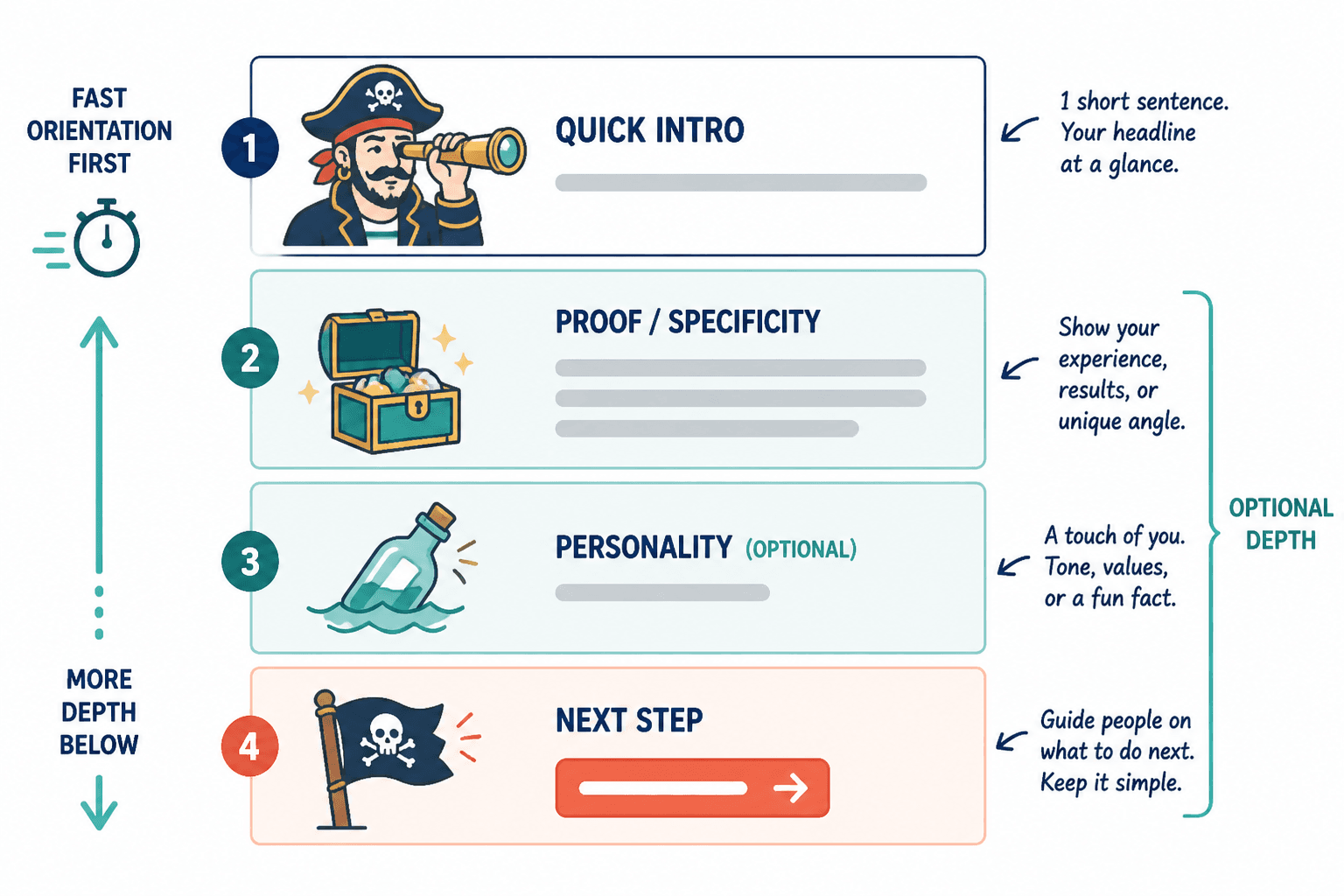
In 2026, good bio copy tends to be tighter up top and richer lower down. People want fast orientation first, then optional depth. So the best bios often work like this:
- A crisp opening that says who you help and what you do
- A few lines of proof, specificity, or positioning
- A little personality, if it supports trust rather than performance art
- A clear next step
That layered structure matters more than raw word count. If you want broader guidance on the role this copy plays across a site, the hub on bio and profile copy for websites is a useful next stop.
The real factors that decide bio length
If you are trying to figure out how long your bio should be, start here instead of staring at a word counter like it owes you insight.
1. Page type matters
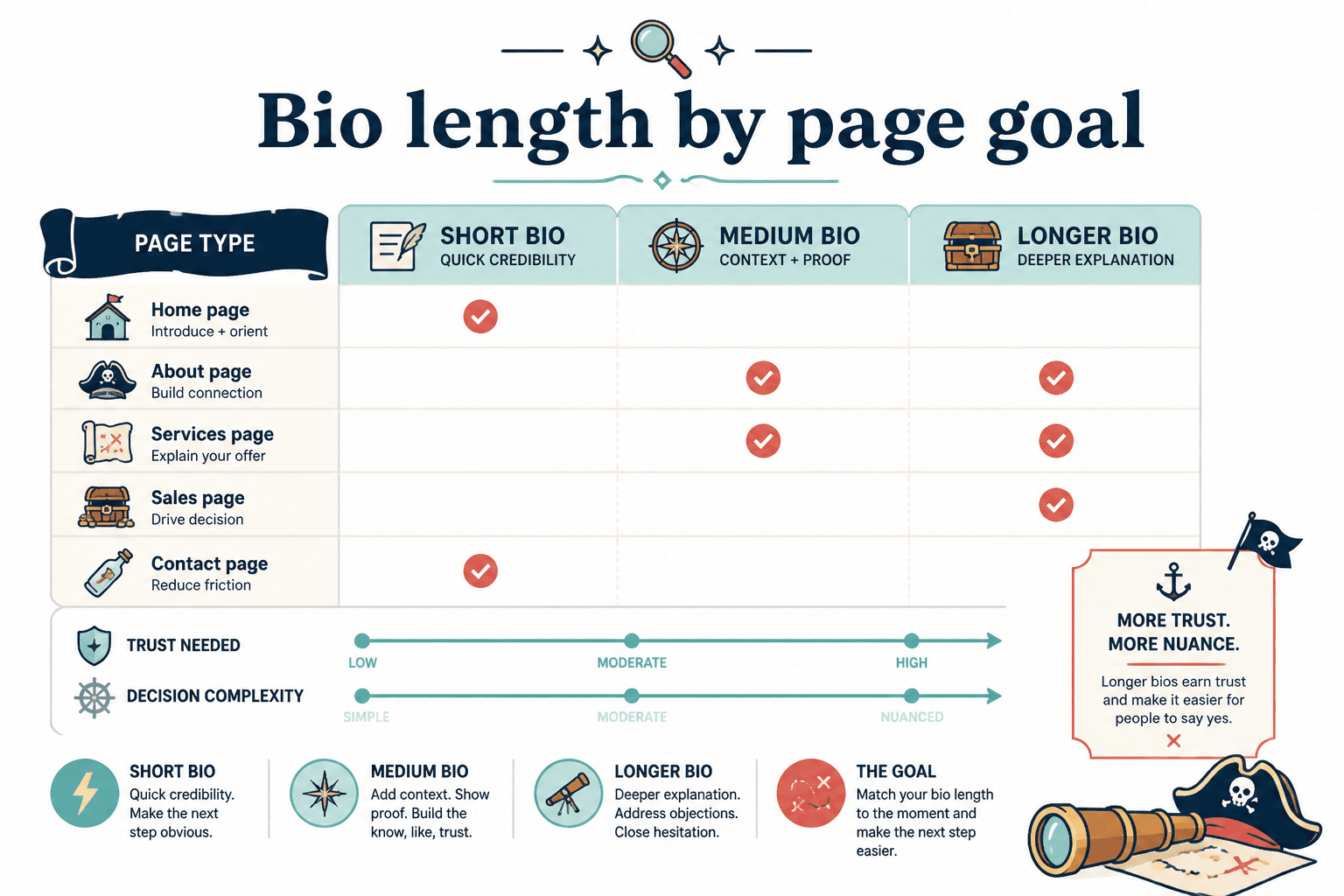
A homepage bio section has a different job from an About page. The homepage needs to orient and move. The About page can slow down a bit and build trust. A speaker page, media kit, or consultant profile may need a more formal version with stronger credentials up front.
Trying to use one identical bio everywhere is usually where things go sideways. A website is not a social platform profile. It gives you more room, but that does not mean you should fill every inch like rent is due.
2. Audience awareness changes the amount of explanation needed
If your audience already understands the category you work in, you can usually say less. If your offer is newer, more nuanced, or easy to misunderstand, you may need a bit more space to explain what you do without sounding vague.
A fractional CMO serving SaaS founders probably needs less educational setup than a consultant with a hybrid offer nobody can identify in one line. The more unfamiliar the positioning, the more carefully you need to explain it. Carefully, though. Not endlessly.
3. Proof reduces the need for extra words
One sharp credibility line can replace three paragraphs of self-description.
For example:
- “I help consultants simplify their messaging” is fine.
- “I help consultants simplify their messaging so prospects understand the value in under 30 seconds” is better.
- “I help consultants simplify their messaging so prospects understand the value in under 30 seconds, with positioning work used by solo firms, niche agencies, and executive advisors” is doing more work without becoming bloated.
Specificity shortens the distance to trust. Generic copy makes you compensate with length, and usually badly.
4. The goal of the page changes the ideal length
If the goal is a quick click to book a call, the bio should be tighter. If the goal is authority and reassurance before a high-trust sale, a longer profile can work well. If the goal is media credibility or speaking inquiries, the copy may need more polished credentials and fewer conversational asides.
Length should follow conversion logic, not ego. Some bios read like the writer wanted to prove they have depth. That is not the same as helping a reader make a decision.
Practical bio length ranges by website section
| Website section | Recommended length | Main goal |
|---|---|---|
| Homepage intro bio | 40–90 words | Quick clarity and positioning |
| Homepage “about” section | 75–150 words | Add trust and personality |
| About page opening | 80–150 words | Orient the reader fast |
| Main About page bio | 150–300 words | Build trust, explain value, show fit |
| Expanded personal story section | 300–600 words | Add depth when it supports conversion |
| Sidebar/profile snippet | 25–60 words | Fast identification |
| Speaker or press bio | 75–200 words | Credentials and authority |
Notice what is missing here: a single magic number. Because there is not one.
A lean 70-word homepage bio can outperform a 240-word one if it is clearer, sharper, and attached to the right CTA. Meanwhile, a thoughtful 350-word About section can absolutely work if the service is high trust, the buyer needs reassurance, and the writing earns the space.
What strong website bios do before they earn more length
Before your bio gets longer, it needs to get better.
The strongest website bio and profile copy usually answers four questions early:
- Who are you for?
- What do you help them do?
- Why should they trust you?
- What should they do next?
If your first 2 to 4 lines do not cover most of that, adding more words tends to make things worse. You do not need a longer bio. You need a clearer opening. If that is the part you keep fumbling, read how to start bio and profile copy for websites without a weak opening.
And yes, personality matters. But it should support relevance, not replace it. A quirky detail can help someone feel there is a human here. It should not be doing all the lifting while your actual positioning hides backstage.
A good bio does not try to say everything. It says the right things in the right order.
When short bio and profile copy works best
Short bios work beautifully when the reader mainly needs orientation and a reason to continue.
A shorter bio is often the better choice when:
- Your offer is simple and easy to grasp
- Your audience already knows the kind of service you provide
- The page’s main goal is a quick click, inquiry, or booking
- You already show proof elsewhere on the page through testimonials, results, or case studies
- You are writing for a homepage, footer, sidebar, or contact page snippet
Short does not mean thin. It means compressed and intentional. One clean paragraph can do a lot if it is built properly.
For a deeper look at when brevity wins, check out when short bio and profile copy for websites beat long ones.
Example of a strong short bio
“I help coaches and consultants turn vague website copy into clear messaging that earns more inquiries, better-fit clients, and fewer awkward ‘so what do you actually do?’ conversations.”
That is under 30 words, and it already does more than many 200-word bios.
When longer bio and profile copy earns its keep
Longer copy works when the extra detail helps someone trust you enough to move forward.
That often applies when:
- You sell high-trust, high-ticket, or nuanced services
- Your background or method is part of the buying decision
- Your audience is skeptical and needs more proof
- Your positioning is differentiated enough that it needs explanation
- Your About page is doing serious conversion work, not just sitting there looking polished
This is where a second or third paragraph can help. You can explain your approach, show a little philosophy, and add credibility without turning the page into a memoir no one asked for.
The trick is that every added paragraph must answer one question: does this make the next step easier? If not, cut it.
The mistakes that make bios feel too long even when they are not
Sometimes the issue is not length. It is drag.
A 140-word bio can feel endless if it is stuffed with vague claims, throat-clearing, and self-important mush. Meanwhile, a 300-word bio can feel easy to read if it is specific, structured, and useful.
Here is what usually creates that heavy, overlong feeling:
- Weak openings: “I’m passionate about helping…” is rarely doing you any favors.
- Too many roles: strategist, speaker, mentor, creator, advisor, founder, coffee enthusiast. Pick the relevant ones.
- Abstract language: “empowering transformation through aligned messaging” means almost nothing to a busy reader.
- Timeline clutter: not every career pivot deserves a paragraph.
- No visual structure: one dense block can make even decent copy feel punishing.
- No clear next step: if the bio does not direct momentum, people drift.
This is why writing by word count alone is such a bad idea. A shorter bad bio is still bad. It is just over faster.
A simple structure that keeps bio length under control
If you want a website bio that is clear, flexible, and easy to trim, use this 4-part structure:
- Positioning line: who you help and what you help them do
- Proof line: experience, results, clients, credibility markers, or method
- Personality line: a human detail or point of view, if it supports fit
- CTA line: what to do next
That structure works at 60 words, 120 words, or 250 words. The difference is just how much depth you add under each part.
Example at about 70 words
“I help consultants and service businesses sharpen their website messaging so visitors understand the offer quickly and trust it faster. My work focuses on positioning, conversion copy, and bios that sound like real humans instead of polished fog. If your website sounds nice but sells softly, start here.”
Example at about 180 words
“I help consultants, coaches, and expert-led businesses turn unclear website messaging into copy that earns trust faster and converts better. That usually means fixing the parts most sites keep fumbling: positioning, homepage clarity, About page strategy, and bio copy that says something useful before the reader loses patience.
My approach is practical and conversion-focused. Not louder. Not more hyped. Just clearer, sharper, and more aligned with what the buyer actually needs to see before taking the next step. The goal is not to sound impressive to everyone. It is to sound right to the people most likely to hire you.
If your website currently sounds polished but forgettable, there is usually a fixable reason. Start with your bio, your positioning, and the first few lines people read.”
Same core structure. Different depth. Still readable.
How to know if your current bio is too short or too long
Use this quick check.
Your bio is probably too short if:
- A new visitor cannot tell what you actually do
- The copy sounds clever but not clear
- There is no proof or credibility
- It creates intrigue but not trust
- People still ask basic questions after reading it
Your bio is probably too long if:
- The first useful point appears halfway through
- You are listing your whole professional identity crisis
- The page repeats things already shown elsewhere
- The story matters more to you than to the buyer
- The CTA is buried or absent
If you want to pressure-test your approach against more use cases, the piece on bio and profile copy for websites examples for coaches, consultants, and personal brands should help.
What changed in 2026?
The core principles did not suddenly mutate. Clear still beats clever. Specific still beats vague. Trust still beats noise.
But a few shifts do make bio length more important now:
- People are faster at spotting generic copy. Which means padded bios get punished harder.
- AI-generated sameness is everywhere. So specificity and voice matter more than ever.
- Scannability keeps winning. People expect to get the point quickly, even on About pages.
- Trust signals matter earlier. Buyers want proof sooner, not a dramatic reveal in paragraph six.
That means your website bio in 2026 should usually be tighter at the top, more specific throughout, and more intentional about where detail appears. Not necessarily shorter overall. Just better arranged for modern reading behavior.
There is also a broader context here. Bio copy lives inside a larger system of messaging, page structure, and conversion flow. If you are working on that bigger picture, explore website conversion copy and core copy guidance alongside your bio updates.
Do not stop at the bio if you want better results
The bigger point is simple: clearer structure and clearer writing make the piece more useful. That is usually what makes the ending land better too.
Bio and profile copy work best when they make the reader understand who you help and why it matters quickly. Clearer positioning usually beats extra polish.