
Most creator CTAs are not failing because they are too short.
They are failing because they are vague, needy, mistimed, or written like someone copied the last surviving webinar funnel from 2018 and slapped it under a decent post.
A weak call to action does not just lower clicks. It makes the whole piece feel less credible. You can write a smart post, a useful email, a sharp landing page, or a strong thread, then ruin the ending with “DM me if this resonates” and wonder why the response feels limp.
This CTA Guide for Creators Who Want Better Results will help you write calls to action that actually fit the content, the audience, and the level of trust you have earned so far. Not louder CTAs. Better ones. The kind that feel clear instead of pushy and practical instead of weirdly performative.
If you are a creator, coach, consultant, freelancer, or solo business owner, your CTA has one job: move the right person to the next sensible step. That step might be a click, a reply, a booking, a signup, a download, or a sale. But it should not feel random.
For the main guide behind this topic, visit the parent guide.
What a CTA is actually supposed to do
A CTA is not just the sentence at the bottom that says “buy now” or “comment below.” It is the instruction that turns attention into movement.
Good CTA writing does three things:
- It makes the next step obvious
- It matches the reader’s current level of trust
- It gives them a reason to act now, or at least soon
That middle point matters more than people think. If someone just discovered you through one post, asking them to “book a strategy call” can be a bit much. If they have read your article, checked your profile, and already understand what you do, then a direct CTA can work beautifully.
Too many creators write CTAs as if every reader is standing at the exact same stage. They are not. Some need a low-friction next step. Some need proof. Some are ready to act. Your CTA should respect that.
Why most creator CTAs underperform
Usually, the problem is not effort. It is mismatch.
Here are the most common ways CTAs go sideways:
- They are too vague: “Reach out if you want to learn more” says almost nothing.
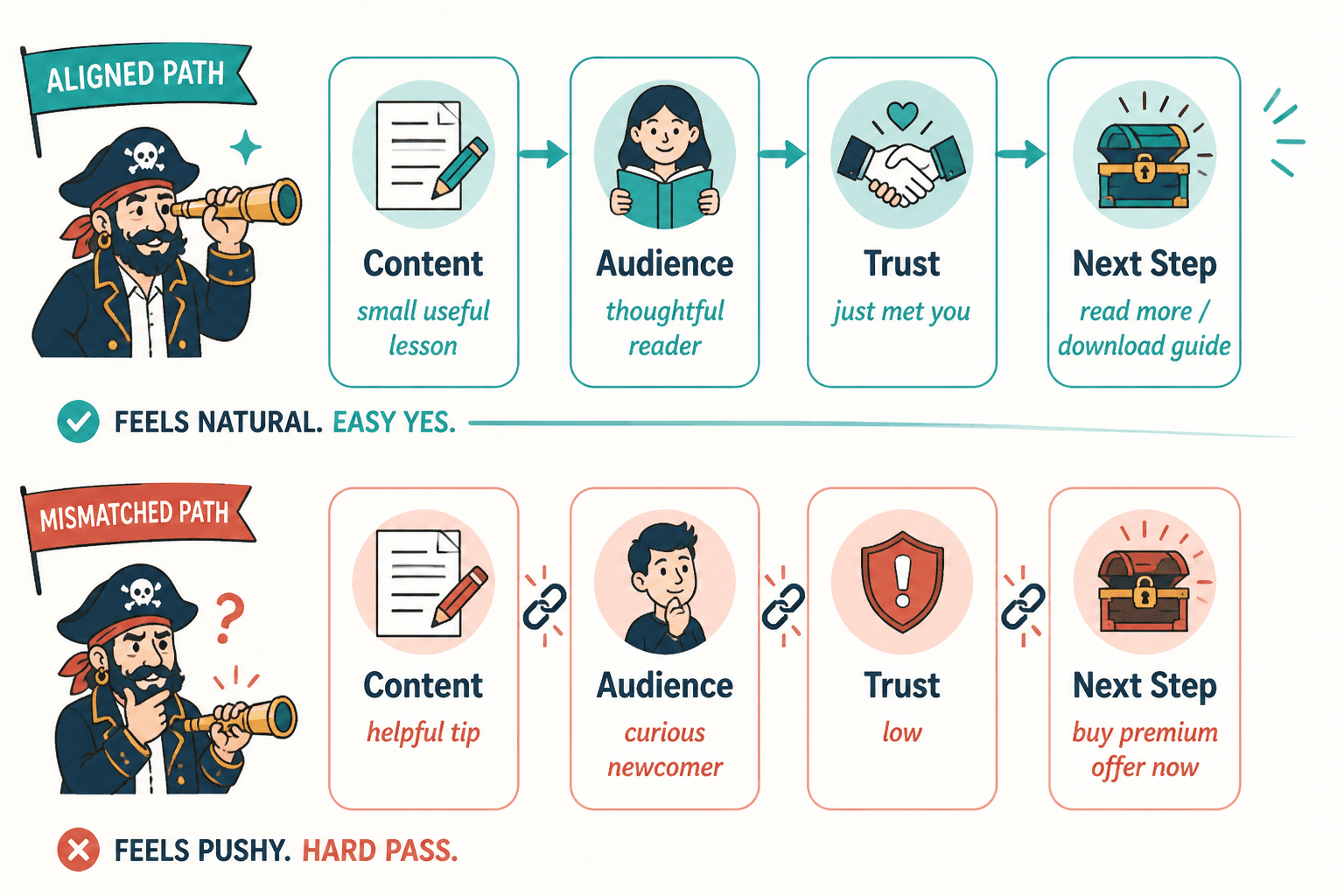
- They ask too much too soon: cold readers usually are not ready for your premium offer five seconds after meeting you.
- They do not match the content: a post about one small lesson ends with a huge pitch for a broad service.
- They sound fake: “I’d be absolutely honored to support your transformational journey” is a lot.
- They create friction: the next step is unclear, complicated, or awkward.
- They are trying too hard to be soft: in trying not to sound salesy, they become invisible.
And then there is the classic creator mistake: writing content for one audience and the CTA for another. You attract thoughtful readers with useful ideas, then end with hypey funnel language. It feels like two different people wrote the piece, and one of them just discovered urgency tactics.
The 4 parts of a strong CTA
You do not need a 19-point persuasion formula. Most strong CTAs are built from four simple parts.
1. The action
Tell the reader what to do.
Examples:
- Download the guide
- Reply with “audit”
- Book a call
- Read the full article
- Browse the templates
- Join the list
Simple wins here. If the reader has to decode the instruction, the CTA is already working too hard.
2. The value
Why should they do it?
Not in a grand philosophical sense. In a practical, immediate sense.
- Get 12 better CTA examples
- See how to rewrite your landing page CTA
- Find the best next step for your funnel
- Steal a cleaner template instead of guessing
3. The fit
Who is it for?
This part is optional in very simple CTAs, but incredibly useful when you want better-quality clicks.
- If you are trying to turn posts into leads, start here
- If your audience is small but relevant, this will help
- If your homepage CTA feels generic, fix that first
4. The friction remover
What makes the step feel easier, safer, or clearer?
- No sales call required
- Takes 5 minutes
- You can use the template as-is
- Short and practical
- Start with the free version
That is often the missing piece. People know what to do, but they still hesitate. A small friction remover can help without becoming manipulative.
A strong CTA does not shove. It reduces uncertainty.
Match the CTA to the stage of trust
This is where most better results actually come from.
Not from making your button orange. Not from saying “now” three more times. From matching the ask to the relationship.
| Trust level | What the reader is likely thinking | Better CTA type |
|---|---|---|
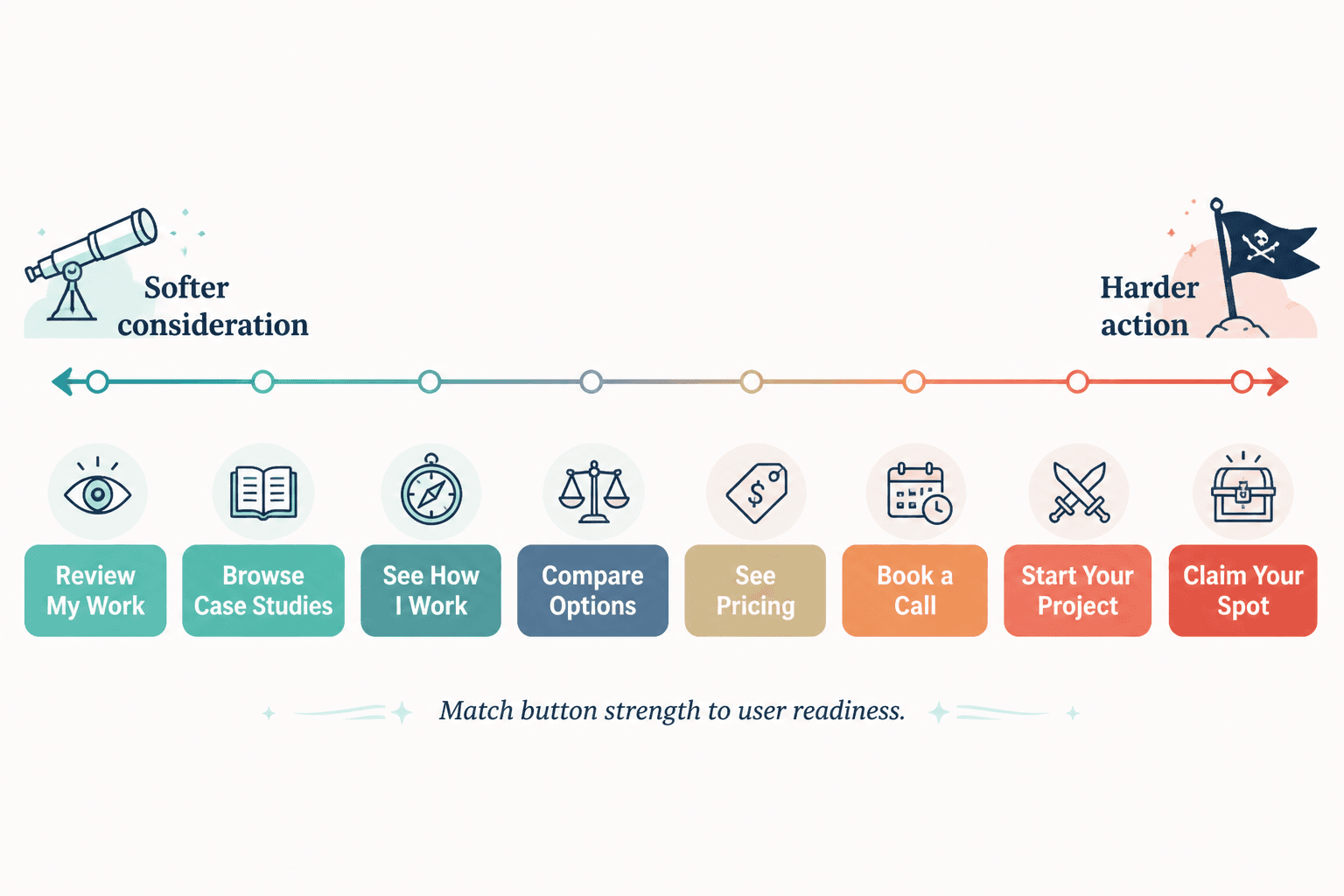
| Low | Who are you and is this useful? | Read more, follow, get the free guide, reply with a keyword |
| Medium | I think you know your stuff | Join the list, view examples, use the template, watch the demo |
| High | I trust you enough to consider buying | Book a call, apply, start now, buy the offer |
When creators complain that CTAs “do not work,” they are often asking high-trust actions from low-trust audiences.
If your audience is still getting to know you, use calls to action that build momentum first. That is one reason CTA writing for creators with small audiences often works better when it focuses on replies, visits, and low-pressure next steps instead of immediate conversion theatrics.
Different CTA goals need different wording
“Call to action” gets treated like one thing. It is not. You might be trying to get reach, engagement, email signups, leads, or sales. Those are different goals, so they need different language.
Engagement CTAs
These work when you want conversation, signal, or feedback.
Better examples:
- What part of this are people still getting wrong?
- Reply with the line you are stuck on and I will give you a sharper version.
- If this is the part you struggle with too, say “same” and I will write a follow-up.
These are better than limp prompts like “Thoughts?” which somehow manages to sound lazy and demanding at the same time.
Traffic CTAs
Use these when you want readers to click through to something deeper.
- Read the full guide if you want the exact structure.
- I broke the whole process down here, with examples.
- If your CTA still sounds like corporate wallpaper, start with this breakdown.
You can also point readers to supporting content, like this broader resource on CTA writing, if they need the bigger picture before applying specific tactics.
Lead generation CTAs
These should make the exchange feel worth it.
- Grab the checklist if you want 20 CTA ideas you can adapt this week.
- Download the template pack if writing endings is slowing you down.
- Get the swipe file if you want examples that do not sound like AI oatmeal.
Sales CTAs
These can be direct. They just need earned context.
- If you want help fixing your site copy, book a consult.
- Need this done properly, not eventually? Start here.
- If your funnel is getting traffic but not action, this is the service for that.
Notice these are specific. They name the problem, the offer, or the fit. They are not hiding behind mushy language.
How to write a CTA that sounds like a person
A lot of CTAs fail on tone before strategy even gets a chance.
If your CTA sounds robotic, overpolished, or suspiciously “brand voice approved,” people feel the distance. You are asking for action at the exact moment trust matters most. So the wording needs to feel human.
Here is a simple way to get there:
- Say the action plainly
- Add the reason it is worth doing
- Remove any phrase you would never say out loud
- Trim the fluff
Example:
Too polished: “If this content aligned with your current growth objectives, I invite you to explore the resource below.”
Better: “If you want the full template, grab it here.”
Too vague: “Feel free to reach out.”
Better: “Reply with ‘CTA’ and I’ll send the framework.”
Too salesy-soft: “When you’re ready to step into the next level of your brand journey, I’d love to support you.”
Better: “If you want help tightening your website copy, book a session.”
Direct does not mean cold. It means clear.
If you want more practical breakdowns, how to write better CTA writing is a useful next read. Slightly clunky slug, useful article. We move.
CTA formulas that actually hold up
You do not need to write every CTA from scratch. A few durable formulas will carry most of the load.
Formula 1: Action + clear benefit
Structure: Do this to get that.
- Download the checklist to improve your homepage CTA fast.
- Read the guide to see 15 examples that do not sound recycled.
- Join the email list to get weekly content prompts worth using.
Formula 2: Problem + next step
Structure: If you have this problem, do this.
- If your CTA gets clicks but no follow-through, fix the offer-page match first.
- If your posts end weak, use this template pack.
- If your audience is reading but not moving, start with a lower-friction ask.
Formula 3: Fit filter + invitation
Structure: If you are this kind of person, here is the next step.
- If you are a consultant trying to turn articles into leads, this guide will help.
- If you sell high-trust services, book a consult instead of forcing a cold sale.
- If you are still testing your positioning, start with the free resource first.
Formula 4: Curiosity + payoff
Structure: Want to see how? Go here.
- Want the exact before-and-after rewrites? They are here.
- Want better CTA ideas without sounding pushy? Start with these examples.
- Want the simple version? Use this stripped-down template.
For more swipeable options, best CTA writing ideas and examples for creators is worth bookmarking.
Before-and-after CTA rewrites
Sometimes the fastest way to improve your CTA writing is to see what changed.
Example 1: Generic website CTA
Before: Learn More
After: See How the Process Works
Why it is better: “Learn More” says nothing. The rewrite gives the click a purpose.
Example 2: Weak post CTA
Before: Let me know your thoughts in the comments.
After: Which part of your CTA is harder right now: the wording or the offer behind it?
Why it is better: specific questions get better responses than broad social shrugging.
Example 3: Soft, vague service CTA
Before: If this resonated and you want support, feel free to contact me.
After: If your website gets traffic but the copy is not converting, book a copy consult here.
Why it is better: it names the problem and the next step. Much less fog.
Example 4: Generic lead magnet CTA
Before: Download my free resource.
After: Download the CTA swipe file if you want 25 stronger ways to end posts, emails, and pages.
Why it is better: readers know what they are getting and why it matters.
Where creators should place CTAs
One CTA at the bottom is not always enough. But scattering asks everywhere like confetti is not the answer either.
Good CTA placement depends on the format.
For articles and blog posts
- Use a light CTA early if the fit is strong
- Add a contextual CTA mid-article when the reader has enough value to care
- Use the clearest CTA at the end
This works because readers are not all equally committed. Some skim. Some read deeply. Give both types a sensible path.
For social posts
- Keep the main CTA near the end
- If the post is short, the CTA can be the final line
- If the post is longer, build naturally to it instead of dropping it in from nowhere
For landing pages
- Repeat the main CTA in multiple places
- Keep the wording consistent unless the section context clearly changes
- Support each CTA with nearby proof, clarity, or objection handling
In other words, do not make people scroll back up because you hid the button like it was shy.
How to choose between soft CTAs and hard CTAs
You need both.
Soft CTAs are lower-commitment asks. Hard CTAs are direct conversion asks. The mistake is treating one as morally better than the other.
| Type | Best for | Examples |
|---|---|---|
| Soft CTA | Cold audiences, early trust, content engagement | Read this, reply with a word, get the guide, browse examples |
| Hard CTA | Warm audiences, clear offers, buying moments | Book a call, buy now, apply here, start today |
If you want a more detailed breakdown of when to use each one, simple CTA writing hard CTAs templates for busy creators should help, even if that slug reads like it lost a fight with formatting.
As a rule:
- Use soft CTAs to build momentum
- Use hard CTAs when trust and offer clarity are already there
- Do not use fake-soft CTAs that secretly feel like hard pitches
Small tweaks that improve CTA performance fast
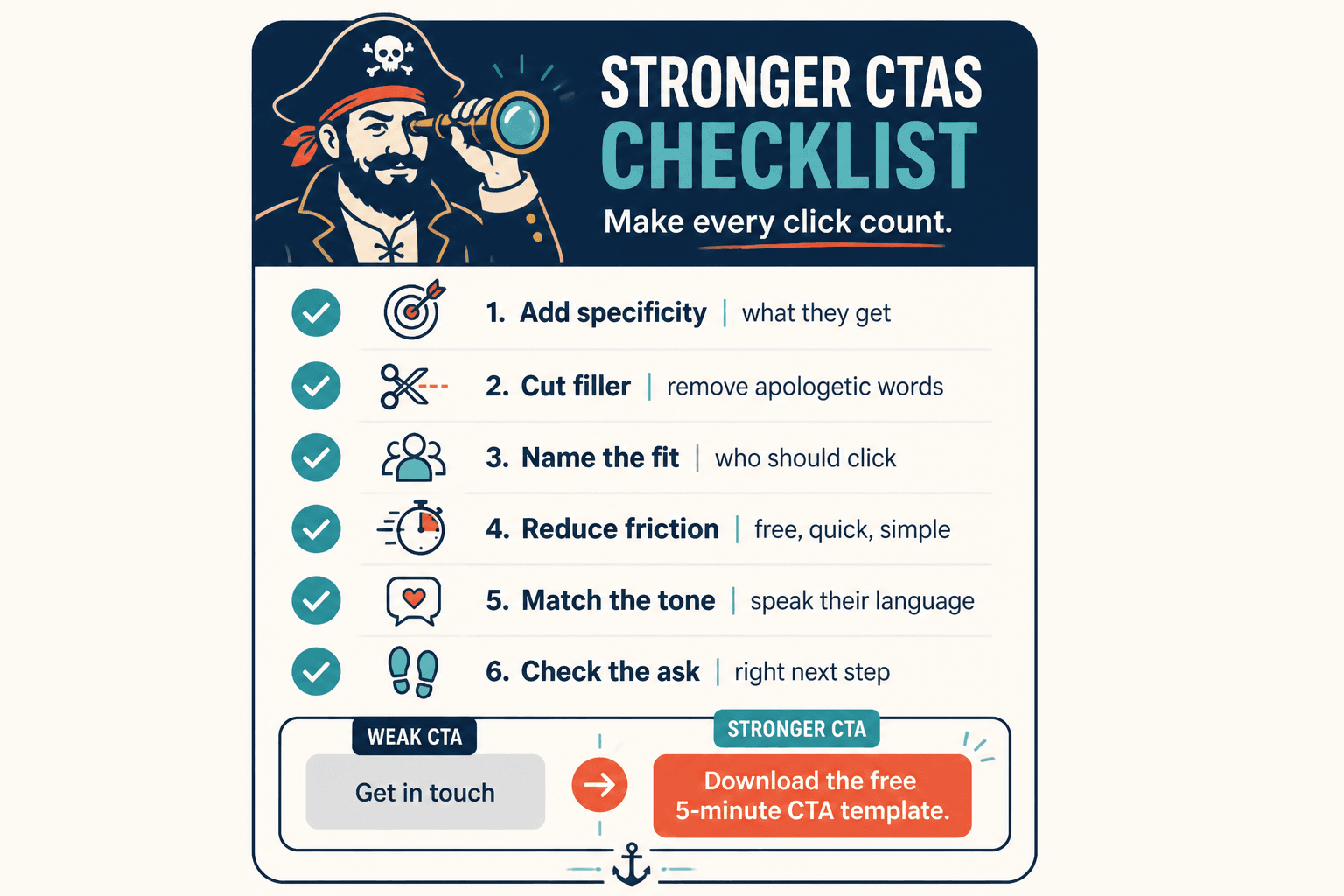
You do not always need a full rewrite. Sometimes a few sharp edits make a mediocre CTA much stronger.
- Add specificity: say what they get, not just what they do.
- Cut filler: remove “feel free,” “if you’d like,” and other apologetic wallpaper.
- Name the fit: call out who should click.
- Reduce friction: mention if it is free, quick, simple, or low-pressure.
- Match the tone: if the content is direct, the CTA should not suddenly sound ceremonial.
- Check the ask: is this the right next step for someone at this point?
A lot of creators think CTA writing is about persuasion tricks. Often it is just editing out the mush.
Common CTA mistakes worth fixing immediately
- Using the same CTA everywhere: your article, post, bio, and landing page do not all need the identical ask.
- Giving too many options: confused readers usually choose none.
- Writing for everyone: broad CTAs attract broad, weak action.
- Overusing urgency: if everything is urgent, nothing is.
- Skipping the why: people need a reason, not just an instruction.
- Hiding behind softness: “just wanted to share” is fine until you actually need movement.
And yes, “DM me if this resonates” deserves one final side-eye. It is not always wrong. It is just wildly overused, usually underspecified, and often deployed by people who have not made the outcome clear enough to resonate with anything except mild confusion.
FAQ
How long should a CTA be?
Usually short. One to two lines is enough if the offer and benefit are clear.
Should every piece of content have a CTA?
Mostly yes, but not every CTA needs to sell. Some should invite a click, reply, or next read.
Are questions good CTAs?
Yes, if they are specific. Weak questions get weak responses.
What makes a CTA feel pushy?
Usually bad timing, too much pressure, or an ask that does not match the trust level.
Can soft CTAs still drive sales?
Absolutely. They often work better for creators because they build movement before the bigger ask.
Write CTAs like next steps, not closing speeches
The best CTA writing does not feel like a dramatic finale. It feels like the obvious next move.
That is the standard to aim for. Not louder. Not pushier. Not more “optimized” in the fake-internet-marketer sense. Just clearer, better matched, and more useful to the person reading.
If your CTA Guide for Creators Who Want Better Results comes down to one thing, it is this: earn the click, then ask cleanly. Say what the next step is. Say why it matters. Make it easy to take.
And if your current CTA sounds like it was written by a networking event in a blazer, rewrite it until it sounds like you again.
If you want to keep going, the broader conversion copy section and the related pieces linked throughout this guide can help you tighten the rest of the path, not just the last line.