
Most people do not have a content volume problem. They have a content reuse problem.
They record a good podcast episode, write a decent email, post one useful LinkedIn thought, and then move on like that idea has fully done its job. It has not. One solid idea can usually become ten or twenty strong assets if you edit it properly and shift it into the right formats.
That is where AI can help. Not by becoming your personality in a blazer. Not by turning your voice into smooth corporate paste. But by helping you extract, reshape, tighten, reframe, and repurpose what you already know into content people will actually read.
This guide gives you practical Creator AI Editing and Repurposing Examples for Coaches, Consultants, and Personal Brands so you can turn one source piece into sharper posts, emails, threads, articles, and lead assets without sounding like a machine that recently discovered empathy.
If you want the broader workflow behind this, start with this guide for creators who want better results. If you are still figuring out the category itself, the main AI writing tools and workflows hub and the creator AI editing and repurposing pillar page will help.
Want the broader roadmap? Start with the parent guide.
What AI is actually good at in editing and repurposing
AI is useful when the work is structural, repetitive, or variation-heavy.
It is good at pulling out key points from transcripts, rewriting a paragraph for a different platform, generating multiple hook angles, compressing long-form ideas into short-form formats, and helping you spot what is vague, bloated, or oddly stiff. It can also help organize rough notes into usable drafts faster than most humans can.
What it cannot do well on its own is make you sound distinct, know which client objection matters most, or create trust where none exists. It also cannot rescue a boring idea with “better wording.” A dull point rewritten five ways is still a dull point. Just now with more adjectives.
The sweet spot is simple: you bring the judgment, positioning, examples, and standards. AI helps with speed, range, and cleanup.
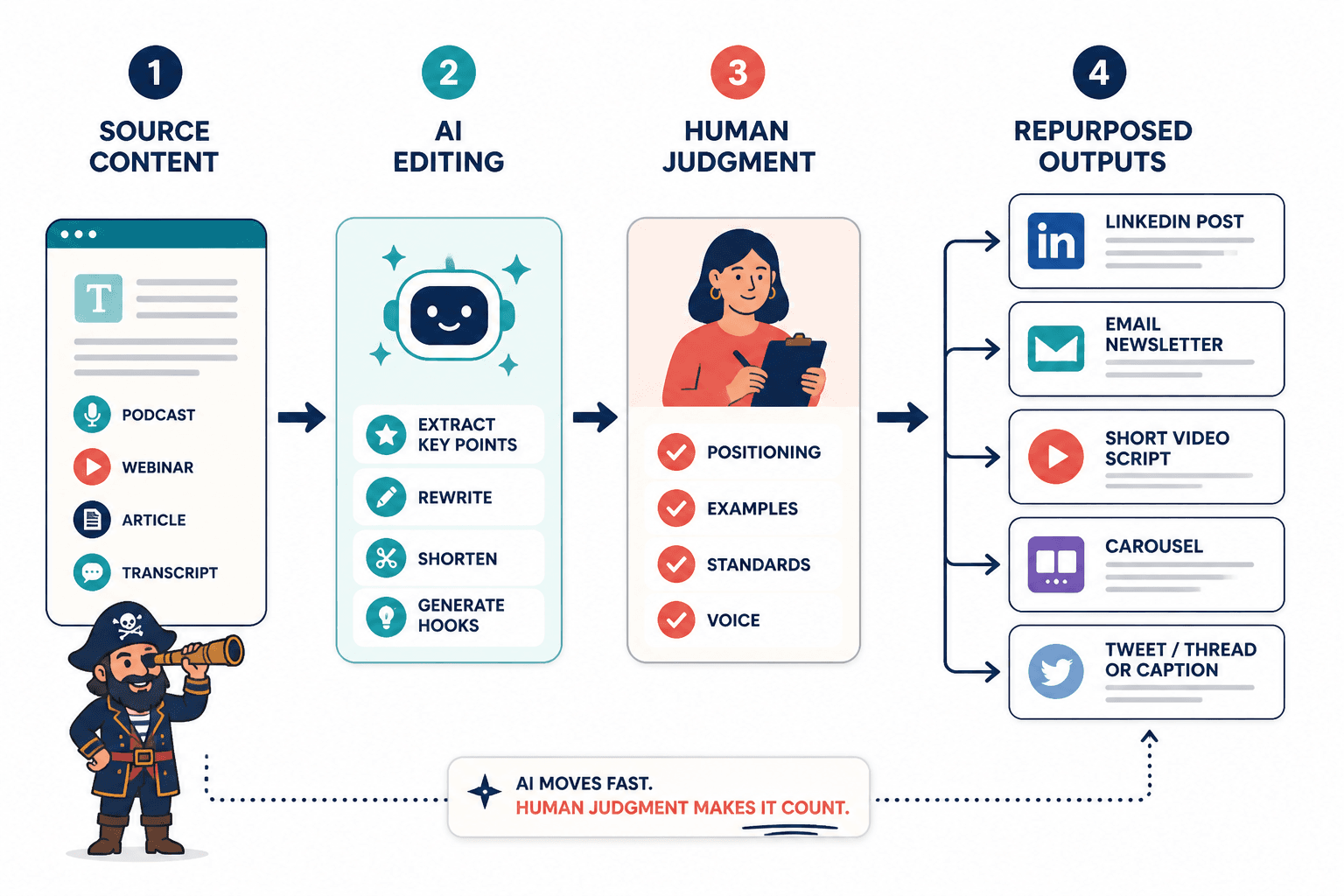
A practical repurposing workflow before the examples
Before you start asking AI for twenty content pieces from one source, get the process right. Otherwise you just create twenty weaker versions of the same half-formed thought.
Step 1: Start with a source worth repurposing
Good source material usually has one or more of these:
- A clear opinion
- A useful framework
- A client pattern or mistake
- A process breakdown
- A case study
- A story with a practical takeaway
If the original content says nothing specific, repurposing will not save it. It will just spread the problem around faster.
Step 2: Extract the strongest angles
One podcast, workshop, or article often contains several sub-ideas. Do not repurpose the whole thing as one big blob. Pull out the strongest pieces.
Ask AI to identify:
- The sharpest opinion
- The most quotable line
- The most practical tip
- The strongest objection you addressed
- The best story or example
- The clearest CTA opportunity
Step 3: Match each angle to the right format
Not every idea wants to become a carousel, a thread, a LinkedIn post, and an email. Some ideas work best as short opinion posts. Some need more space. Some are better as a lead magnet section or a nurture email.
This matters more than people think. A lot of bad repurposing is not bad because AI wrote it. It is bad because the format was wrong.
Step 4: Edit for voice, not just grammar
This is the part people skip, then act confused when everything sounds like a customer support intern trying to become a thought leader.
When AI gives you a draft, check for:
- Vague opening lines
- Over-polished transitions
- Fake certainty
- Generic business language
- Claims without examples
- CTA lines that sound needy or canned
If you want stronger platform shifts, this article on better format shifts for personal brands is worth reading next.
Example 1: Turn a client call transcript into a LinkedIn post series
Say you are a consultant and you have a client call transcript where you explained why their content is getting polite engagement but weak lead flow.
That transcript can become a very solid LinkedIn series because it likely contains live objections, clear explanations, and practical language. In other words: useful material made by an actual human conversation, which is usually a lot better than trying to conjure “thought leadership” from a blank page.
What to ask AI to do
- Pull out 5 recurring problems mentioned in the transcript
- Turn each problem into a single-idea LinkedIn post
- Write 3 hook options per post
- Keep the tone direct and useful, not motivational
- End with a simple conversation CTA
Source idea
“You are posting helpful content, but none of it leads naturally to your offer. So people can agree with you all day and still have no reason to see you as the person to hire.”
Repurposed LinkedIn post
Helpful content is not the same as commercially useful content.
A lot of smart consultants post advice people agree with, save, and then completely disconnect from the actual service being sold.
So the post performs fine.
But the business impact stays weirdly flat.
If your content never bridges into your method, your lens, your offer, or your proof, people may think you are smart without ever seeing you as hireable.
That is usually the gap.
Not visibility.
Commercial relevance.
If you create service-based content, that distinction matters a lot more than people want it to.
Simple question: does your content teach around your work, or does it also help people understand why your specific work is worth paying for?
That is tighter, clearer, and far more useful than posting another foggy “consistency is key” sermon into the void.
Example 2: Turn a podcast episode into an email, thread, and article outline
Podcast episodes are one of the best repurposing sources because they are naturally spoken, often less stiff, and usually packed with examples. Good spoken content tends to repurpose better than polished first drafts because it already sounds human.
Let us say you recorded a 25-minute episode about why most personal brands overcomplicate their messaging.
What AI can extract
- A short email built around one problem
- An X thread with a tighter, punchier sequence
- A LinkedIn article outline for the deeper argument
- A list of quotable lines for social posts
- A FAQ section for your site or newsletter
Repurposed email example
A lot of personal brands do not have a visibility problem.
They have a clarity problem wearing a content problem costume.
If people land on your profile, read three posts, and still cannot tell who you help, what kind of work you do, or why your angle is different, posting more will not fix much.
More content does not clean up muddy positioning. It usually just gives the confusion more surface area.
Start here instead:
- What specific type of person are you for?
- What outcome do you help them get?
- What do you do differently from other people saying similar things?
Answer those cleanly and your content gets easier to write and easier to trust.
Repurposed X thread opener
Most personal brands do not need more content ideas.
They need messaging that survives contact with a real audience.
7 ways to tell your positioning is doing absolutely none of the heavy lifting:
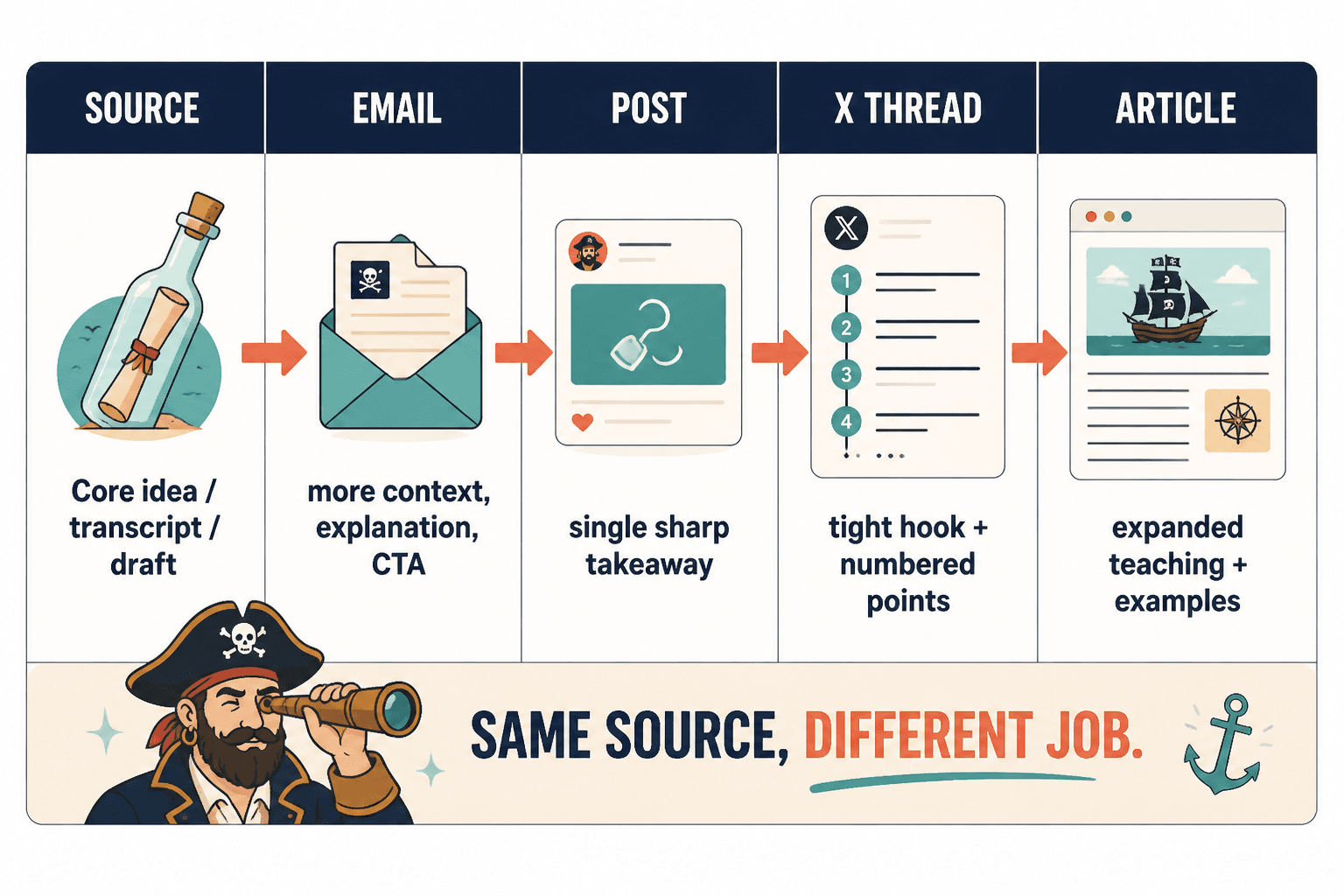
Notice what changed. The thread version gets tighter and more compressed. The email version has a little more room to explain. Same source. Different job.
If you want more format inspiration, these repurposing ideas and examples for creators are a useful next stop.
Example 3: Turn webinar content into a lead magnet and nurture sequence
This is where AI can save a lot of time for coaches and consultants who already teach live.
If you have a workshop or webinar transcript, you do not need to create a fresh lead magnet from scratch. You probably already have one hiding in the content. AI can help you identify the structure, clean up the language, remove repetition, and convert spoken teaching into a more readable document.
Good source material from webinars often includes
- A step-by-step framework
- Common mistakes
- Audience questions
- Case examples
- Objection handling
- A natural next step into your offer
What you can turn it into
- A PDF guide
- A short email mini-course
- A landing page draft
- A FAQ section for your sales page
- Several social posts promoting the resource
Mini example
Source webinar topic: how service providers can create content that leads to discovery calls without posting like a maniac.
AI-assisted lead magnet title options:
- 5 Content Fixes That Make Service Posts More Client-Ready
- Why Your Content Gets Attention But Not Inquiries
- The Simple Content-to-Consultation Path for Service Brands
Then you edit. You choose the title that best matches your voice, combine the best sections, and remove the weirdly overconfident bits AI likes to sneak in when nobody is looking.
This also works well for a post → profile → lead magnet funnel. Not a complicated funnel. Not seventeen automations and a sales sequence that feels like it was written by a manipulative toaster. Just a clean next step that matches the topic of the content.
Example 4: Turn one article into platform-specific short-form content
A lot of creators repurpose badly because they copy and paste instead of adapt.
One article can absolutely become LinkedIn posts, Facebook posts, X posts, and email snippets. But each version should reflect how the platform is read.
Source article point
“Expert creators often bury their strongest insight under long introductions and safe framing.”
LinkedIn version
A lot of strong experts weaken their content before the reader even gets to the point.
Not because the idea is bad.
Because the first 4 lines are doing nervous throat-clearing instead of saying the thing.
If your best insight is hidden under disclaimers, context, and polite setup, people will not discover it. They will scroll past it.
X version
Many experts do not have weak ideas.
They have weak starts.
If your point shows up in sentence 6, you are probably losing people in sentence 2.
Facebook version
One of the most common writing problems I see from smart people is this: they know the useful thing, but they take forever to get to it.
It is usually not a knowledge issue. It is a hesitation issue.
They soften the point. Add context. Add qualifiers. Try to make it sound balanced. Then the actual insight arrives after the reader has already wandered off to argue with a stranger about productivity.
That version is a little more conversational and a little less tightly compressed. Same underlying idea. Different delivery.
Example 5: Use AI to create before-and-after rewrites from existing content
This is one of the most useful editing use cases for personal brands because it trains your eye, not just your output.
You can feed AI one of your weak posts and ask it to produce several rewrites with different goals: sharper hook, more authority, more specificity, cleaner CTA, shorter version, stronger opinion, and so on. Then compare them and learn what changed.
Before
I have been thinking a lot about how important authenticity is in content marketing. People really want to connect with real voices and stories, and I believe that by showing up consistently and sharing value, businesses can build meaningful relationships over time.
After
“Be authentic” is lazy content advice.
People do not trust you because you posted a slightly vulnerable paragraph and used the phrase “showing up.”
They trust you when your content sounds specific, useful, and consistent enough to feel like there is a real mind behind it.
Authenticity is not a tone. It is the absence of generic sludge.
That rewrite is stronger because it has tension, contrast, and a more precise point. AI can help generate that shift, but you should still be the one deciding what is true, what is too much, and what actually sounds like you.
If tool selection is your sticking point, read the best AI tools for creator editing and repurposing. Tools matter. Just not as much as the workflow and judgment sitting behind them.
Best prompts for creator AI editing and repurposing
You do not need 400-line prompt documents with ceremonial formatting and sixteen role definitions. You need clear instructions.
Here are a few prompt patterns that actually help.
For extracting angles
Review this transcript and identify the 7 strongest standalone ideas for content. Prioritize ideas with specificity, tension, practical value, and relevance for coaches, consultants, or personal brands.
For platform shifts
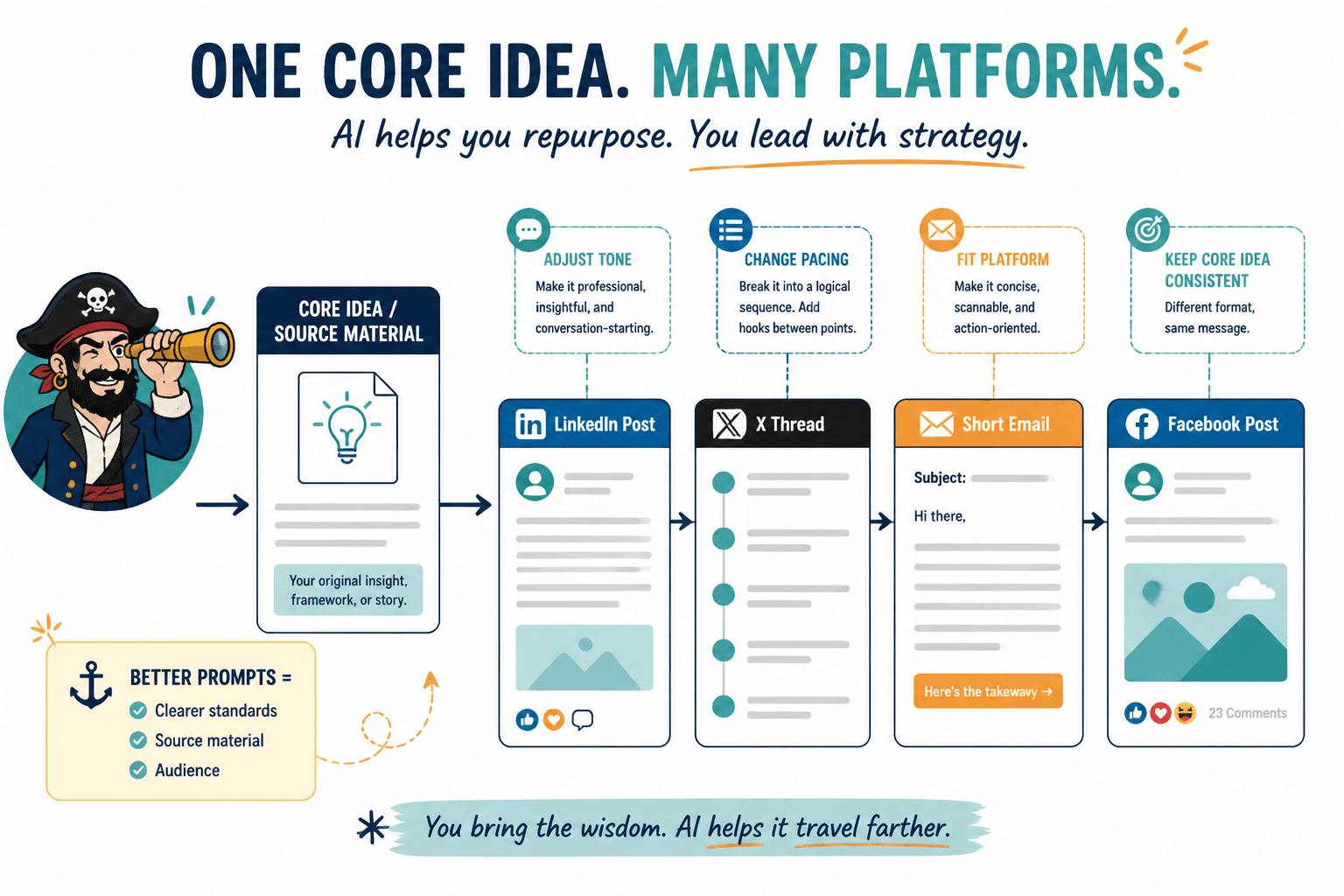
Turn this article section into: 1 LinkedIn post, 1 X post, 1 short email, and 1 Facebook post. Keep the core idea consistent, but adapt the tone, pacing, and structure for each platform.
For editing weak copy
Rewrite this post to make it more specific, less generic, and more commercially relevant. Remove vague phrasing, cut throat-clearing, and keep the tone direct and natural.
For preserving voice
Use plain English. Avoid hype, motivational clichés, and polished corporate language. Keep the tone smart, practical, and lightly sharp.
Prompting is not magic. The clearer your standards, source material, and audience, the better the output.
Common mistakes when using AI for repurposing
The bigger point is simple: clearer structure and clearer writing make the piece more useful. That is usually what makes the ending land better too.