
Most creator AI editing and repurposing content is not bad because AI touched it. It is bad because nobody bothered to rewrite it into something a real person would want to read.
You can usually spot it fast. The tone goes flat. The wording gets suspiciously polished. Every point sounds technically fine and emotionally dead. It says things like “maximize your content strategy” when what it should say is “this post is trying way too hard and saying too little.”
If you want to know how to rewrite boring creator AI editing and repurposing, the fix is not “use less AI.” The fix is learning where AI drafts go bland, where repurposed content loses its point, and how to put sharpness, specificity, and actual human judgment back into the piece.
This article will help you do exactly that. You’ll get a simple rewrite process, concrete before-and-after examples, and a practical way to turn flat AI-assisted drafts into content that sounds clearer, smarter, and much less like it was assembled by a very obedient intern with no taste.
For the full path around this topic, head to the parent guide.
Why creator AI editing and repurposing gets boring so fast
AI is good at producing usable raw material. It’s not especially good at producing strong final material without direction. And when creators repurpose content with AI, they often make the same mistake twice: first they generate bland source copy, then they turn that bland copy into six more bland assets.
That is not a workflow. That is multiplication of mediocrity.
Boring creator AI editing and repurposing usually happens because of a few predictable problems:
- The draft is too generic
- The original point is too weak
- The tone is polished but lifeless
- The repurposed version copies structure without adapting to the platform
- The examples are vague
- The opening takes too long to say anything
- The piece sounds “helpful” without being memorable or useful
And this part matters: repurposing is not just resizing content. If you turn a newsletter into a LinkedIn post, or a video transcript into a thread, the job is not to preserve every sentence. The job is to preserve the strongest idea and rebuild it in the right shape.
If you skip that rewrite step, you get content that feels copied from itself. Which is somehow even more boring than regular bad content.
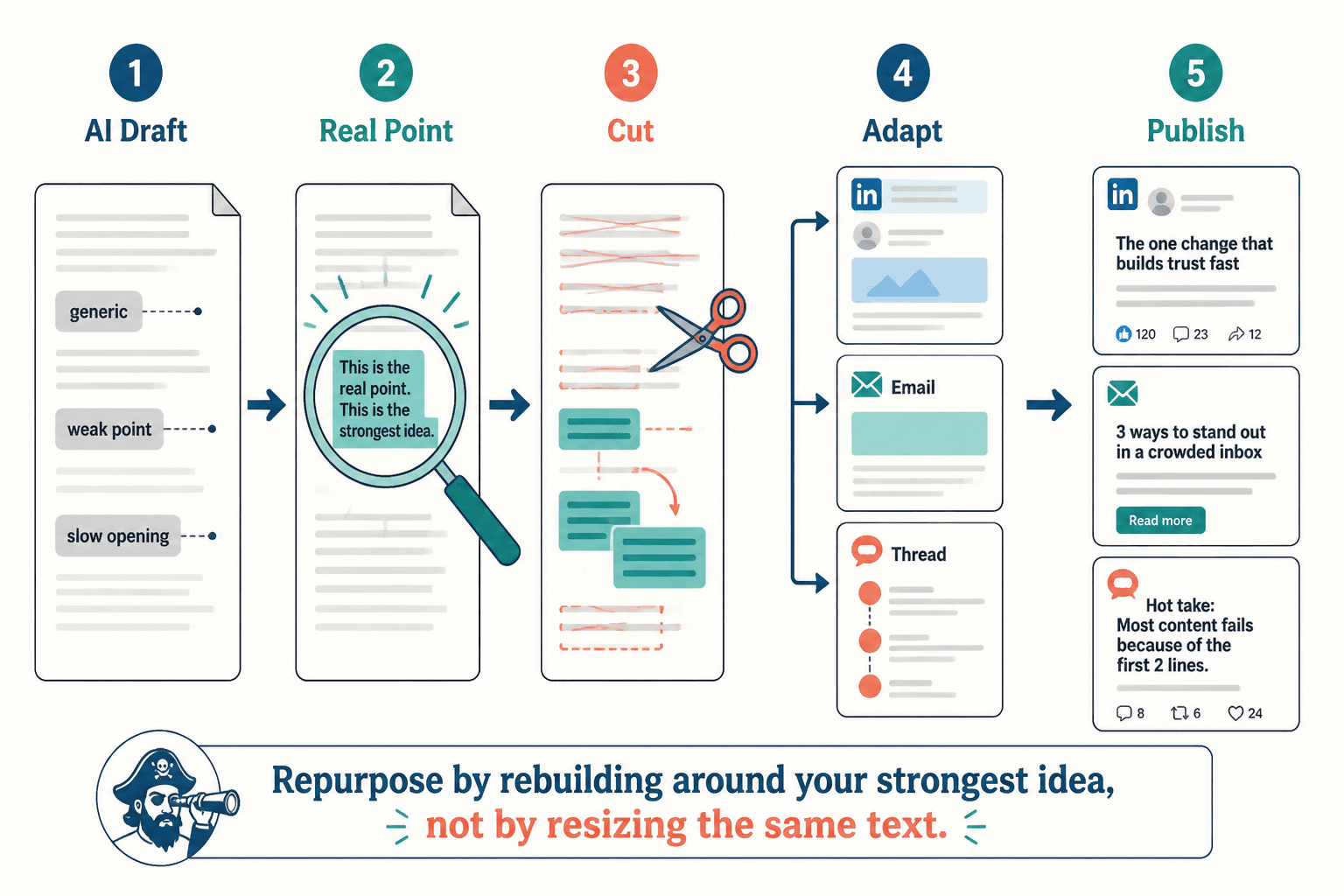
Start by finding the real point
Before you rewrite anything, figure out what the piece is actually trying to say.
This sounds obvious. It is not. A lot of AI-assisted drafts are made of adjacent sentences that technically relate to the topic but never quite arrive at a clear argument. They have motion, not direction.
So ask:
- What is the main claim here?
- What does the reader need to understand, do, avoid, or change?
- What is the sharpest sentence in this draft?
- What can be cut without losing the point?
If you cannot answer those questions in one or two lines, the draft is not ready for editing. It needs a point before it needs polish.
A useful shortcut is this: write one sentence that begins with “This really means…”
For example:
- “AI can help repurpose content faster” becomes “Repurposing gets better when AI handles formatting and you handle judgment.”
- “Editing matters in content creation” becomes “Most AI content does not need more words. It needs more decisions.”
- “Creators should reuse old content” becomes “Old content is only worth reusing if the core idea still has teeth.”
That one sentence gives you something to rewrite around. Without it, you’re just rewording fluff.
How to rewrite boring creator AI editing and repurposing in 6 steps
Here’s the practical process. It works for blog drafts, LinkedIn posts, newsletters, X threads, captions, and most other creator content.
1. Cut the throat-clearing
AI loves a soft runway. It starts with context, broad framing, safe statements, and little warm-up phrases that feel polite and accomplish nothing.
Cut lines like:
- “In a fast-paced digital world…”
- “Content creation is more important than ever…”
- “Many creators are starting to realize…”
- “Repurposing content can be a valuable strategy…”
These are not openings. They are delays.
Start where the tension is. Name the mistake. Challenge the lazy assumption. Say the thing people keep avoiding.
2. Replace vague claims with specifics
Generic content usually hides inside abstract language.
Bad:
AI tools can streamline your content workflow and improve engagement across multiple channels.
Better:
AI can help you turn one webinar into a draft article, a few post ideas, and an email outline. It cannot tell you which angle is worth publishing or which version sounds like you.
Specificity creates credibility. It also makes the sentence worth finishing.
3. Add tension, contrast, or a clear opinion
Boring content often reads like it is trying not to offend anyone. Which is lovely if you are writing HR policy. Less useful if you are trying to earn attention.
You do not need fake hot takes. You do need contrast.
Try lines like:
- “Faster repurposing is not the goal. Better reuse is.”
- “The issue is not volume. It’s that every version sounds equally forgettable.”
- “If your AI draft sounds clean but empty, that is not efficiency. That is missed editing.”
Contrast gives the piece shape. It helps the reader feel where the argument is going.
4. Rewrite for the platform, not just the topic
This is where repurposing usually falls apart.
People take a long article, ask AI to make it into a thread or LinkedIn post, then publish the output with almost no adaptation. The result keeps the same pacing, same assumptions, and same density, even though the platform wants something different.
A few quick examples:
- A LinkedIn post needs a stronger first line and simpler structure
- An X thread needs tighter sequencing and sharper compression
- An email can carry more nuance and a more direct CTA
- A blog article needs depth, examples, and cleaner scannability
Repurposing means rebuilding for context. Not just reformatting the same mush in different containers.
If your openings are consistently weak, this guide on starting creator AI editing and repurposing without a weak opening will help you tighten that part fast.
5. Put human proof back in
AI strips out a lot of texture unless you force it back in. That means your rewrite should usually include one or more of these:
- A concrete example
- A sharper phrasing choice
- A real-world use case
- A platform-specific nuance
- A useful warning
- A sentence with actual personality
You do not need fake storytelling. You do need signs that a thinking person made decisions here.
6. Tighten the ending so it actually lands
AI endings often drift into summary sludge: “By using these strategies, creators can optimize their workflows and achieve better results.”
That says nothing. It just politely leaves the room.
A stronger ending usually does one of three things:
- Gives the reader a clear next action
- Restates the main point more sharply
- Leaves them with a useful standard to apply
For example:
If a repurposed draft sounds smooth but says very little, do not publish it faster. Rewrite it until it earns its place.
Before-and-after rewrites that fix the usual mess
Let’s make this less theoretical.
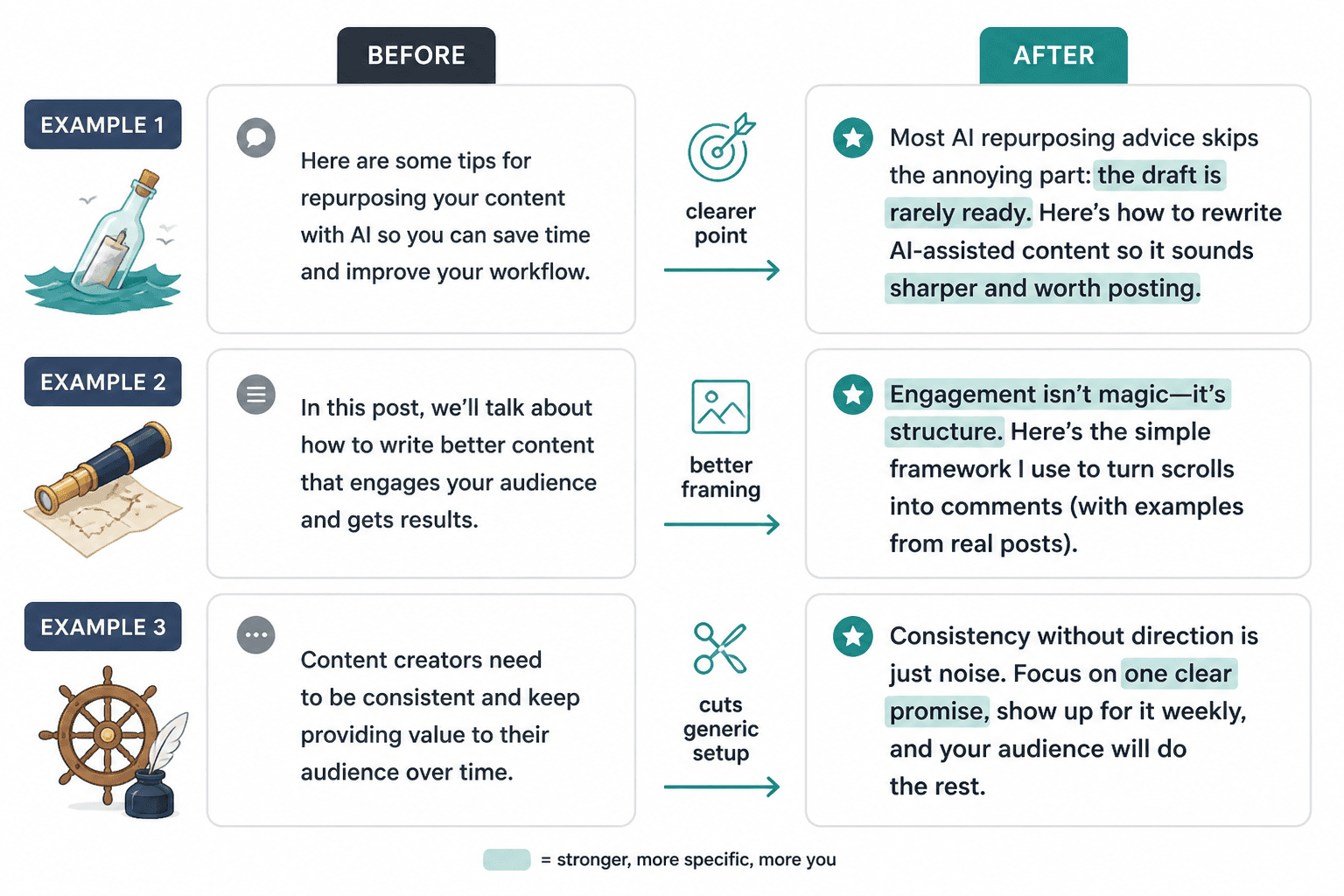
Example 1: boring article intro
Before:
Repurposing content is an effective strategy for creators who want to maximize the value of their existing content and improve efficiency across different platforms.
After:
Repurposing is not the problem. Lazy repurposing is. If every recycled post sounds like a watered-down version of the original, AI is not saving you time. It’s helping you publish weaker content faster.
What changed?
- Started with tension
- Cut generic phrasing
- Added a point of view
- Made the consequence clear
Example 2: boring LinkedIn-style post
Before:
AI has transformed the way creators approach editing and repurposing. By leveraging smart tools, it becomes easier to create content at scale and maintain consistency.
After:
AI did not make creator editing better. It made weak editing easier to hide.
You can now turn one idea into ten assets in twenty minutes.
Great.
If the original idea was dull and every rewrite sounds vaguely “professional,” all you did was scale the problem.
That rewrite has rhythm, contrast, and a stronger hook. It sounds like someone has a real opinion, which tends to help.
Example 3: boring repurposed thread opener
Before:
Here are some tips for repurposing your content with AI so you can save time and improve your workflow.
After:
Most AI repurposing advice skips the annoying part:
the draft is rarely ready.
Here’s how to rewrite AI-assisted content so it sounds sharper, less generic, and actually worth posting.
Again, the key is not fancier wording. It is a clearer point and better framing.
A simple rewrite checklist for creator AI editing and repurposing
If you want something quick you can use every time, run your draft through this checklist before publishing.
- Can I state the main point in one sentence?
- Does the opening say something specific fast?
- Did I cut generic setup lines?
- Did I replace abstract language with concrete examples?
- Does the piece sound like a person, not a panel discussion?
- Did I adapt it to the platform instead of preserving the original format?
- Is there at least one sharp sentence worth quoting or remembering?
- Does the ending land with a useful next step or clear takeaway?
- Did I remove any line that sounds like AI oatmeal?
That last one is a technical term now. I don’t make the rules.
What to keep and what to change when repurposing old content
One reason old content goes limp in repurposing workflows is that creators try to preserve too much. They keep all the original framing, all the supporting points, all the explanation, and then wonder why the new version feels heavy.
When you repurpose, keep the core idea. Change the delivery.
| Keep | Change |
|---|---|
| Main argument | Opening angle |
| Best example | Structure and pacing |
| Useful proof | Sentence length |
| Strong opinion | CTA style |
| Relevant lesson | Platform formatting |
If you want more help on reshaping older material without making it feel stale, read how to turn old content into better creator AI editing and repurposing.
What AI is good for here, and what it absolutely is not
It helps to be honest about the division of labor.
AI is useful for:
- Turning transcripts into rough drafts
- Extracting post ideas from long-form content
- Creating version one of a summary, outline, or thread
- Generating angle variations you can evaluate
- Helping you move faster through repetitive formatting work
AI is not useful for:
- Knowing which point is strongest without guidance
- Sounding distinct by default
- Making a bland idea more interesting
- Understanding your audience better than you do
- Replacing taste, positioning, or editorial judgment
This matters because many creators expect the tool to solve a strategy problem. Then they blame the output when the real issue was the input, the angle, or the lack of rewriting afterward.
If your tone keeps slipping into polished nonsense, you’ll probably like how to write creator AI editing and repurposing without sounding salesy or robotic. And if your workflow keeps producing samey content, this piece on improving creator AI editing and repurposing flows without sounding generic is the next useful stop.
A practical prompt to improve your rewrites
If you’re using AI as part of the editing process, do not ask it to “make this better.” That is how you get corporate soup.
Give it a job with standards.
Rewrite this draft for a creator audience. Keep the main idea, but cut generic phrasing, remove bloated intro lines, add specificity, and make the tone sound direct, clear, and human. Do not make it more formal. Do not use vague marketing language. Preserve the strongest argument and sharpen the opening and ending.
Then edit what comes back. Because again, the machine can assist with variation. It should not be making final taste decisions unsupervised like it just got promoted.
For broader workflow help, you can also explore the main AI writing tools and workflows hub, the creator AI editing and repurposing section, and the wider creator AI workflow pathways if you want the surrounding system, not just this one rewrite step.
FAQ
How do I know if AI-repurposed content is boring?
It sounds polished but forgettable, opens too softly, says generic things, and could have been written for almost anyone.
Should I always rewrite AI-generated content?
For anything public-facing that affects trust, yes. At minimum, rewrite the opening, specific examples, transitions, and ending.
What is the fastest way to improve a bland AI draft?
Find the real point, cut the first few generic lines, replace vague claims with specifics, and add one clear opinion or contrast point.
Can AI still help with repurposing?
Absolutely. It’s useful for drafts, extraction, summaries, and formatting. It just should not be trusted with final voice and judgment without review.
Does repurposing mean keeping the same wording?
No. Keep the idea. Rewrite the structure, pacing, and framing for the platform.
The bigger point is simple: clearer structure and clearer writing make the piece more useful. That is usually what makes the ending land better too.