
Most creator AI editing and repurposing falls apart before the workflow even starts.
Not because the tool is bad. Not because the prompts are too short. Not because you forgot to ask for “high-converting output” in a deeply cursed spreadsheet of prompt templates.
It falls apart because the opening is weak.
If the original content starts with throat-clearing, generic context, or a soft little “hey everyone, today I want to talk about…” then AI will happily preserve that weakness at scale. It will turn one bland opening into twelve bland assets, each slightly shinier and somehow even less alive.
That is the real problem behind How to Start Creator AI Editing and Repurposing Without a Weak Opening. You do not need a bigger workflow first. You need stronger source material and a better way to begin.
Here’s how to build an AI editing and repurposing process that starts sharp, stays useful, and does not produce content that sounds like your laptop attended a thought-leadership webinar against its will.
For the main guide behind this topic, visit the parent guide.
Why weak openings wreck creator AI editing and repurposing
AI is good at transforming structure, compressing ideas, expanding sections, rewriting tone, and helping you turn one piece into many.
What it is not good at is rescuing a vague point you never properly stated.
When your opening is weak, three things usually happen:
- The AI guesses the point instead of sharpening it.
- The repurposed outputs all sound interchangeable.
- The best part of your idea shows up too late, if at all.
That means your LinkedIn post meanders, your email takes forever to land, your thread starts with a sentence no one would ever choose to read, and your short-form clips open like they are apologizing for existing.
Repurposing does not fix weak beginnings. It multiplies them.
If the first ten seconds, first line, or first paragraph is fuzzy, the rest of the workflow is usually just efficient mediocrity.
What a strong opening actually needs
A strong opening is not about being dramatic. It is about making the point fast enough that the reader, viewer, or listener knows why they should keep going.
For creator AI editing and repurposing, your opening should usually do at least one of these things immediately:
- Name a problem the audience already feels
- Challenge a bad assumption
- Make a specific claim
- Show a useful contrast
- State the stakes clearly
That is enough. You do not need fireworks. You need traction.
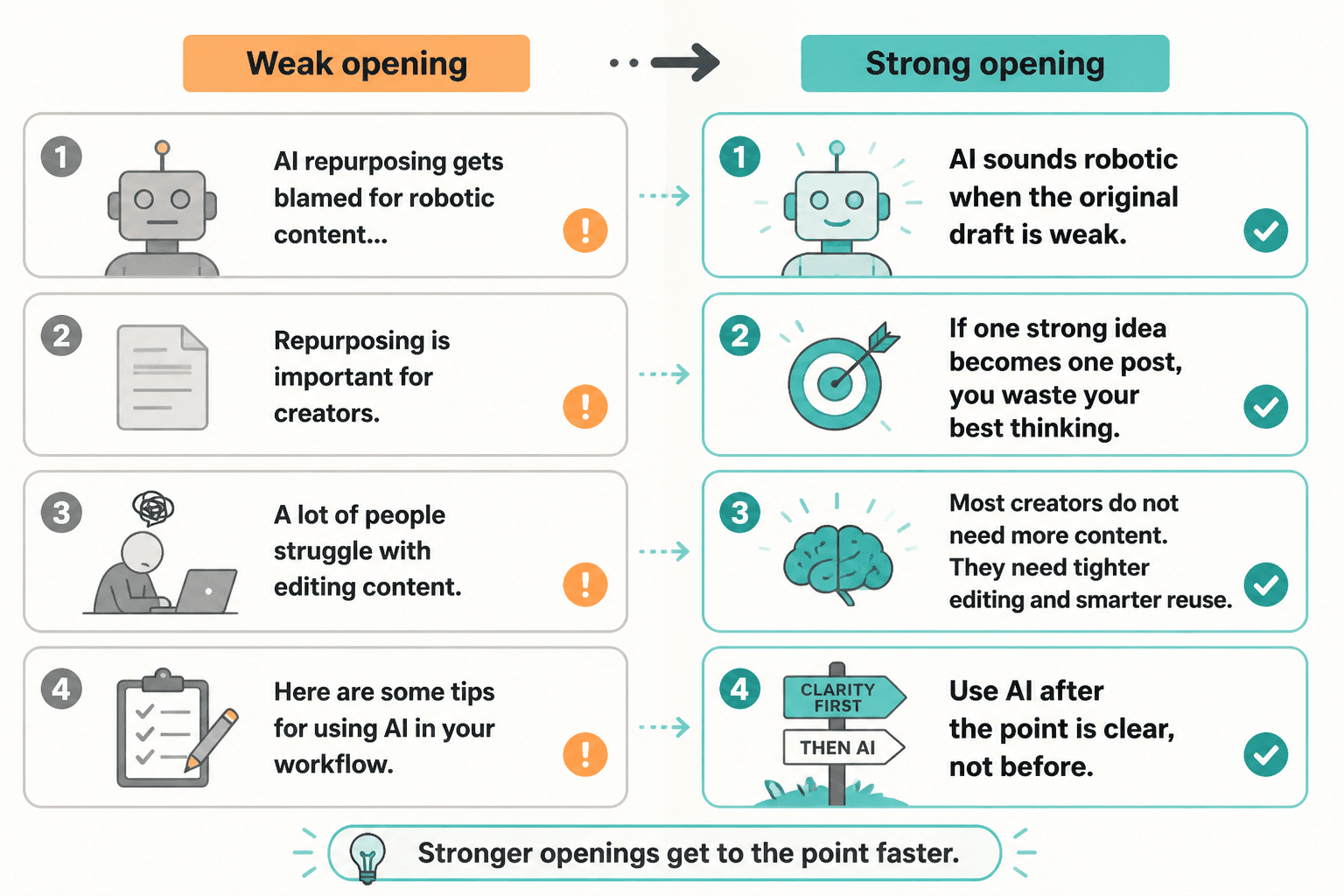
Weak opening vs strong opening
| Weak | Stronger |
|---|---|
| Today I want to talk about repurposing content with AI. | AI repurposing gets blamed for robotic content when the real issue is usually the sloppy original draft. |
| Repurposing is important for creators. | If one good idea only becomes one post, you are wasting your best thinking. |
| A lot of people struggle with editing content. | Most creators do not need more content. They need tighter editing and better reuse of what already works. |
| Here are some tips for using AI in your workflow. | Use AI after the point is clear, not before. Otherwise you are automating mush. |
Notice what changed. The stronger versions do not try harder to sound smart. They just get to the point faster.
That one shift matters more than most prompt tweaks people obsess over.
Start with source content that already has a pulse
If you want AI editing and repurposing to produce useful outputs, the source content needs a real argument, insight, or lesson. Not just a topic.
“Personal branding” is a topic. “Most personal brand bios are unclear because they try to sound impressive instead of useful” is a usable point.
AI works much better when you feed it content built around a point with tension. Tension gives the model something to preserve while it edits, shortens, expands, or reformats.
Before you repurpose, make sure the source has these pieces
- A clear main idea in one sentence
- A specific audience or use case
- One strong opening line or segment
- At least one example, proof point, or contrast
- A next step, takeaway, or CTA that fits the format
If those pieces are missing, stop there. Edit the source first.
This is where a lot of creators waste time. They try to repurpose too early, as if volume will somehow reveal clarity. It won’t. More versions of a vague idea do not become strategy. They become content confetti.
If you want a broader look at this workflow category, the AI writing tools and workflows hub and the creator AI editing and repurposing cluster are useful places to keep reading.
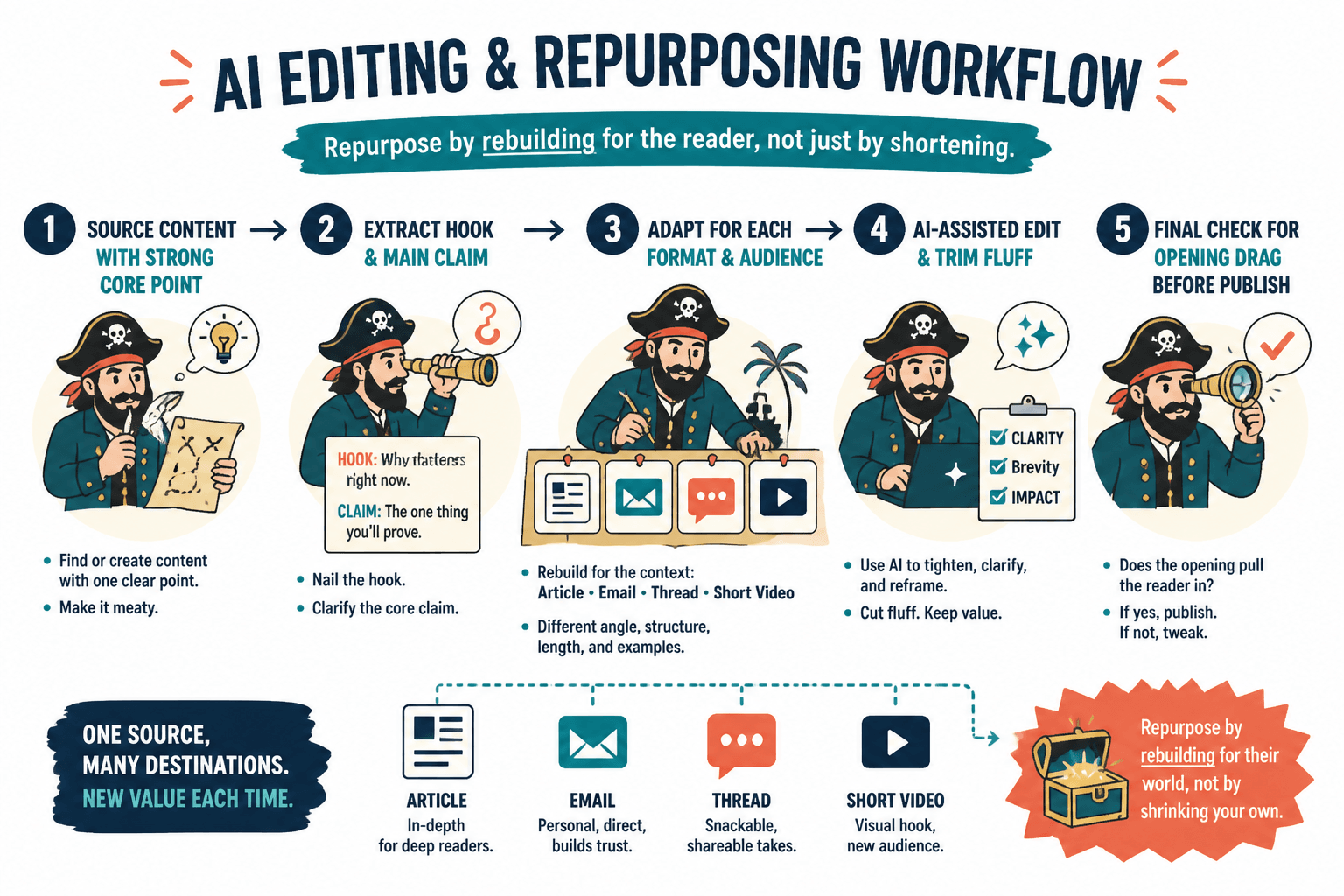
A simple workflow for creator AI editing and repurposing without a weak opening
You do not need a giant content machine. You need a workflow that protects the good part of your idea from getting watered down.
1. Pull out the real point first
Before using AI, write the core point in one plain sentence.
Examples:
- Creators overuse AI for drafting and underuse it for editing.
- Most repurposed content sounds generic because the source content never had a sharp angle.
- A strong opening makes every downstream asset easier to write.
If you cannot do this, the content is not ready for repurposing yet.
2. Rewrite the opening manually before asking AI to help
This is the part people try to skip, and it is exactly why their outputs sound beige.
Take the first line, intro paragraph, or first 15 seconds and rewrite it yourself. Sharpen the claim. Cut the warm-up. Make the value obvious.
Good manual editing beats clever prompting when the start is mushy.
3. Ask AI to preserve the point, not invent one
Now the tool can help.
Useful prompt direction looks more like this:
Edit this piece for clarity and punch. Keep the opening direct and specific. Do not add generic setup. Preserve the main claim: “Most creators use AI too early in the workflow and end up scaling weak source material.”
That works better than vague instructions like “make this more engaging” or “optimize for virality,” which usually produce the kind of output no one trusts.
4. Repurpose by format, not by copy-pasting length
Different formats need different openings.
- A LinkedIn post may open with a useful opinion.
- An email may open with a sharper problem statement.
- A thread may open with a claim plus payoff.
- A reel or short may open with the most surprising line first.
Repurposing is not “make this shorter.” It is “rebuild this for a different reading environment.”
5. Check every output for opening drag
Before publishing, scan the first line or first few seconds and ask:
- Does it say something real?
- Does it earn attention quickly?
- Would the intended audience care within five seconds?
- Did AI sneak in fluff, hedging, or generic context?
If not, fix it there. Do not polish the middle while the front door is hanging off the frame.
How to rewrite weak openings before repurposing
If your original content starts weak, use this quick rewrite method.
The 4-part opening fix
- Cut the setup: Remove “I want to talk about,” “I’ve been thinking about,” and other soft intros.
- Find the tension: What is going wrong, misunderstood, overrated, or wasted?
- State the point early: Put the useful claim in the first line or two.
- Match the format: Keep it tighter for social, slightly fuller for articles and email.
Example 1: Generic article intro
Before: AI has changed the way creators work in many different ways. One area where this is especially true is editing and repurposing content across platforms.
After: AI editing and repurposing only helps creators when the original idea is already clear. If the opening is weak, the workflow just scales the weakness.
Example 2: Soft video opening
Before: Hey guys, in this video I want to share a few thoughts on how I use AI to repurpose my content.
After: If your AI repurposing sounds robotic, the problem probably is not the tool. It is usually the first few lines of the source content.
Example 3: Weak LinkedIn opener
Before: Repurposing content is something a lot of creators should probably be doing more often.
After: Most creators do not need more ideas. They need to stop burying the useful one under six lines of polite preamble.
If you want more examples of tightening flat source material, read How to Rewrite Boring Creator AI Editing and Repurposing.
What AI is actually good for in editing and repurposing
AI can be very good at:
- Cutting repetition
- Reformatting one idea into multiple channel versions
- Suggesting alternate hooks
- Turning transcripts into cleaner written drafts
- Pulling out quote lines, summaries, or snippets
- Adapting tone within reason
- Helping you test several opening angles quickly
It is not very good at:
- Knowing your best angle without context
- Creating taste from scratch
- Fixing an unclear message
- Understanding what your audience is tired of hearing unless you tell it
- Making weak source material suddenly persuasive
This matters because creators often use AI at the wrong stage. They open a blank chat window too early, ask for content ideas too broadly, then spend an hour sanding down lifeless outputs.
A better move is to bring AI in after you have a point, a rough structure, and a decent opening. Then the tool becomes an editor and multiplier, not an overconfident intern with no context.
If your main issue is tone, this will help: How to Write Creator AI Editing and Repurposing Without Sounding Salesy or Robotic.
How to repurpose one strong opening across multiple formats
Once you have a strong opening, you can adapt it instead of reinventing it every time.
Say your base idea is:
AI repurposing sounds generic when creators use it before they have a clear point.
Here is how that can shift by format.
LinkedIn post version
Most AI content sounds generic for a simple reason:
People use it before they know what they are trying to say.
Email version
If your repurposed content keeps sounding polished but empty, check the source draft first. AI usually is not ruining the message. It is repeating an unclear one.
X post version
AI does not create generic content from nowhere.
It scales unclear thinking very efficiently.
Short video version
If your AI repurposing feels robotic, stop blaming the tool. The problem usually starts in your first sentence.
Same point. Different packaging. That is repurposing done properly.
A practical prompt structure for stronger openings
You do not need fifty prompts. You need a few good ones that force clarity.
Prompt template: opening rewrite
Rewrite the opening of this draft so it makes the main point faster. Remove generic setup, avoid vague claims, and lead with a specific problem, opinion, or contrast. Keep the tone clear and natural, not hypey.
Prompt template: repurposing with opening protection
Turn this draft into a [LinkedIn post/email/thread/script]. Keep the opening sharp and direct. Do not start with a broad statement about content, AI, or business. Preserve the main claim and make the first line worth reading on its own.
Prompt template: hook variations
Give me 10 opening lines for this idea. Make them specific, non-clickbait, and useful. Use different angles: problem, contrarian point, sharp observation, direct claim, and mistake. Do not use clichés or generic creator language.
That last instruction matters. If you do not tell AI what to avoid, it will often slide right back into the same recycled patterns.
For a broader improvement process, see How to Improve Creator AI Editing and Repurposing Repurposing Flows Without Sounding Generic and How to Write Better Creator AI Editing and Repurposing.
Common mistakes creators make when starting this workflow
- Starting with tools instead of source material: The app is not the strategy.
- Keeping the original intro untouched: If the first version drags, the derivatives will too.
- Asking AI for engagement instead of clarity: “More engaging” is usually too vague to help.
- Repurposing everything: Not every draft deserves five new formats.
- Making every version sound the same: Format should shape the opening.
- Leaving in AI filler: Words like “incredible,” “powerful,” “valuable,” and “transform” often show up where meaning should be.
The fix is not complicated, but it does require taste and a bit of discipline. You have to be willing to cut the warm-up, name the point early, and reject outputs that sound polished but empty.
That is less glamorous than collecting prompts. It is also far more effective.
A quick starter checklist
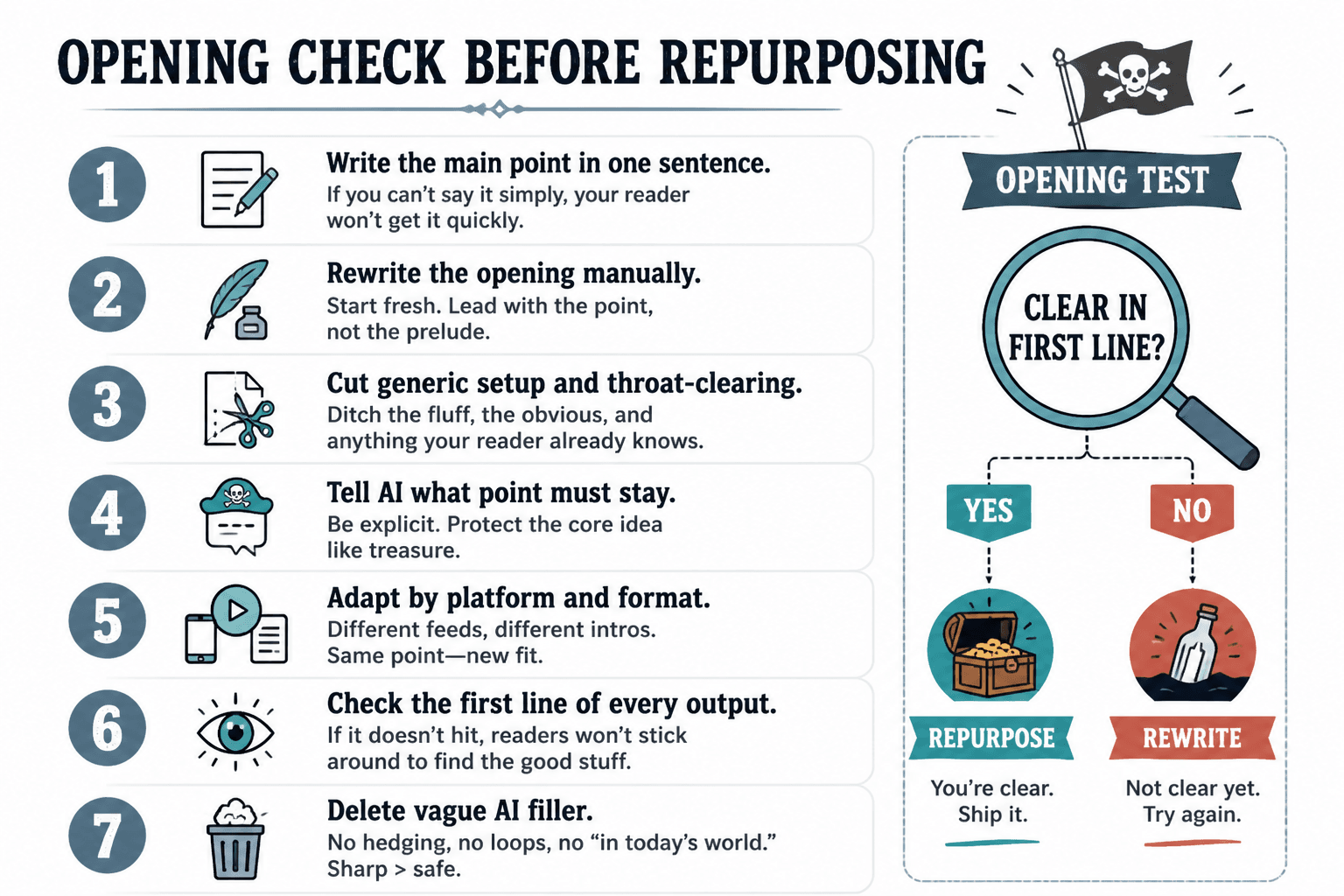
- Write the main point in one sentence
- Rewrite the opening manually
- Remove generic setup and throat-clearing
- Give AI the point you want preserved
- Repurpose by platform and format
- Check every output’s first line before publishing
- Delete anything that sounds like AI oatmeal
That is enough to start. You do not need a massive workflow map on day one. You need one good idea, one sharp opening, and a process that does not sand it into paste.
FAQ
Should I use AI to create the opening from scratch?
Sometimes, but usually after you define the point yourself. If you outsource the thinking too early, the opening gets vague fast.
How many opening variations should I generate?
Start with 5 to 10. Then pick the one that is clearest, not the one trying hardest to be clever.
Can I use the same opening on every platform?
Use the same core idea, yes. Use the exact same wording everywhere, probably not. Different formats need different pacing.
What if my source content is a transcript?
Pull out the strongest line or clearest claim first. Do not repurpose the transcript raw unless you enjoy reading other people’s verbal furniture.
The bigger point is simple: clearer structure and clearer writing make the piece more useful. That is usually what makes the ending land better too.