
Most creator AI editing and repurposing gets weird in the same two ways.
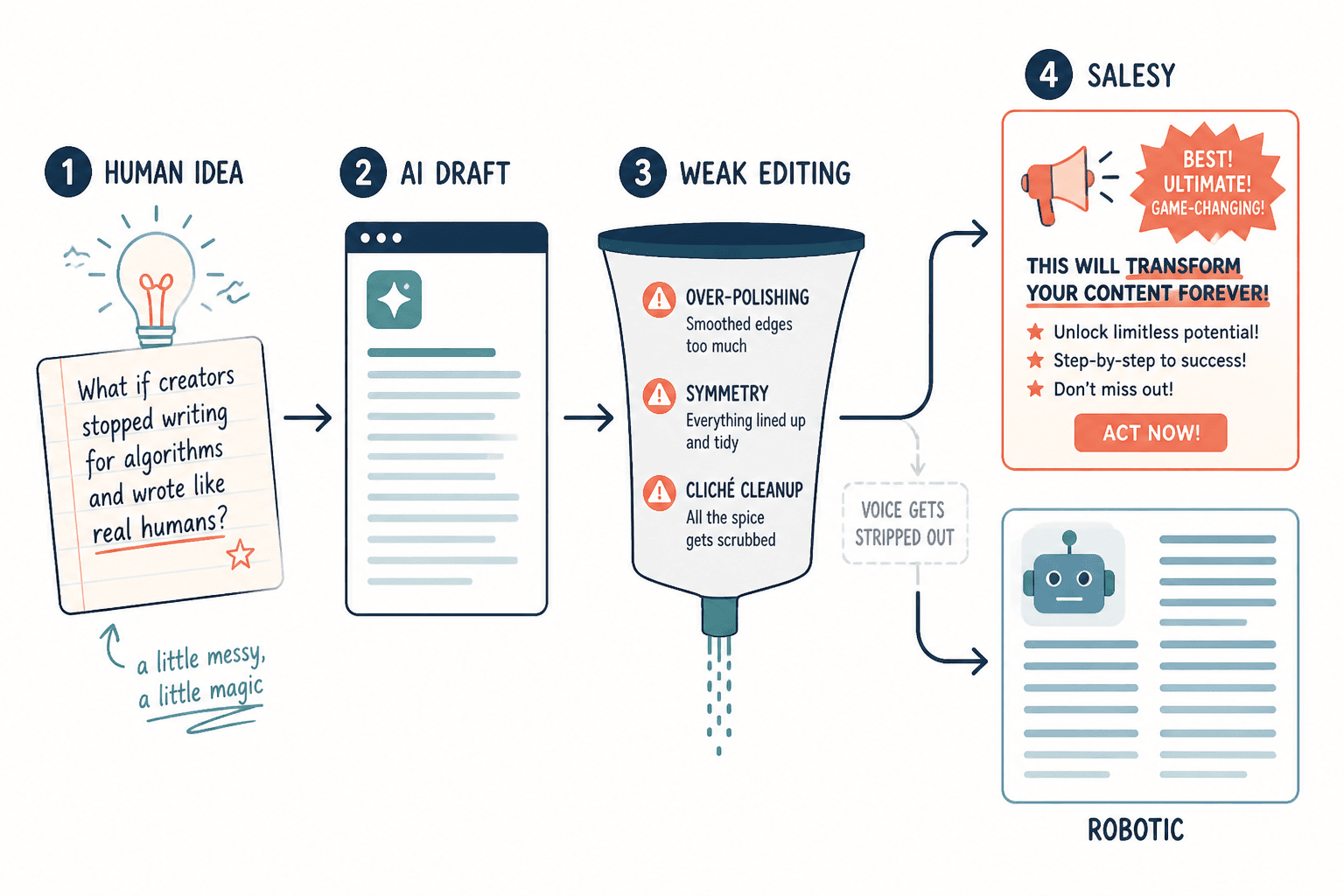
It either sounds like a sales intern fed on webinar funnels wrote it, or it sounds like a soft beige robot that has never had an actual opinion in its life.
That is usually not because the tool is bad. It is because the input is lazy, the editing is absent, and the creator treats repurposing like copy-paste with extra steps.
If you want to learn How to Write Creator AI Editing and Repurposing Without Sounding Salesy or Robotic, the fix is not “use less AI.” The fix is using AI for the parts it is good at, then making sure your taste, point of view, and actual human judgment survive the process.
Here’s how to make your AI-assisted content sharper, more natural, and far less likely to sound like it was assembled by a polite machine trying to hit a quarterly target.
For the broader learning path, visit our parent guide.
Why creator AI editing and repurposing goes bad so fast
AI can help you move faster. It can help you trim, restructure, expand, summarize, format, and remix ideas across platforms. That part is real.
What it cannot do on its own is give your content a real point. It cannot invent earned authority. It cannot tell when your post sounds needy, overcooked, vague, or suspiciously eager to “provide value.”
That matters because repurposed content only works when the core idea was good to begin with. If the source material is mush, AI will efficiently produce more mush. Faster mush is still mush.
- Salesy usually happens when the output leans on generic persuasion language, inflated promises, and obvious conversion moves.
- Robotic usually happens when the output is technically clean but emotionally dead, overly symmetrical, and stripped of any real voice.
- Generic happens when both problems join forces and create content that sounds fine until you realize nobody would remember it ten seconds later.
This is why a decent workflow matters more than a fancy prompt library. If the process is wrong, the voice goes first.
If you want a broader view of this category, it helps to browse the main AI writing tools and workflows section and the related creator AI editing and repurposing hub. This article is the practical version: what to actually do when you want better output now.
Use AI for transformation, not personality replacement
A good rule: use AI to reshape content, not to impersonate your brain.
That means AI is useful for:
- turning a long article into a short post draft
- pulling out key points from a transcript
- generating multiple hook options
- rewriting for platform length and format
- organizing messy notes into sections
- finding repetition and trimming fluff
- creating first-pass variations for testing
It is not useful for:
- deciding what you actually believe
- making a weak idea interesting
- creating trust from thin air
- understanding your buyer better than you do
- building a voice if you never developed one in the first place
This sounds obvious, but people ignore it constantly. They ask AI to “write a compelling thought leadership post” and then act shocked when it returns something that sounds like a networking event trapped in paragraph form.
A better mental model
Think of AI as a junior editor with speed, not a ghostwriter with judgment.
You still need to supply the raw material that makes content worth reading: a strong opinion, a lived pattern you keep noticing, a useful framework, a result, a mistake, a tension, or a specific argument. AI can help package that. It cannot reliably create it.
Start with source material that has an actual point
The easiest way to stop sounding robotic is to begin with source material that already sounds like you.
That source material might be:
- a voice note where you explain a client problem
- a rough post you wrote quickly without overthinking
- a workshop transcript
- an email where you answered a smart question clearly
- notes from a call, live, or podcast appearance
- a ranty draft with energy that needs cleanup, not flattening
Notice what these have in common: they come from natural language, not performance language.
When creators get stiff with AI, it is often because they feed it polished-but-empty source text. Then they ask it to make that “more engaging.” That is how you end up with synthetic enthusiasm and suspiciously tidy bullets.
If your source is flat, the output will usually be flatter. Better in grammar, worse in pulse.
If weak openings are part of the problem, read how to start creator AI editing and repurposing without a weak opening. A lot of robotic content gives itself away in the first two lines.
Give AI constraints that protect your voice
Bad prompts ask for outcomes in vague marketing language.
Good prompts give the model guardrails around tone, audience, structure, and what to avoid.
Weak prompt
Rewrite this into a compelling LinkedIn post that drives engagement and positions me as a thought leader.
That prompt is basically asking for the exact problem.
Stronger prompt
Rewrite this into a LinkedIn post for creators and consultants. Keep the core opinion intact. Use plain English, short paragraphs, and natural rhythm. Do not sound inspirational, corporate, or overly polished. Avoid phrases like “game-changer,” “unlock,” “valuable insights,” and “in today’s landscape.” Keep one clear point, one useful example, and a simple CTA that does not sound pushy.
That is better because it tells the tool what to preserve, what to avoid, and what matters structurally.
Useful prompt ingredients
- Audience: who this is for, specifically
- Intent: educate, challenge, clarify, convert softly, summarize, repurpose
- Voice guards: direct, dry, plainspoken, conversational, lightly opinionated
- Banned language: empty hype, fake urgency, overused phrases
- Structural limits: short paragraphs, no long intros, one CTA, one example
- Preserve list: key opinion, examples, metaphors, phrases that sound like you
You do not need some sacred mega-prompt. You need enough specificity that the output does not wander into beige nonsense.
Edit for human texture after the AI draft
This is the part people skip, then blame the tool.
The AI draft should not be the final draft. It should be your clay. You still need to shape the thing so it sounds like a person with a pulse wrote it.
What “human texture” actually means
- slightly uneven sentence rhythm instead of perfect sameness
- a real opinion instead of balanced-for-the-sake-of-balance language
- specific nouns and examples instead of abstract claims
- natural transitions instead of textbook signposting
- occasional sharpness where the point deserves it
- removing lines you would never say out loud
AI loves smoothness. Human writing often needs texture. Not chaos. Not sloppy writing. Just a little life.
Quick edit pass that catches most robotic output
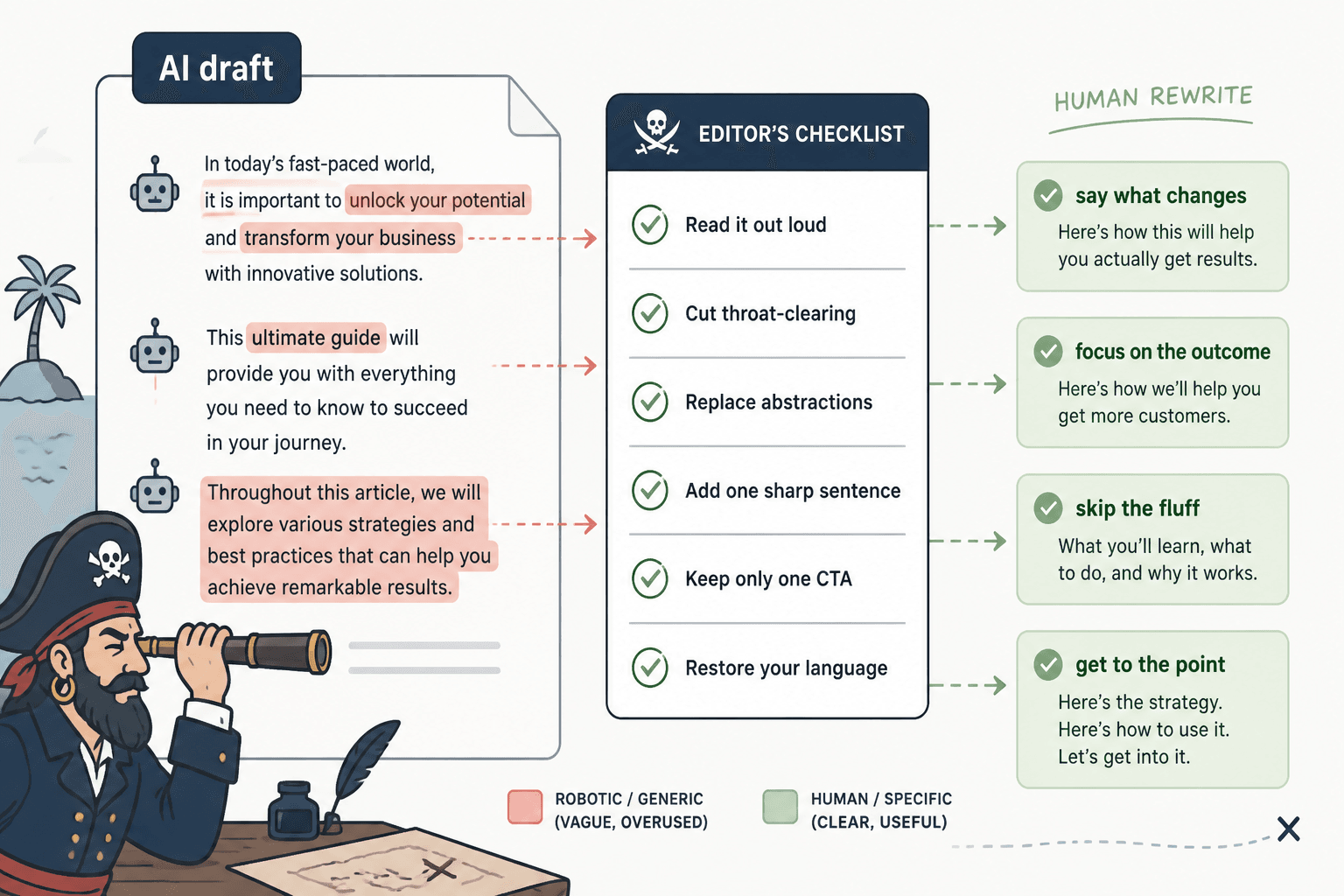
- Read it out loud. If you would not say it, rewrite it.
- Cut throat-clearing. Delete the first line if it sounds like a presentation intro.
- Replace abstractions. Turn “improve your strategy” into what actually improves.
- Add one sharp sentence. Not for drama. For clarity.
- Keep only one CTA. If it sounds like a funnel in a trench coat, tone it down.
- Restore your language. Put back phrases you actually use.
If you want a stronger editing process overall, how to write better creator AI editing and repurposing is a useful next read.
Cut the sales language before it infects everything
Salesy content is rarely persuasive content. It is usually content that is trying too hard too early.
The biggest tell is language that sounds designed to trigger action without first earning trust. Readers feel that instantly. Especially creators, consultants, and smart buyers who have seen every funnel trick with a Canva cover.
Phrases that usually make AI-assisted content worse
- unlock your potential
- transform your business
- proven system
- skyrocket results
- if you are serious about success
- you do not want to miss this
- the ultimate guide
- revolutionary approach
- high-value content
None of these are illegal. They are just tired. They signal performance, not credibility.
Replace them with cleaner language
| Instead of this | Try this |
|---|---|
| Transform your content strategy | Make your content clearer and easier to reuse |
| Drive meaningful engagement | Get more replies from the right people |
| Position yourself as a thought leader | Sound like someone who actually knows what they are talking about |
| Compelling call to action | Simple next step |
| Provide value consistently | Say something useful on a regular basis |
Cleaner language does not just sound better. It makes the content easier to trust because it says what it means.
Repurpose by adapting the idea, not cloning the wording
This is where a lot of creator AI editing and repurposing falls apart.
People take one post, ask AI to “turn this into five platform variations,” and end up with the same content wearing five different hats. Slightly changed wording is not repurposing. It is duplication with better posture.
Real repurposing means keeping the core idea while changing the angle, format, pacing, and payoff to fit the platform and the reader’s mindset there.
Example: one source idea, several useful versions
Core idea: AI makes content faster, but speed without voice makes creators blend in.
- LinkedIn post: lead with the mistake, add one client-facing implication, end with a practical takeaway
- X post: compress into one sharp line with contrast
- Newsletter: expand into a short argument with one example and one recommendation
- Instagram carousel script: break into punchy slides with one point per frame
- Article intro: open with the tension and explain the cost of getting it wrong
The message can stay consistent. The expression should not.
If you want to tighten the workflow side of this, read how to improve creator AI editing and repurposing repurposing flows without sounding generic. The process matters more than people think.
A simple repurposing framework
- Identify the core idea in one sentence.
- Choose the target platform and its content style.
- Decide the angle for that platform.
- Ask AI for a draft with constraints.
- Edit for voice, specificity, and natural flow.
- Remove any line that sounds like borrowed authority.
Use examples and specifics so the content stops floating
One reason AI-assisted writing sounds robotic is that it hovers above reality. It talks about “audience engagement,” “content optimization,” and “streamlined workflows” without ever touching the ground.
Specificity fixes that fast.
Before
Repurposing content with AI can help creators maximize efficiency and expand their reach across multiple platforms.
After
AI can turn one decent workshop transcript into a LinkedIn post, an email, three X posts, and a rough article outline. Useful. But if you publish all of it without editing, it will sound like one idea got trapped in a corporate blender.
The second version has an actual scene. You can picture the use case. You can feel the warning. It sounds more human because it is anchored in something real.
Whenever your AI draft starts floating, add one of these:
- a real format: thread, post, article, email, bio, sales page
- a real asset: transcript, voice note, webinar, podcast clip, Q&A answer
- a real reader: coach, consultant, founder, freelancer
- a real problem: weak hook, stiff CTA, duplicated posts, flat voice
Keep CTAs calm, clear, and proportionate
A lot of “salesy” content is not ruined by the body. It is ruined by the ending.
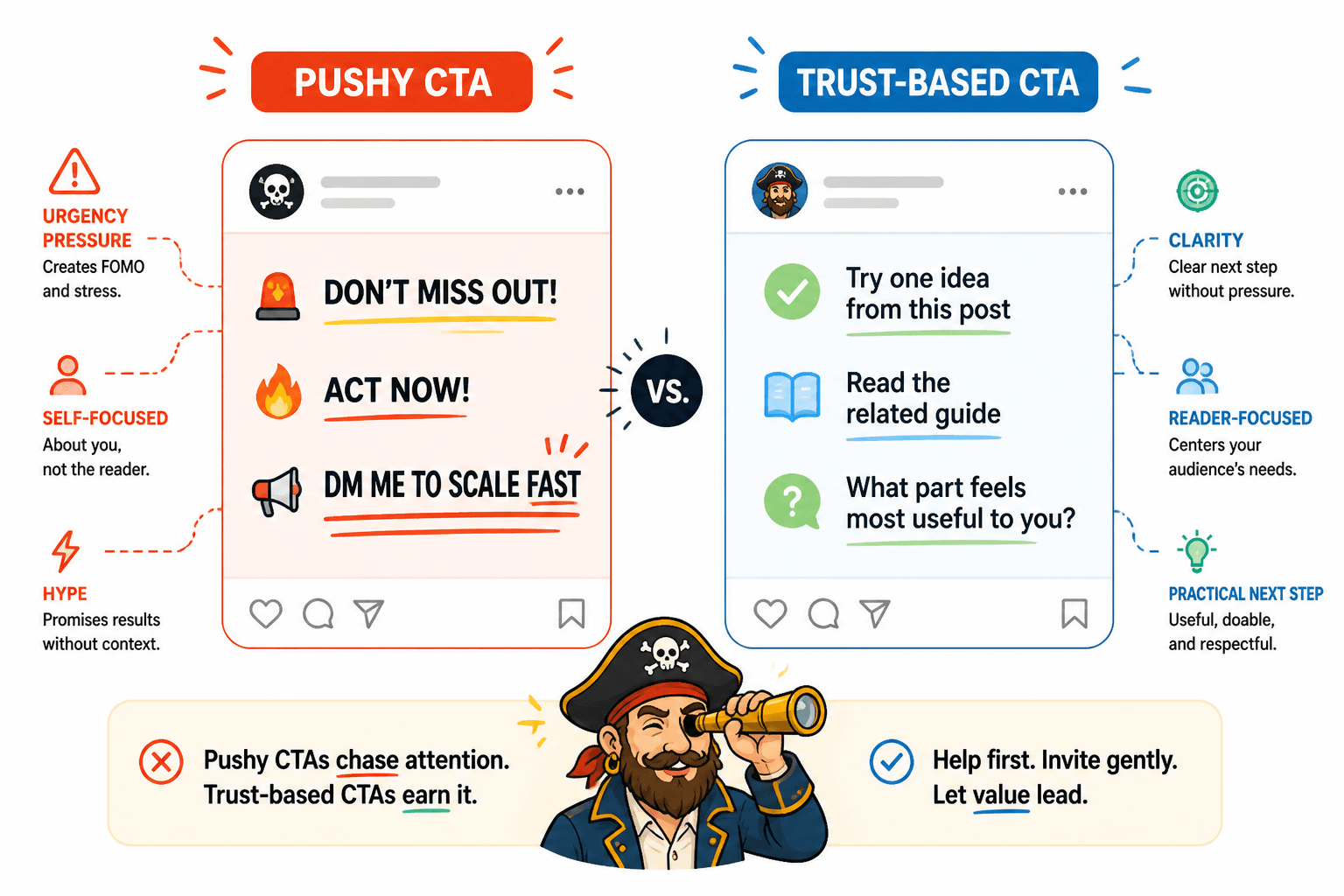
You can write a useful, sane, credible post and then wreck the whole thing with a CTA that suddenly sounds like it came from a launch sequence written in a panic.
Weak CTA
If you are ready to finally scale your content and dominate your niche, DM me the word AI and let’s unlock your next level.
Better CTA
If your AI-assisted posts sound too polished to trust, that is usually an editing problem, not a tool problem. I help creators fix that. Details are in my profile.
The second one is calmer. It fits the content. It does not demand a commitment from someone who just met you eight seconds ago.
If your goal is monetization, trust still has to come first. How to monetize creator AI editing and repurposing without wrecking trust goes deeper on that side of the equation.
Good CTA options for AI editing and repurposing content
- Invite the reader to test one idea
- Point them to a related article or resource
- Offer a simple next step through your profile
- Ask a genuinely relevant question
- Suggest one practical action they can take today
Not every post needs a lead-gen move. Sometimes the best CTA is just giving the reader a next thought to act on.
A practical workflow for writing creator AI editing and repurposing content
If you want a repeatable process, use this.
- Capture a strong raw idea. Use voice notes, rough writing, transcripts, or client questions.
- Define the point. What is the actual argument or takeaway?
- Choose the format. Post, thread, article, email, caption, bio, or script.
- Prompt with constraints. Tell AI what to preserve, avoid, and emphasize.
- Edit for voice. Remove hype, flattening, and anything you would never say.
- Add specifics. Include one example, one scenario, or one useful detail.
- Match the CTA to trust level. Keep it simple and sane.
- Repurpose from the core idea, not the exact wording.
This is not glamorous. It is effective. And unlike “just automate everything,” it does not leave your brand sounding like outsourced wallpaper.
For more workflow-specific reading, the broader creator AI workflows section is worth keeping nearby while you refine your process.
Mistakes creators keep making with AI-assisted repurposing
The bigger point is simple: clearer structure and clearer writing make the piece more useful. That is usually what makes the ending land better too.
The bigger point is simple: clearer structure and clearer writing make the piece more useful. That is usually what makes the ending land better too.