
Most Facebook story posts do not flop because the story was too long. They flop because the story did not actually go anywhere.
It rambled. It delayed the point. It sounded like a diary entry with a business cardigan thrown over it at the end. Or worse, it built up a perfectly decent story only to finish with a dead little shrug like, “What do you think?”
If you are writing story-driven Facebook posts to build trust, spark comments, and stay memorable, the mistakes are usually structural, not mystical. Facebook rewards posts people want to react to, reply to, and share with another human. That means your story needs shape, tension, and a reason to exist beyond “here is a thing that happened to me once.”
This is where a lot of creators, coaches, consultants, and personal brands get it wrong. They treat story posts like mini memoirs, or they copy polished LinkedIn storytelling and paste it onto Facebook. Bad move. Facebook story posts work better when they feel conversational, specific, and worth responding to.
Here’s how to spot the Facebook Story Post Mistakes That Hurt Performance, fix them, and write story posts people actually finish reading.
To see how this fits into the wider strategy, open the parent guide.
Why Facebook story posts underperform in the first place
A good Facebook story post is not just “content with a beginning, middle, and end.” It is a story with a point that fits the platform.
Facebook is more conversational than performative. People are not only asking, “Is this smart?” They are asking, “Do I care?” and “Do I have something to say back?”
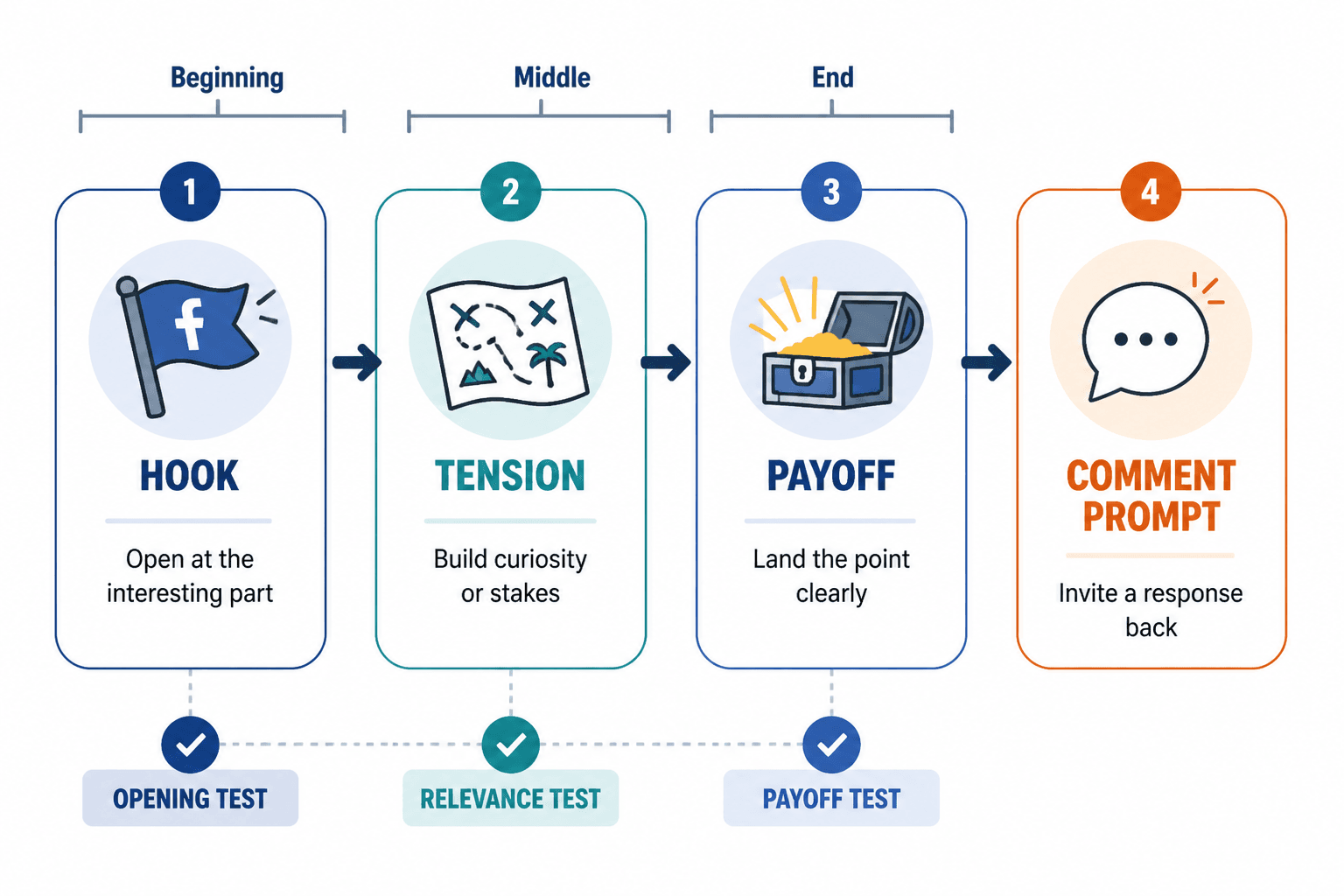
So when story posts underperform, it is usually because they fail one of three tests:
- The opening test: does the first line make anyone want to keep going?
- The relevance test: is this story interesting to the reader, not just to you?
- The payoff test: does the post land on a useful, sharp, or emotionally satisfying point?
Miss those, and no amount of “authenticity” will save it.
Facebook Story Post Mistakes That Hurt Performance
1. Starting too far away from the interesting part
A lot of story posts open like this:
Three years ago, when I was going through a season of transition, I had no idea one small moment would change the way I thought about business forever…
No one asked for this warm-up lap.
If the interesting part is that a client said something brutal, you forgot a key lesson mid-presentation, or your kid accidentally exposed a truth about your business, start there. Facebook readers decide fast. They are not patiently waiting for your scene-setting to bloom into relevance.
Better opening:
A client once told me, “I like your work. I just do not know what you actually do.”
That gives us a reason to continue. It has tension. It has a human voice. It sounds like something happened.
2. Making the story too private to be useful
Personal does not automatically mean compelling.
Some story posts read like the audience accidentally opened someone else’s journal. The details may be sincere, but sincerity is not structure. If readers cannot connect the story to a shared experience, useful insight, or interesting tension, they will drift.
You do not need to strip the personality out. You do need to translate the story so the reader can see themselves in it.
Ask:
- What is the larger idea behind this story?
- Why should someone else care?
- What tension or lesson makes this relevant beyond my own experience?
That shift turns “here’s what happened to me” into “here’s something you might recognize too.” Much better.
3. Telling a story with no clear point
This one is everywhere.
The post starts decently. There is a scene. A challenge. Maybe even a little tension. Then it just sort of trails into a vague moral about growth, mindset, or “trusting the process.” Which is content-speak for “I did not know how to end this.”
Your story post needs a point. Not a TED Talk. Just a clear takeaway.
That point can be:
- A lesson
- An opinion
- A pattern you noticed
- A mistake to avoid
- A belief that changed
- A question that creates discussion
But it has to be there. Otherwise readers finish the post and feel nothing except mild resentment about the time you borrowed.
4. Overexplaining every beat of the story
Facebook is not the place to narrate every micro-detail unless those details create tension or texture.
Too many story posts sound like this:
I got up, made coffee, checked my calendar, noticed I was running late, grabbed my laptop, got in the car, and started thinking about something my coach had said…
Half of that can go. Probably more.
Readers do not need a full surveillance report. They need the details that make the story vivid and the point believable. Keep the parts that add emotion, contrast, or consequence. Cut the rest.
If you want help tightening loose writing, this is the same skill behind rewriting boring Facebook posts. A story gets stronger when the filler stops clogging it.
5. Sounding too polished to feel real
Facebook story posts usually perform better when they sound like a person, not a brand team doing impression management.
If your story reads like it was ironed flat by AI or polished into motivational glass, people can feel that. They may not say, “This sounds fake,” but they respond less because it feels less human.
Common signs:
- Every sentence sounds equally formal
- The emotion feels staged
- The lesson sounds too neat
- The ending tries too hard to be profound
You do not need to write messily. You do need some texture. A real phrase. A little friction. Maybe even a line that sounds like something an actual person would say out loud.
Clean is good. Sterile is not.
6. Turning every story into a lesson machine
Not every story needs to end with “Here are 3 things this taught me about entrepreneurship.”
That format gets old fast, especially on Facebook. Story posts do not always need to convert into tidy listicles. Sometimes the stronger move is a sharp observation, a single sentence insight, or a comment prompt that invites people into the conversation.
Compare these endings:
- Weak: “Here are five lessons this moment taught me about resilience.”
- Stronger: “It reminded me that most people do not need more information. They need clearer language.”
- Also strong: “Curious if you have had a moment where someone misunderstood your work so badly it exposed a messaging problem.”
Facebook likes interaction. Give people a thought to respond to, not a laminated seminar handout.
7. Forcing a sales pitch into the ending
Nothing kills a decent story post faster than a clunky pivot into “and that’s why you should book a discovery call today.”
Yes, your content should support the business. No, that does not mean every story has to finish by lunging at the wallet.
If the post naturally leads into an offer, fine. If not, let the post build trust. Story posts often work better higher up the relationship ladder. They warm people up. They help readers feel like you get something real. That matters.
If you do want a CTA, keep it soft and relevant. Something like:
- “If this sounds familiar, I wrote more about this here…”
- “If your content has this problem too, that is exactly what I help fix.”
- “If you want more posts like this, follow along.”
For stronger, less awkward endings, see better Facebook post CTA endings for personal brands.
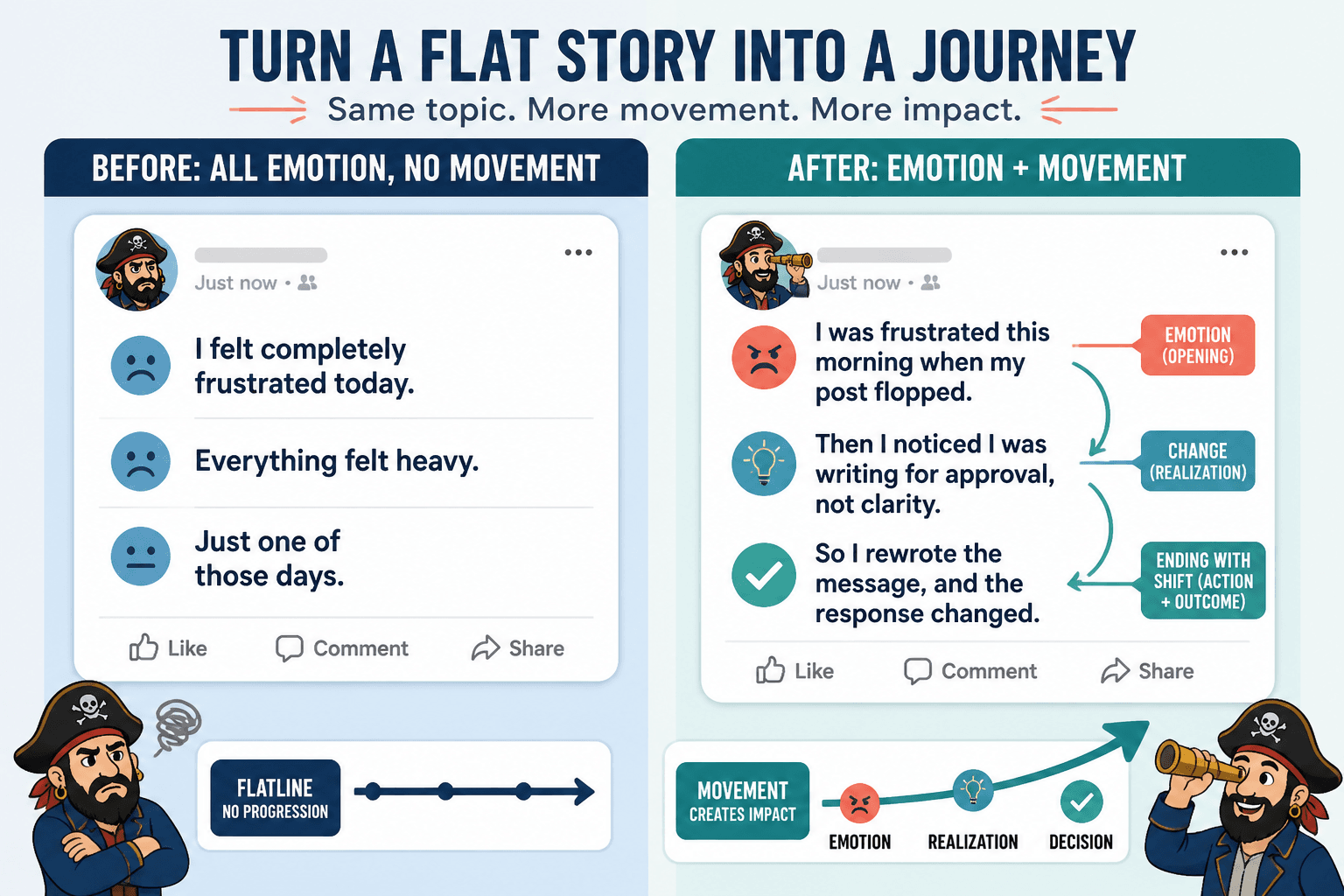
8. Writing stories that are all emotion and no movement
Some story posts have feeling, but no progression. The whole thing sits in one emotional note. Frustration. Gratitude. Sadness. Pride. Fine, but then what?
Stories need movement. That does not mean dramatic plot twists. It means something changes:
- You realized something
- You were challenged
- You saw a contradiction
- You changed your mind
- You made a decision
- You noticed a pattern
Without movement, a story becomes a mood update. Those can work if you are already widely known or outrageously funny. Most people should not rely on that.
9. Copying LinkedIn storytelling onto Facebook
This is a sneaky one because the post might still look “good” on paper.
But Facebook and LinkedIn are not the same room. LinkedIn often rewards cleaner authority, career framing, and more explicit professional lessons. Facebook usually responds better to a looser, more conversational style with stronger community energy.
If your story post sounds like this, it probably needs work:
Yesterday reminded me of an important leadership principle that applies to business, communication, and long-term growth.
That sentence has oxygen, but no pulse.
Try:
Yesterday, someone repeated my own offer back to me so badly I realized my messaging had a real problem.
Still professional. Much more alive.
If you want a broader sense of what works on the platform, the main guide to Facebook posts is a useful next stop. You can also browse more ideas in social media writing and Facebook writing resources.
10. Ending with a lazy question
Not every post needs a question. And definitely not this one:
Can anyone relate?
That question usually signals that the writer did not know how to create a real conversation prompt, so they tossed a generic one at the end and hoped for mercy.
Good ending questions are specific enough to answer and relevant enough to feel worth answering.
For example:
- “Have you ever had someone misunderstand your offer in a way that showed your messaging was too vague?”
- “What is one story your audience keeps telling you that reveals a bigger problem?”
- “Do you prefer story posts that end with a lesson, an opinion, or a question?”
Specific beats generic almost every time.
A simple structure for better Facebook story posts
If your story posts keep falling flat, use this shape. It is simple enough to remember and flexible enough to sound like you.
1. Hook with the tension
Open with the moment, problem, contradiction, or line that makes someone curious.
Examples:
- “A client complimented my work and accidentally exposed a big messaging problem.”
- “I almost deleted a post that ended up starting three client conversations.”
- “Someone asked what I do, and my answer was bad enough to annoy me all afternoon.”
2. Add only the details that matter
The bigger point is simple: clearer structure and clearer writing make the piece more useful. That is usually what makes the ending land better too.
Facebook posts work best when the point is easy to follow and worth reacting to. Clearer structure usually beats longer wandering.