
Most Facebook post CTAs are doing too much or not enough.
They either lunge at the reader with “DM me if you’re ready to transform your life,” or they end with a lifeless question that sounds like it was stapled on by a scheduling tool. Neither works especially well for personal brands trying to build trust.
Better Facebook CTA endings for personal brands are usually simpler than people think. They do not need to sound polished. They need to fit the post, match the relationship, and make the next step feel natural instead of weirdly transactional.
If your posts get some likes but weak comments, no real conversations, and not much movement toward leads or clients, the ending may be part of the problem. A good CTA does not rescue a boring post, but a bad one can absolutely flatten a good post right at the finish line.
Here’s how to write Facebook CTA endings that feel human, invite response, and help your content actually do something useful for your business.
For the main guide behind this topic, visit the parent guide.
Why Facebook CTAs need a different approach
Facebook is not LinkedIn in a hoodie. The tone is different. The reading behavior is different. The kind of response people are willing to give is different too.
On Facebook, people respond better to posts that feel conversational, specific, and socially easy to engage with. That matters at the ending. If your CTA suddenly shifts into webinar-funnel mode, the post stops feeling like a post and starts feeling like a trap.
That is why so many personal brands get awkward results from otherwise decent content. The post sounds like a person. The final line sounds like a cold marketing intern took over.
A strong Facebook CTA ending usually does one of three things:
- Invites a low-friction comment
- Encourages a natural next step
- Extends the conversation without forcing it
That’s the game. Not “maximize engagement.” Not “drive insane urgency.” Just make it easy for the right people to keep moving.
What makes a Facebook CTA ending actually work
The best CTA endings feel like a logical extension of the post.
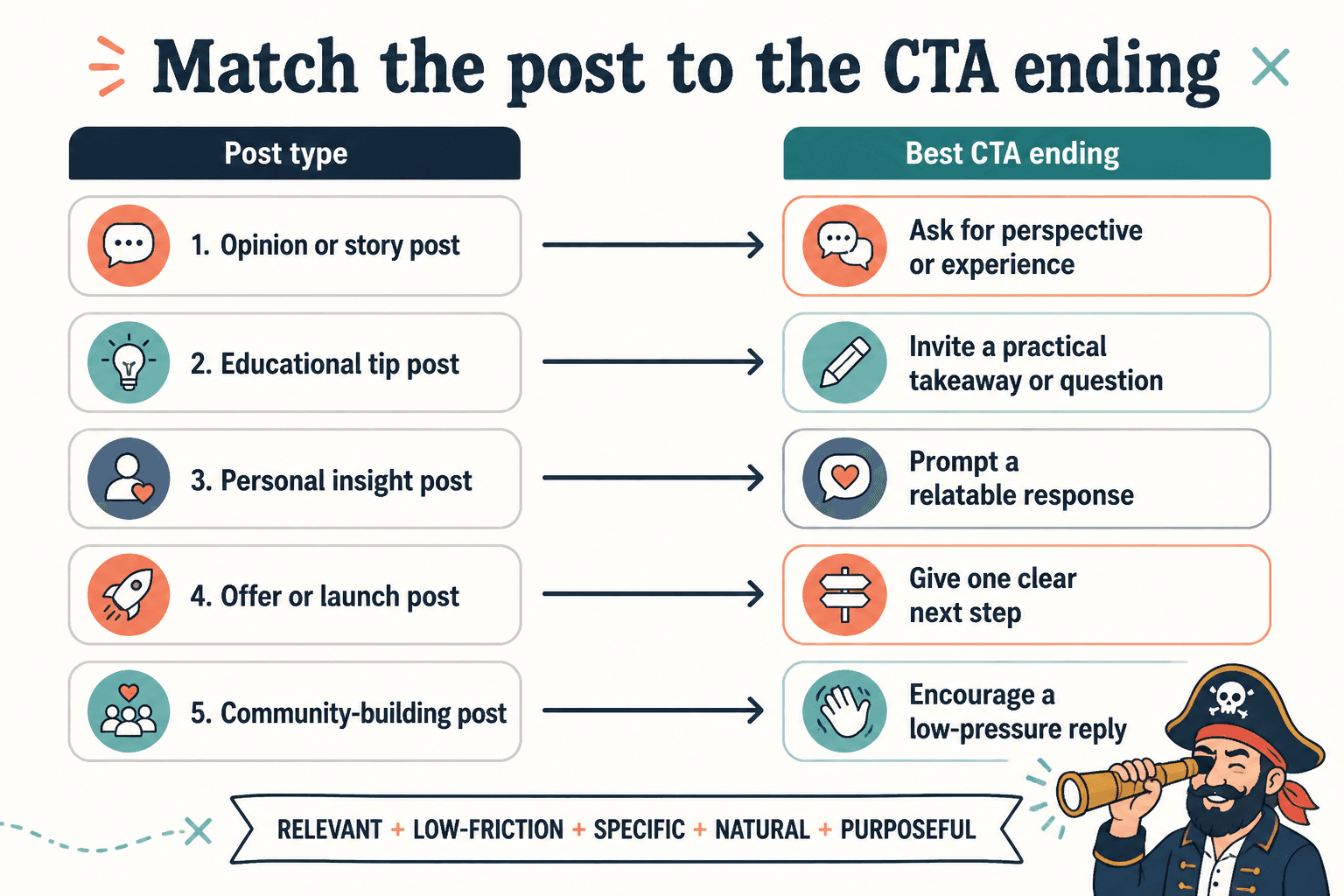
If you shared an opinion, the CTA can invite perspective. If you shared a story, the CTA can ask for a related experience. If you taught something practical, the CTA can ask which part landed or offer a resource. If the post is aimed at lead generation, the CTA should still feel proportional to the amount of trust you have earned in that specific post.
Good CTA endings usually have these traits:
- Relevant: They match the post that came before them.
- Low-friction: They do not ask the reader to do emotional admin.
- Specific: They make it obvious how to respond.
- Natural: They sound like something a real person would actually say.
- Purposeful: They are trying to create a useful next step, not just random activity.
Weak CTA endings usually fail because they are vague, needy, too salesy, or disconnected from the rest of the post.
If the CTA feels bolted on, readers feel it too.
5 types of better Facebook CTA endings for personal brands
You do not need a hundred CTA formulas. You need a few reliable types you can match to the right kind of post.
1. The conversation CTA
This is for posts built to spark comments and rapport.
It works best when you have shared an opinion, observation, story, or relatable frustration. The goal is not to “boost engagement.” The goal is to start an actual discussion with people who care about the topic.
Good examples:
- What part of this do you agree with, and where do you see it differently?
- Curious if you’ve noticed this too, or if this is just my corner of the internet being chaotic again.
- What’s your version of this in your business?
- Have you run into this lately?
Why these work: they give people a clear lane. Respond with agreement, disagreement, experience, or example. That is much easier than “Thoughts?” which is the content equivalent of shrugging at strangers.
2. The reflection CTA
This works well for personal-brand posts with a lesson, mindset shift, or behind-the-scenes realization.
It invites the reader to think, but without sounding fake-deep. Facebook can handle thoughtful posts just fine. It just does not need a grand piano soundtrack under them.
Examples:
- If this hit a nerve, that may be the part worth looking at.
- You do not need to comment, but you probably know exactly which part applies right now.
- If this is where you’re stuck, start there instead of pretending the problem is “consistency.”
- Might be worth asking yourself where you’re making this harder than it needs to be.
This kind of CTA is especially useful when the post is more about trust and positioning than comments. It still creates momentum, just more quietly.
3. The soft lead CTA
This is where many personal brands get clumsy. They either avoid offers entirely or pitch way too hard. There is a middle ground, and it’s usually where better leads come from.
A soft lead CTA works when the post has already demonstrated relevance and usefulness. The ask should feel like a continuation, not a jump cut into sales mode.
Examples:
- If you want help fixing this in your own content, send me a message and I’ll tell you if I can help.
- I work on this with clients all the time. If you want a cleaner version of this in your business, feel free to reach out.
- If this is the bottleneck in your marketing right now, I’ve got a few ways to help. Happy to point you in the right direction.
- If you want the template I use for this, comment “template” and I’ll send it over.
Notice the tone. Calm. Clear. No chest-beating. No fake urgency. No “spots are filling fast” nonsense unless that is genuinely true and actually relevant, which it usually is not.
4. The action CTA
This is for practical posts where the reader should do something with what they just read.
It works especially well for creators, coaches, consultants, and service businesses teaching a process, framework, or content tip.
Examples:
- Try this on your next post before you write anything else.
- Go check your last three posts and see if this is the part they’re missing.
- Use this as a filter before you publish this week.
- If your content feels flat, start by fixing this one piece first.
These CTAs are underrated because they do not scream for attention. But they strengthen authority. When readers use your advice and it works, trust goes up.
5. The community CTA
This is useful when your Facebook strategy depends on relationship-building more than immediate conversion. Think creators with engaged followings, consultants building familiarity, or personal brands that want stronger repeat commenters.
Examples:
- I’d love to hear how you handle this.
- Steal this if it helps, and tell me how you’d tweak it.
- Tell me the version of this you see in your world.
- If you’ve got a better take, I’m listening.
That last one works because it lowers the social pressure. It invites contribution instead of applause. Big difference.
Bad Facebook CTA endings to stop using
Some CTA endings are not evil. They are just tired, vague, or badly matched to how people actually behave on Facebook.
| Weak CTA | Why it underperforms | Better direction |
|---|---|---|
| Thoughts? | Too vague. Reader has to invent the response. | Ask a narrower question or invite a specific kind of reaction. |
| Can anyone relate? | Feels generic and slightly needy. | Name the exact experience you want people to weigh in on. |
| DM me to learn more | Cold and salesy if the post has not earned it. | Offer help more softly and more specifically. |
| Agree? | Often reads like engagement bait. | Invite perspective, examples, or pushback. |
| What do you think? | Still too broad in most cases. | Ask what part landed, what people disagree with, or what they’ve seen. |
One more thing: not every Facebook post needs a question mark at the end. Some posts are stronger with a statement CTA or a quiet nudge. Constantly ending with a question can make your posts feel formulaic fast.
How to match the CTA ending to the kind of Facebook post you wrote
The easiest way to improve your CTA endings is to stop treating them like interchangeable toppings.
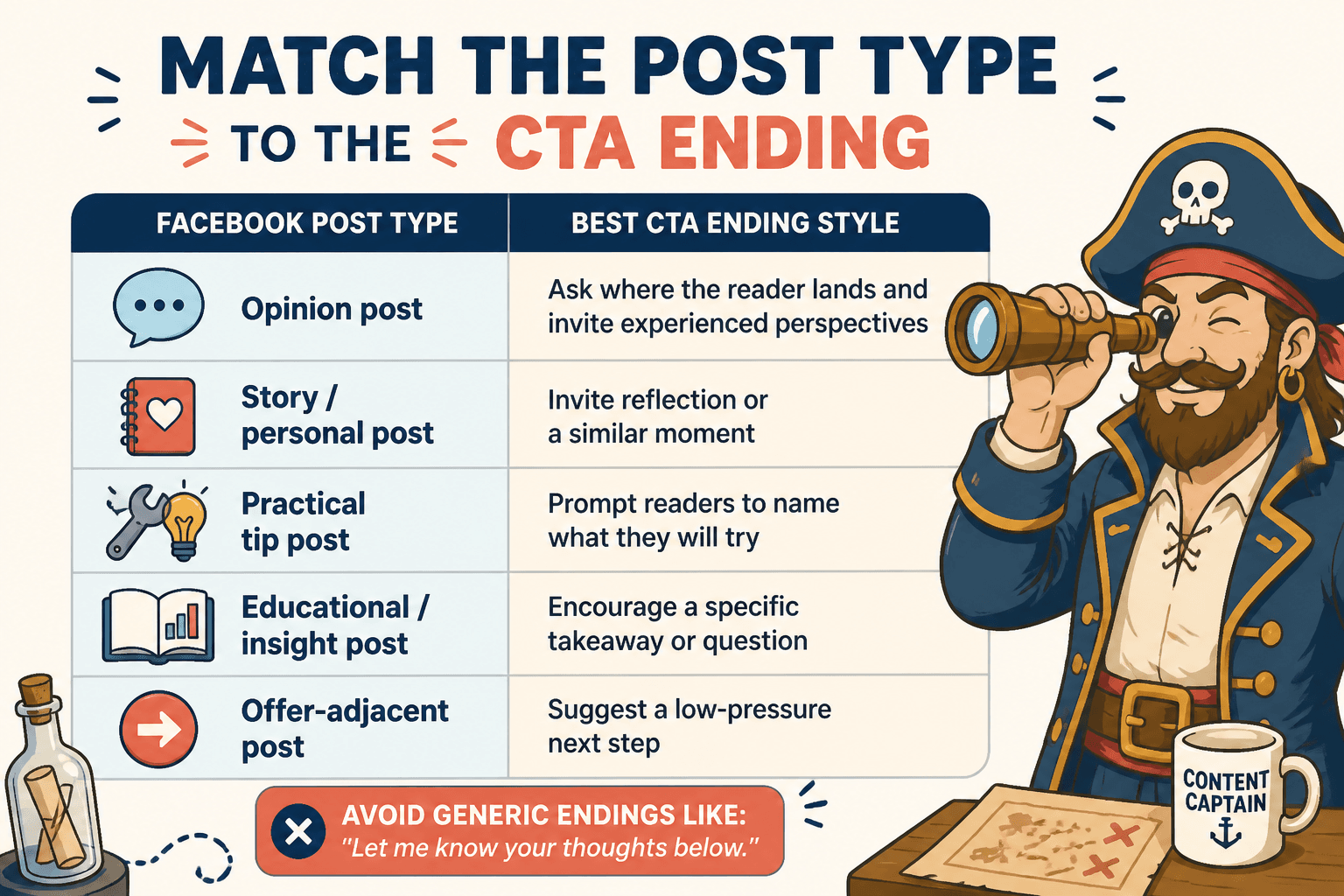
Different posts need different endings. If your post is story-driven, your CTA should usually open conversation or reflection. If your post is tactical, your CTA should encourage action or offer a useful next step. If your post sets up your expertise clearly, then a soft lead CTA may make sense.
- Opinion post: Invite agreement, disagreement, or examples.
- Story post: Ask for a similar experience or shared lesson.
- Teaching post: Prompt action, testing, or follow-up questions.
- Behind-the-scenes post: Invite reflection or practical curiosity.
- Offer-adjacent post: Suggest a low-pressure next step.
This sounds obvious, but plenty of posts still end like this:
Post: specific, useful, thoughtful.
CTA: “Let me know your thoughts below.”
That is not a CTA. That is an exhausted placeholder.
For a broader strategy on post structure and tone, it’s worth reading these Facebook post writing resources and the more practical guide on how to write better Facebook posts.
Before-and-after Facebook CTA rewrites
Here’s where this gets more useful. A lot of people do not need more theory. They need to see the rewrite.
Example 1: opinion post
Weak ending: What do you think?
Better ending: Curious where you land on this, especially if you’ve tried both approaches.
Why it’s better: it narrows the kind of response and gives experienced readers a reason to speak up.
Example 2: practical tip post
Weak ending: Hope this helps.
Better ending: Try this on your next post and see if the response changes.
Why it’s better: it creates movement. “Hope this helps” is polite, but it has no job.
Example 3: story with lesson
Weak ending: Can anyone relate?
Better ending: If you’ve had a version of this happen in your business, I’d love to hear what it taught you.
Why it’s better: it invites richer responses and filters for people with relevant experience.
Example 4: soft sales post
Weak ending: DM me now if you need help.
Better ending: If this is the part of your content that’s getting messy, send me a message and I’ll tell you if I can help.
Why it’s better: more specific, less pushy, and easier to trust.
A simple formula for writing better Facebook CTA endings
If you want a repeatable way to write better Facebook CTA endings for personal brands, use this:
- Step 1: Ask what the post is trying to do.
- Step 2: Decide the most natural next step for the reader.
- Step 3: Make that next step easy and specific.
- Step 4: Remove any phrase that sounds like marketing residue.
In practice, that means:
The bigger point is simple: clearer structure and clearer writing make the piece more useful. That is usually what makes the ending land better too.