
Most lead magnets do not underperform because the PDF looked ugly or the headline needed one more “power word.” They underperform because the so-called quick win is either too small to matter, too vague to use, or too disconnected from the paid thing you actually sell.
That is the trap behind a lot of lead magnet advice. People hear “give them a quick win” and translate that into “throw together a checklist by Thursday.” Then they wonder why signups are weak, downloads go unopened, and the email list fills up with people who never buy anything.
If you want better results, the goal is not just a fast win. It is a relevant win. A useful win. A win that creates trust and naturally leads to the next step. This article breaks down the lead magnet quick win mistakes that hurt performance, why they happen, and how to fix them without turning your freebie into a bloated mini-course no one asked for.
If you want broader context on what makes a lead magnet work in the first place, start with the lead magnets guide for creators who want better results or browse the main lead magnets hub.
For the main guide behind this topic, visit the parent guide.
What people get wrong about the “quick win” idea
A quick win is not supposed to be a random small tip.
It is supposed to help someone experience progress fast enough that they think, “Okay, this person gets my problem and can help me solve it.” That is different from giving them a mildly interesting worksheet they save to a folder called “resources” and never open again.
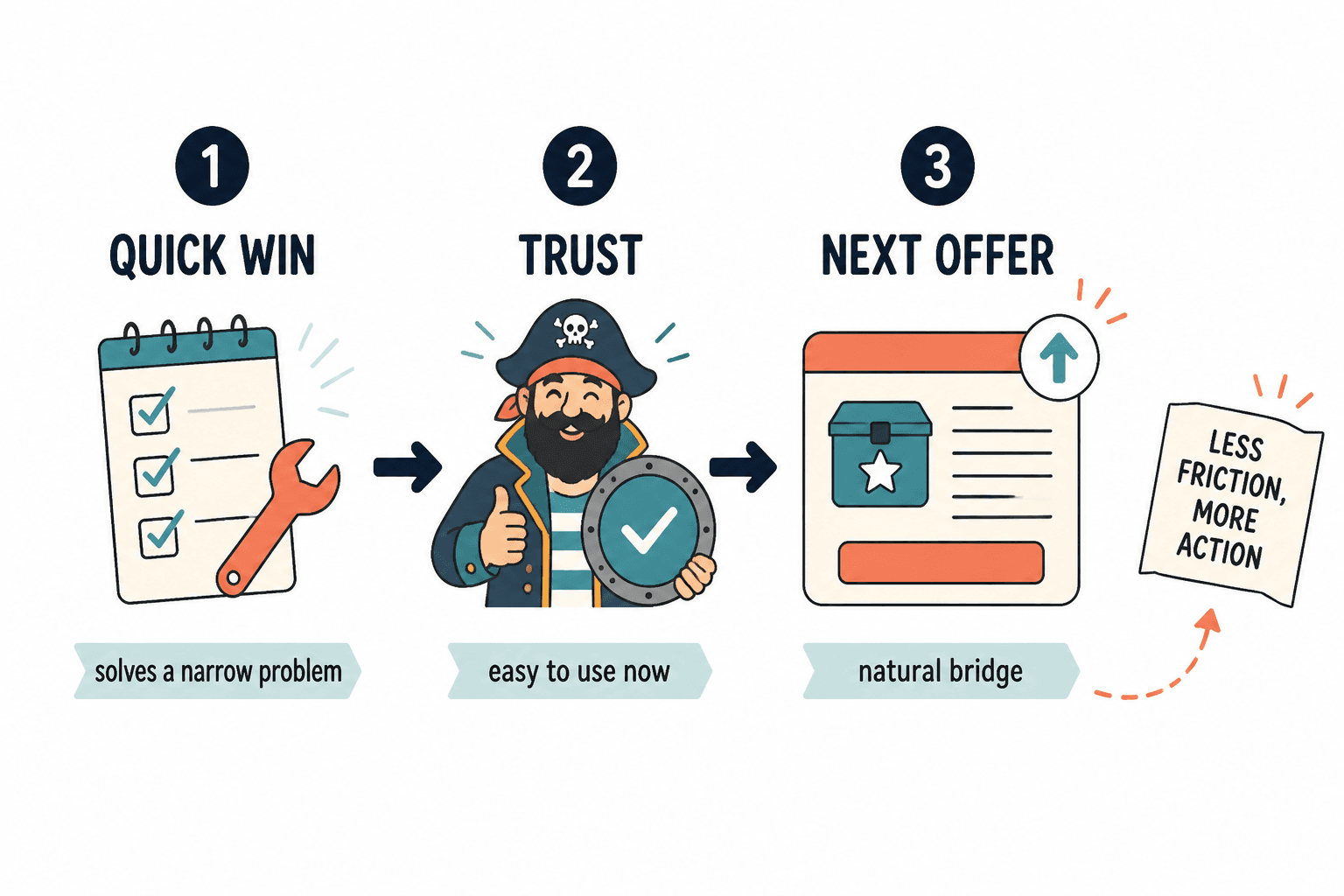
The best quick wins do three things at once:
- They solve a narrow, annoying problem
- They are easy to use right away
- They create a natural bridge to your paid offer, service, or deeper content
If one of those pieces is missing, performance usually drops. Sometimes signups drop. Sometimes conversions drop. Sometimes you get plenty of subscribers and almost no buyers, which is its own special kind of fake progress.
Quick win lead magnets work best when they reduce friction, not when they perform as tiny monuments to your expertise.
Lead magnet quick win mistakes that hurt performance
Here are the mistakes that show up constantly, especially for creators, coaches, consultants, and service businesses trying to grow leads without sounding like an internet mall kiosk.
1. The win is too generic to feel useful
“10 tips for better content” is not a quick win. It is a polite nothing.
Generic lead magnets attract generic attention. They sound broad, safe, and easy to make, which is exactly why they often flop. Nobody feels urgency around vague improvement. People act when they can see the problem clearly and imagine relief fast.
Weak: “Content Planning Checklist”
Stronger: “A 15-Minute Weekly Content Planning Template for Solo Creators Who Keep Posting Last Minute”
The stronger version has a user, a use case, and a believable outcome. It sounds like it belongs to a real person with a real mess to clean up.
2. The quick win solves the wrong problem
This one is sneaky. The lead magnet may be genuinely helpful, but it helps with a side issue, not the core buying problem.
Say you sell messaging strategy for consultants. If your freebie is “50 Canva post ideas,” you might get signups, but they may be the wrong signups. You are attracting people who want surface-level content prompts, not people who are ready to invest in positioning, offer clarity, or conversion-focused messaging.
A lead magnet should help with an early-stage version of the same problem your paid work solves. Not a random adjacent problem. Not a cute bonus topic. Not whatever seemed easiest to package at 11:40 p.m.
If you need examples of stronger lead magnet types that align better with real offers, this roundup of lead magnet ideas and examples for creators will help.
3. It gives information, not momentum
A lot of freebies are technically useful and practically inert.
They explain things. They define things. They include nice thoughts about what someone should do. But they do not create action. And if the lead magnet does not lead to movement, the person does not feel a win. They just feel informed, briefly. Then life happens, the tab closes, and you become another unopened email in a crowded inbox.
A quick win should make action easier than procrastination.
That usually means including one of these:
- A fill-in template
- A short decision framework
- A swipe file with examples
- A checklist with clear sequence
- A script someone can adapt in minutes
- A tiny implementation plan
Formats matter here. The best delivery method is often the one that reduces effort the most, not the one that looks most “premium.” If you want practical format ideas, see simple lead magnets delivery formats and templates for busy creators.
4. The win is too tiny to build trust
Yes, keep it focused. No, do not make it flimsy.
Some creators hear “quick win” and respond with something so slight it feels disposable. One quote graphic. Three recycled tips. A one-page checklist with no explanation. That is not a quick win. That is a content crumb wearing a funnel hat.
Your lead magnet should be fast to use, not shallow to the point of uselessness. People need enough substance to think, “If this is free, the paid offer is probably worth a look.”
A useful test: would the reader get a visible result, better decision, clearer draft, or saved hour from this? If not, it probably needs more depth, better examples, or a more specific promise.
5. The win is too big, so nobody finishes it
And then we swing to the opposite problem.
Some lead magnets are not quick wins at all. They are free courses disguised as downloads. Forty pages. Twelve modules. Homework. Videos. Bonus vault. Probably a dashboard nobody wanted to log into. All for a person who just met you five seconds ago.
Bigger does not automatically mean better. Usually it means more friction. More delay. More chance the person puts it off until “later,” which is where digital resources go to die.
The sweet spot is enough value to earn trust, but small enough that someone can consume and use it quickly. Think first useful result, not total transformation.
6. The signup hook promises one thing, but the lead magnet delivers another
This kills trust fast.
If the landing page promises “a plug-and-play sales page framework,” and the download turns out to be a vague brainstorming worksheet, people feel baited. Even when the resource is decent, the mismatch creates disappointment. That disappointment follows your brand into the next email.
Your signup hook should be specific, honest, and tightly matched to what the person receives. Not inflated. Not padded. Not written like a tiny infomercial.
If your signup page feels too bland or too broad, this article on how to improve lead magnets signup hooks without sounding generic is worth a read.
7. There is no obvious path to the next step
A lead magnet is not just a giveaway. It is part of a trust path.
Too many freebies stop at delivery. The person opts in, gets the resource, maybe gets one “here you go” email, and then nothing points them forward in a useful way. No next action. No related offer. No deeper resource. No invitation to continue.
The quick win should lead naturally to a next step such as:
- Reading a related article
- Joining your newsletter
- Watching a short walkthrough
- Booking a consultation
- Using a paid template pack
- Replying with a question
Not every lead magnet needs a hard sell. In fact, most should not. But it should make the next move obvious. Otherwise you are collecting emails like a dragon collects decorative objects. Impressive pile. Questionable utility.
For a broader look at how lead magnets fit into your monetization path, you can also explore the monetization and lead magnets section.
8. The lead magnet attracts freebie hunters instead of buyers
Not everyone who downloads your free thing is a bad lead. Obviously. But some lead magnets are shaped in a way that attracts people who want endless free resources and have no intent to solve the bigger problem seriously.
This usually happens when the lead magnet is broad, trendy, and disconnected from the actual paid outcome. Massive template vaults, giant resource libraries, or catch-all “ultimate guides” can do this if they are not carefully positioned.
A stronger lead magnet often filters a little. It speaks to a specific problem, stage, audience, or use case. That may lower raw signup volume, but it often improves lead quality. And quality matters more than applause metrics pretending to be business growth.
9. It is built around what you want to teach, not what they want solved
This is one of the most common expert mistakes.
You know the deeper system. You understand the nuance. You want to educate people properly. Fair. But your audience often wants a simpler entry point. They do not wake up thinking, “I would love a conceptual framework for message architecture today.” They wake up thinking, “Why is nobody replying to my pitch?”
The best lead magnets meet the reader at the surface pain while quietly introducing the deeper thinking underneath. That is good strategy. You solve the thing they feel while setting up the thing they actually need.
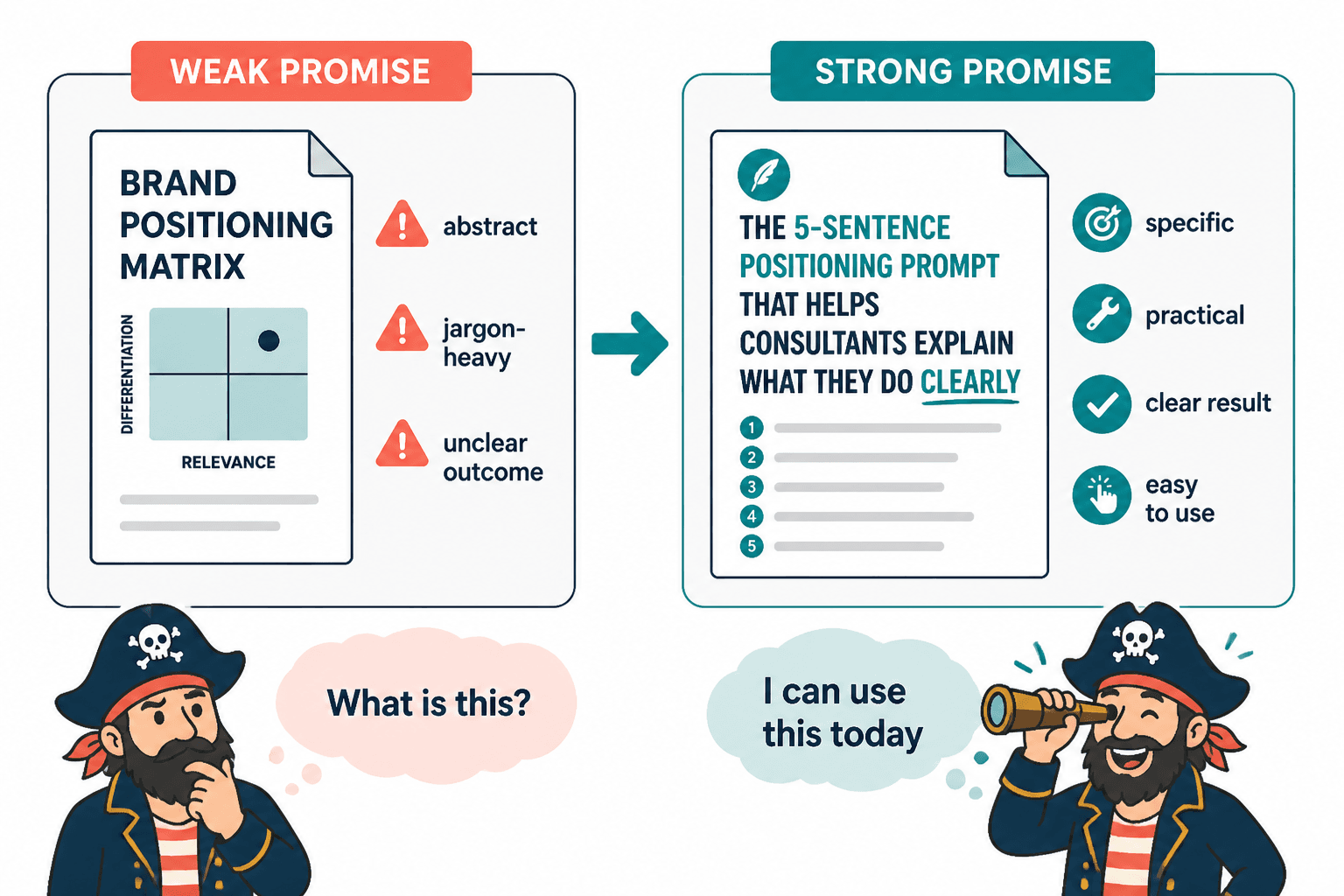
That may mean reframing your topic from:
- “Brand Positioning Matrix”
- to “The 5-Sentence Positioning Prompt That Helps Consultants Explain What They Do Clearly”
Same expertise. Better packaging. Much more likely to get used.
10. The quick win is isolated from your content ecosystem
Your lead magnet should not feel like a random object floating in space.
It should connect to your posts, your articles, your email welcome flow, your offer, and your profile messaging. When it does, trust compounds. People can see the same clear point of view across everything. When it does not, the lead magnet feels like a disconnected growth tactic you found in a checklist somewhere.
A healthy content path might look like this:
- A post calls out a specific problem
- The post points to a relevant lead magnet
- The lead magnet helps solve one immediate piece of that problem
- The follow-up emails deepen the issue and show what comes next
- The reader is invited to the most logical paid step
Simple. Coherent. Much better than spraying freebies around and hoping commerce appears.
How to fix a weak quick win lead magnet
If your lead magnet already exists and results are soft, you probably do not need to scrap the whole thing. Usually you need to tighten the promise, narrow the problem, improve usability, and add a clearer bridge to what comes next.
A simple 5-part fix
- Name the exact problem
What frustrating, specific issue is this helping solve? - Define the immediate result
What can they do, decide, write, fix, or understand within a short time? - Reduce effort
Can this become a checklist, script, example pack, prompt set, or template instead of a lecture? - Align it with your paid offer
Does the free win naturally point toward the bigger transformation you sell? - Add the next step
What should they do after using it?
That last one matters more than people think. A freebie with no next step often creates dead-end subscribers. A freebie with a smart next step creates momentum.
Before and after: quick win lead magnet rewrites
Here is what this looks like in practice.
| Weak version | Why it struggles | Stronger version |
|---|---|---|
| Social Media Tips PDF | Too broad, no visible outcome | 7 Plug-In Post Openers for Consultants Who Sound Too Generic Online |
| Email Marketing Checklist | Useful-sounding, but vague and forgettable | The 10-Point Welcome Email Check That Fixes Cold, Awkward First Emails |
| Brand Workbook | Feels heavy and unclear | A 20-Minute Brand Message Prompt Pack for Creators Who Cannot Explain What They Do |
| Lead Generation Guide | Too big, too broad, no quick payoff | 3 Simple DM Starters That Turn Warm Content Readers Into Real Sales Conversations |
Notice the pattern. The stronger versions are narrower, easier to picture, and more likely to produce action. They sound like tools, not school assignments.
What a good quick win actually looks like
A strong quick win lead magnet usually has these traits:
- It targets one clear problem
- It can be used in one sitting
- It helps the reader make visible progress
- It reflects your real expertise
- It naturally leads toward your paid solution
- It is framed with a specific, honest promise
That could be a short template pack, a message script, a swipe file, a mini audit checklist, a decision tool, or a short implementation guide. It does not need to be flashy. It needs to be usable.
And this is where a lot of people overcomplicate things. They chase the perfect format before they have nailed the actual utility. But a plain Google Doc with sharp content will outperform a polished freebie that says almost nothing. Every time.
A quick evaluation checklist before you publish
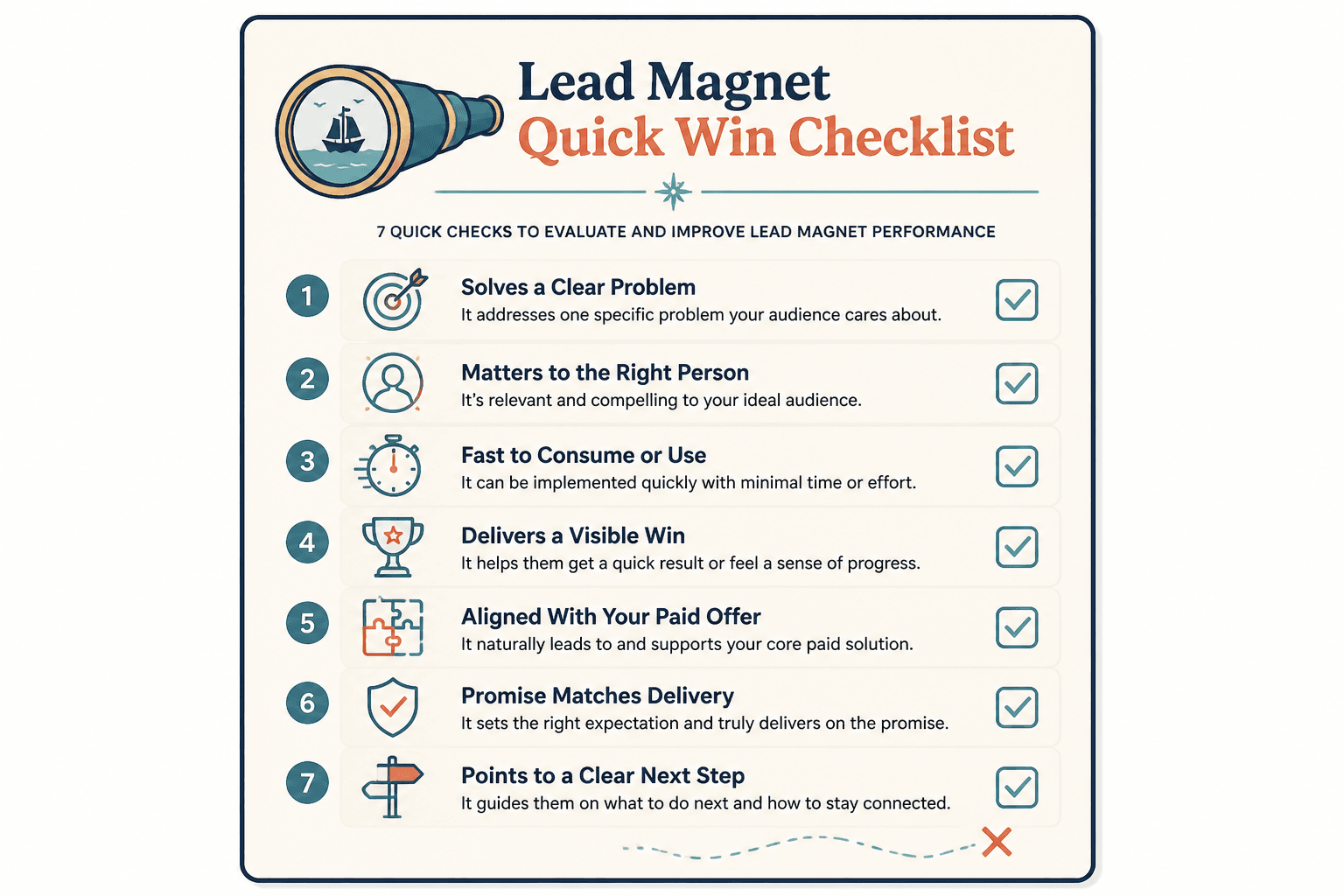
Run your lead magnet through these questions:
- Can I describe the problem it solves in one sentence?
- Would the right person immediately understand why this matters?
- Can they use it fast without a lot of setup?
- Does it create a visible win, not just vague insight?
- Is it aligned with what I actually sell?
- Does the signup promise match the delivery?
- Is there a clear next step after they use it?
If you hesitate on more than two of those, that is probably the issue. Not your email software. Not the button color. Not Mercury being in retrograde. The lead magnet itself likely needs work.
Small FAQ
How long should a quick win lead magnet be?
Long enough to create a real result. Short enough that someone can use it quickly. For most creators, that is often 1 to 10 pages, a short template, a checklist, a script pack, or a brief walkthrough.
Should every lead magnet offer a quick win?
Mostly, yes. Even deeper resources should give the reader some immediate clarity, action, or momentum. If the payoff is too delayed, completion and conversion usually suffer.
Can a checklist be enough?
Yes, if it is specific and actionable. No, if it is just a generic list of obvious reminders.
What matters more, signup volume or buyer quality?
Buyer quality. A smaller list of relevant people beats a bigger list of freebie collectors who never wanted your actual offer.
Make the quick win worth winning
The best fix for lead magnet quick win mistakes that hurt performance is not more hype. It is better alignment.
Give people a fast result they actually care about. Make it easy to use. Make it specific. Make it relevant to the bigger problem you solve. Then show them the next logical step while trust is warm.
That is how a lead magnet stops being a polite freebie and starts acting like a real part of your funnel.
If your current one is broad, forgettable, or weirdly disconnected from your offer, do not add more pages. Tighten the problem. Sharpen the promise. Improve the path. That is usually where the performance lives.
Lead magnets work best when they solve one real problem cleanly and make the next step feel natural. The clearer the bridge from free value to real offer, the stronger the whole system gets.