Most homepage copy does one of two bad things when money enters the chat.
It either gets weirdly shy about selling, so visitors leave with a vague sense that you seem nice but do not know what you actually offer. Or it turns into a pressure-soaked pitch deck in paragraph form, full of claims, urgency, and promises that make people trust you less with every scroll.
That is the real challenge behind How to Monetize Homepage Copy Without Wrecking Trust. You do need your homepage to help generate leads, sales, bookings, and inquiries. But if your copy starts sounding like it was written by a funnel goblin with a conversion spreadsheet and no social skills, you are going to lose the exact people you wanted to convert.
The good version sits in the middle. Your homepage should make the business model obvious, the next step easy, and the buying path feel sane. It should help people understand what you do, who it is for, why it matters, and what they should do next without making them feel cornered.
Here is how to make your homepage pull its weight commercially without sounding slippery, needy, or weirdly desperate.
If you want the bigger picture, start with the parent guide.
What “monetize homepage copy” actually means
Monetizing homepage copy does not mean turning every section into a sales pitch.
It means your homepage helps move a visitor toward revenue in a way that fits their level of awareness and trust. Sometimes that means they book a call. Sometimes they join your email list. Sometimes they click to a service page, product page, or case study. Sometimes they just realize, “Ah, this person is for me,” and come back later ready to buy.
So the job is not “sell immediately at all costs.” The job is to reduce friction between interest and action.
If your homepage gets attention but does not direct it, you have a branding asset. Cute. If it directs people aggressively before trust exists, you have a leak. What you want is a homepage that earns belief and channels intent.
If your broader site messaging still feels muddy, start with the bigger picture in website conversion copy and homepage copy. Monetization gets much easier when the fundamentals are not wobbling.
Trust breaks when the homepage asks for too much too soon
People do not land on your homepage already convinced. They land with questions.
- What do you actually do?
- Is this for someone like me?
- Do you understand my problem?
- Can I trust your judgment?
- What happens if I click?
Bad homepage monetization skips those questions and jumps straight to “Book now,” “Apply today,” or “Get instant access before spots disappear.” That kind of copy can work when trust is already strong, demand is warm, and the audience knows you. On a homepage, for many businesses, it is often premature.
Trust usually breaks in smaller ways first:
- The headline makes a big promise with no proof.
- The copy sounds polished but says nothing specific.
- The CTA feels high-pressure relative to the page’s usefulness.
- Every section points to a sale without helping the visitor think.
- The tone gets corporate, inflated, or suspiciously “optimized.”
This is why monetization is not just about adding offers and buttons. It is about sequencing. Your homepage needs to earn each next ask.
And yes, this means some homepages are trying to convert before they have even explained themselves. Which is bold. Not smart, but bold.
Start with clarity before persuasion
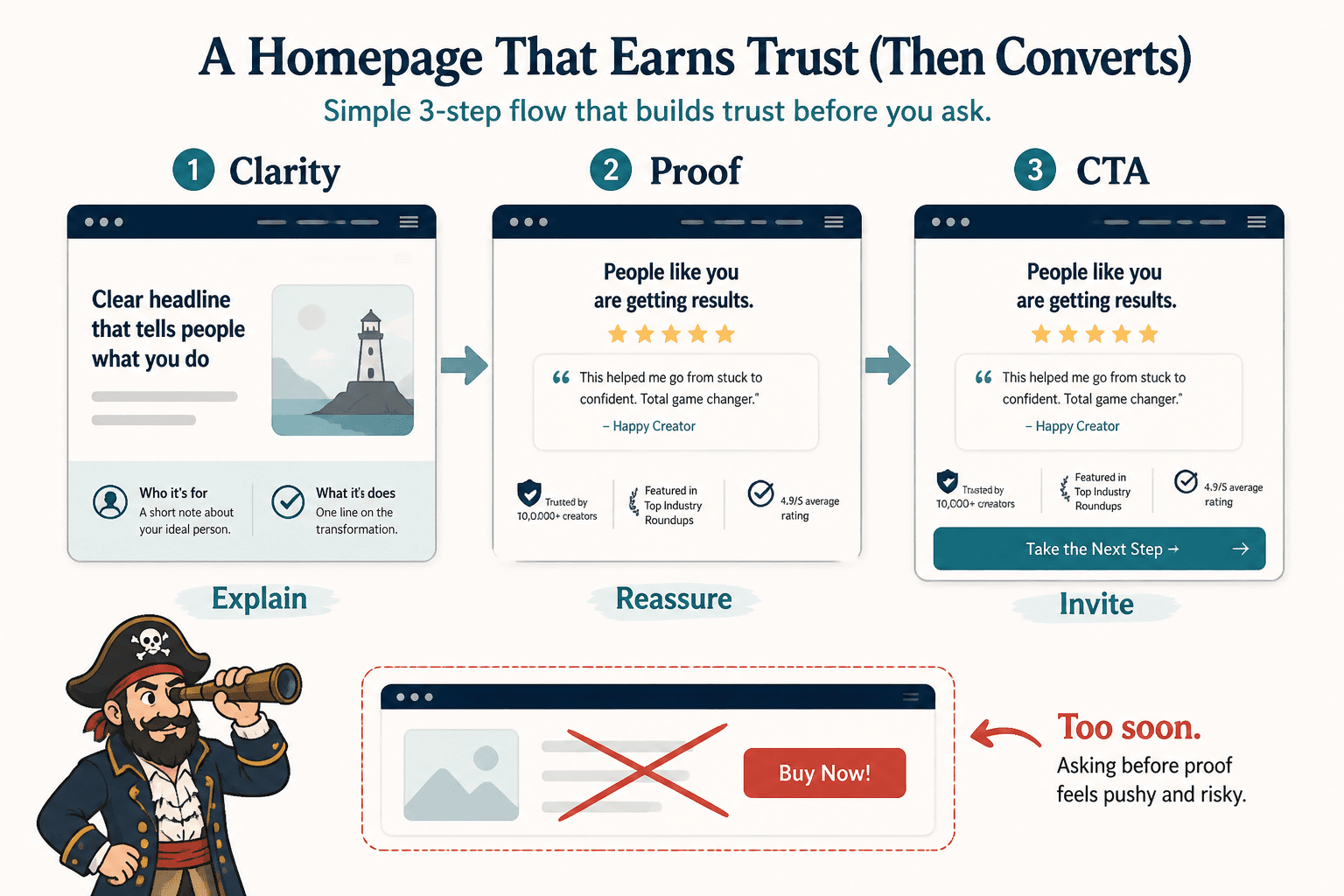
If you want a homepage to make money, the first thing it needs is not more persuasion. It needs more clarity.
Clarity lowers suspicion. It helps visitors orient themselves fast. It tells them where they are, who you help, and what kind of result or transformation you offer. Until that is clear, persuasion just feels louder, not better.
Your opening section should quickly answer four things:
- Who this is for
- What you help them do
- How you help
- What to do next
For example, this is weak:
I help ambitious brands unlock growth through strategic solutions.
That sounds expensive and empty at the same time. A difficult trick, yet very common.
This is stronger:
Homepage and website copy for coaches, consultants, and personal brands who need more leads without sounding pushy, vague, or AI-generated.
Now we know the audience, the service, the outcome, and the tone. Trust improves because the visitor can place you quickly.
If your homepage opening is still doing that floaty “welcome to my digital home” thing, fix that first. This article on how to start homepage copy without a weak opening will help.
Make the offer visible without making the whole page feel like an ad
A homepage should not hide the fact that you sell something. That is not trustworthy either. People should be able to tell, pretty fast, what you offer and how to take the next step.
The key is to present the offer as a logical extension of the page, not an ambush.
What that usually looks like
- A clear hero CTA tied to the main offer
- A secondary CTA for people who are interested but not ready
- One or two sections that explain services or products plainly
- Proof that supports the offer
- A low-friction path to learn more before committing
In other words, do not pretend the offer is not there. Just stop acting like every visitor should marry it on the first date.
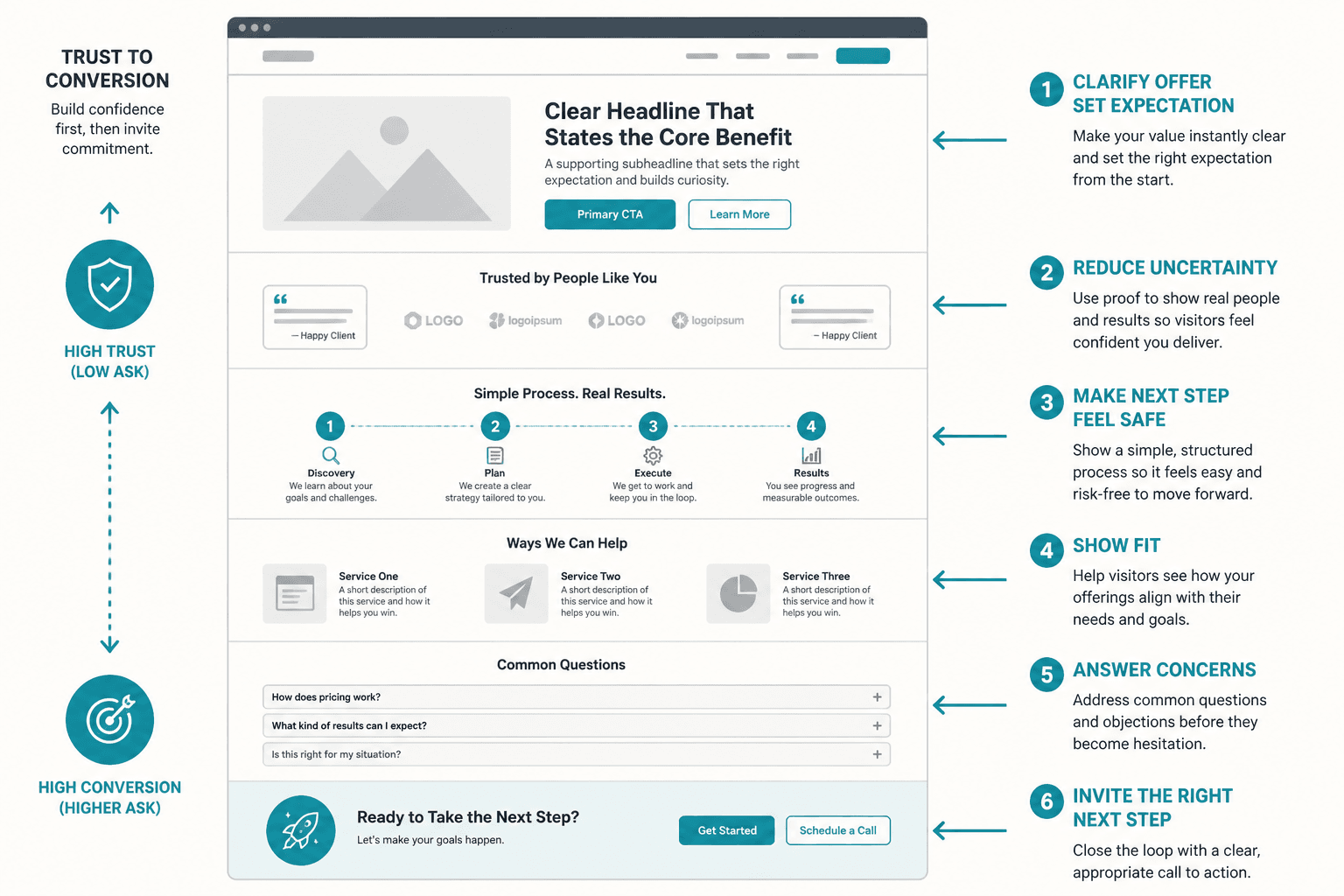
A simple homepage monetization path could look like this:
- Headline makes the value clear
- Subhead explains who it is for and what changes
- Primary CTA leads to service or booking page
- Secondary CTA offers lower-commitment exploration
- Mid-page sections build understanding and trust
- Final CTA gives a clean next step
If your CTAs are either too weak or too thirsty, better homepage copy homepage CTAs for personal brands will give you stronger options.
Use trust-building sections that also support conversion
The smartest homepage sections do both jobs at once: they help the visitor believe you, and they help them move closer to buying.
That means fewer filler blocks and more sections with a commercial purpose that does not feel nakedly commercial.
1. A specific problem section
Show that you understand the real situation your audience is in. Not just the symptom they say out loud, but the frustrating pattern underneath it.
For example:
Your site might be getting visits, but if the homepage is vague, overdesigned, or trying too hard to sound premium, people leave without understanding why they should trust you or what to do next.
That kind of copy builds trust because it feels observed, not manufactured.
2. A “how I help” section
Spell out what you offer in normal language. Keep it concrete. The visitor should not need to decode your process names like they are solving a sponsored riddle.
- Homepage copy audits
- Full website messaging strategy
- Conversion-focused homepage rewrites
- Done-with-you positioning and offer clarity
Clean beats clever here.
3. Proof that reduces risk
Proof is one of the least subtle but most important trust signals on a monetized homepage. If you make claims, support them. That support can take different forms:
- Client results
- Short testimonials
- Recognizable client types or industries
- Case study snippets
- Relevant experience
- Specific outcomes, if you can honestly share them
The point of proof is not to flex. It is to lower uncertainty.
4. A process section that makes the next step feel safe
People hesitate when they do not know what happens after the click. A short process section can do a lot of trust work.
For example:
- Book a consult
- We review your current homepage and goals
- You get a clear recommendation and scope
- If it fits, we move into strategy and copy
This removes mystery. Mystery is great in thrillers, less so in sales paths.
Pick the right CTA for the trust level
One reason homepage monetization feels gross is that many sites only know one move: ask for the biggest possible commitment immediately.
But not every visitor is ready for the same step. A homepage that respects that usually converts better because it gives people options that match their intent.
Higher-trust CTA options
- Book a consultation
- Apply to work together
- Start your project
- Schedule a strategy call
Mid-trust CTA options
- See services
- View packages
- Read case studies
- See how it works
Lower-trust CTA options
- Get the guide
- Join the newsletter
- Read more articles
- See examples
You do not need all of these. But you probably need more than one path.
A good homepage often pairs one commercial CTA with one softer exploratory CTA. That way, ready visitors can move, and cautious visitors do not bounce just because your first ask felt too big.
Write sales language that sounds like a sane person
If your homepage monetization feels trust-breaking, the problem may not be the offer. It may be the language wrapped around it.
Sales copy does not have to be timid. It does have to sound believable.
Common trust-killing phrases
- Transform your business overnight
- Skyrocket your results
- Done-for-you success system
- Limited spots available act now
- Results guaranteed
- Unlock your full potential
Most of that language feels borrowed, inflated, or both. It reads like someone tried to sound convincing by turning the sincerity down and the hype up.
Stronger alternatives
- Get clearer homepage messaging that turns more visits into qualified leads
- Make your offer easier to understand and easier to buy
- Fix the homepage sections that are creating confusion or drop-off
- Work together to sharpen your message, structure, and calls to action
These work because they are specific enough to believe. They promise something meaningful without pretending your copy service is a moon landing.
If your homepage tends to tip into stiff or salesy language, read how to write homepage copy without sounding salesy or robotic. That will save you from a lot of expensive wording mistakes.
Show commercial intent honestly
Trust gets stronger when people feel like you are being straight with them.
If your homepage exists to help sell your services, that is fine. Say so clearly through the structure. What breaks trust is pretending the page is “just here to help” while every section quietly shoves visitors toward a hidden sales trap.
Honest commercial intent looks like this:
- Your offer is visible
- Your CTA is clear
- Your audience fit is obvious
- Your proof is real
- Your next step is explained
- Your tone does not pretend money is embarrassing
You are a business. Acting like one is not the problem. Acting like one in a way that ignores human trust signals is the problem.
Do not monetize every section the same way
A homepage gets stronger when different sections do different jobs.
One of the easiest ways to wreck trust is to make every block sound like a closer trying to hit quota by 4 p.m. That creates tonal fatigue. It also makes visitors skim right past important information because everything feels equally “salesy.”
Here is a better division of labor:
| Section | Main job | Monetization role |
|---|---|---|
| Hero | Clarity and direction | Introduce primary CTA |
| Problem section | Relevance and empathy | Build desire for solution |
| Offer section | Explain what you sell | Make path to purchase obvious |
| Proof section | Credibility | Reduce risk |
| Process section | Safety and expectation-setting | Lower friction to act |
| Final CTA | Decision point | Capture action from ready visitors |
Not every section needs to “convert” in the same way. Some sections convert by clarifying. Some convert by reassuring. Some convert by moving the visitor one click closer.
Before-and-after: monetized homepage copy that keeps trust intact
Here is a simplified example.
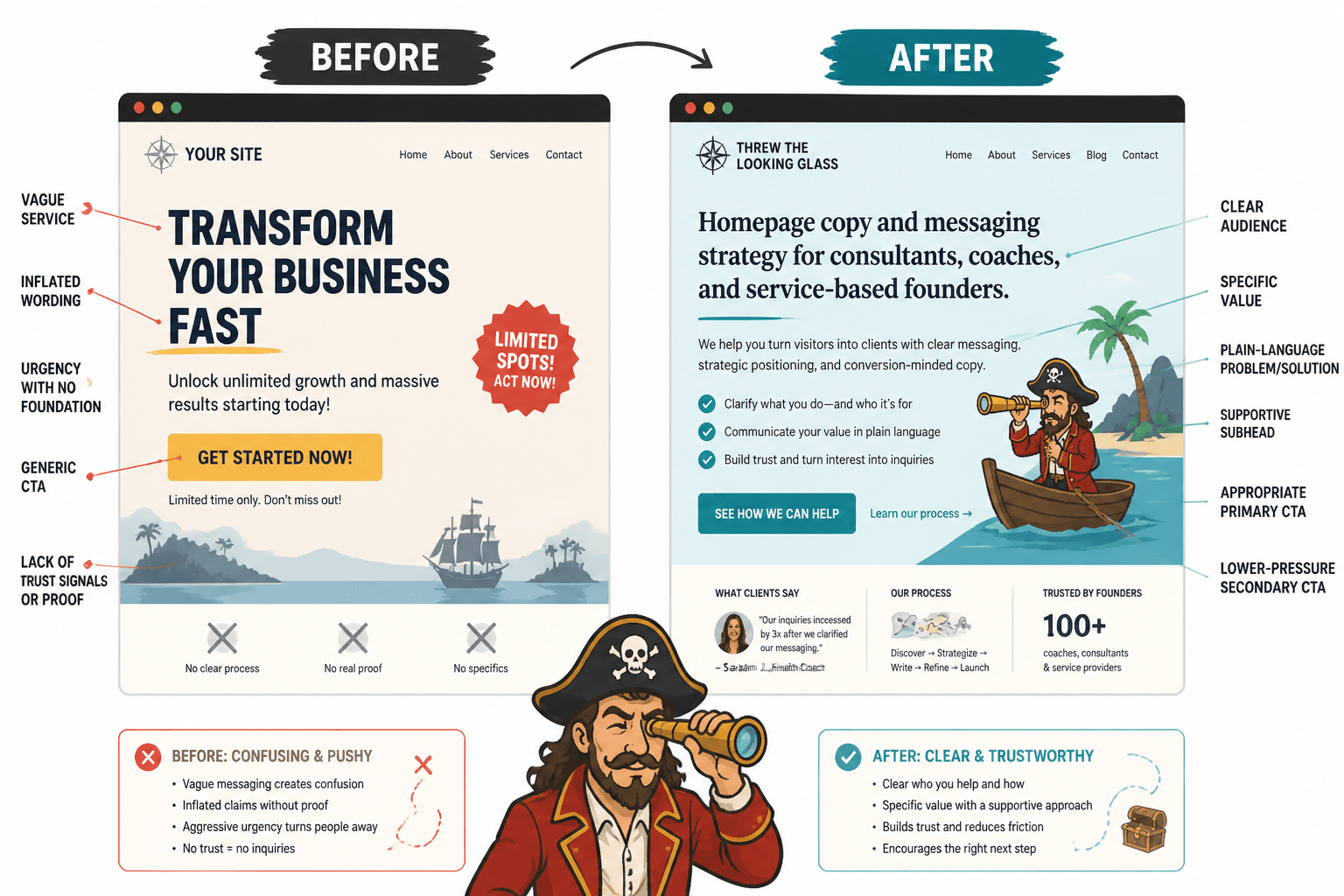
Before
I help visionary entrepreneurs scale with magnetic messaging and high-converting brand strategy.
Ready to unlock aligned success?
Book now before spots fill up.
Problems:
- Vague audience
- Vague service
- Inflated wording
- Urgency with no foundation
- No trust-building detail
After
Homepage copy and messaging strategy for consultants, coaches, and service-based founders who need their site to generate better leads.
If your homepage sounds polished but does not clearly explain what you do, why it matters, or what to do next, I help fix that.
See how homepage copy turns into more leads or sales or book a consult if you already know you need the rewrite.
This version still sells. It just does it with more clarity, better audience fit, and less dramatic hand-waving.
Simple homepage monetization framework
If you want a usable structure, use this:
- Lead with clarity. Say what you do, who it is for, and what outcome you help create.
- Frame the problem. Show you understand the visitor’s friction or pain point.
- Present the offer. Explain how you help in plain English.
- Support with proof. Testimonials, outcomes, examples, or experience.
- Reduce risk. Explain the process, what happens next, or what working together looks like.
- Give an appropriate CTA. Match the ask to the trust level and visitor intent.
This is not flashy. It is just effective. Which, annoyingly, is often less glamorous than people want.
What people keep getting wrong
- They try to sound premium instead of useful. Visitors trust usefulness faster than posturing.
- They hide the offer to seem less salesy. That just creates confusion and weakens conversion.
- They push too hard in the hero. Big ask, low trust, bad combo.
- They use generic proof. “Amazing experience” does not do much heavy lifting.
- They cram three audiences into one homepage. If everyone is welcome, no one feels specifically understood.
- They treat trust like a design issue only. Design matters, but trust also lives in wording, specificity, structure, and restraint.
If your homepage is underperforming, the issue is often not that you need to “sell harder.” It is that your message is unclear, your proof is weak, or your CTA outruns your trust signals.
Quick FAQ
Homepage copy works best when the core promise is clearer and the next step is easier to understand. Simpler, sharper messaging usually does more work.
Homepage copy works best when the core promise is clearer and the next step is easier to understand. Simpler, sharper messaging usually does more work.