Your homepage copy should not be doing cardio for no reason.
A lot of homepages try very hard to sound polished, clear, impressive, strategic, premium, trusted, innovative, and somehow also warm. Then they send people absolutely nowhere useful. Nice words. No path. No next step. No funnel that matches the intent of the person reading.
That is the real problem. Homepage copy is not just a branding exercise. It is the front door to a decision. If the copy attracts the right person but the funnel behind it is lazy, mismatched, or weirdly aggressive, you lose the lead anyway.
The best funnel ideas to pair with homepage copy are the ones that fit what the visitor is actually ready for. Not every homepage visitor wants to “book a call” five seconds after landing. Not every service business needs a 14-email nurture sequence either. Some people need a simple path. Some need proof. Some need a low-friction way to raise their hand without feeling like they just wandered into a closing script.
Here’s how to choose the right funnel for your homepage, match it to your copy, and stop turning decent traffic into polite disappearance.
Want the broader roadmap? Start with the parent guide.
What homepage copy is actually supposed to do
Before talking funnels, it helps to clear up a common mess: your homepage is not supposed to do every job at once.
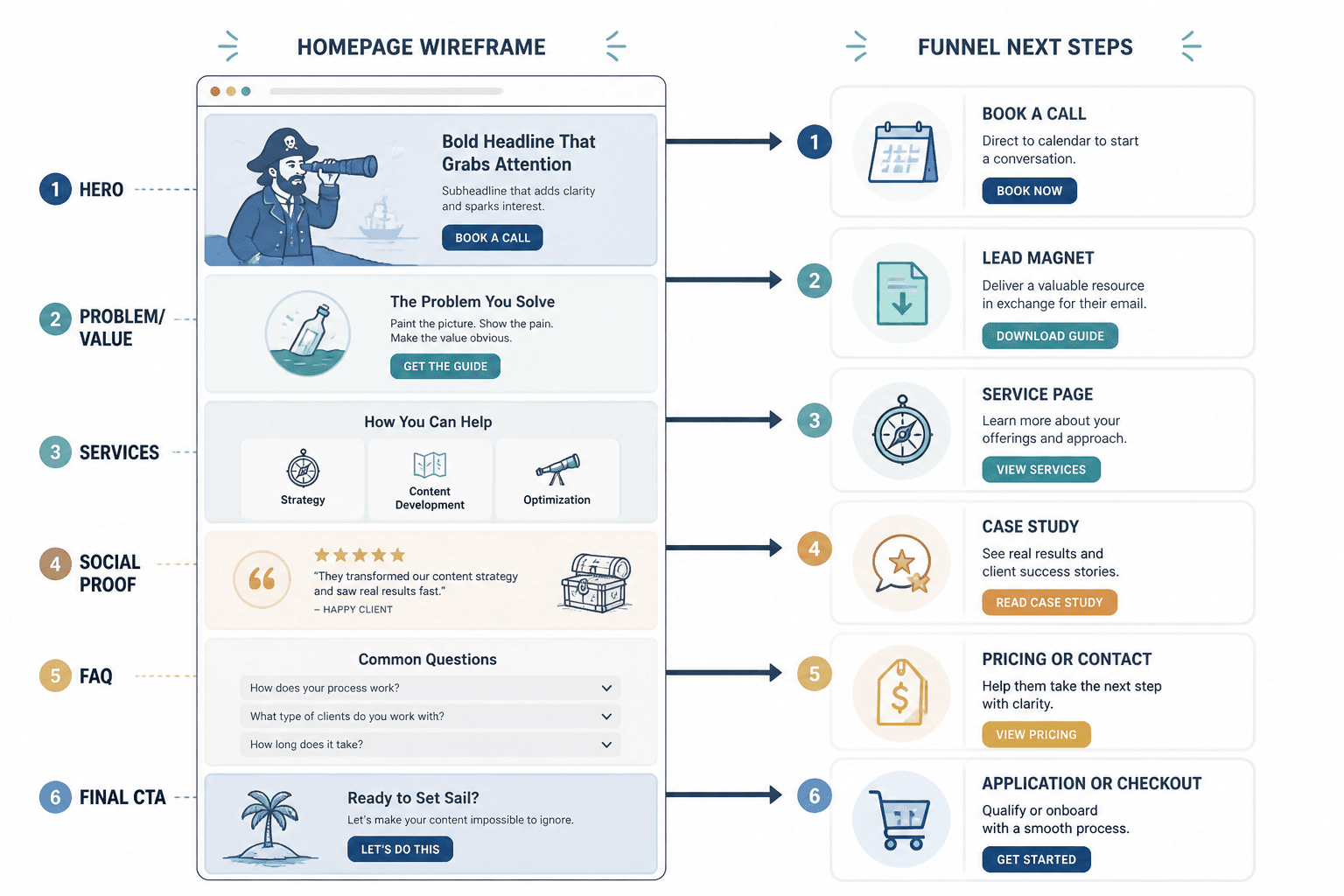
Good homepage copy usually does four things:
- Shows the visitor they are in the right place
- Explains what you do and who it is for
- Builds enough trust to keep them moving
- Points them toward the right next step
That last part is where the funnel comes in.
If your homepage says, “I help consultants turn their expertise into better content and better leads,” the next step should make sense for that promise. It should not dump them into a generic newsletter sign-up with no context, or a calendar page that asks for a 45-minute sales call before they even know if you are any good.
Your homepage copy sets the expectation. Your funnel either confirms it or wrecks it.
If you want to tighten the homepage itself first, start with homepage copy strategy and then check homepage copy examples for creators for stronger ways to structure the page.
How to choose the right funnel idea for your homepage
The best funnel ideas to pair with homepage copy depend on three things:
- Your offer
- Your audience’s level of awareness
- The amount of trust needed before they buy
That is the part people skip. They copy a funnel because some marketer on the internet said it converts, then wonder why their homepage feels like a suit three sizes too big.
Here is a simpler way to think about it.
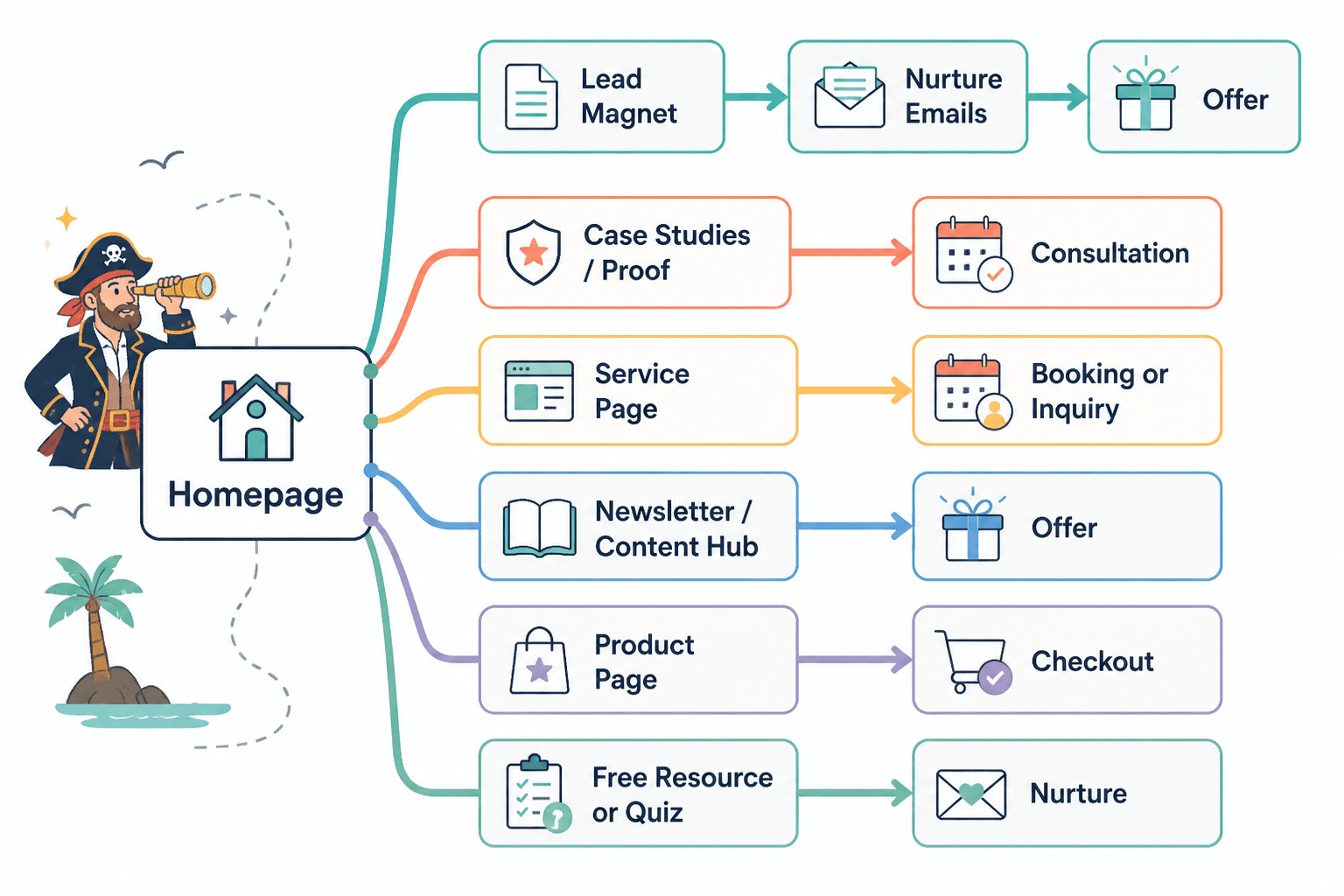
| Situation | Best homepage funnel style |
|---|---|
| High-trust service, expensive offer | Homepage → case studies/proof → consultation or application |
| Mid-ticket service with warmer audience | Homepage → lead magnet or email opt-in → nurture → call or offer |
| Simple service with clear demand | Homepage → service page → booking or inquiry form |
| Personal brand building authority | Homepage → newsletter/content hub → nurture toward offer |
| Course, template, or digital product | Homepage → product page → checkout, with optional email capture |
| Audience not ready to buy yet | Homepage → free resource, quiz, or starter guide → nurture sequence |
You do not need a complicated funnel. You need a believable one.
Best funnel ideas to pair with homepage copy
Let’s get into the practical stuff.
1. Homepage → lead magnet → nurture emails → offer
This is still one of the best options when your audience needs education, trust, or a little more time before buying.
It works especially well for coaches, consultants, copywriters, strategists, and service providers with offers that are not instant yeses.
Your homepage copy should lead naturally into a specific resource, not a vague “join my list” form. Nobody is waking up desperate to receive your updates. They want help with a problem.
Good fit for: authority building, email list growth, warmer leads, longer sales cycles
Examples of homepage CTA angles:
- Get the homepage checklist
- Steal my 10 best content CTA examples
- Download the client messaging template
- See the funnel audit guide
Why it works: It gives curious visitors a lower-friction next step. They do not have to marry your brand on first date energy. They can just take the useful thing, read your emails, and decide if you are worth trusting.
What people get wrong: The lead magnet is too broad, too boring, or too disconnected from the paid offer. If your homepage sells brand strategy but your freebie is “50 inspirational captions,” that is not a funnel. That is content littering.
2. Homepage → service page → inquiry form
This is the cleanest option for businesses with a straightforward service and buyers who already know they need help.
If someone lands on your homepage looking for homepage copywriting, design, SEO support, or messaging help, do not make them detour through six educational steps unless they actually need it. Sometimes the smartest funnel is the shortest one.
Good fit for: done-for-you services, clear demand offers, local services, specialist experts
Best homepage copy setup:
- Clear headline about what you do
- Specific audience or problem
- Credibility or proof section
- Primary CTA to the service page or inquiry form
This funnel works when the homepage copy removes enough doubt. That means specific language, decent proof, and a CTA that sounds human. If you need help there, better homepage CTAs for personal brands will save you from writing “Let’s connect” and calling it strategy.
3. Homepage → case study or proof page → consultation
If your offer is expensive, nuanced, or credibility-heavy, proof needs to be closer to the homepage than most people think.
A consultant charging serious money should not rely on one fluffy testimonial tucked near the footer. Visitors often need to see examples, outcomes, process, or client wins before they book.
Good fit for: consultants, agencies, strategists, ghostwriters, premium service providers
Simple funnel path: Homepage promise → proof or case study page → book a call
This works because the homepage creates interest, and the proof page handles the “why you?” question with actual evidence instead of polished adjectives.
For some businesses, this can outperform the classic homepage-to-calendar route because it gives buyers a chance to self-qualify first. That saves you from discovery calls with people who liked your font choices but were never serious.
4. Homepage → newsletter → content nurture → soft sell
This is a strong funnel for personal brands, educators, and creators whose business grows through trust over time.
The homepage does not need to push hard. It needs to make a sharp promise and offer a consistent way to keep hearing from you. The newsletter becomes the trust engine.
Good fit for: writers, coaches, creators, solo founders, educators, thought-leadership-led businesses
What the homepage should do:
- Position your expertise clearly
- Show what kind of thinking or help people will get
- Make the newsletter sound useful, not obligatory
- Offer examples of past topics or outcomes
This approach is slower than a direct booking funnel, but it can be much stronger for businesses built on authority and trust. It also gives you more chances to sell without turning the homepage into a carnival of buttons.
5. Homepage → free mini-offer or low-ticket product → upsell
If you sell templates, digital products, mini-courses, audits, or starter services, this can work beautifully.
Your homepage copy should frame the low-ticket offer as a fast win, not a discount bin impulse grab. The point is to help people get a result quickly, then invite the right buyers into the next thing.
Good fit for: digital creators, educators, productized services, audience-first businesses
Example path: Homepage → $19 template pack → checkout → post-purchase upsell to workshop or consulting
This works best when the homepage is honest about who the offer is for and what it solves. If the copy overpromises and the product underdelivers, you do not have a funnel. You have a refund request with branding.
6. Homepage → quiz or assessment → segmented follow-up
This is useful when your audience has different needs and one generic CTA would be clumsy.
A good quiz or assessment can route people into different offers, emails, or service pages based on their stage, problem, or goals. A bad one is just BuzzFeed in a blazer.
Good fit for: coaches, consultants, educators, service providers with multiple offer paths
Example uses:
- What is blocking your homepage conversions?
- Which content strategy fits your business stage?
- What kind of funnel do you actually need right now?
The homepage copy needs to make the quiz feel relevant and quick. People will not take an assessment just because you used the word “personalized.” They will take it if they think it will save them from guessing.
Match the homepage CTA to the funnel, not your wishful thinking
This is where a lot of homepage funnels fall apart.
The CTA on the page says one thing. The funnel expects another. The visitor feels the mismatch immediately, even if they cannot quite explain it.
For example:
- Homepage says “Get practical help improving your website copy” → CTA goes to a vague newsletter page
- Homepage says “See how we help founders fix weak messaging” → CTA goes straight to a high-pressure sales call
- Homepage says “Start with a quick win” → CTA opens a long application form
None of those feel clean. The promise and the next step should match in tone, friction, and intent.
Here is a simple rule: your CTA should feel like the natural next sentence after the section above it.
Examples:
- If the section teaches, offer a guide or email opt-in
- If the section proves results, offer a consultation or case study
- If the section explains a service, offer a service page or inquiry form
- If the section promises speed, offer a quick-start product or audit
It sounds obvious. Yet plenty of homepages still act like every visitor is equally ready, equally trusting, and equally thrilled to click “Book now.” They are not.
Simple homepage funnel combinations that work well
If you want swipeable structure, here are a few homepage and funnel combinations that usually make sense.
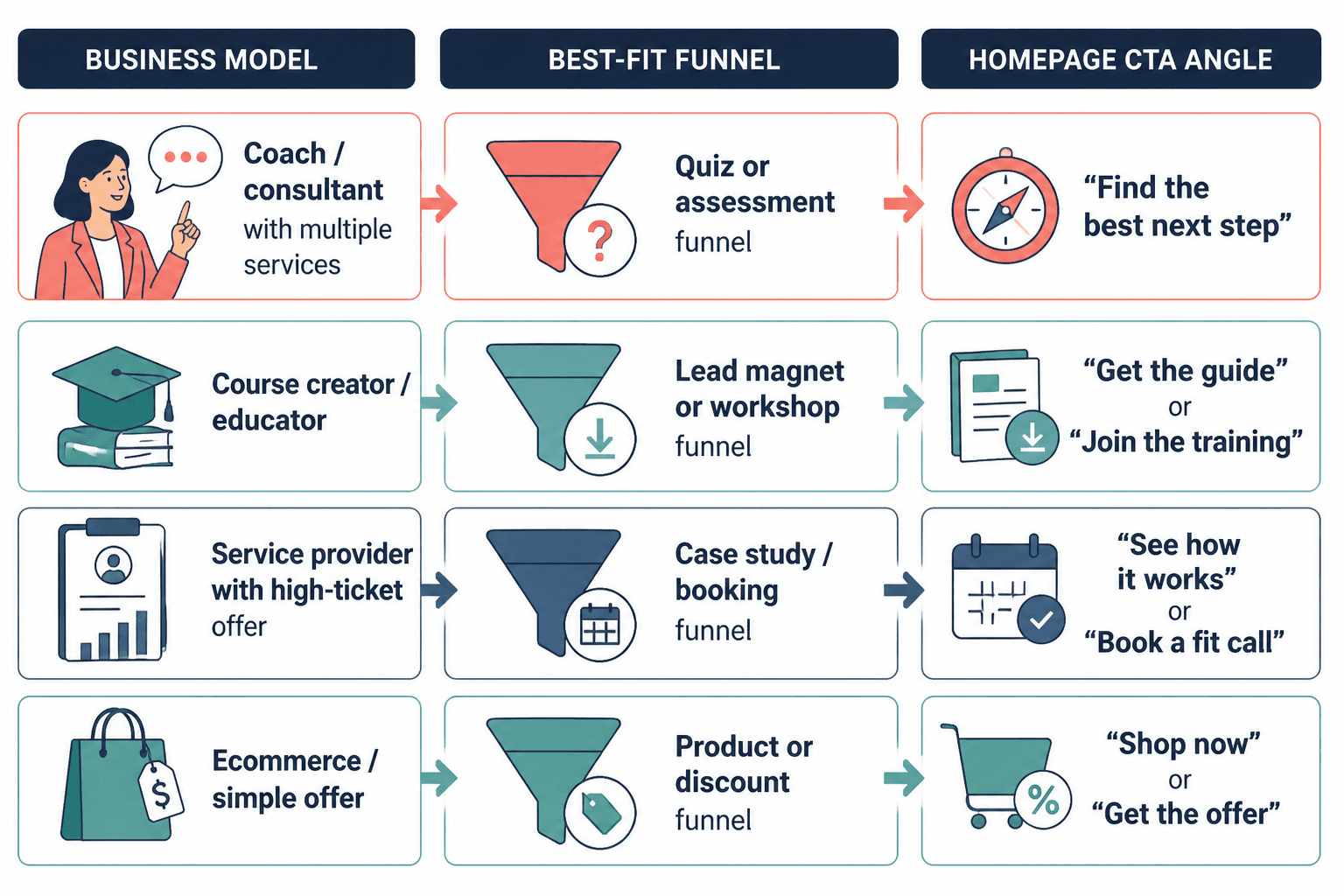
For a consultant
- Homepage headline with niche and outcome
- Proof section with results or named experience
- Link to case studies
- CTA to strategy call or application
For a copywriter or brand strategist
- Homepage promise around messaging or conversion problem
- Mini breakdown of your process
- Lead magnet like a messaging checklist
- Email nurture toward inquiry or audit
For a creator with digital products
- Homepage focused on audience problem and category of help
- Featured paid template, guide, or workshop
- Optional newsletter CTA for non-buyers
- Upsell after purchase
For a coach
- Homepage focused on the transformation and who it is for
- Free assessment or starter guide
- Nurture emails with examples, philosophy, and proof
- Invitation to apply or book a consult
For a service business that needs faster conversions
- Homepage with a clear service promise
- Short proof section
- FAQ to remove objections
- Direct CTA to inquiry form
If your homepage copy is already decent but the conversion path feels muddy, you will probably get more traction by fixing the funnel than by endlessly tweaking one subheadline and pretending that is optimization.
What to avoid when pairing homepage copy with funnels
Some homepage funnel mistakes show up everywhere because they look smart in theory and work terribly in real life.
- Too many CTAs. If every section pushes a different next step, people stall.
- One CTA for every visitor type. Sometimes you need a primary next step and a softer secondary one.
- Early pitch insanity. Do not ask for a major commitment before earning basic trust.
- Lead magnets with no offer alignment. Freebie popularity is not the same thing as buyer quality.
- No proof before the ask. Especially for premium services.
- Funnels copied from bigger brands. Their audience knows them already. Yours probably needs more clarity.
- Making the homepage a dead end. A beautiful homepage with no clear path is just decorative friction.
This matters even more for personal brands and solo businesses, where trust is often tied directly to your voice, specificity, and credibility. If your funnel feels generic, your business feels generic. Not ideal.
How to improve your homepage funnel without rebuilding your whole site
You do not need a dramatic redesign to make this better. Usually, a few smart changes do more than a full homepage rewrite followed by six weeks of aesthetic debate.
Start here:
- Pick one primary conversion path for the homepage
- Make sure the headline and CTA belong to the same journey
- Add proof before the main ask if trust is a factor
- Reduce CTA clutter
- Offer a softer next step for people who are interested but not ready
- Check that your free resource, service page, or booking step actually matches the promise of the page
If you want a fuller walkthrough on connecting homepage messaging to conversions, read how to turn homepage copy into more leads or sales. For broader site strategy, you can also explore website conversion copy resources and homepage copy guidance.
If you are using AI to speed up drafts, research, or CTA variations, fine. Just do not let it write you into generic mush. These AI tools for homepage copy can help with workflow, but they cannot choose the right funnel for your business if your positioning is fuzzy.
FAQ
Should every homepage have a funnel?
Yes, in the practical sense. A homepage should lead somewhere intentional. That might be a booking page, service page, email opt-in, product page, or application. Random wandering is not a funnel.
What is the best funnel for a service business homepage?
Usually either homepage → service page → inquiry, or homepage → proof/case study → consultation. The better choice depends on how much trust your buyer needs before reaching out.
Should I send homepage visitors straight to a booking page?
Only if the offer is clear and trust is already fairly high. If not, send them to proof, a service page, or a useful lead magnet first.
Is a newsletter enough of a funnel?
It can be, if the newsletter is tightly connected to your offer and you actually nurture readers toward a next step. A newsletter with no strategy is just inbox wallpaper.
Homepage copy works best when the core promise is clearer and the next step is easier to understand. Simpler, sharper messaging usually does more work.