
A blog rewrite that gets more traffic but no clicks, no signups, and no sales has still failed the business. It just failed with cleaner punctuation. The cost is wasted trust, weak leads, and a team that spent hours polishing a page that never gave readers a reason to move.
That is why blog rewrites and refreshes should not stop at “better SEO” or “updated facts.” They are one of the easiest places to connect useful content to a real next step. If you want the broader editorial system behind that, the parent guide to blog rewrites and refreshes is the right place to start. This article focuses on the monetization part: how to turn an improved post into leads or sales without making the page feel like it swallowed a funnel whole.
Why rewrites and refreshes are such strong conversion opportunities
A refresh usually reaches readers who already care about the topic. That matters. You are not asking for attention from scratch; you are asking for the next logical action after the reader has gotten value. That is much easier than convincing a cold visitor to trust you out of pure vibes and a hero section.
The other advantage is context. A refreshed article already has a topic, a job, and a reader intent. That means the CTA does not need to be random. It can match the question the post is already answering.
That is the difference between “we added a signup box” and “we built a useful path from this article to the next step.” One is decoration. The other is a system.
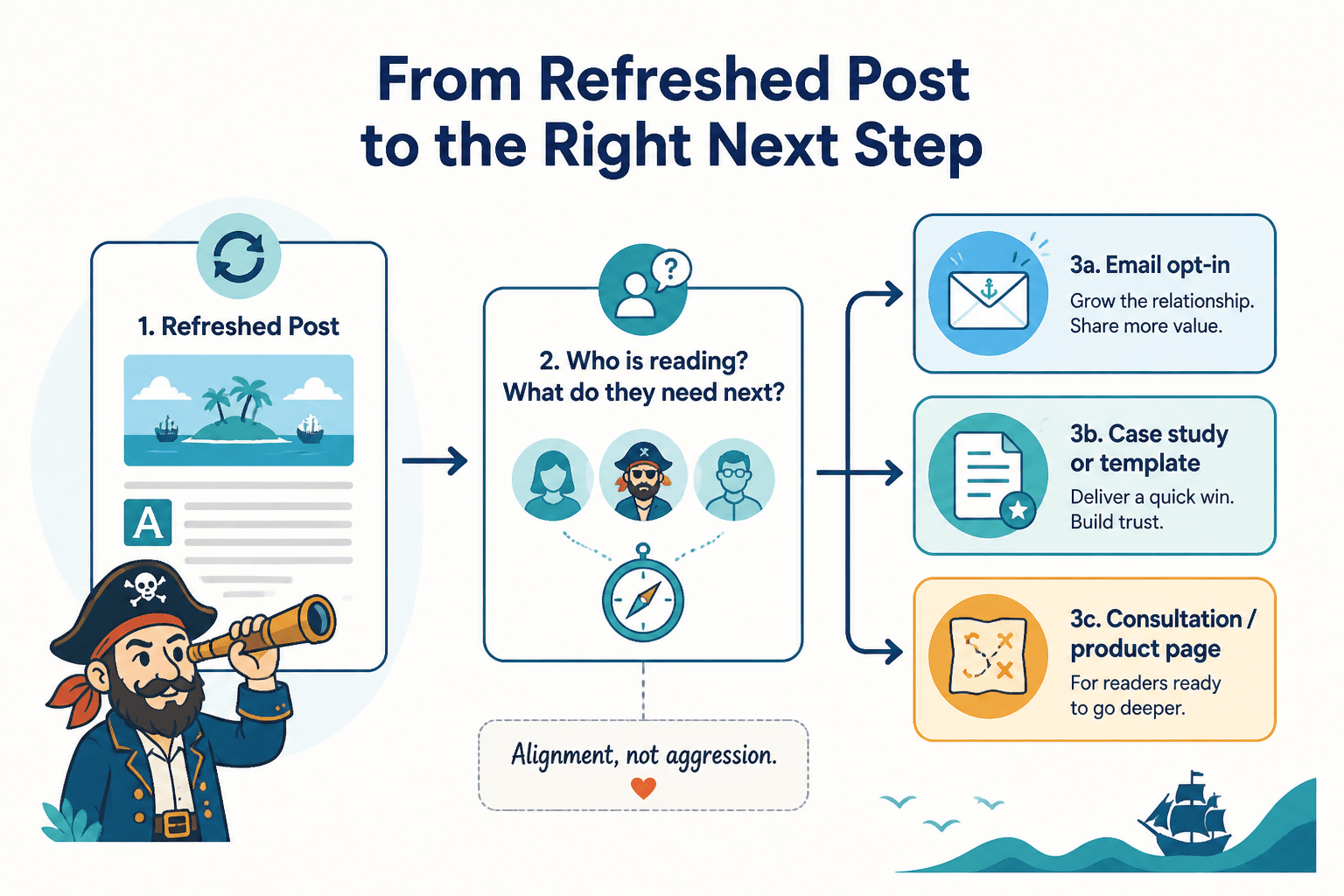
Start with reader intent, not the revenue fantasy
Before you decide what to sell, decide what the article is doing for the reader.
- Informational intent: the reader wants a better explanation, framework, or example.
- Comparative intent: the reader is weighing options and needs help choosing.
- Problem-solving intent: the reader knows the pain point and wants a fix.
- Transactional intent: the reader is closer to buying and needs a clear offer.
When the intent is informational, push too hard and the page gets cranky. When the intent is transactional, hide the offer and you lose the moment. The CTA should fit the reader’s readiness, not the writer’s quarterly optimism.
A quick test: if someone reads the refreshed article and says, “That was helpful,” what would be the most natural next step?
- Download a related checklist?
- Read the next article in the series?
- Request an audit or consultation?
- Join the newsletter for more examples?
- Buy a small, low-friction product?
That answer is usually your best conversion path.
What you can monetize without making the post feel gross
Not every article should push the same offer. Different posts support different conversion jobs.
1. Lead magnets tied to the topic
This is the cleanest option when the post solves a broad problem but does not close the sale by itself. Offer something concrete and relevant:
- checklist
- template
- swipe file
- worksheet
- decision guide
The lead magnet should feel like the article’s useful younger sibling, not a random bribe.
2. Newsletter signup
If the reader is not ready for a product or service, invite them into a repeatable trust path. This works well for evergreen guides and educational posts where the goal is continued attention.
A newsletter CTA works best when it tells the reader what they will actually get: examples, practical breakdowns, or short strategy notes. “Join my list” is not a value proposition. It is a shrug.
3. Audit, consultation, or service inquiry
Use this when the article attracts readers who may already know they need help. A rewrite can point directly to a service page or inquiry path if the topic naturally exposes a gap in the reader’s process.
For example, a post about fixing underperforming content can end with an invitation to review a site, map a content system, or assess conversion opportunities. The CTA is not a hard sell; it is the obvious next step for a reader who wants help.
4. Related article cluster
Sometimes the best conversion move is not a direct sale. It is a tighter path through related content that prepares the reader for a higher-value offer later.
This is especially useful when the refreshed post sits near the top of the funnel. Send readers to a more specific sibling article first, then to the offer page once they have enough context.
If you are building that kind of path, the companion piece on best funnel ideas to pair with blog rewrites and refreshes is a useful follow-on read.
5. Low-ticket product with an upsell path
A small product can work when the article solves a narrow, practical problem. Think of a low-friction offer that matches the post’s promise, then connect it to a higher-value service, course, or package.
This is not about stuffing the page with offers. It is about giving the reader a small yes that feels aligned with the article they just read.
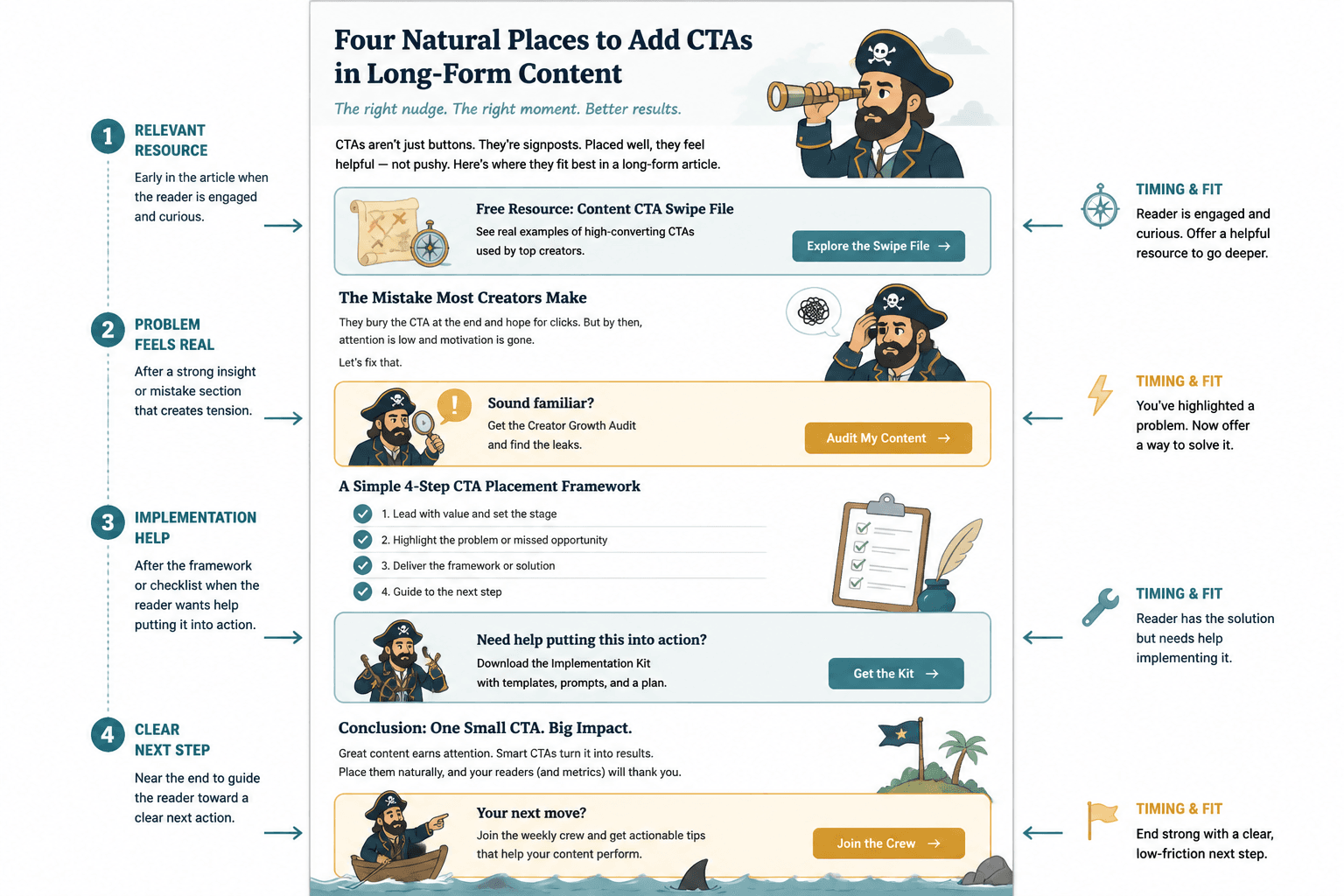
Where to place the CTA in a refreshed article
Placement matters because timing matters. A CTA that shows up before the reader has enough confidence will get ignored. A CTA that waits until the end may miss the people who already know what they want.
A simple pattern works well:
- Above the fold: only for obvious transactional intent or a very clear service offer.
- Mid-article: for readers who need a little proof before they click.
- End of article: for readers who made it through the full piece and are ready for the next step.
Use the body of the article to earn the CTA. Then make the CTA easy to see, easy to understand, and easy to ignore if it is not the right fit. That sounds less dramatic than “optimize for conversion,” but it is far more persuasive.
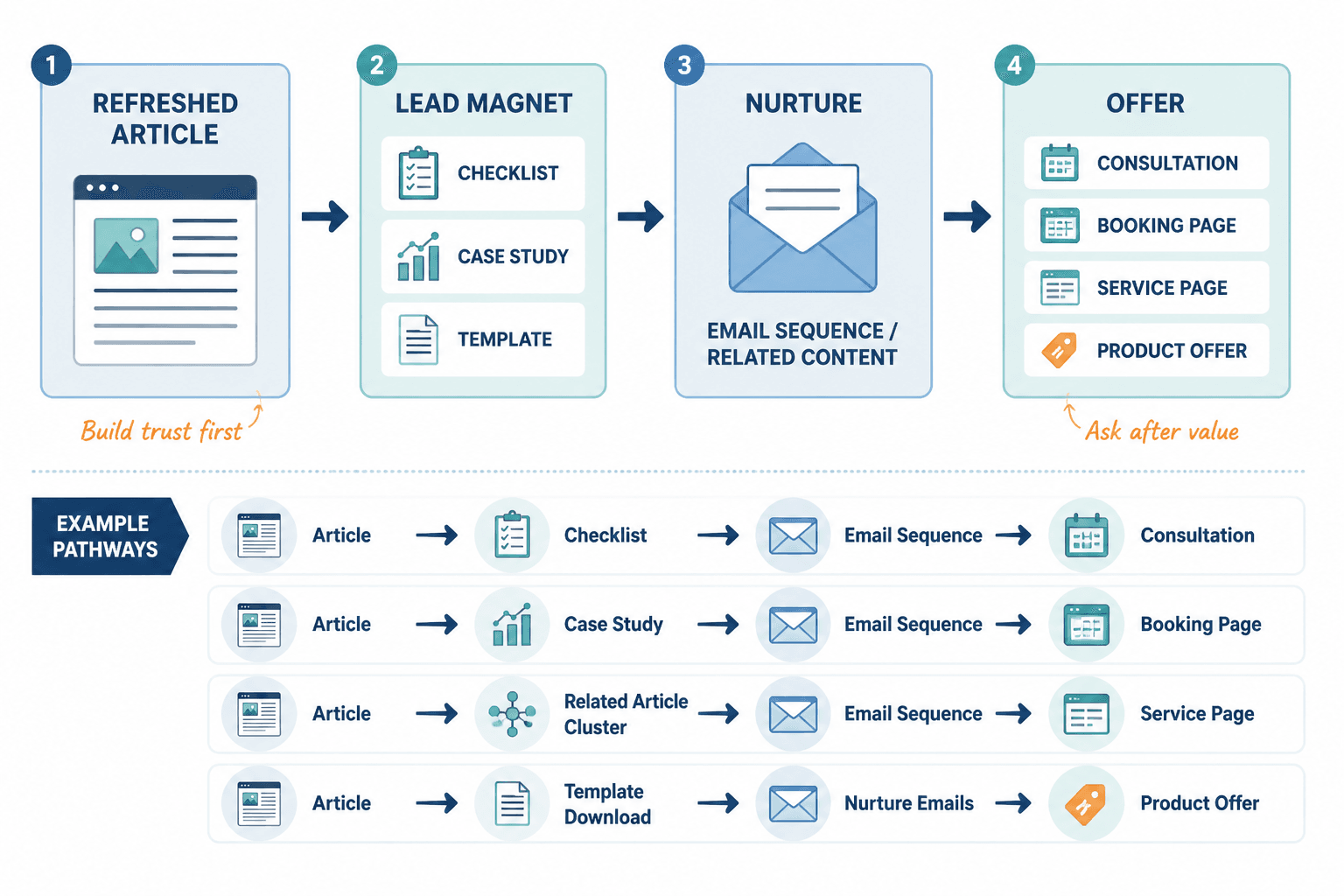
Simple funnel patterns that actually fit rewritten content
Refreshed post → lead magnet → email sequence
This is the safest and most flexible path. The post earns interest, the lead magnet captures it, and the email sequence continues the conversation with more specific value.
Use this when the article is educational, broad, or early-stage. It keeps the conversion pressure light while still making the content do business work.
Refreshed post → related article cluster → offer page
This works well when the topic needs more context before a sale. The first article introduces the problem, the second article sharpens the solution, and the final page presents the offer.
It is a good fit for more complex services or products where readers usually need a few steps before they are ready.
Refreshed post → audit CTA → service inquiry
This path is ideal when the article reveals a problem readers already suspect they have. Instead of sending them to a generic contact page, give them a specific action: request an audit, book a consult, or ask for a review.
Specificity helps. “Talk to us” is vague. “See what is blocking your blog from converting” is easier to act on.
Refreshed post → newsletter signup → recurring trust funnel
If the article does not justify an immediate offer, use the newsletter as the bridge. This is especially useful when your brand depends on repeated exposure, consistent examples, or a longer buying cycle.
Refreshed post → low-ticket product → upsell
This is the closest thing to a direct conversion path that still feels friendly. A small product lowers friction, while the upsell handles the readers who want more support.
It works best when the post solves a specific task and the product extends that same task instead of veering off into a completely different offer category.
How to keep the monetization honest
Readers do not mind being offered something. They mind being interrupted by something irrelevant.
That means three things:
- Match the offer to the topic. The CTA should be the next sensible step.
- Keep the promise narrow. Do not imply the article solves everything if the offer is specific.
- Preserve the article’s usefulness. The post should still stand on its own even if the reader never clicks.
This is where a little restraint pays off. A good rewrite does not beg. It earns.
For a deeper trust-first framing, the companion guide on how to monetize blog rewrites and refreshes without wrecking trust covers the “how far is too far” question in more detail.
What to measure after the refresh
Traffic alone is not the scorecard. If the post is meant to create leads or sales, measure the parts that prove it is doing that job.
- CTA click-through rate
- Lead magnet conversion rate
- Newsletter signup rate
- Consultation or inquiry rate
- Assisted conversions from the post
- Revenue or pipeline influenced by the page
Look at behavior by intent as well. An informational post might never convert like a sales page, but it can still become a dependable source of qualified leads. That is a good trade, not a consolation prize.
If you want to track content more rigorously, Google’s own documentation on GA4 conversions is a sensible place to start, and its event model is useful for understanding how page actions are measured. For search-side context, Google’s Search Central documentation is the primary reference worth trusting.
A simple decision rule for every rewrite
Before you publish a refreshed post, ask one final question: what should happen next for the right reader?
If the answer is “nothing,” the article is leaving money on the table. If the answer is “everything,” the funnel is too messy. The sweet spot is one clear next step that fits the reader’s intent and the page’s job.
That is the point of monetizing rewrites well. Not to turn every article into a sales pitch. Not to pretend content is “just awareness.” The point is to make useful writing do a useful job all the way through the page.
When the rewrite is clean, the CTA is relevant, and the offer matches the moment, the article stops being busywork. It starts doing business.