
Most website bios are not terrible because the person is unimpressive. They are terrible because the copy is vague, padded, and trying way too hard to sound professional.
You have probably seen the type. “Passionate entrepreneur.” “Helping businesses grow.” “Dedicated to excellence.” It reads like someone fed a résumé into a blender and poured it onto a homepage.
If you want to know how to rewrite boring website bio and profile copy, the fix is not adding fancier words. It is saying something clearer, more specific, and more useful. Your bio should help the right person quickly understand who you help, what you do, why you are credible, and what to do next.
That is the real job. Not sounding impressive to strangers from 2009. Not cramming in every title you have ever had. Not writing like a LinkedIn robot in a blazer.
Here’s how to rewrite your website bio so it actually sounds like a smart human and does something for your business.
If you want the bigger picture, start with the parent guide.
Why website bio and profile copy gets boring so fast
Boring bio copy usually comes from one of four mistakes:
- It tries to sound credible by being abstract
- It lists roles instead of showing relevance
- It hides the actual value behind buzzwords
- It forgets the reader and turns into a mini autobiography
People write bios like they are applying for approval. But your website bio is not there to win a professionalism contest. It is there to help a potential client, customer, reader, or partner decide if you are relevant to them.
That means clarity beats polish. Specificity beats fluff. And a sharp point beats a long paragraph about your passion for excellence every single time.
If your current bio sounds fine but forgettable, that is usually the issue. It is not saying anything wrong. It is just not saying anything distinct.
What strong website bio and profile copy actually needs to do
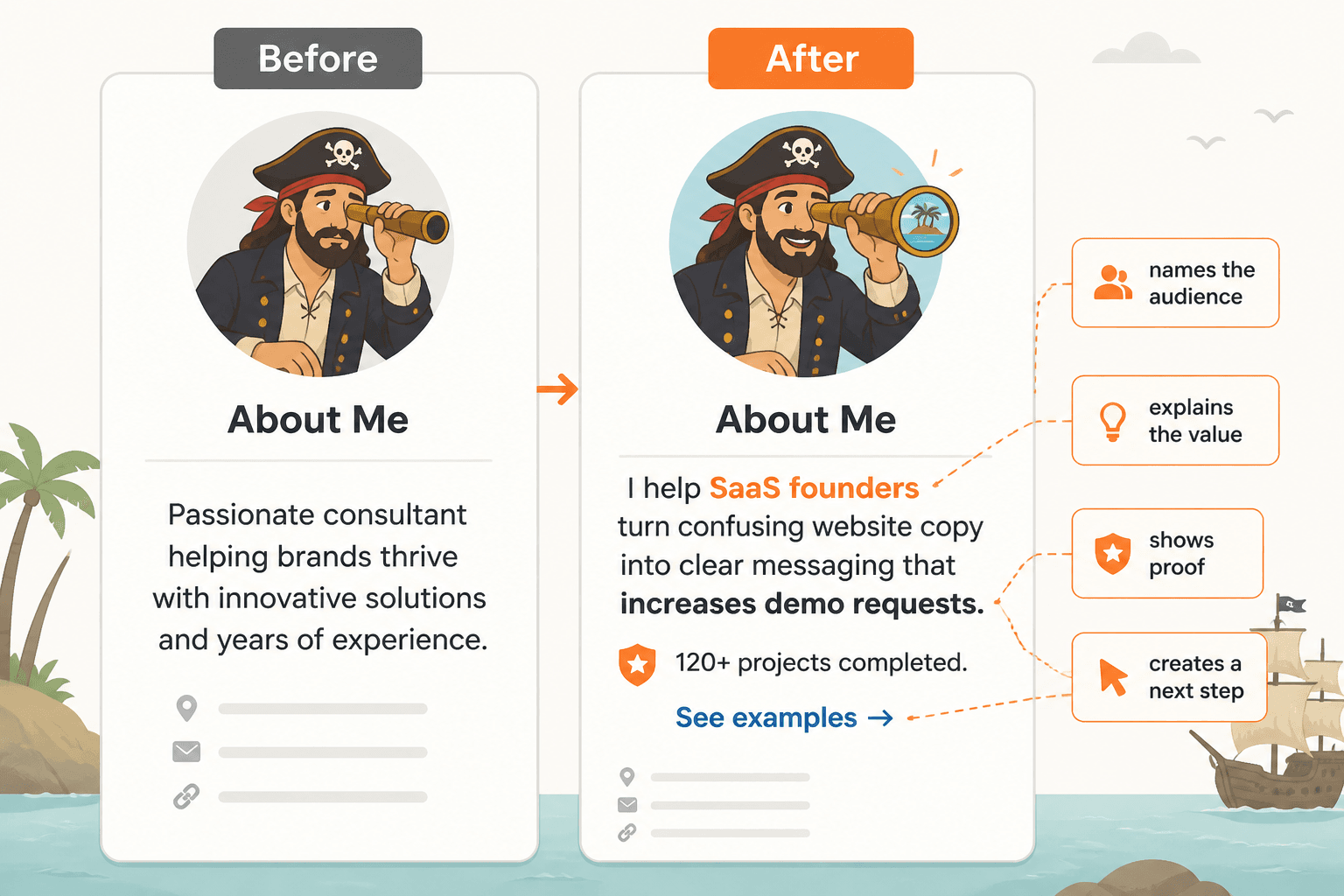
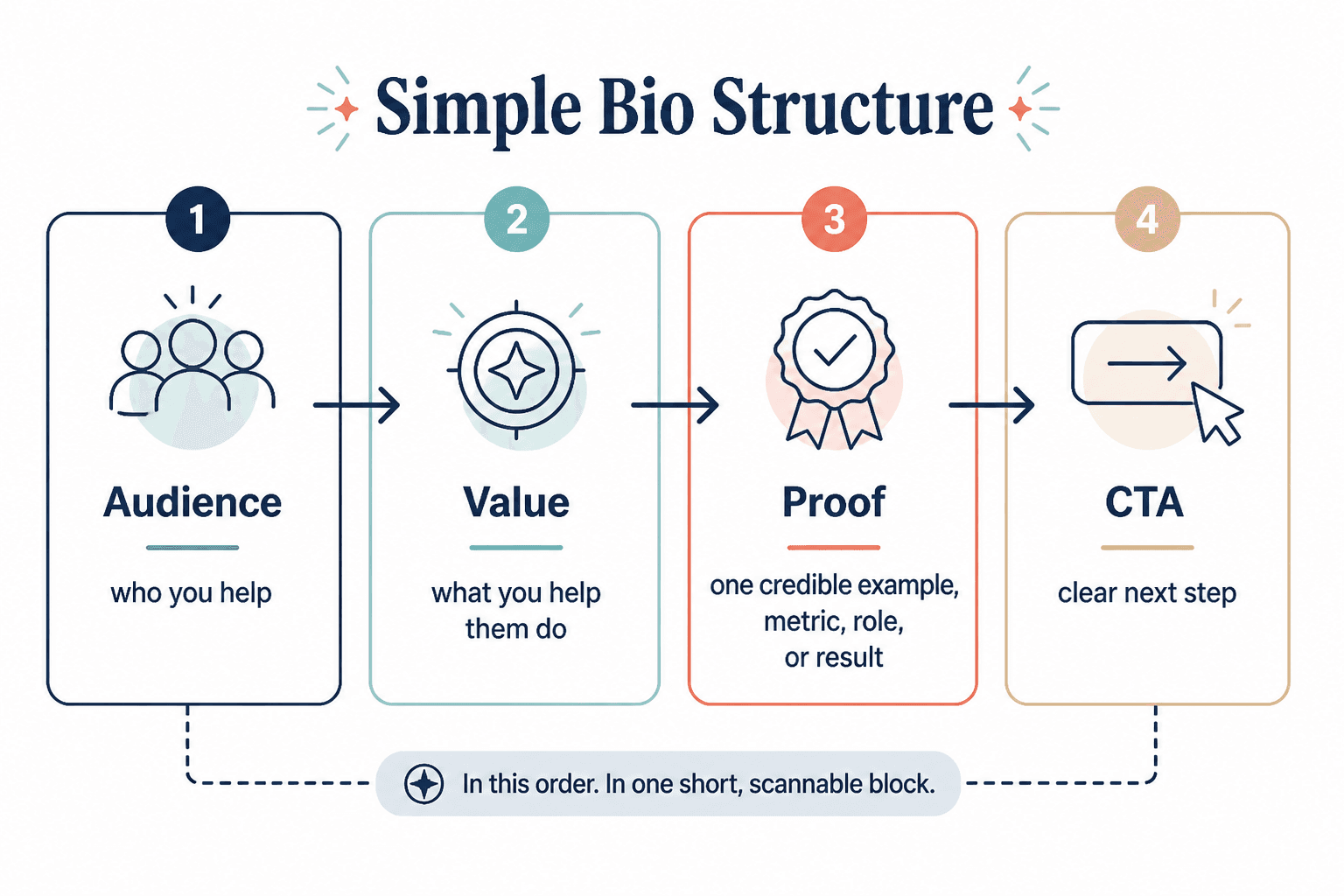
Good bio and profile copy for websites does four simple things fast:
- Names the audience so the right person knows it is for them
- Explains the value without making them decode jargon
- Shows proof so it does not sound made up
- Creates a next step so the page leads somewhere useful
That is why a short, clear bio often works better than a longer one full of fog. The reader is scanning. They want a reason to care, not a scenic tour of your adjectives.
If you want more foundational help on structure, the main bio and profile copy for websites guide is worth keeping open in another tab.
How to rewrite boring website bio and profile copy
You do not need a mystical writing ritual for this. You need a practical rewrite process.
1. Find the actual point
Before rewriting anything, ask one blunt question:
If someone reads this bio for 10 seconds, what is the one thing I want them to understand?
If you cannot answer that clearly, the copy will wander. Most bios get boring because they are trying to say six things at once: credentials, personality, mission, life story, service list, thought leadership, and a soft pitch. Pick the main point first.
Examples of a clear point:
- I help consultants turn messy expertise into clear website copy that sells
- I write conversion-focused messaging for coaches and personal brands
- I build simple systems that help solo founders get more qualified leads
That point becomes the spine of the bio. Everything else should support it, not compete with it.
2. Cut the throat-clearing
Throat-clearing is the stuff people write before they get to the real thing. It usually sounds polite, safe, and empty.
Common offenders:
- “I am passionate about…”
- “With years of experience…”
- “I have always believed…”
- “My mission is to empower…”
- “I wear many hats…”
None of those automatically make your bio bad. They just usually delay the useful part.
Try this instead: move straight to what you do, for whom, and why it matters. If a sentence does not help the reader understand your relevance, trim it or kill it.
If your opening is especially weak, read how to start bio and profile copy for websites without a weak opening. Openings do a lot of heavy lifting here.
3. Replace vague claims with specifics
“I help brands grow” is vague.
“I help service businesses tighten their website messaging so more visitors turn into booked calls” is better.
The second version gives the reader something to grab onto. It names a type of business. It suggests a concrete outcome. It sounds like a person who has done this before, not a slogan generator.
When rewriting, look for fuzzy words like these:
- growth
- impact
- elevate
- transform
- authentic
- purpose-driven
- results-oriented
- strategic solutions
Then ask what they actually mean in context. Growth of what? Transform what? Results for whom? Specific copy feels more credible because it gives the reader less interpretive labor.
4. Add tension, contrast, or a point of view
One reason bios blur together is that they are all trying to sound universally agreeable. Safe bios are forgettable bios.
You do not need to turn your About page into a manifesto, but a little contrast helps. Show how you think. Show what you care about. Show what you do differently.
For example:
- “I help experts simplify their messaging without sanding off their personality.”
- “My approach is practical, conversion-focused, and allergic to bloated brand fluff.”
- “I build websites that sound like the founder, not a committee.”
That kind of line gives your bio some shape. It tells the reader there is a real brain behind the page.
5. Use proof that sounds believable
Good bios do not just make claims. They support them.
Proof can include:
- Years of relevant experience
- Types of clients served
- Results achieved
- Projects completed
- Recognizable credentials if they matter
- Media features if genuinely relevant
- A sharp mini-case-study sentence
The important part is relevance. “Featured in 17 publications” is not impressive if the client wants to know whether you can write a homepage that converts. Meanwhile, “Helped 40+ service businesses clarify their offer and improve lead quality” is much more useful.
Proof should support the promise, not decorate it.
6. Write like a person, not a laminated brochure
A lot of website bios become stiff because the writer thinks “professional” means formal. It usually just means awkward.
You can sound credible without sounding taxidermied. In fact, slightly more natural language often improves trust because it feels less manufactured.
Compare these:
- Boring: “She is dedicated to delivering tailored strategic solutions for mission-driven brands.”
- Better: “She helps mission-driven brands clean up messy messaging and turn it into clear, usable copy.”
The second version is not sloppy. It is just readable. There is a difference.
If your bio currently sounds overly polished or robotic, this guide on how to write bio and profile copy for websites without sounding salesy or robotic will help you sand off the weirdly synthetic edges.
7. End with a useful next step
A surprising number of bios just stop. Nice story. No next move.
Your bio should point somewhere. That does not mean you need a shrill CTA. It just means the page should help the reader continue the relationship.
Simple options:
- Read more about your services
- Book a consultation
- View case studies
- Join your newsletter
- See examples of your work
A clean ending might be as simple as: “If you want website copy that sounds sharper and converts better, take a look at my services.” No drumroll required.
Before and after: boring bio rewrites
Here is where things get easier. Once you see the pattern, you can start fixing your own copy fast.
Example 1: coach bio
Before: “I am a passionate mindset coach committed to helping ambitious women unlock their fullest potential and live with purpose.”
After: “I help high-achieving women untangle the mental noise that keeps them overworking, second-guessing, and staying stuck in patterns that look successful from the outside.”
Why it works better: it is more specific, less cliché, and actually hints at the problem being solved.
Example 2: consultant bio
Before: “With over a decade of experience, I provide customized strategic solutions to businesses seeking growth and transformation.”
After: “For 10+ years, I’ve helped B2B service firms fix messy positioning, tighten their sales messaging, and make their marketing easier to trust.”
Why it works better: it keeps the experience point but ties it to concrete work and a defined audience.
Example 3: personal brand writer bio
Before: “I am a writer, entrepreneur, speaker, creative thinker, and digital strategist passionate about authentic storytelling.”
After: “I write clear, persuasive content for founders and personal brands who have strong ideas but weak packaging.”
Why it works better: fewer titles, more relevance. Readers care less about your label collection than your usefulness.
For more inspiration, see bio and profile copy for websites examples for coaches, consultants, and personal brands.
A simple rewrite framework you can use in 15 minutes
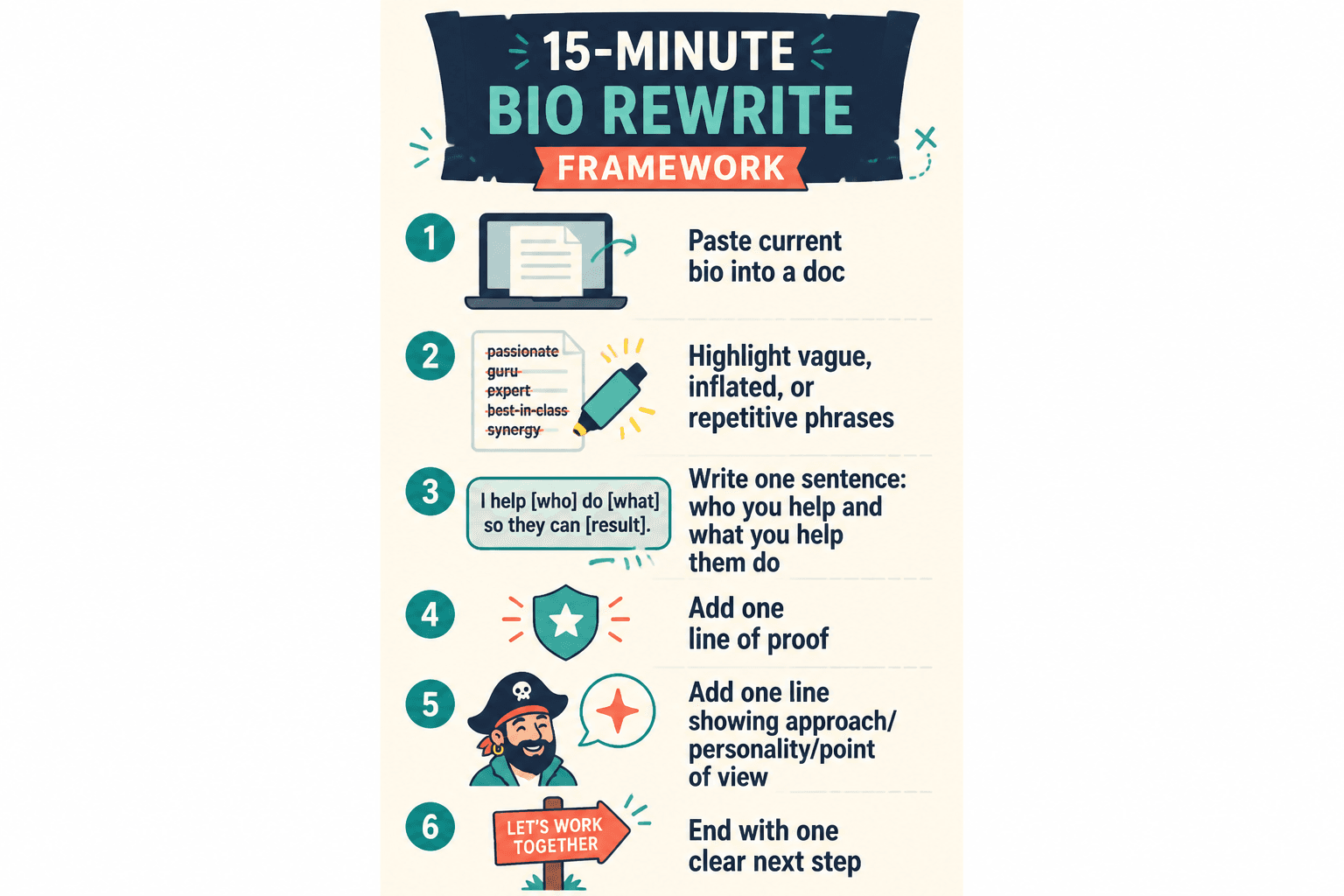
If your current bio is a mess, use this quick framework.
- Paste your current bio into a doc.
- Highlight anything vague, inflated, or repetitive.
- Write one sentence answering: who do I help and what do I help them do?
- Add one line of proof.
- Add one line that shows your approach, personality, or point of view.
- End with one clear next step.
That gives you a much better draft than most bios people publish after three hours of frowning at their laptop.
Here is the structure in a fill-in version:
I help [specific audience] do [specific outcome] without [common frustration or bad alternative].
[Relevant proof or credibility line].
My approach is [brief style or point of view].
[Simple CTA or next step].
Example:
I help coaches and consultants turn fuzzy expertise into sharp website copy that builds trust and gets more qualified inquiries.
Over the last five years, I’ve worked with service brands that needed clearer positioning, stronger offers, and less beige messaging.
My style is practical, strategic, and very unimpressed by generic “brand voice” fluff.
If your website sounds polished but forgettable, start here.
What to remove from your bio immediately
If your bio is feeling stale, these are usually the first things to cut:
- Long lists of roles that confuse your positioning
- Generic praise words with no proof
- Life story details that do not support the current offer
- Industry jargon your reader would never say out loud
- Claims that could describe 50,000 other people
- Formal third-person copy that sounds weirdly corporate if the rest of the site is casual
This part matters more than people think. A stronger bio is often not about adding brilliance. It is about removing the mush.
And yes, some personality helps. But personality is not random quirk clutter. It should support trust, fit, and tone. A small sharp line usually works better than a full paragraph trying to prove you are relatable.
How to rewrite older bio copy without starting from zero
You do not always need a blank page. Sometimes your existing content already contains better raw material than your current bio does.
Check your old posts, emails, client notes, proposals, call transcripts, or About page drafts. Look for lines where you sounded clear, useful, or unusually direct. That is often where your real voice is hiding.
In other words, the problem may not be that you have nothing to say. It may be that your best lines are scattered everywhere except the page where they are needed most.
This is exactly why how to turn old content into better bio and profile copy for websites can save you time. Rewriting is easier when you are refining good material instead of inventing it from scratch.
Quick self-check before you publish
Before you call the bio done, ask:
- Can a stranger tell who this is for?
- Can they understand what I do without decoding buzzwords?
- Is there at least one believable proof point?
- Does this sound like a person and not a brochure rack?
- Is there a clear next step?
If the answer is no to two or more of those, the copy probably still needs work.
The bigger point is simple: clearer structure and clearer writing make the piece more useful. That is usually what makes the ending land better too.