
If your audience on X is small, threads can still work absurdly well. In fact, they can work better for you than for bigger creators who’ve gotten lazy and started posting bloated nonsense because they know people will read it anyway.
The mistake small creators make is assuming threads are only useful once you already have reach. So they either avoid them, or they write long, rambling mini-blogs nobody asked for. Neither helps.
X Threads for Creators With Small Audiences are not about looking big. They are about making your thinking easier to follow, easier to share, and easier to trust. A good thread lets a stranger understand what you know, how you think, and why you might be worth following before you’ve earned much attention.
That is the real job.
Here’s how to write threads that work when you do not have a giant audience, a blue-check halo, or a fan club waiting to applaud your every recycled insight.
For the full path around this topic, head to the parent guide.
Why threads make sense for small creators
Small accounts do not win by being louder. They win by being clearer.
A thread gives you more room to prove a point than a single post does. That matters when people do not know you yet. If your name carries no built-in trust, your structure has to do more of the work.
A good thread helps you do three useful things at once:
- Show expertise without sounding like a know-it-all
- Walk people through an idea instead of dropping a vague one-liner and hoping it lands
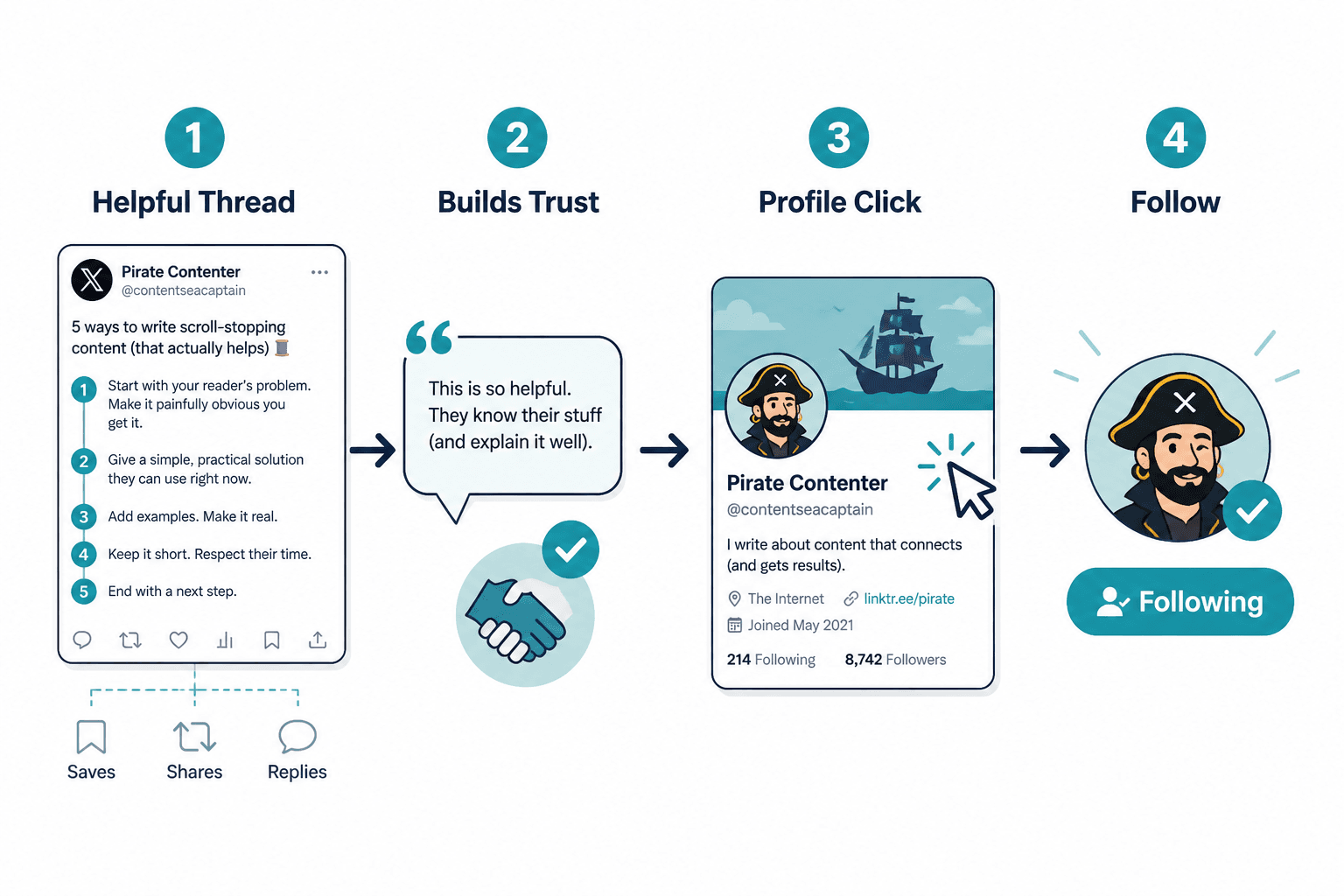
- Create a piece of content that can earn saves, shares, replies, profile clicks, and follows
For small creators, that combination matters more than vanity reach. A thread that gets 1,000 views from the right people is worth more than a clever throwaway post that gets mild attention from people who will never buy, refer, or remember you.
If you want broader thread strategy, the main X threads resource hub is a useful next stop after this.
What small creators should stop doing immediately
Before getting into what works, it helps to clear out what keeps ruining threads from smaller accounts.
1. Writing threads that are too broad
“How to grow on X” is too broad. “How consultants can use 5-post threads to earn more profile clicks” is much better.
Broad topics attract broad writing. Broad writing gets ignored.
2. Copying big-account thread style
Big creators can get away with dramatic hooks, ultra-short tweets, and vague setup because people already care who they are. You probably cannot. Not yet.
Small creators need more substance, not more theatrics.
3. Posting 24 tweets to say 4 things
Thread bloat is one of the fastest ways to lose people. If the point could fit in 6 to 10 posts, do not stretch it to 19 because that feels more “serious.” It just feels longer.
4. Hiding the point until halfway through
Nobody owes your thread patience.
If your first few posts are all throat-clearing, context, scene-setting, and dramatic suspense, most readers will leave. You are not writing prestige television. Get to the thing.
5. Ending with a needy pitch
A small audience is built on trust. If every thread ends with “follow for more,” “DM me,” “book a call,” and “buy now,” people start smelling funnel fumes.
Calls to action are fine. Desperation in a blazer is not.
What makes an X thread work when your audience is small
You do not need celebrity. You need structure.
The best X Threads for Creators With Small Audiences usually share a few traits:
- A clear promise in the first post
- One focused idea, not five
- Logical sequencing from point to point
- Specific examples, proof, or useful detail
- Clean pacing
- A simple next step at the end
That sounds basic because it is basic. Most content problems are not caused by lack of hacks. They are caused by vague thinking dressed up as content strategy.
The first post has one job
Your opener does not need to be flashy. It needs to answer one question fast: why should anyone keep reading?
Good thread openers usually do one of these:
- Promise a practical outcome
- Name a specific mistake
- Offer a sharp point of view
- Show a useful contrast
- Call out a problem the right reader already feels
Weak: I have been thinking a lot about content lately and wanted to share some thoughts.
Better: Most creator threads flop for a boring reason: they explain too much and prove too little. Here’s how to fix that without writing like a hype salesman.
Each post should earn the next one
A thread is a sequence, not a pile.
That means each post should do one clear job: set up the idea, explain a point, give an example, add proof, sharpen the argument, or move toward the takeaway. If two posts do the same job, cut one.
Readers should feel guided, not trapped.
Specificity matters more when you are unknown
Established creators can tweet “be consistent” and get applause. You cannot afford that kind of emptiness.
Small creators need specifics because specifics create credibility.
Instead of:
- Write better hooks
- Know your audience
- Be authentic
Say:
- Start your thread with the mistake your audience keeps making
- Write for one kind of reader, not “creators” in general
- Use examples from your actual work, process, or observations
A simple thread structure that works
If you are a creator with a small audience, you do not need a complicated framework. You need a reliable one.
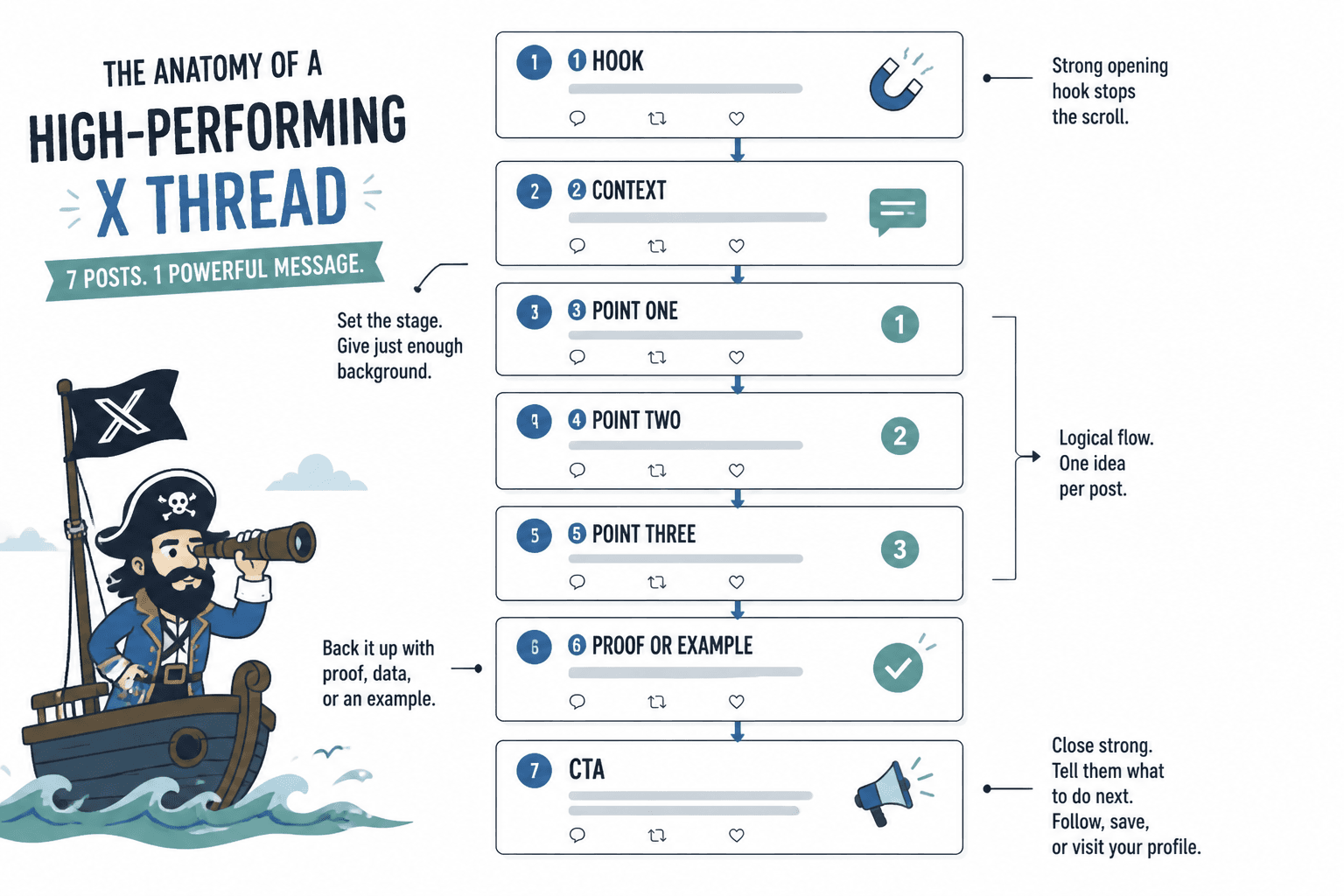
Try this 7-part structure:
- Post 1: Hook with a clear promise or sharp point
- Post 2: Explain the problem or wrong assumption
- Post 3: Introduce your main idea or framework
- Post 4: Expand point one
- Post 5: Expand point two
- Post 6: Add an example, proof, or application
- Post 7: Wrap with a takeaway and soft CTA
That is enough for most useful threads.
Could you go longer? Sure. Should you? Only if the extra posts genuinely improve clarity. Most threads get weaker the moment the writer starts admiring their own stamina.
Example thread structure
Say you help consultants write better content.
Post 1: Most consultant threads die because they read like notes, not arguments. Here’s a simple thread structure that gets more reads and more profile clicks.
Post 2: A lot of people start with a topic, then dump everything they know into a thread. That creates bloat, repetition, and weak momentum.
Post 3: A better approach: hook, mistake, framework, proof, takeaway, CTA.
Post 4: The hook should promise a result or expose a mistake. Not “some thoughts.” Not “a thread.” Nobody is excited by admin language.
Post 5: The middle should move logically. One point per post. No duplicate advice in slightly different outfits.
Post 6: Add proof: a rewrite, client pattern, audience response, or practical example. Threads without proof feel suspiciously clean.
Post 7: If your thread needs 14 posts to make one point, the point is probably not ready. Follow for more practical writing strategy, or check my profile for deeper examples.
If you want more thread formats to borrow, see simple X thread templates for busy creators and X thread ideas and examples for creators.
The best thread angles for small creators
Small creators should not try to sound universal. You should try to sound relevant.
These thread angles tend to work especially well when your audience is still growing:
1. Mistake threads
Call out a common error and explain the fix.
Example: 5 reasons your content sounds smart but gets ignored
2. Process threads
Walk people through how you do something.
Example: How I turn one client insight into 7 posts, 1 thread, and a newsletter draft
3. Rewrite threads
Show before-and-after improvements. These are useful because they make your skill visible.
Example: 4 boring hooks rewritten so they actually earn attention
4. Opinion threads
Take a clear stance, then support it.
Example: Why most “authority content” sounds polished and forgettable
5. Framework threads
Give people a simple lens or process they can reuse.
Example: My 3-part filter for deciding if a content idea is worth posting
6. Story-with-a-point threads
These can work well, but only if the story actually leads somewhere. A good story thread creates tension, then earns the lesson. A bad one just wanders around hoping the reader will call it authentic.
For a deeper walkthrough, this guide for creators who want better X thread results pairs nicely with what you are reading now.
How long should your thread be?
Long enough to be useful. Short enough to keep momentum.
Annoying answer, yes. Still true.
For small creators, a good practical range is often 5 to 10 posts. That gives you room to develop an idea without exhausting the reader. If you are writing educational, strategic, or story-driven threads, you might go a bit longer. But once you move past 12 or so, every extra post should justify itself.
A useful rule: if removing a post changes nothing, remove it.
How to end a thread without sounding weirdly thirsty
The ending matters because it shapes what happens next. A thread that teaches well but closes badly can still lose the follow, click, or reply.
Good ending options for small creators:
- Invite a reply with a specific question
- Point people to your profile for related work
- Offer a practical summary line
- Suggest one next action
- Encourage a follow if the content is clearly aligned with what you regularly post
Weak CTA: Like, comment, repost, bookmark, follow, subscribe, and DM me “THREAD” for more.
Better CTA: If you write educational content on X, check my profile. I share practical writing breakdowns like this every week.
Also good: Which part of your threads tends to lose people: the hook, the middle, or the ending?
One clear action is plenty. You are not trying to squeeze every conversion event out of one thread like it owes you rent.
The bigger point is simple: clearer structure and clearer writing make the piece more useful. That is usually what makes the ending land better too.